Aluminium oxynitride
Aluminium oxynitride (marketed under the name ALON by Surmet Corporation[3]) is a transparent ceramic composed of aluminium, oxygen and nitrogen. Aluminium oxynitride is optically transparent (≥ 80%) in the near-ultraviolet, visible, and midwave-infrared regions of the electromagnetic spectrum. It is four times as hard as fused silica glass, 85% as hard as sapphire, and nearly 115% as hard as magnesium aluminate spinel. Since it has a cubic spinel structure, it can be fabricated to transparent windows, plates, domes, rods, tubes, and other forms using conventional ceramic powder processing techniques.
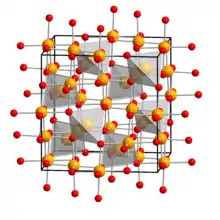 Spinel structure of ALON | |
| Names | |
|---|---|
| Systematic IUPAC name
Aluminium oxynitride | |
| Identifiers | |
| Abbreviations | ALON |
| Properties | |
| (AlN)x·(Al2O3)1−x, 0.30 ≤ x ≤ 0.37 | |
| Appearance | White or transparent solid |
| Density | 3.691–3.696 g/cm3[1] |
| Melting point | ~2150 °C[1] |
| insoluble | |
Refractive index (nD) |
1.79[2] |
| Structure | |
| cubic spinel | |
Except where otherwise noted, data are given for materials in their standard state (at 25 °C [77 °F], 100 kPa).
Infobox references | |


Aluminium oxynitride is the hardest polycrystalline transparent ceramic available commercially.[2] Because of its relatively low weight, distinctive optical and mechanical properties, and resistance to oxidation or radiation, it shows promise for applications such as bulletproof, blast-resistant, and optoelectronic windows.[4] Aluminium oxynitride-based armor has been shown to stop multiple armor-piercing projectiles of up to .50 BMG.[5]
Aluminium oxynitride is commercially available in sizes as large as 18-by-35-inch (460 mm × 890 mm; 46 cm × 89 cm) monolithic windows.[6]
Properties
Aluminium oxynitride is resistant to damage from various acids, bases, and water.[7]
Mechanical
Aluminum oxynitride has the following mechanical properties:[2]
- Compressive strength 2.68 GPa
- Flexural strength 0.38–0.7 GPa
- Fracture toughness 2.0 MPa·m1/2
- Knoop hardness 1800 kg/mm2 (0.2 kg load)
- Poisson ratio 0.24
- Shear modulus 135 GPa
- Young's modulus 334 GPa
Thermal and optical
Aluminum oxynitride has the following thermal and optical properties:[8]
- Specific heat 0.781 J/(g·°C)
- Thermal conductivity 12.3 W/(m·°C)
- Thermal expansion coefficient ~4.7×10⁻⁶/°C
- Transparency range 200–5000 nm
Applications
Aluminium oxynitride is used for infrared-optical windows, with greater than 80% transparency at wavelengths below about 4 micrometers, dropping to near zero at about 6 micrometers.[9] As such, it has applications as a sensor component, specialty IR domes, and windows for laser communications.[9] It has also been demonstrated as an interface passivation layer in some semiconductor-related applications.[10]
Aluminium oxynitride has less than half the weight and thickness of glass-based transparent armor.[11] 1.6-inch (41 mm; 4.1 cm) thick aluminium oxynitride armor is capable of stopping .50 BMG armor-piercing rounds, which can penetrate 3.7 inches (94 mm; 9.4 cm) of traditional glass laminate.[9][12]
In 2005, the United States Air Force began testing aluminium oxynitride-based armor "to shield troops".[13]
Manufacture
Aluminium oxynitride can be fabricated as windows, plates, domes, rods, tubes and other forms using conventional ceramic powder processing techniques. Its composition can vary slightly: the aluminium content from about 30% to 36%, which has been reported to affect the bulk and shear moduli by only 1–2%.[14] The fabricated greenware is subjected to heat treatment (densification) at elevated temperatures followed by grinding and polishing to transparency. It can withstand temperatures of about 2,100 °C (2,370 K) in inert atmospheres. The grinding and polishing substantially improves the impact resistance and other mechanical properties of armor.[8]
Patents
Patents related to aluminum oxynitride include:
- Aluminum oxynitride having improved optical characteristics and method of manufacture TM Hartnett, RL Gentilman U.S. Patent 4,481,300, 1984
- Process for producing polycrystalline cubic aluminum oxynitride JW McCauley U.S. Patent 4,241,000, 1980
- Transparent aluminum oxynitride and method of manufacture RL Gentilman, EA Maguire U.S. Patent 4,520,116, 1985; U.S. Patent 4,720,362, 1988
- Transparent aluminum oxynitride-based ceramic article JP Mathers U.S. Patent 5,231,062, 1993
In popular culture
"Transparent aluminum" became a popular term after its use in the film Star Trek IV: The Voyage Home (1986).[15][16]
References
- "ALON Optical Ceramic. Technical data" (PDF). Surmet Corporation. 2003. Archived from the original (PDF) on 2013-06-12. Retrieved 2009-01-09.
- Mohan Ramisetty et al. Transparent Polycrystalline Spinels Protect and Defend, American Ceramic Society Bulletin, vol.92, 2, 20–24 (2013)
- 4520116, Richard L. Gentilman, Edward A. Maguire, Leonard E. Dolhert, "Transparent aluminum oxynitride and method of manufacture", published May 28, 1985, assigned to Surmet Corp
- "Domes & Infrared Optics". Surmet.
- Ramisetty, Mohan; Sastri, Suri A.; Goldman, Lee (Aug 2013). "Transparent Ceramics Find Wide Use in Optics". Photonics Spectra.
- "Surmet Achieves Major Milestone on its ALON Window Scale-up Program". PRWeb. May 28, 2013.
- Corbin, N (1989). "Aluminum oxynitride spinel: A review". Journal of the European Ceramic Society. 5 (3): 143–154. doi:10.1016/0955-2219(89)90030-7.
- Joseph M. Wahl et al. Recent Advances in ALON Optical Ceramic, Surmet
- Goldman, Lee M.; Twedt, Rich; Balasubramanian, Sreeram; Sastri, Suri (2011-05-20). "ALON optical ceramic transparencies for window, dome, and transparent armor applications". Window and Dome Technologies and Materials XII. SPIE. 8016: 64–77. doi:10.1117/12.886122.
- Zhu, Ming; Tung, Chih-Hang; Yeo, Yee-Chia (2006). "Aluminum oxynitride interfacial passivation layer for high-permittivity gate dielectric stack on gallium arsenide". Applied Physics Letters. 89 (20): 202903. Bibcode:2006ApPhL..89t2903Z. doi:10.1063/1.2388246. Retrieved 2022-02-11.
- Security News (2015-06-03). Optically Clear Aluminium Provides Bulletproof Protection. TSS, 3 June 2015. Retrieved on 2015-07-10 from http://www.tssbulletproof.com/optically-clear-aluminum-provides-bulletproof-protection/.
- "Surmet's ALON® Transparent Armor 50 Caliber Test". Retrieved 2023-01-09.
- Schogol, Jeff (October 30, 2005). "Air Force testing lighter, transparent ALON armor". Stars and Stripes. Retrieved 2020-06-25.
- Graham, Earl K.; Munly, W.C.; McCauley, James W.; Corbin, Norman D. (1988). "Elastic properties of polycrystalline aluminum oxynitride spinel and their dependence on pressure, temperature and composition". Journal of the American Ceramic Society. 71 (10): 807–812. doi:10.1111/j.1151-2916.1988.tb07527.x.
- Harve Bennett, Nicholas Meyer, Steve Meerson, & Peter Krikes (1986). "Screenplay for Star Trek IV: The Voyage Home". Retrieved 2020-02-22.
{{cite web}}: CS1 maint: multiple names: authors list (link) - Harve Bennett, Nicholas Meyer, Steve Meerson, & Peter Krikes (1986). "Screenplay for Star Trek IV: The Voyage Home". Retrieved 2020-02-22.
{{cite web}}: CS1 maint: multiple names: authors list (link)
External links
- Processing of Optically Transparent Aluminum Oxynitride
- Solubility Limits of La and Y in Aluminum Oxynitride (AlON) at 1870°C Lior Miller and Wayne D. Kaplan. Department of Materials Engineering, Technion, Haifa, Israel, 2006
- The Influence of Sintering Additives on the Microstructure and Properties of ALON. Yechezkel Ashuach. Master's Thesis, Technion – Israel Institute of Technology, 2003