Buchanan's Station
Buchanan's Station was a fortified stockade featuring a bunkhouse, a way station, and a surrounding settlement established about 1784 in Davidson County on Mill Creek by Major John Buchanan[lower-alpha 1] in what is today the Donelson neighborhood of Nashville, Tennessee. It was the site of the critical 1792 Battle of Buchanan's Station during the Cherokee–American wars taking place in the late eighteenth century. J.G.M. Ramsey, the historian, referred to the battle and resultant victory as "...a feat of bravery which has scarcely been surpassed in all the annals of border warfare."[2]
Buchanan's Station | |
|---|---|
 19th century view of the site; the log building on the right is a remnant of the 1780s fort.[1] | |
 Location of Buchanan's Station in Davidson County, Tennessee | |
| Coordinates: 36°14′59″N 86°59′33″W | |
| Country |  United States United States |
| Territory | Southwest Territory |
| County | Davidson |
| Settled | April 1784 |
| Station sold | 1841 |
| Compound demolished | c. 1843 |
| Government | |
| • Major | John Buchanan |
| Elevation | 599 ft (183 m) |
| 1936 photo of site; courtesy of TN State Library & Archives | |
History
John Buchanan and his 19 year old wife, Sarah "Sally" (née Ridley) Buchanan, first came to the Washington District in early 1780, settling in the vicinity of Fort Nashboro. Buchanan, who had risen to the rank of major during the War of Independence, left Fort Nashboro with a large party in the spring of 1784 and finally occupied his compound and settlement that had been constructed over the preceding three years and located just four miles south of the fort. It was situated between Mill Creek and what later became the Buchanan Mill Road near the intersection of two of the area's wilderness trails that led to Nashville.[3][lower-alpha 2] These were: the Lower Trace (an old buffalo trail that later became known as The Hermitage Road); and the old Indian road to Nickajack (being a segment of the Cisca & St. Augustine Indian Trail that ran southeast to Chickamauga Creek near today’s City of Chattanooga).[5][3] Blazed in 1788, the First Holston Road became the third major travel artery that passed the bunkhouse on the way to Nashville. It ran across the Cumberland Plateau to Knoxville, the first direct overland route to the Mero District from the east.[3] Buchanan's station comprised just a few buildings surrounded by a picket stockade that included a solidly-built blockhouse at the front gate [6]
The Battle of Buchanan's Station
Background
In the summer of 1792, Buchanan's Station and the Mero District were then being governed as part of the Southwest Territory. Governor William Blount, residing in the territorial capital of Knoxville, had been warned by friendly Native Americans of possible attacks in the near future. He had therefore ordered the raising of militias throughout the territory. When Fall approached, and none of the expected attacks had occurred, Blount ordered the militias, including the Nashville militia under the leadership of early town founder, James Robertson, to be dismissed. Robertson, however, remained vigilant, regularly sending out scouts into the Middle Tennessee wilderness. News from several sources of a possible attack against Fort Nashboro had also reached the ears of the residents of Buchanan's Station, so a watchful eye was kept over the area's roadways.[1]
The surprise attack was to be the major opening engagement in a war plan designed to destroy Nashville, raze the surrounding Cumberland settlements, and to finally rid the area of any American frontier presence. The southern based Creek and Lower Cherokee had been meeting for some time with the Spanish forces along the Gulf Coast and Spanish Florida, who had a vested interest in seeing the American westward expansion halted. Throughout the Cherokee–American wars they eagerly supplied guns, liquor, and supplies to any tribe willing to confront the Americans pioneers.[1]
The Indians who attacked the settlement probably approached the station via the Nickajack Trail,[3] where they had left a path of destroyed homesteads on their way up the trail from Chickamauga country. A group of about 60 led by Doublehead (Tal-tsu'tsa) ambushed a party of six and took one scalp. They then continued on toward Nashville. On their way, they were attacked by a small militia force and lost 13 men.[7][8]
When the divergent war parties re-grouped in the vicinity of Buchanan's Station, there was a heated debate among the leaders about whether to bypass the stockade and press on directly to Nashville.[1][9] The choice of the organizer, overall leader, and white chief of the united Indian force, John Watts (or Kunokeski), was to strike at Nashville first, thus by-passing the fortified station for the moment. The choice of Creek chief, Talotiskee[10] of the Broken Arrow clan—the skiagusta (the red, or war chief) of his people—was to first attack the small and apparently weak way-station that the Creeks expected to fall quickly. Watts finally acquiesced, and the latter action was chosen.[11][12] [lower-alpha 3]
The battle
The Battle of Buchanan’s Station took place on the night of September 30, 1792, at which time the settlement was attacked by a combined force of over 300[lower-alpha 4][lower-alpha 5] Lower Cherokee, Shawnee, and Creek Indians. The station's unsuspecting defenders suffered no fatalities during the attack, although the occupants numbered only 35 to 40 that night, with just about half that number able to shoot.[1] Two scouts who had been sent out earlier to reconnoiter the Nickajack Trail, however, were found dead after the battle.[3][1]
Standing guard that night, farmer John McCrory alerted the occupants to danger when he fired the first shot of the battle—a shot fatal to one of the war party's leaders, the war chief known at the battle as Shawnee Warrior (who was in fact Tecumseh’s older brother, Cheeseekau, or Chiksika).[7][lower-alpha 6] The well-planned and fortified bunkhouse was equipped with portholes from which its defenders could send repeated volleys of musket and rifle fire upon the attackers. Thus, the small force could successfully resist the invaders' over-whelming numbers, as unmolested approach to the building was almost impossible. Due to the concerted efforts of its occupants, as few as 15, but no more than 20, frontier sharpshooters enclosed therein held off the overwhelming Indian force, while the women supported the defenders by loading firearms and feeding the men fresh ammunition, some of which was newly molded from leaden tableware that was on-hand.[1] Sally Buchanan, John's young wife who was at that point nine months pregnant, rallied and organized the women, children, and slaves present to support the defending riflemen with food, alcohol, and ammunition.[1]
Several attempts to set fire to the building were also foiled.[1] One Cherokee warrior, Kiachatalle[lower-alpha 7] died with a torch in his hand as he repeatedly tried to set fire to the building, even while fatally wounded.[3] Well into the battle, one of the blockhouse's defenders, Jemmy O'Connor, an Irishman who had become inebriated during the fight, over-filled a blunderbuss and fired at the attackers through a porthole. The gun blew up instead. The resultant explosion so terrified the Indians they quickly scattered, thinking the fort defenders had brought the use of a cannon into the melee, thus ending the battle.[1][7]
Battle results
The attack against the station, that had lasted just over an hour, was repulsed, and the Native American force broke up into smaller raiding parties that wrecked havoc on the farmsteads in the surrounding area. The main objective of wiping out Nashville, however, was abandoned.[1] The battle was costly to the raiding parties: Talotiskee was killed, along with Unacata, Cheeseekau, and about 25 others (all together, about 10% of the original raiding party). Another Cherokee warrior, Little Owl (son of White Owl)—and a possible brother to the recently deceased leader of the Chickamauga, Dragging Canoe (Tsiyu Gansini)—was also killed.[1] Watts, the current headman of the Lower Cherokee and future Cherokee National Chief, was gravely wounded, but survived.[1]
The remainder of Talotiskee's party stayed out into early October, attacking Black's Station on Crooked Creek, where they killed three men, wounded several more, and captured several horses. Chief Middle Striker's party, numbering 54, meanwhile, ambushed a large armed force coming into the Mero District down the Walton Road and routed it completely—without losing a single man.[7][8] In revenge for the deaths at Buchanan's Station, Bob Benge, Doublehead, and his brother Pumpkin Boy led a party of about 60 warriors into southwestern Kentucky, where they attacked several settlements.[16][lower-alpha 8] One notable Native American who fought in the battle included an unknown Shawnee warrior at that time named Tecumseh.[1] Although Tecumseh survived, his older brother Chiksika was killed.[17]
After the battle, Sally Buchanan became widely known as "the greatest Heroine of the West" due to her determined leadership and aid to the fort's defense during the conflict.[1][18]
Later development

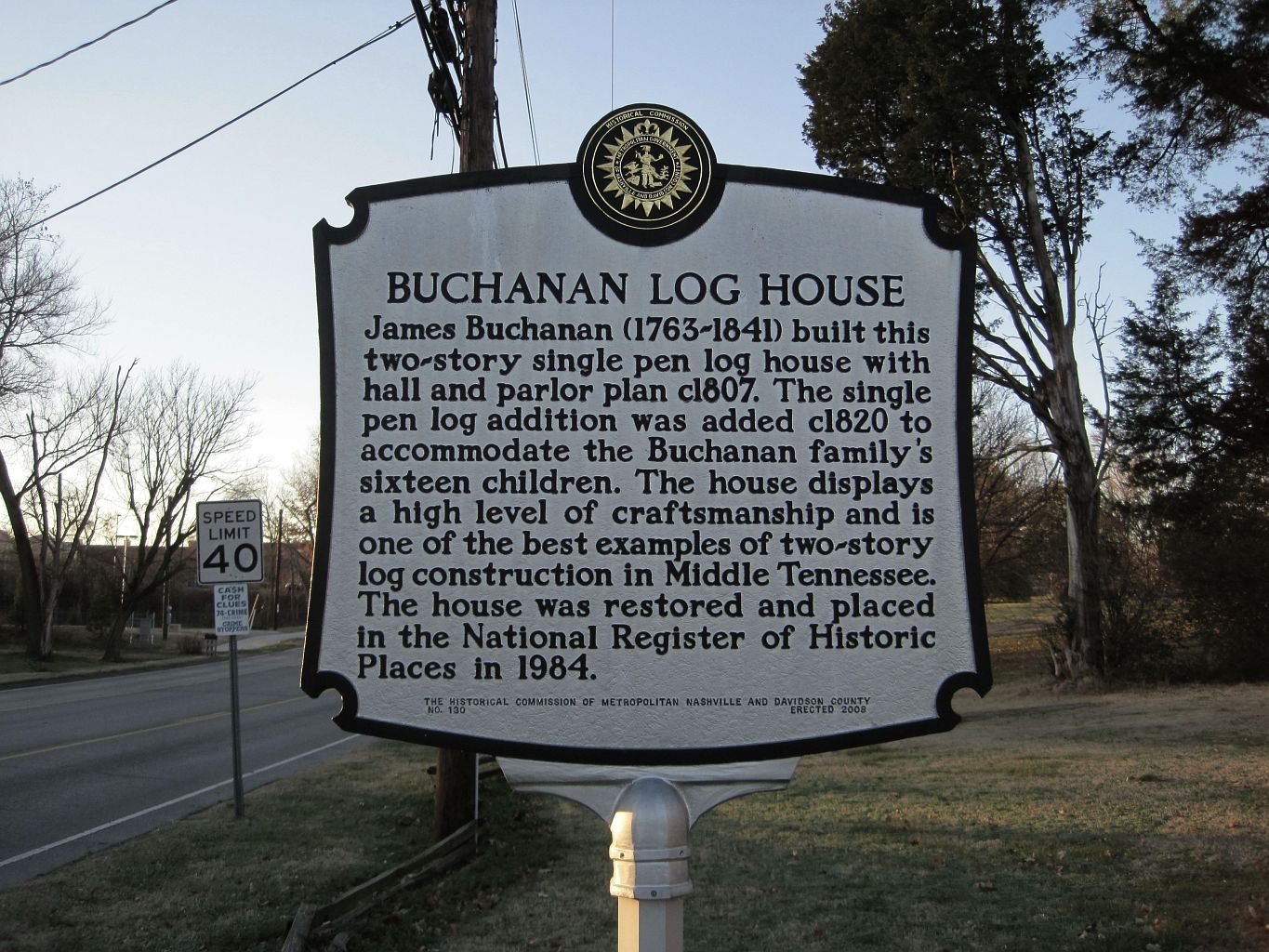
Major Buchanan continued to add infrastructure to his settlement after the events of 1792. He added a two-story log cabin that included a large hall and parlor about 1807. According to its entry in the National Register of Historic Places (NRHP), "...the house displays a high level of craftmanship and is one of the best examples of two-story log construction in Middle Tennessee..."[19] The log house was further expanded in the 1820s to include a pen log addition due to the expanding family, at that time numbering 16 children plus the parents.[19]
Major Buchanan died in 1832, and his son, Richard, sold the property in 1841 to Ralph Smith, who demolished much of the compound and built a plantation on the site, itself later razed.[3][20] The Buchanan Station log house, however, was restored in 1984 and was placed in the NRHP, though not at the original site,[19] as the land today is covered by a large industrial compound.[3]
Legacy
A roadside plaque marks the spot of the settlement.[3] Today, the only remains of the settlement is the still extant cemetery that holds the identifiable graves of about 65 family, friends, settlers, and slaves (including those of John and Sally Buchanan). At least five of the settlement's residents who had been killed by Indians before the battle are also buried here.[3][lower-alpha 10]
See also
Notes
- John Buchanan (January 12, 1759 – November 7, 1832)
- The historic site of Buchanan's Station today is at the northwest corner of Elm Hill Pike and Massman Drive in Nashville.[4][3]
- As the skiagust (or war chief)) of the Creek force, Talotiskee, upon whose counsel the decision to first attack Buchanan's Station had been made, would have more than likely led the combined attack.[12][10][13]
- A report from Blount on November 5, 1792, states: "...appeared to have been, Creeks, from 400 to 500; Cherokees, 200; Shawanese, from 30-40...[14]
- Some historian estimates of the size of the attacking forces are considerably higher—going up to 900 participants. The actual figure was likely no more than 400.[1][10]
- "...Their approach was suspected by the running of cattle, that had taken fright at them, and, upon examination, they were found rapidly advancing within ten yards of the gate; from this place and distance they received the first fire from the man who discovered them, (John Mc. Rory.) ..."[15]
- Kiachatalle (or Chiachattalla) was known to locals as "Tom Tunbridge’s step-son" from Running Water town
- In early 1793—in an act initiated by Doublehead—they killed several settlers and cooked and ate them. This event caused a fracturing of Cherokee leadership that continued into the time of Cherokee Nation[16]
- The marker reads: "3A-10; Buchanan's Station. One of Cumberlands settlements, established here in 1780. The fort was attacked September 30, 1792, by about 300 Creeks and Lower Cherokee, under Chiachattalla [ed.: Kiachatalle]. Aided by the heroism and efficiency of Mrs. Buchanan and other women in the stockade, the attack was repulsed and Chiachattalla was killed."[1]
- Known casualties probably interred here include: Samuel Buchanan (killed May 8, 1786, while ploughing a field); Cornelius Riddle (killed November 1786 while hunting); William Mulherrin and John Buchanan, Sr. (died 1787; both hacked to death with tomahawks—John in the presence of his wife, Jane (née Trindle) Buchanan—while inside the compound); and John Blackburn (speared to death, 1789).[3]
References
- Slate, Mike; Buchanan's Station : The battle that saved the Cumberland settlements; WebPage; Nashville Historical Newsletter online; retrieved December 2022
- Ramsey, J.G.M.; The Annals of Tennessee to the End of the Eighteenth Century; Johnson City, Tennessee; The Overmountain Press; (1999, reprint0
- Buchanan’s Station and Cemetery; WebPage; Nashville Historical Newsletter online; retrieved December 2022
- Allen, Dan S.; An Archaeological Survey of the Buchanan's Station Cemetery; Murfreesboro; Dan S. Allen and Associates; (2013)
- Masters & Puryear; Thoroughfare for Freedom : Second atlas of the Cumberland settlements, 1779-1804; Gallatin Tennessee; Warioto Press (2011); pp. 96–97
- Sugden, John (1997). Tecumseh: A Life. Reprint (paperback). Henry Holt and Company. pp. 73–76. ISBN 9780805061215.
- Brown, John P; Old Frontiers: The Story of the Cherokee Indians from Earliest Times to the Date of Their Removal to the West, 1838; Kingsport, Tennessee; Southern Publishers; (1938); pp. 344–366,
- Hoig, Stanley; The Cherokees and Their Chiefs: In the Wake of Empire; Fayetteville, Arkansas; University of Arkansas Press; (1998); pp. 82–84
- Cherokee Leaders – Teacher's Section – Introduction; webpage; Tennessee for Me; accessed September 2020
- M'Elwee, W. E. 'THE OLD ROAD,’ : From Washington and Hamilton Districts to the Cumberland Settlement; "The American Historical Magazine and Tennessee Historical Society Quarterly"; vol. 8, no. 4; (1903): 347–54; retrieved February 2023; via jstor; quote: "...the Creek division was commanded by Talotiskee, of the Broken Arrow, the great friend of Bowles. He is not to be confounded with Talotiskee, the cousin of Watts, who was not with the invading army..."
- Cherokee People; editors; article; Britannica online; accessed September 2020
- Slate, Mike; Buchanan's Station : The battle that saved the Cumberland settlements; WebPage; Footnote 11; Nashville Historical Newsletter online; retrieved February 2023
- Index to Tennessee Historical Magazine, Series I. "Tennessee Historical Magazine; vol 10 (1926): 5–87; via jstor; retrieved February 2023
- American State Papers: Indian Affairs 1: 331
- From James Robertson’s original account of the Battle of Buchanan’s Station; as found in American State Papers: Indian Affairs 1: 294-295:
- Evans, E. Raymond; Notable Persons in Cherokee History: Ostenaco; in the "Journal of Cherokee Studies, Vol. 1, No. 1"; via the Museum of the Cherokee Indian; (1976); pp. 41–54
- Gold, Melanie (May–June 2004). "Tecumseh: Panther Crossing the Sky". Native People's Magazine. Vol. 17, no. 4. Retrieved 2023-02-14 – via EBSCOHost.
- Ellet, Elizabeth F.; The Women of the American Revolution, Vol. III; New York: Charles Scribner; (1856); pp. 310-327
- Roadside Historic Marker – The Historical Commission of Metropolitan Nashville and Davidson County; marker #130; erected 2009; [Located at original station site]; 1365x1024 picture; Tennessee Ghost Hunters blog; tnghosthunters.com; via Blogspot; accessed February 2023; [white-listed content]
- Trabue, Laurence O.; Early Nashville Homes, 1780–1830; via "Nashville Families & Homes: Paragraphs from the Nashville History Lecture Series, 1979–81"; Graham, E.; and Hearne, M.G.; The Nashville Public Library; Nashville, Tennessee; (1983); p. 111
Further reading
- Buchanan, John; Jackson’s Way: Andrew Jackson and the People of the Western Waters; Hoboken, New Jersey; John Wiley & Sons; (2001); reprint by Castle Books
- Caruso, John Anthony; The Appalachian Frontier: America’s First Surge Westward; Knoxville: University of Tennessee Press; (2003); (The new edition of the 1959 original edition)
- Meyer, William E. Meyer; Indian Trails of the Southeast; Davenport Iowa: Gustav’s Library, (2009); Reprint from the "Forty-second Annual Report of the Bureau of American Ethnology" 1924-25; (see especially the included maps)