Cardiac Pacemakers, Inc.
Cardiac Pacemakers, Inc.(CPI), doing business as Guidant Cardiac Rhythm Management, manufactured implantable cardiac rhythm management devices, such as pacemakers and defibrillators. It sold microprocessor-controlled insulin pumps and equipment to regulate heart rhythm. It developed therapies to treat irregular heartbeat. The company was founded in 1971 and is based in St. Paul, Minnesota. Cardiac Pacemakers, Inc. is a subsidiary of Boston Scientific Corporation.[1]
 | |
| Type | Public (NYSE: BSX) S&P 500 Component |
|---|---|
| Industry | Medical equipment |
| Founded | 1971 |
| Headquarters | Saint Paul, Minnesota, USA |
| Products | Medical devices |
| Services | Medical technology |
Early history
CPI was founded in February 1972 in St. Paul, Minnesota. The first $50,000 capitalization for CPI was raised from a phone booth on the Minneapolis skyway system.[2] They began designing and testing their implantable cardiac pacemaker powered with a new longer-life lithium battery in 1971. The first heart patient to receive a CPI pacemaker emerged from surgery in June 1973. Within two years, the upstart company that challenged Medtronic had sold approximately 8,500 pacemakers.[3]
Medtronic at the time had 65% of the artificial pacemaker market. CPI was the first spin-off from Medtronic. It competition using the world's first lithium-powered pacemaker. Medtronic's market share plummeted to 35%.[4][5]
Founding partners Anthony Adducci, Manny Villafaña, Jim Baustert, and Art Schwalm, were former Medtronic employees. Lawsuits ensued, all settled out of court.[6]
Acquisition

CPI was concerned about a friendly takeover attempt early in 1978. Although the company's sales were impressive, CPI's stock price had fluctuated wildly a year earlier - from $33 to $11 per share. Some guessed that the stock was being sold short. Others attributed the price to swings in the natural volatility of the high-tech stock. And because CPI was a one-product company, the stock was susceptible to changing market conditions.[7]
CPI's founders knew the enterprise must diversify and consider two fundamental choices: acquiring other medical device companies or being bought. They chose the latter.
Several companies were interested in CPI, including 3M, American Hospital Supply, Pfizer, and Johnson & Johnson. But the most ardent suitor was Eli Lilly, one of American's premier pharmaceutical houses.
Before the final negotiations late in 1978, there was numerous flight from Minneapolis to Indianapolis for CPI principals and representatives of Piper, Jaffray & Hopwood's corporate finance department.[8]
CPI was a successful startup, increasing sales from zero in 1972 to a profitable $47 million. It was acquired by Eli Lilly and Company in 1978 for $127 million.[9]
Lithium battery
CPI designed and manufactured the world's first pacemaker with a lithium anode and a lithium-iodide electrolyte solid-state battery. The pacemaker structure is enclosed in a hermetically sealed metallic enclosure, allowing electrode leads to pass in a sealed relationship. The surface of the casing is polished metal, with a zone through which the external electrode leads pass.[10]
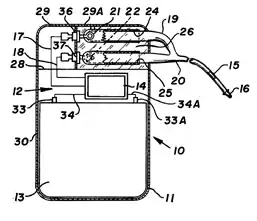
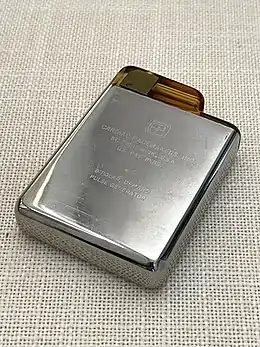
The Lithium-iodide or lithium anode cells revolutionized the medical industry by increasing the pacemaker life from 1 year up to 11 years. It became the standard for pacemaker designs.
References
- "Cardiac Pacemakers Inc - Company Profile and News".
- St. Anthony N: Ingenuity and integrity mark Medtronic co-founder. Minneapolis Star and Tribune, Feb 11, 1985, pp M1-3
- Implantable pacemaker : High Technology Entrepreneurship and Strategy. February 2002; by Prof. Ron Adner
- Mundale S: Blessed are the pacemakers. Corporate Report Minnesota, Nov 1981, pp 63-70
- Jeffrey, Kirk (April 2003). Machines in Our Hearts: The Cardiac Pacemaker, the Implantable Defibrillator, and American Health Care. ISBN 9780801876165.
{{cite book}}: CS1 maint: url-status (link) - Fiedler T: Straight from the heart. Minnesota Business Journal, Feb 1985, p p 24-35
- MarkIntel, Industry and Market Intelligence, Cardiac Pacemakers, Inc. – Company Report.
- "Piper jaffray companies inc.: An Inventory of Its Records at the Minnesota Historical Society". Minnesota Historical Society.
- "Pioneers of the Medical Device Industry". Minnesota Historical Society.
- "Metal-enclosed cardiac pacer with solid-state power source". US3822707 A.