120-cell
In geometry, the 120-cell is the convex regular 4-polytope (four-dimensional analogue of a Platonic solid) with Schläfli symbol {5,3,3}. It is also called a C120, dodecaplex (short for "dodecahedral complex"), hyperdodecahedron, polydodecahedron, hecatonicosachoron, dodecacontachoron[1] and hecatonicosahedroid.[2]
| 120-cell | |
|---|---|
 Schlegel diagram (vertices and edges) | |
| Type | Convex regular 4-polytope |
| Schläfli symbol | {5,3,3} |
| Coxeter diagram |     |
| Cells | 120 {5,3}  |
| Faces | 720 {5}  |
| Edges | 1200 |
| Vertices | 600 |
| Vertex figure |  tetrahedron |
| Petrie polygon | 30-gon |
| Coxeter group | H4, [3,3,5] |
| Dual | 600-cell |
| Properties | convex, isogonal, isotoxal, isohedral |
| Uniform index | 32 |

The boundary of the 120-cell is composed of 120 dodecahedral cells with 4 meeting at each vertex. Together they form 720 pentagonal faces, 1200 edges, and 600 vertices. It is the 4-dimensional analogue of the regular dodecahedron, since just as a dodecahedron has 12 pentagonal facets, with 3 around each vertex, the dodecaplex has 120 dodecahedral facets, with 3 around each edge.[lower-alpha 1] Its dual polytope is the 600-cell.
Geometry
The 120-cell incorporates the geometries of every convex regular polytope in the first four dimensions (except the polygons {7} and above). As the sixth and largest regular convex 4-polytope,[lower-alpha 2] it contains inscribed instances of its four predecessors (recursively). It also contains 120 inscribed instances of the first in the sequence, the 5-cell, which is not found in any of the others.[4] The 120-cell is a four-dimensional Swiss Army knife: it contains one of everything.
It is daunting but instructive to study the 120-cell, because it contains examples of every relationship among all the convex regular polytopes found in the first four dimensions. Conversely, it can only be understood by first understanding each of its predecessors, and the sequence of increasingly complex symmetries they exhibit. That is why Stillwell titled his paper on the 4-polytopes and the history of mathematics[5] of more than 3 dimensions The Story of the 120-cell.[6]
| Regular convex 4-polytopes | |||||||
|---|---|---|---|---|---|---|---|
| Symmetry group | A4 | B4 | F4 | H4 | |||
| Name | 5-cell Hyper-tetrahedron |
16-cell Hyper-octahedron |
8-cell Hyper-cube |
24-cell
|
600-cell Hyper-icosahedron |
120-cell Hyper-dodecahedron | |
| Schläfli symbol | {3, 3, 3} | {3, 3, 4} | {4, 3, 3} | {3, 4, 3} | {3, 3, 5} | {5, 3, 3} | |
| Coxeter mirrors | |
 |
|
|
|
| |
| Mirror dihedrals | 𝝅/3 𝝅/3 𝝅/3 𝝅/2 𝝅/2 𝝅/2 | 𝝅/3 𝝅/3 𝝅/4 𝝅/2 𝝅/2 𝝅/2 | 𝝅/4 𝝅/3 𝝅/3 𝝅/2 𝝅/2 𝝅/2 | 𝝅/3 𝝅/4 𝝅/3 𝝅/2 𝝅/2 𝝅/2 | 𝝅/3 𝝅/3 𝝅/5 𝝅/2 𝝅/2 𝝅/2 | 𝝅/5 𝝅/3 𝝅/3 𝝅/2 𝝅/2 𝝅/2 | |
| Graph |  |
 |
 |
 |
 |
 | |
| Vertices | 5 tetrahedral | 8 octahedral | 16 tetrahedral | 24 cubical | 120 icosahedral | 600 tetrahedral | |
| Edges | 10 triangular | 24 square | 32 triangular | 96 triangular | 720 pentagonal | 1200 triangular | |
| Faces | 10 triangles | 32 triangles | 24 squares | 96 triangles | 1200 triangles | 720 pentagons | |
| Cells | 5 tetrahedra | 16 tetrahedra | 8 cubes | 24 octahedra | 600 tetrahedra | 120 dodecahedra | |
| Tori | 1 5-tetrahedron | 2 8-tetrahedron | 2 4-cube | 4 6-octahedron | 20 30-tetrahedron | 12 10-dodecahedron | |
| Inscribed | 120 in 120-cell | 675 in 120-cell | 2 16-cells | 3 8-cells | 25 24-cells | 10 600-cells | |
| Great polygons | 2 𝝅/2 squares x 3 | 4 𝝅/2 rectangles x 3 | 4 𝝅/3 hexagons x 4 | 12 𝝅/5 decagons x 6 | 50 𝝅/15 dodecagons x 4 | ||
| Petrie polygons | 1 pentagon | 1 octagon | 2 octagons | 2 dodecagons | 4 30-gons | 20 30-gons | |
| Long radius | |||||||
| Edge length | |||||||
| Short radius | |||||||
| Area | |||||||
| Volume | |||||||
| 4-Content | |||||||


Cartesian coordinates

Hulls 1, 2, & 7 are each overlapping pairs of Dodecahedrons.
Hull 3 is a pair of Icosidodecahedrons.
Hulls 4 & 5 are each pairs of Truncated icosahedrons.
Hulls 6 & 8 are pairs of Rhombicosidodecahedrons.
The 600 vertices of a 120-cell with an edge length of 2/φ2 = 3−√5 and a center-to-vertex radius of √8 = 2 √2 include all permutations of:
- (0, 0, ±2, ±2)
- (±1, ±1, ±1, ±√5)
- (±φ−2, ±φ, ±φ, ±φ)
- (±φ−1, ±φ−1, ±φ−1, ±φ2)
and all even permutations of
- (0, ±φ−2, ±1, ±φ2)
- (0, ±φ−1, ±φ, ±√5)
- (±φ−1, ±1, ±φ, ±2)
where φ is the golden ratio, 1 + √5/2.[7]
Polyhedral graph
Considering the adjacency matrix of the vertices representing its polyhedral graph, the graph diameter is 15, connecting each vertex to its coordinate-negation, at a Euclidean distance of 4√2 away (its circumdiameter), and there are 24 different paths to connect them along the polytope edges. From each vertex, there are 4 vertices at distance 1, 12 at distance 2, 24 at distance 3, 36 at distance 4, 52 at distance 5, 68 at distance 6, 76 at distance 7, 78 at distance 8, 72 at distance 9, 64 at distance 10, 56 at distance 11, 40 at distance 12, 12 at distance 13, 4 at distance 14, and 1 at distance 15. The adjacency matrix has 27 distinct eigenvalues ranging from 2/φ2, with a multiplicity of 4, to 4, with a multiplicity of 1. The multiplicity of eigenvalue 0 is 18, and the rank of the adjacency matrix is 582.
The vertices of the 120-cell polyhedral graph are 3-colorable.
It has not been published whether the graph is Hamiltonian. It is Eulerian having degree 4 in every vertex.
Constructions
The 120-cell is the sixth in the sequence of 6 convex regular 4-polytopes (in order of size and complexity).[lower-alpha 2] It can be deconstructed into ten distinct instances (or five disjoint instances) of its immediate predecessor (and dual) the 600-cell,[lower-alpha 3] just as the 600-cell can be deconstructed into twenty-five distinct instances (or five disjoint instances) of its immediate predecessor the 24-cell,[lower-alpha 4] the 24-cell can be deconstructed into three distinct instances of its predecessor the tesseract (8-cell), and the 8-cell can be deconstructed into two disjoint instances of its predecessor the 16-cell.[10] The 120-cell contains 675 distinct instances (75 disjoint instances) of the 16-cell.[11]
The reverse procedure to construct each of these from an instance of its predecessor preserves the radius of the predecessor, but generally produces a successor with a smaller edge length. The 600-cell's edge length is ~0.618 times its radius (the inverse golden ratio), but the 120-cell's edge length is ~0.270 times its radius.
Dual 600-cells

Since the 120-cell is the dual of the 600-cell, it can be constructed from the 600-cell by placing its 600 vertices at the center of volume of each of the 600 tetrahedral cells. From a 600-cell of unit long radius, this results in a 120-cell of slightly smaller long radius (φ2/√8 ≈ 0.926) and edge length of exactly 1/4. Thus the unit-edge-length 120-cell (with long radius φ2√2 ≈ 3.702) can be constructed in this manner just inside a 600-cell of long radius 4.

Reciprocally, the 120-cell whose coordinates are given above of long radius √8 = 2√2 ≈ 2.828 and edge length 2/φ2 = 3−√5 ≈ 0.764 can be constructed just outside a 600-cell of slightly smaller long radius, by placing the center of each dodecahedral cell at one of the 120 600-cell vertices. The 600-cell must have long radius φ2, which is smaller than √8 in the same ratio of ≈ 0.926; it is in the golden ratio to the edge length of the 600-cell, so that must be φ.
Cell rotations of inscribed duals
Since the 120-cell contains inscribed 600-cells, it contains its own dual of the same radius. The 120-cell contains five disjoint 600-cells (ten overlapping inscribed 600-cells of which we can pick out five disjoint 600-cells in two different ways), so it can be seen as a compound of five of its own dual (in two ways).[lower-alpha 3] The vertices of each inscribed 600-cell are vertices of the 120-cell, and (dually) each dodecahedral cell center is a tetrahedral cell center in each of the inscribed 600-cells.
The dodecahedral cells of the 120-cell have tetrahedral cells of the 600-cells inscribed in them.[13] Just as the 120-cell is a compound of five 600-cells (in two ways), the dodecahedron is a compound of five regular tetrahedra (in two ways). As two opposing tetrahedra can be inscribed in a cube, and five cubes can be inscribed in a dodecahedron, ten tetrahedra in five cubes can be inscribed in a dodecahedron: two opposing sets of five, with each set covering all 20 vertices and each vertex in two tetrahedra (one from each set, but not the opposing pair of a cube obviously).[14] This shows that the 120-cell contains, among its many interior features, 120 compounds of ten tetrahedra, each of which is dimensionally analogous to the whole 120-cell as a compound of ten 600-cells.
All ten tetrahedra can be generated by two chiral five-click rotations of any one tetrahedron. In each dodecahedral cell, one tetrahedral cell comes from each of the ten 600-cells inscribed in the 120-cell.[lower-alpha 6] Therefore the whole 120-cell, with all ten inscribed 600-cells, can be generated from just one 600-cell by rotating its cells.
Augmentation
Another consequence of the 120-cell containing inscribed 600-cells is that it is possible to construct it by placing 4-pyramids of some kind on the cells of the 600-cell. These tetrahedral pyramids must be quite irregular in this case (with the apex blunted into several 'apexes'), but we can discern their shape in the way a tetrahedron lies inscribed in a dodecahedron.
Only 120 tetrahedral cells of each 600-cell can be inscribed in the 120-cell's dodecahedra; its other 480 tetrahedra span dodecahedral cells. Each dodecahedron-inscribed tetrahedron is the center cell of a cluster of five tetrahedra, with the four others face-bonded around it lying only partially within the dodecahedron. The central tetrahedron is edge-bonded to an additional 12 tetrahedral cells, also lying only partially within the dodecahedron.[lower-alpha 7] The central cell is vertex-bonded to 40 other tetrahedral cells which lie entirely outside the dodecahedron.
Weyl orbits
Another construction method uses quaternions and the Icosahedral symmetry of Weyl group orbits of order 120.[15] The following are the orbits of weights of D4 under the Weyl group W(D4):
O(0100) : T = {±1,±e1,±e2,±e3,(±1±e1±e2±e3)/2}
O(1000) : V1
O(0010) : V2
O(0001) : V3


With quaternions where is the conjugate of and and , then the Coxeter group is the symmetry group of the 600-cell and the 120-cell of order 14400.


Given such that and as an exchange of within , we can construct:


- the snub 24-cell
- the 600-cell
- the 120-cell


As a configuration
This configuration matrix represents the 120-cell. The rows and columns correspond to vertices, edges, faces, and cells. The diagonal numbers say how many of each element occur in the whole 120-cell. The nondiagonal numbers say how many of the column's element occur in or at the row's element.[16][17]

Here is the configuration expanded with k-face elements and k-figures. The diagonal element counts are the ratio of the full Coxeter group order, 14400, divided by the order of the subgroup with mirror removal.
| H4 | |
k-face | fk | f0 | f1 | f2 | f3 | k-fig | Notes |
|---|---|---|---|---|---|---|---|---|---|
| A3 |   | ( ) | f0 | 600 | 4 | 6 | 4 | {3,3} | H4/A3 = 14400/24 = 600 |
| A1A2 | | { } | f1 | 2 | 720 | 3 | 3 | {3} | H4/A2A1 = 14400/6/2 = 1200 |
| H2A1 | | {5} | f2 | 5 | 5 | 1200 | 2 | { } | H4/H2A1 = 14400/10/2 = 720 |
| H3 | | {5,3} | f3 | 20 | 30 | 12 | 120 | ( ) | H4/H3 = 14400/120 = 120 |
Visualization
The 120-cell consists of 120 dodecahedral cells. For visualization purposes, it is convenient that the dodecahedron has opposing parallel faces (a trait it shares with the cells of the tesseract and the 24-cell). One can stack dodecahedrons face to face in a straight line bent in the 4th direction into a great circle with a circumference of 10 cells. Starting from this initial ten cell construct there are two common visualizations one can use: a layered stereographic projection, and a structure of intertwining rings.[18]
Layered stereographic projection
The cell locations lend themselves to a hyperspherical description.[19] Pick an arbitrary dodecahedron and label it the "north pole". Twelve great circle meridians (four cells long) radiate out in 3 dimensions, converging at the fifth "south pole" cell. This skeleton accounts for 50 of the 120 cells (2 + 4 × 12).
Starting at the North Pole, we can build up the 120-cell in 9 latitudinal layers, with allusions to terrestrial 2-sphere topography in the table below. With the exception of the poles, the centroids of the cells of each layer lie on a separate 2-sphere, with the equatorial centroids lying on a great 2-sphere. The centroids of the 30 equatorial cells form the vertices of an icosidodecahedron, with the meridians (as described above) passing through the center of each pentagonal face. The cells labeled "interstitial" in the following table do not fall on meridian great circles.
| Layer # | Number of Cells | Description | Colatitude | Region |
|---|---|---|---|---|
| 1 | 1 cell | North Pole | 0° | Northern Hemisphere |
| 2 | 12 cells | First layer of meridional cells / "Arctic Circle" | 36° | |
| 3 | 20 cells | Non-meridian / interstitial | 60° | |
| 4 | 12 cells | Second layer of meridional cells / "Tropic of Cancer" | 72° | |
| 5 | 30 cells | Non-meridian / interstitial | 90° | Equator |
| 6 | 12 cells | Third layer of meridional cells / "Tropic of Capricorn" | 108° | Southern Hemisphere |
| 7 | 20 cells | Non-meridian / interstitial | 120° | |
| 8 | 12 cells | Fourth layer of meridional cells / "Antarctic Circle" | 144° | |
| 9 | 1 cell | South Pole | 180° | |
| Total | 120 cells | |||
The cells of layers 2, 4, 6 and 8 are located over the faces of the pole cell. The cells of layers 3 and 7 are located directly over the vertices of the pole cell. The cells of layer 5 are located over the edges of the pole cell.
Intertwining rings


The 120-cell can be partitioned into 12 disjoint 10-cell great circle rings, forming a discrete/quantized Hopf fibration.[20][21][22][23][18] Starting with one 10-cell ring, one can place another ring alongside it that spirals around the original ring one complete revolution in ten cells. Five such 10-cell rings can be placed adjacent to the original 10-cell ring. Although the outer rings "spiral" around the inner ring (and each other), they actually have no helical torsion. They are all equivalent. The spiraling is a result of the 3-sphere curvature. The inner ring and the five outer rings now form a six ring, 60-cell solid torus. One can continue adding 10-cell rings adjacent to the previous ones, but it's more instructive to construct a second torus, disjoint from the one above, from the remaining 60 cells, that interlocks with the first. The 120-cell, like the 3-sphere, is the union of these two (Clifford) tori. If the center ring of the first torus is a meridian great circle as defined above, the center ring of the second torus is the equatorial great circle that is centered on the meridian circle.[24] Also note that the spiraling shell of 50 cells around a center ring can be either left handed or right handed. It's just a matter of partitioning the cells in the shell differently, i.e. picking another set of disjoint (Clifford parallel) great circles.
Other great circle constructs
There is another great circle path of interest that alternately passes through opposing cell vertices, then along an edge. This path consists of 6 cells and 6 edges. Both the above great circle paths have dual great circle paths in the 600-cell. The 10 cell face to face path above maps to a 10 vertex path solely traversing along edges in the 600-cell, forming a decagon. The alternating cell/edge path above maps to a path consisting of 12 tetrahedrons alternately meeting face to face then vertex to vertex (six triangular bipyramids) in the 600-cell. This latter path corresponds to a ring of six icosahedra meeting face to face in the snub 24-cell (or icosahedral pyramids in the 600-cell).
Projections
Orthogonal projections
Orthogonal projections of the 120-cell can be done in 2D by defining two orthonormal basis vectors for a specific view direction. The 30-gonal projection was made in 1963 by B. L. Chilton.[25]
The H3 decagonal projection shows the plane of the van Oss polygon.
| H4 | - | F4 |
|---|---|---|
[30] (Red=1) |
 [20] (Red=1) |
 [12] (Red=1) |
| H3 | A2 / B3 / D4 | A3 / B2 |
 [10] (Red=5, orange=10) |
 [6] (Red=1, orange=3, yellow=6, lime=9, green=12) |
 [4] (Red=1, orange=2, yellow=4, lime=6, green=8) |
3-dimensional orthogonal projections can also be made with three orthonormal basis vectors, and displayed as a 3d model, and then projecting a certain perspective in 3D for a 2d image.
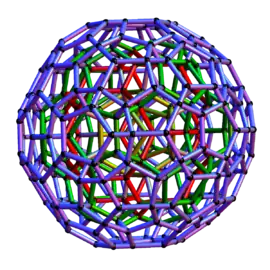 3D isometric projection |
Animated 4D rotation |
Perspective projections
These projections use perspective projection, from a specific viewpoint in four dimensions, projecting the model as a 3D shadow. Therefore, faces and cells that look larger are merely closer to the 4D viewpoint. Schlegel diagrams use perspective to show four-dimensional figures, choosing a point above a specific cell, thus making that cell the envelope of the 3D model, with other cells appearing smaller inside it. Stereographic projections use the same approach, but are shown with curved edges, representing the polytope as a tiling of a 3-sphere.
A comparison of perspective projections from 3D to 2D is shown in analogy.
| Projection | Dodecahedron | 120-cell |
|---|---|---|
| Schlegel diagram |  12 pentagon faces in the plane |
120 dodecahedral cells in 3-space |
| Stereographic projection |  |
 With transparent faces |
| Perspective projection | |
|---|---|
 |
Cell-first perspective projection at 5 times the distance from the center to a vertex, with these enhancements applied:
|
 |
Vertex-first perspective projection at 5 times the distance from center to a vertex, with these enhancements:
|
 |
A 3D projection of a 120-cell performing a simple rotation. |
 |
A 3D projection of a 120-cell performing a simple rotation (from the inside). |
| Animated 4D rotation | |
Related polyhedra and honeycombs
H4 polytopes
The 120-cell is one of 15 regular and uniform polytopes with the same H4 symmetry [3,3,5]:[26]
| H4 family polytopes | |||||||||||
|---|---|---|---|---|---|---|---|---|---|---|---|
| 120-cell | rectified 120-cell |
truncated 120-cell |
cantellated 120-cell |
runcinated 120-cell |
cantitruncated 120-cell |
runcitruncated 120-cell |
omnitruncated 120-cell | ||||
|
|
|
|
|
|
|
| ||||
| {5,3,3} | r{5,3,3} | t{5,3,3} | rr{5,3,3} | t0,3{5,3,3} | tr{5,3,3} | t0,1,3{5,3,3} | t0,1,2,3{5,3,3} | ||||
|
 |
 |
 |
 |
 |
 |
 | ||||
 |
 |
 |
 |
 |
 |
 | |||||
| 600-cell | rectified 600-cell |
truncated 600-cell |
cantellated 600-cell |
bitruncated 600-cell |
cantitruncated 600-cell |
runcitruncated 600-cell |
omnitruncated 600-cell | ||||
|
|
|
|
|
|
|
| ||||
| {3,3,5} | r{3,3,5} | t{3,3,5} | rr{3,3,5} | 2t{3,3,5} | tr{3,3,5} | t0,1,3{3,3,5} | t0,1,2,3{3,3,5} | ||||
{p,3,3} polytopes
The 120-cell is similar to three regular 4-polytopes: the 5-cell {3,3,3} and tesseract {4,3,3} of Euclidean 4-space, and the hexagonal tiling honeycomb {6,3,3} of hyperbolic space. All of these have a tetrahedral vertex figure {3,3}:
| {p,3,3} polytopes | |||||||||||
|---|---|---|---|---|---|---|---|---|---|---|---|
| Space | S3 | H3 | |||||||||
| Form | Finite | Paracompact | Noncompact | ||||||||
| Name | {3,3,3} | {4,3,3} | {5,3,3} | {6,3,3} | {7,3,3} | {8,3,3} | ...{∞,3,3} | ||||
| Image |  |
 |
|
 |
 |
 |
 | ||||
| Cells {p,3} |
 {3,3} |
 {4,3} |
{5,3} |
 {6,3} |
 {7,3} |
 {8,3} |
 {∞,3} | ||||
{5,3,p} polytopes
The 120-cell is a part of a sequence of 4-polytopes and honeycombs with dodecahedral cells:
| {5,3,p} polytopes | |||||||
|---|---|---|---|---|---|---|---|
| Space | S3 | H3 | |||||
| Form | Finite | Compact | Paracompact | Noncompact | |||
| Name | {5,3,3} | {5,3,4} | {5,3,5} | {5,3,6} | {5,3,7} | {5,3,8} | ... {5,3,∞} |
| Image | |
 |
 |
 |
 |
 |
 |
| Vertex figure |
{3,3} |
 {3,4} |
 {3,5} |
 {3,6} |
 {3,7} |
 {3,8} |
 {3,∞} |
Davis 120-cell
The Davis 120-cell, introduced by Davis (1985), is a compact 4-dimensional hyperbolic manifold obtained by identifying opposite faces of the 120-cell, whose universal cover gives the regular honeycomb {5,3,3,5} of 4-dimensional hyperbolic space.
See also
- Uniform 4-polytope family with [5,3,3] symmetry
- 57-cell – an abstract regular 4-polytope constructed from 57 hemi-dodecahedra.
- 600-cell - the dual 4-polytope to the 120-cell
Notes
- In the 120-cell, 3 dodecahedra and 3 pentagons meet at every edge. 4 dodecahedra, 6 pentagons, and 4 edges meet at every vertex. The dihedral angle (between dodecahedral hyperplanes) is 144°.[3]
- The convex regular 4-polytopes can be ordered by size as a measure of 4-dimensional content (hypervolume) for the same radius. Each greater polytope in the sequence is rounder than its predecessor, enclosing more 4-content within the same radius. The 4-simplex (5-cell) is the limit smallest case, and the 120-cell is the largest. Complexity (as measured by comparing configuration matrices or simply the number of vertices) follows the same ordering. This provides an alternative numerical naming scheme for regular polytopes in which the 120-cell is the 600-point 4-polytope: sixth and last in the ascending sequence that begins with the 5-point 4-polytope.
- The vertices of the 120-cell can be partitioned into those of five disjoint 600-cells in two different ways.[12]
- In the 120-cell, each 24-cell belongs to two different 600-cells.[8] The 120-cell can be partitioned into 25 disjoint 24-cells.[9]
- In the dodecahedral cell of the unit-radius 120-cell, the dodecahedron (120-cell) edge length is 1/φ2√2 ≈ 0.270. The orange vertices lie at the Cartesian coordinates (±φ3√8, ±φ3√8, ±φ3√8) relative to origin at the cell center. They form a cube (dashed lines) of edge length 1/φ√2 ≈ 0.437 (the pentagon diagonal, and the 1st chord of the 120-cell). The face diagonals of the cube (not shown) of edge length 1/φ ≈ 0.618 are the edges of tetrahedral cells inscribed in the cube (600-cell edges, and the 2nd chord of the 120-cell). The diameter of the dodecahedron is √3/φ√2 ≈ 0.757 (the cube diagonal, and the 4th chord of the 120-cell).
- The 10 tetrahedra in each dodecahedron overlap; but the 600 tetrahedra in each 600-cell do not, so each of the ten must belong to a different 600-cell.
- As we saw in the 600-cell, these 12 tetrahedra belong (in pairs) to the 6 icosahedral clusters of twenty tetrahedral cells which surround each cluster of five tetrahedral cells.
Citations
- N.W. Johnson: Geometries and Transformations, (2018) ISBN 978-1-107-10340-5 Chapter 11: Finite Symmetry Groups, 11.5 Spherical Coxeter groups, p.249
- Matila Ghyka, The Geometry of Art and Life (1977), p.68
- Coxeter 1973, pp. 292–293, Table I(ii); "120-cell".
- Coxeter 1973, p. 304, Table VI (iv): 𝐈𝐈 = {5,3,3}.
- Mathematics and Its History, John Stillwell, 1989, 3rd edition 2010, ISBN 0-387-95336-1
- Stillwell 2001.
- Coxeter 1973, p. 157, §8.7 Cartesian coordinates.
- van Ittersum 2020, p. 435, §4.3.5 The two 600-cells circumscribing a 24-cell.
- Denney et al. 2020, p. 5, §2 The Labeling of H4.
- Coxeter 1973, p. 305, Table VII: Regular Compounds in Four Dimensions.
- Waegell & Aravind 2014, pp. 3–4, §2 Geometry of the 120-cell: rays and bases; "The 120-cell has 600 vertices distributed symmetrically on the surface of a [3-sphere] in four-dimensional Euclidean space. The vertices come in antipodal pairs, and the lines through antipodal pairs of vertices define the 300 rays [or axes] of the 120-cell. We will term any set of four mutually orthogonal rays (or directions) a basis. The 300 rays form 675 bases, with each ray occurring in 9 bases and being orthogonal to its 27 distinct companions in these bases and to no other rays."
- Waegell & Aravind 2014, pp. 5–6.
- Sullivan 1991, pp. 4–5, The Dodecahedron.
- Coxeter et al. 1938, p. 4; "Just as a tetrahedron can be inscribed in a cube, so a cube can be inscribed in a dodecahedron. By reciprocation, this leads to an octahedron circumscribed about an icosahedron. In fact, each of the twelve vertices of the icosahedron divides an edge of the octahedron according to the "golden section". Given the icosahedron, the circumscribed octahedron can be chosen in five ways, giving a compound of five octahedra, which comes under our definition of stellated icosahedron. (The reciprocal compound, of five cubes whose vertices belong to a dodecahedron, is a stellated triacontahedron.) Another stellated icosahedron can at once be deduced, by stellating each octahedron into a stella octangula, thus forming a compound of ten tetrahedra. Further, we can choose one tetrahedron from each stella octangula, so as to derive a compound of five tetrahedra, which still has all the rotation symmetry of the icosahedron (i.e. the icosahedral group), although it has lost the reflections. By reflecting this figure in any plane of symmetry of the icosahedron, we obtain the complementary set of five tetrahedra. These two sets of five tetrahedra are enantiomorphous, i.e. not directly congruent, but related like a pair of shoes. [Such] a figure which possesses no plane of symmetry (so that it is enantiomorphous to its mirror-image) is said to be chiral."
- Koca, Al-Ajmi & Ozdes Koca 2011, pp. 986–988, 6. Dual of the snub 24-cell.
- Coxeter 1973, §1.8 Configurations.
- Coxeter 1991, p. 117.
- Sullivan 1991, p. 15, Other Properties of the 120-cell.
- Schleimer & Segerman 2013, p. 16, §6.1. Layers of dodecahedra.
- Coxeter 1970, pp. 19–23, §9. The 120-cell and the 600-cell.
- Schleimer & Segerman 2013, pp. 16–18, §6.2. Rings of dodecahedra.
- Banchoff 2013.
- Zamboj 2021, pp. 6–12, §2 Mathematical background.
- Zamboj 2021, pp. 23–29, §5 Hopf tori corresponding to circles on B2.
- Chilton 1964.
- Denney et al. 2020.
References
- Coxeter, H.S.M. (1973) [1948]. Regular Polytopes (3rd ed.). New York: Dover.
- Coxeter, H.S.M. (1991). Regular Complex Polytopes (2nd ed.). Cambridge: Cambridge University Press.
- Coxeter, H.S.M. (1995). Sherk, F. Arthur; McMullen, Peter; Thompson, Anthony C.; Weiss, Asia Ivic (eds.). Kaleidoscopes: Selected Writings of H.S.M. Coxeter (2nd ed.). Wiley-Interscience Publication. ISBN 978-0-471-01003-6.
- (Paper 22) H.S.M. Coxeter, Regular and Semi Regular Polytopes I, [Math. Zeit. 46 (1940) 380-407, MR 2,10]
- (Paper 23) H.S.M. Coxeter, Regular and Semi-Regular Polytopes II, [Math. Zeit. 188 (1985) 559-591]
- (Paper 24) H.S.M. Coxeter, Regular and Semi-Regular Polytopes III, [Math. Zeit. 200 (1988) 3-45]
- Coxeter, H.S.M.; du Val, Patrick; Flather, H.T.; Petrie, J.F. (1938). The Fifty-Nine Icosahedra. Vol. 6. University of Toronto Studies (Mathematical Series).
- Coxeter, H.S.M. (1970), "Twisted Honeycombs", Conference Board of the Mathematical Sciences Regional Conference Series in Mathematics, Providence, Rhode Island: American Mathematical Society, 4
- Stillwell, John (January 2001). "The Story of the 120-Cell" (PDF). Notices of the AMS. 48 (1): 17–25.
- J.H. Conway and M.J.T. Guy: Four-Dimensional Archimedean Polytopes, Proceedings of the Colloquium on Convexity at Copenhagen, page 38 und 39, 1965
- N.W. Johnson: The Theory of Uniform Polytopes and Honeycombs, Ph.D. Dissertation, University of Toronto, 1966
- Four-dimensional Archimedean Polytopes (German), Marco Möller, 2004 PhD dissertation
- Davis, Michael W. (1985), "A hyperbolic 4-manifold", Proceedings of the American Mathematical Society, 93 (2): 325–328, doi:10.2307/2044771, ISSN 0002-9939, MR 0770546
- Denney, Tomme; Hooker, Da'Shay; Johnson, De'Janeke; Robinson, Tianna; Butler, Majid; Claiborne, Sandernishe (2020). "The geometry of H4 polytopes". Advances in Geometry. 20 (3): 433–444. arXiv:1912.06156v1.
- Steinbach, Peter (1997). "Golden fields: A case for the Heptagon". Mathematics Magazine. 70 (Feb 1997): 22–31. doi:10.1080/0025570X.1997.11996494. JSTOR 2691048.
- Copher, Jessica (2019). "Sums and Products of Regular Polytopes' Squared Chord Lengths". arXiv:1903.06971 [math.MG].
- Miyazaki, Koji (1990). "Primary Hypergeodesic Polytopes". International Journal of Space Structures. 5 (3–4): 309–323. doi:10.1177/026635119000500312.
- van Ittersum, Clara (2020). "Symmetry groups of regular polytopes in three and four dimensions". TUDelft.
- Mamone, Salvatore; Pileio, Giuseppe; Levitt, Malcolm H. (2010). "Orientational Sampling Schemes Based on Four Dimensional Polytopes". Symmetry. 2: 1423–1449. doi:10.3390/sym2031423.
- Sullivan, John M. (1991). "Generating and Rendering Four-Dimensional Polytopes". Mathematica Journal. 1 (3): 76–85.
- Waegell, Mordecai; Aravind, P.K. (10 Sep 2014). "Parity proofs of the Kochen-Specker theorem based on the 120-cell". arXiv:1309.7530v3 [quant-ph].
- Zamboj, Michal (8 Jan 2021). "Synthetic construction of the Hopf fibration in the double orthogonal projection of the 4-space". arXiv:2003.09236v2 [math.HO].
- Sadoc, Jean-Francois (2001). "Helices and helix packings derived from the {3,3,5} polytope". W:European Physical Journal E. 5: 575–582. doi:10.1007/s101890170040. S2CID 121229939.
- Chilton, B. L. (September 1964). "On the projection of the regular polytope {5,3,3} into a regular triacontagon". Canadian Mathematical Bulletin. 7 (3): 385–398. doi:10.4153/CMB-1964-037-9.
- Schleimer, Saul; Segerman, Henry (2013). "Puzzling the 120-cell" (PDF). Notices Amer. Math. Soc. 62 (11): 1309–1316.
- Banchoff, Thomas F. (2013). "Torus Decompostions of Regular Polytopes in 4-space". In Senechal, Marjorie (ed.). Shaping Space. Springer New York. pp. 257–266. doi:10.1007/978-0-387-92714-5_20. ISBN 978-0-387-92713-8.
- Koca, Mehmet; Ozdes Koca, Nazife; Al-Barwani, Muataz (2012). "Snub 24-Cell Derived from the Coxeter-Weyl Group W(D4)". Int. J. Geom. Methods Mod. Phys. 09 (8). arXiv:1106.3433. doi:10.1142/S0219887812500685. S2CID 119288632.
- Koca, Mehmet; Al-Ajmi, Mudhahir; Ozdes Koca, Nazife (2011). "Quaternionic representation of snub 24-cell and its dual polytope derived from E8 root system". Linear Algebra and Its Applications. 434 (4): 977–989. doi:10.1016/j.laa.2010.10.005. ISSN 0024-3795. S2CID 18278359.
External links
- Weisstein, Eric W. "120-Cell". MathWorld.
- Olshevsky, George. "Hecatonicosachoron". Glossary for Hyperspace. Archived from the original on 4 February 2007.
- Klitzing, Richard. "4D uniform polytopes (polychora) o3o3o5x - hi".
- Der 120-Zeller (120-cell) Marco Möller's Regular polytopes in R4 (German)
- 120-cell explorer – A free interactive program that allows you to learn about a number of the 120-cell symmetries. The 120-cell is projected to 3 dimensions and then rendered using OpenGL.
- Construction of the Hyper-Dodecahedron
- YouTube animation of the construction of the 120-cell Gian Marco Todesco.
| H4 family polytopes | |||||||||||
|---|---|---|---|---|---|---|---|---|---|---|---|
| 120-cell | rectified 120-cell |
truncated 120-cell |
cantellated 120-cell |
runcinated 120-cell |
cantitruncated 120-cell |
runcitruncated 120-cell |
omnitruncated 120-cell | ||||
|
|
|
|
|
|
|
| ||||
| {5,3,3} | r{5,3,3} | t{5,3,3} | rr{5,3,3} | t0,3{5,3,3} | tr{5,3,3} | t0,1,3{5,3,3} | t0,1,2,3{5,3,3} | ||||
|
|
|
|
|
|
|
| ||||
|
|
|
|
|
|
| |||||
| 600-cell | rectified 600-cell |
truncated 600-cell |
cantellated 600-cell |
bitruncated 600-cell |
cantitruncated 600-cell |
runcitruncated 600-cell |
omnitruncated 600-cell | ||||
|
|
|
|
|
|
|
| ||||
| {3,3,5} | r{3,3,5} | t{3,3,5} | rr{3,3,5} | 2t{3,3,5} | tr{3,3,5} | t0,1,3{3,3,5} | t0,1,2,3{3,3,5} | ||||