Dildarnagar Kamsar
Dildarnagar Kamsar or Kamsaar, (also known as Ahl-e-Kamsar or Kamsar-O-Bar) is a Pargana or a region consisting 33 villages in Ghazipur district, and Kaimur District of Uttar Pradesh, India.
History
Dildarnagar Kamsar or also Known as Kamsar-O-Bar is a large fertile region located on the banks of Ganges and Karamnasa. It's original name is Kamsar which is derived from Kamesaradih were its founder Narhar Khan use to live in his small fort but later Bar(Bara) was added in it. Its history dates back to the time of a Mughal emperor Babur in year 1530. When two rulers named Kam dev Rao Sikarwar or Rao Dalpat Dev and Dham Dev Rao Sikarwar's family came with their army to settle here. They were the rulers of present-day Gwalior, Morena and Jhansi and later the ruler of Kanpur and Fatehpur Sikri during Babur, They were Sikarwar Rajputs. They came here after their defeat in the Battle of Madarpur with Babur. They first settled on a place near Gahmar and then the elder brothers (Kam Dev or Rao Dalpat's) family shifted to a place know known named a Dalpatpur know known as Reotipur. From there the family scattered all over Zamania and near by area and establish more than hundred villages in Ghazipur , Buxar and present day Kaimur districts. While dham Dev's family establish Gahmar, Chausa, Bhabua, Chainpur and Kudra.[1][2]
After the early settlement
In Kam Dev's or Rao Dalpat's family there was one of his 4th generation grandson named Narhar Dev getting influenced by Islam became a Muslim Being eldest and most responsible in his family he was also granted a big jagir and Sarkar of the region and he became a noble man and ruler of this region. His father name was Puranmal Rao Sakarwar and eight sons among whom he was eldest. He had his fort at Kamesaradih.
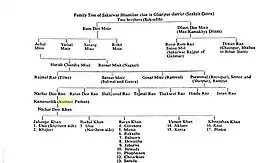
He recited kalma in Sher Shah Suri 's court were he went to pay up the lagan of his reasat and became a Muslim and got the title of Khan or Khan Bahadur in year 1542 and became Narhar Khan.The legend says before becoming a Muslim he and his wife wasn't having any children and we're very sad but because of a prayer or miracle of a Sufi saint he later had five sons in 1540s named as Jahangir Khan, Barbal Khan, Baran Khan, Usman Khan and Khan Jahan Khan Narhar Khan was also very influenced by Islam and Sufies his elder son Jahangir Khan also became a Sufi sant whose dargah is at Akhini village of Kamsar. Their descendants established many villages on the banks of Karamnasa and Ganga river. At its most spread Kamsar - O - bar was spread over more than half of Zamania tehsil some parts of Ramgarh, Nuaon, Chausa and Chainpur tehsils. His descendants are also Known as Muslim Rajput or Khanzada Rajput Pathans well know after many generations many other pathan communities also live in this region and are intermixed. Later Mircha (previously knon as an Amir Chak) and Dildarnagar (previously Deendarnagar) villages also emerged in the area. His descendants became noble people in Mughal period and notable people of the region establishing many small Zamindari estates during Mughals and British rule the place was famous for having many zamindars, Lamberdars, Jagirdars, Faujdars ets. There were also some small battles fought in this region (at Seorai, Dildarnagar) during the time of foreign invasions in the area or any big robbery.[3][4][5]
Towns and villages
It consists of these places.
References
- Ansari, Saiyad Hasan (1986). Evolution and Spatial Organization of Clan Settlements: A Case Study of Middle Ganga Valley. Concept Publishing Company. pp. 101–103.
- "Ghazipur Gazateer".
- "Kamsarbook".
- "Kamsar-O-Bar Forum".
- Gottschalk, Peter (2013). Sikarwar Rajputs history and conversion to Islam. ISBN 978-0-19-539301-9.
{{cite book}}: CS1 maint: url-status (link) - "Mircha, India".
- Acharya Hazari Prasad Dwivedi Rachnawali, Rajkamal Prakashan, Delhi.
- Bibha Jha's Ph.D. thesis Bhumihar Brahmins: A Sociological Study submitted to the Patna University.
- People of India Uttar Pradesh Volume XLII Part Two edited by A Hasan & J C Das pages 718 to 724 Manohar Publications.
- Page 179 & 180, census of India volume I ethnographic appendices(1903) by h.h. risley