Eurovision Song Contest 2008
The Eurovision Song Contest 2008 was the 53rd edition of the Eurovision Song Contest. It took place in Belgrade, Serbia, following the country's victory at the 2007 contest with the song "Molitva" by Marija Šerifović. Organised by the European Broadcasting Union (EBU) and host broadcaster Radio Television of Serbia (RTS), the contest was held at the Belgrade Arena, and (for the first time) consisted of two semi-finals on 20 and 22 May, and a final on 24 May 2008. The three live shows were presented by Serbian television presenter Jovana Janković and musician Željko Joksimović.
| Eurovision Song Contest 2008 | |
|---|---|
| Confluence of Sound | |
 | |
| Dates | |
| Semi-final 1 | 20 May 2008 |
| Semi-final 2 | 22 May 2008 |
| Final | 24 May 2008 |
| Host | |
| Venue | Belgrade Arena Belgrade, Serbia |
| Presenter(s) | |
| Directed by | Sven Stojanović |
| Executive supervisor | Svante Stockselius |
| Executive producer | Sandra Šuša |
| Host broadcaster | Radio Television of Serbia (RTS) |
| Website | eurovision |
| Participants | |
| Number of entries | 43 |
| Debuting countries | |
| Returning countries | None |
| Non-returning countries |  Austria Austria |
Participation map
| |
| Vote | |
| Voting system | Each country awarded 12, 10, 8–1 points to their 10 favourite songs. |
| Nul points in final | None |
| Winning song | |
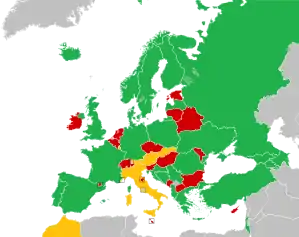
Forty-three countries participated in the contest, the highest ever number of participants in the contest[1] beating the record of forty-two set the year before.[2] Azerbaijan and San Marino[3] participated for the first time, while Austria did not participate, mainly due to questions on the semi-final organisation as well as the politicization of the contest.[4]
The winner was Russia with the song "Believe", performed by Dima Bilan who wrote it with Jim Beanz. Ukraine, Greece, Armenia and Norway rounded out the top five. Armenia achieved their best result to date this year. Of the "Big Four" countries Spain placed the highest, finishing sixteenth, while the United Kingdom ended up in last place for the second time in their Eurovision history, after 2003.
The official website, eurovision.tv, streamed national finals for this year's contest live on ESCTV for the first time.[5] Furthermore, for the first time the winner has been awarded the perpetual glass microphone trophy of the Eurovision Song Contest. The trophy is a handmade piece of sandblasted glass in the shape of a 1950s microphone.[6][7]
Location

Venue
Serbia gained the right to host the contest after Marija Šerifović won the 2007 contest in Helsinki, Finland. Since Serbia was the winner of the preceding contest, the 2008 contest was subsequently held there. The Belgrade Arena in Belgrade was chosen as the venue for the contest,[8] and is among the largest indoor arenas in Europe, with a total capacity of 25,000 seats.
On 14 September 2007, the Mayor of Helsinki handed over the "Eurovision keys" to the Deputy of Belgrade. This ceremony is meant to be a tradition from the 2008 contest and onward, and the ring contains a key from every city that has ever hosted the competition.[9]
Potential change of location
Following the unilateral Kosovo declaration of independence from Serbia on 17 February 2008, which has resulted in protests and unrest across the country, the location of the event was considered to be changed.[10] Ukraine was considered an option since they came second in Eurovision Song Contest 2007. YLE were another option, as they hosted the previous year's competition in Helsinki, Finland.[11] Greece's Ellinikí Radiofonía Tileórasi (ERT) also offered the EBU to host the contest in Athens, Greece again. It was later decided that the contest would stay in Belgrade, with the EBU giving support. RTS would gain a guarantee of safety and security from the government of Serbia for all visitors and participants of the contest.[10] The delegations of Albania, Croatia and Israel had special security.[12] In the end, the contest was held without any incidents.[10][12]
Visual design

RTS ran a competition that led to the creation of the 2008 contest's branding, logo and the stage.[13] The theme of the contest was based around the "confluence of sound". This was symbolic as Belgrade lies on the confluence of two European rivers, the Sava and Danube. The logo chosen, a treble clef, formed the graphical basis of the design created by Boris Miljković.[14]
The postcards in the first and second semi-final were based around the creation of the flag of the nation that was to perform next. Each post card had a short story related to each country and its people. During each postcard a short letter was displayed. All were in the national language of the artist's country, with the exception of the Serbian postcard, which consisted of "Welcome to Belgrade" and "Welcome to Serbia" in various languages and the Belgian postcard which was written in the constructed language the Belgian group performed in. The postcards were brought to an end by a stamp with this year's Eurovision logo.
According to RTS the stage represented native identities, history and modern themes, symbols and universally recognised messages. The confluence-themed stage also contained a large number of television and LCD display screens. The stage had settings for all new electronic possibilities including some movable parts of the stage.[15] It was designed by Chicago-based David Cushing.
The first semi-final was created around a city theme. The contest opened with a panorama of the city of Belgrade forming in the stage's background with two waves sliding down the stage to meet in the centre – at the confluence, the overall theme of the contest.
The second semi-final was based around the theme of water, which was enhanced by the look of the stage during the interval act where the water formed the main colours of the stage.
The grand final was based on the theme of the confluence. Construction of the stage lasted several days and was carried out by various teams from across Europe. Pyrotechnics were heavily used for the entries from Armenia, Azerbaijan, Finland, Germany, Turkey, the Czech Republic, Bulgaria and Switzerland. The stage received positive feedback from the media and fans describing it as "one of the best looking stages in the history of the competition".
Format

At a press conference in Helsinki in May 2007, Svante Stockselius, executive supervisor of the contest for the EBU, announced that the competition's format may be expanded to two semi-finals in 2008 or 2009.[16] On 28 September 2007 it was announced that the EBU had approved the plan of hosting two semi-finals in 2008.[17]
Based on research conducted by the EBU's tele-voting partner Digame, the semi-finalists were sorted into the two heats through the drawing of lots, which was seeded to keep countries that have a significant history of voting for each other apart. Each broadcaster had to broadcast the semi-final in which they took part, with the broadcasting of the other semi-final being optional. The draw for the semi-final allocation occurred in the City Assembly of Belgrade on Monday 28 January 2008 at 13:00 CET and was conducted by the hosts of the contest Jovana Janković and Željko Joksimović.
First, two envelopes with 'Semi-Final 1' and 'Semi-Final 2' were drawn. Then, three countries from each pot were chosen randomly to take part in the first semi-final and the other three in the second one. The country left in Pot 5 took part in the first envelope that is drawn. While, the country left in Pot 6 in the second one.[18]
The automatic grand finalist countries chose whether they would broadcast both semi-finals or just one, but viewers from these countries could only vote in one. From the draw conducted, it was decided which of the five grand finalist countries would broadcast and have voting rights in either of the events. The semi-finals were webcast live through Eurovision.tv. The top nine songs from the televoting qualified for the grand final, and a tenth was determined by the back-up juries. Twenty-five songs competed in the grand final.[19]
Semi-final allocation
On 24 January 2008, all 38 countries in the semi-finals were separated into the following pots based on voting history and geographical location:
| Pot 1 | Pot 2 | Pot 3 | Pot 4 | Pot 5 | Pot 6 |
|---|---|---|---|---|---|
Running order
The draw to decide the running order of the songs in each semi-final and the grand final was conducted at the Heads of Delegation meeting on 17 March 2008.[20]
Participating countries

On 21 December 2007, the EBU confirmed that 43 countries would be present in Belgrade.[21] San Marino, as well as the newest EBU member, Azerbaijan, made its debut at the 2008 contest. Austria did not compete; its broadcaster, ORF, said "we've already seen in 2007 that it's not the quality of the song, but the country of origin that determines the decision."[4]
Automatic grand finalists Germany and Spain exercised voting rights at the first semi-final. France, the United Kingdom and Serbia exercised voting rights at the second semi-final. Spain and France each broadcast only the semi-final in which they participated; Germany, Serbia and the UK screened both semi-finals (with Germany broadcasting on a delay).
Returning artists
Bold indicates a previous winner.
| Artist | Country | Previous year(s) |
|---|---|---|
| Roberto Meloni (member of Pirates of the Sea) |  Latvia Latvia |
2007 (member of Bonaparti.lv) |
| Dima Bilan |  Russia Russia |
2006 |
| Gisela |  Andorra Andorra |
2002 (for  Spain, as backing vocalist for Rosa) Spain, as backing vocalist for Rosa) |
| Charlotte Perrelli |  Sweden Sweden |
1999 |
Semi-final 1
The first semi-final was held on 20 May 2008. Germany and Spain voted in this semi-final.
| R/O | Country | Artist | Song | Language[22] | Points | Place[23] |
|---|---|---|---|---|---|---|
| 1 |  Montenegro Montenegro |
Stefan Filipović | "Zauvijek volim te" (Заувијек волим те) | Montenegrin | 23 | 14 |
| 2 |  Israel Israel |
Boaz | "The Fire in Your Eyes" | Hebrew[lower-alpha 1] | 104 | 5 |
| 3 |  Estonia Estonia |
Kreisiraadio | "Leto svet" | Serbian, German, Finnish | 8 | 18 |
| 4 |  Moldova Moldova |
Geta Burlacu | "A Century of Love" | English | 36 | 12[24] |
| 5 | .svg.png.webp) San Marino San Marino |
Miodio | "Complice" | Italian | 5 | 19 |
| 6 | .svg.png.webp) Belgium Belgium |
Ishtar | "O Julissi" | Imaginary | 16 | 17 |
| 7 |  Azerbaijan Azerbaijan |
Elnur and Samir | "Day After Day" | English | 96 | 6 |
| 8 |  Slovenia Slovenia |
Rebeka Dremelj | "Vrag naj vzame" | Slovene | 36 | 11[25] |
| 9 |  Norway Norway |
Maria | "Hold On Be Strong" | English | 106 | 4 |
| 10 |  Poland Poland |
Isis Gee | "For Life" | English | 42 | 10 ‡ |
| 11 |  Ireland Ireland |
Dustin the Turkey | "Irelande Douze Pointe" | English[lower-alpha 2] | 22 | 15 |
| 12 | Andorra |
Gisela | "Casanova" | English[lower-alpha 3] | 22 | 16 |
| 13 |  Bosnia and Herzegovina Bosnia and Herzegovina |
Laka | "Pokušaj" | Bosnian | 72 | 9 |
| 14 |  Armenia Armenia |
Sirusho | "Qélé, Qélé" (Քելե Քելե) | English, Armenian | 139 | 2 |
| 15 |  Netherlands Netherlands |
Hind | "Your Heart Belongs to Me" | English | 27 | 13 |
| 16 |  Finland Finland |
Teräsbetoni | "Missä miehet ratsastaa" | Finnish | 79 | 8 |
| 17 |  Romania Romania |
Nico and Vlad | "Pe-o margine de lume" | Romanian, Italian | 94 | 7 |
| 18 | Russia |
Dima Bilan | "Believe" | English | 135 | 3 |
| 19 |  Greece Greece |
Kalomira | "Secret Combination" | English | 156 | 1 |
Semi-final 2
The second semi-final was held on 22 May 2008. The United Kingdom, France and Serbia voted in this semi-final.
| R/O | Country | Artist | Song | Language[22] | Points | Place[26] |
|---|---|---|---|---|---|---|
| 1 |  Iceland Iceland |
Euroband | "This Is My Life" | English | 68 | 8 |
| 2 | Sweden |
Charlotte Perrelli | "Hero" | English | 54 | 12 ‡ |
| 3 |  Turkey Turkey |
Mor ve Ötesi | "Deli" | Turkish | 85 | 7 |
| 4 |  Ukraine Ukraine |
Ani Lorak | "Shady Lady" | English | 152 | 1 |
| 5 |  Lithuania Lithuania |
Jeronimas Milius | "Nomads in the Night" | English | 30 | 16 |
| 6 |  Albania Albania |
Olta Boka | "Zemrën e lamë peng" | Albanian | 67 | 9 |
| 7 | .svg.png.webp) Switzerland Switzerland |
Paolo Meneguzzi | "Era stupendo" | Italian | 47 | 13 |
| 8 |  Czech Republic Czech Republic |
Tereza Kerndlová | "Have Some Fun" | English | 9 | 18 |
| 9 | .svg.png.webp) Belarus Belarus |
Ruslan Alehno | "Hasta la vista" | English[lower-alpha 4] | 27 | 17 |
| 10 | Latvia |
Pirates of the Sea | "Wolves of the Sea" | English | 86 | 6 |
| 11 |  Croatia Croatia |
Kraljevi ulice and 75 Cents | "Romanca" | Croatian | 112 | 4 |
| 12 |  Bulgaria Bulgaria |
Deep Zone and Balthazar | "DJ, Take Me Away" | English | 56 | 11 |
| 13 |  Denmark Denmark |
Simon Mathew | "All Night Long" | English | 112 | 3 |
| 14 |  Georgia Georgia |
Diana Gurtskaya | "Peace Will Come" | English | 107 | 5 |
| 15 |  Hungary Hungary |
Csézy | "Candlelight" | English, Hungarian | 6 | 19 |
| 16 |  Malta Malta |
Morena | "Vodka" | English[lower-alpha 5] | 38 | 14 |
| 17 |  Cyprus Cyprus |
Evdokia Kadi | "Femme Fatale" | Greek | 36 | 15 |
| 18 |  Macedonia Macedonia |
Tamara, Vrčak and Adrijan | "Let Me Love You" | English | 64 | 10 |
| 19 |  Portugal Portugal |
Vânia Fernandes | "Senhora do mar (negras águas)" | Portuguese | 120 | 2 |
Final
The grand finalists were:
- the four automatic qualifiers France, Germany, Spain and the United Kingdom;
- the host country Serbia;
- the top nine countries from the first semi-final plus one wildcard from the juries;
- the top nine countries from the second semi-final plus one wildcard from the juries.
The grand final was held on 24 May 2008 and was won by Russia.
| R/O | Country | Artist | Song | Language[22] | Points | Place[27] |
|---|---|---|---|---|---|---|
| 1 | Romania |
Nico and Vlad | "Pe-o margine de lume" | Romanian, Italian | 45 | 20 |
| 2 |  United Kingdom United Kingdom |
Andy Abraham | "Even If" | English | 14 | 25 |
| 3 | Albania |
Olta Boka | "Zemrën e lamë peng" | Albanian | 55 | 17 |
| 4 |  Germany Germany |
No Angels | "Disappear" | English | 14 | 23 |
| 5 | Armenia |
Sirusho | "Qélé, Qélé" (Քելե Քելե) | English, Armenian | 199 | 4 |
| 6 | Bosnia and Herzegovina |
Laka | "Pokušaj" | Bosnian | 110 | 10 |
| 7 | Israel |
Boaz | "The Fire in Your Eyes" | Hebrew[lower-alpha 1] | 124 | 9 |
| 8 | Finland |
Teräsbetoni | "Missä miehet ratsastaa" | Finnish | 35 | 22 |
| 9 | Croatia |
Kraljevi ulice and 75 Cents | "Romanca" | Croatian | 44 | 21 |
| 10 | Poland |
Isis Gee | "For Life" | English | 14 | 24 |
| 11 | Iceland |
Euroband | "This Is My Life" | English | 64 | 14 |
| 12 | Turkey |
Mor ve Ötesi | "Deli" | Turkish | 138 | 7 |
| 13 | Portugal |
Vânia Fernandes | "Senhora do mar (negras águas)" | Portuguese | 69 | 13 |
| 14 | Latvia |
Pirates of the Sea | "Wolves of the Sea" | English | 83 | 12 |
| 15 | Sweden |
Charlotte Perrelli | "Hero" | English | 47 | 18 |
| 16 | Denmark |
Simon Mathew | "All Night Long" | English | 60 | 15 |
| 17 | Georgia |
Diana Gurtskaya | "Peace Will Come" | English | 83 | 11 |
| 18 | Ukraine |
Ani Lorak | "Shady Lady" | English | 230 | 2 |
| 19 |  France France |
Sébastien Tellier | "Divine" | English[lower-alpha 6] | 47 | 19 |
| 20 | Azerbaijan |
Elnur and Samir | "Day After Day" | English | 132 | 8 |
| 21 | Greece |
Kalomira | "Secret Combination" | English | 218 | 3 |
| 22 | Spain |
Rodolfo Chikilicuatre | "Baila el Chiki Chiki" | Spanish, English | 55 | 16 |
| 23 | .svg.png.webp) Serbia Serbia |
Jelena Tomašević feat. Bora Dugić | "Oro" (Оро) | Serbian | 160 | 6 |
| 24 | Russia |
Dima Bilan | "Believe" | English | 272 | 1 |
| 25 | Norway |
Maria | "Hold On Be Strong" | English | 182 | 5 |
Detailed voting results
Semi-final 1
| Voting procedure used: 100% televoting 100% jury vote |
||||||||||||||||||||||
| Montenegro | 23 | 1 | 10 | 12 | ||||||||||||||||||
|---|---|---|---|---|---|---|---|---|---|---|---|---|---|---|---|---|---|---|---|---|---|---|
| Israel | 104 | 5 | 2 | 7 | 10 | 4 | 10 | 4 | 7 | 5 | 7 | 6 | 10 | 6 | 8 | 5 | 4 | 4 | ||||
| Estonia | 8 | 1 | 7 | |||||||||||||||||||
| Moldova | 36 | 5 | 5 | 1 | 6 | 10 | 5 | 4 | ||||||||||||||
| San Marino | 5 | 2 | 3 | |||||||||||||||||||
| Belgium | 16 | 6 | 10 | |||||||||||||||||||
| Azerbaijan | 96 | 3 | 5 | 4 | 10 | 5 | 10 | 5 | 8 | 3 | 2 | 4 | 5 | 7 | 10 | 7 | 8 | |||||
| Slovenia | 36 | 10 | 2 | 2 | 1 | 2 | 10 | 4 | 1 | 2 | 2 | |||||||||||
| Norway | 106 | 4 | 6 | 8 | 3 | 7 | 1 | 7 | 2 | 7 | 8 | 10 | 4 | 8 | 5 | 12 | 4 | 7 | 1 | 2 | ||
| Poland ‡ | 42 | 10 | 3 | 2 | 12 | 1 | 2 | 3 | 1 | 5 | 3 | |||||||||||
| Ireland | 22 | 1 | 3 | 7 | 4 | 1 | 2 | 1 | 2 | 1 | ||||||||||||
| Andorra | 22 | 4 | 3 | 1 | 1 | 1 | 12 | |||||||||||||||
| Bosnia and Herzegovina | 72 | 12 | 1 | 6 | 4 | 12 | 12 | 3 | 7 | 8 | 7 | |||||||||||
| Armenia | 139 | 6 | 10 | 2 | 5 | 8 | 12 | 5 | 3 | 12 | 2 | 3 | 6 | 12 | 4 | 5 | 12 | 12 | 10 | 10 | ||
| Netherlands | 27 | 1 | 3 | 8 | 2 | 7 | 3 | 3 | ||||||||||||||
| Finland | 79 | 2 | 12 | 8 | 4 | 2 | 3 | 6 | 5 | 6 | 12 | 1 | 4 | 6 | 2 | 6 | ||||||
| Romania | 94 | 8 | 12 | 6 | 6 | 6 | 6 | 5 | 3 | 7 | 6 | 5 | 3 | 1 | 1 | 8 | 3 | 8 | ||||
| Russia | 135 | 8 | 12 | 10 | 7 | 3 | 8 | 7 | 8 | 8 | 4 | 4 | 7 | 12 | 2 | 6 | 8 | 10 | 6 | 5 | ||
| Greece | 156 | 7 | 7 | 5 | 4 | 12 | 10 | 12 | 8 | 4 | 6 | 10 | 5 | 8 | 10 | 8 | 3 | 12 | 6 | 12 | 7 | |
12 points
Below is a summary of all 12 points in the first semi-final:
| N. | Contestant | Nation(s) giving 12 points |
|---|---|---|
| 5 | Armenia | Belgium, Greece, Netherlands, Poland, Russia |
| 4 | Greece | Azerbaijan, Germany, Romania, San Marino |
| 3 | Bosnia and Herzegovina | Montenegro, Norway, Slovenia |
| 2 | Russia | Armenia, Israel |
| Finland | Andorra, Estonia | |
| 1 | Andorra | Spain |
| Montenegro | Bosnia and Herzegovina | |
| Norway | Finland | |
| Poland | Ireland | |
| Romania | Moldova |
Semi-final 2
| Voting procedure used: 100% televoting |
|||||||||||||||||||||||
| Iceland | 68 | 10 | 3 | 1 | 2 | 5 | 4 | 1 | 2 | 10 | 7 | 5 | 1 | 5 | 8 | 4 | |||||||
|---|---|---|---|---|---|---|---|---|---|---|---|---|---|---|---|---|---|---|---|---|---|---|---|
| Sweden ‡ | 54 | 8 | 2 | 3 | 1 | 3 | 12 | 1 | 7 | 4 | 3 | 1 | 3 | 6 | |||||||||
| Turkey | 85 | 6 | 5 | 12 | 7 | 3 | 7 | 8 | 5 | 4 | 8 | 10 | 10 | ||||||||||
| Ukraine | 152 | 6 | 3 | 12 | 7 | 1 | 12 | 12 | 6 | 7 | 12 | 7 | 12 | 8 | 8 | 10 | 6 | 12 | 3 | 8 | |||
| Lithuania | 30 | 12 | 10 | 8 | |||||||||||||||||||
| Albania | 67 | 1 | 7 | 8 | 3 | 10 | 1 | 5 | 10 | 12 | 2 | 5 | 3 | ||||||||||
| Switzerland | 47 | 10 | 5 | 5 | 12 | 7 | 1 | 7 | |||||||||||||||
| Czech Republic | 9 | 1 | 2 | 1 | 5 | ||||||||||||||||||
| Belarus | 27 | 10 | 6 | 5 | 4 | 2 | |||||||||||||||||
| Latvia | 86 | 7 | 8 | 2 | 12 | 5 | 6 | 6 | 1 | 6 | 6 | 6 | 4 | 10 | 2 | 5 | |||||||
| Croatia | 112 | 4 | 4 | 5 | 7 | 5 | 3 | 6 | 3 | 7 | 7 | 6 | 3 | 8 | 10 | 6 | 10 | 6 | 2 | 10 | |||
| Bulgaria | 56 | 5 | 6 | 6 | 1 | 2 | 2 | 1 | 1 | 3 | 2 | 8 | 7 | 1 | 6 | 5 | |||||||
| Denmark | 112 | 12 | 12 | 4 | 8 | 4 | 5 | 10 | 4 | 8 | 3 | 2 | 3 | 12 | 4 | 5 | 3 | 8 | 4 | 1 | |||
| Georgia | 107 | 2 | 1 | 10 | 12 | 10 | 8 | 10 | 10 | 4 | 2 | 10 | 12 | 2 | 7 | 7 | |||||||
| Hungary | 6 | 1 | 1 | 4 | |||||||||||||||||||
| Malta | 38 | 3 | 8 | 6 | 4 | 4 | 3 | 4 | 4 | 2 | |||||||||||||
| Cyprus | 36 | 4 | 2 | 2 | 8 | 2 | 5 | 1 | 12 | ||||||||||||||
| Macedonia | 64 | 2 | 7 | 7 | 8 | 4 | 12 | 10 | 2 | 12 | |||||||||||||
| Portugal | 120 | 10 | 5 | 8 | 4 | 6 | 12 | 7 | 8 | 3 | 8 | 5 | 7 | 6 | 3 | 3 | 12 | 6 | 7 | ||||
12 points
Below is a summary of all 12 points in the second semi-final:
| N. | Contestant | Nation(s) giving 12 points |
|---|---|---|
| 6 | Ukraine | Belarus, Bulgaria, Czech Republic, Georgia, Portugal, Turkey |
| 3 | Denmark | Hungary, Iceland, Sweden |
| 2 | Georgia | Cyprus, Ukraine |
| Macedonia | Croatia, Serbia | |
| Portugal | France, Switzerland | |
| 1 | Albania | Macedonia |
| Cyprus | United Kingdom | |
| Latvia | Lithuania | |
| Lithuania | Latvia | |
| Sweden | Denmark | |
| Switzerland | Malta | |
| Turkey | Albania |
Final
| Voting procedure used: 100% televoting 100% jury vote |
||||||||||||||||||||||||||||||||||||||||||||
| Romania | 45 | 1 | 6 | 3 | 12 | 4 | 4 | 12 | 3 | |||||||||||||||||||||||||||||||||||
|---|---|---|---|---|---|---|---|---|---|---|---|---|---|---|---|---|---|---|---|---|---|---|---|---|---|---|---|---|---|---|---|---|---|---|---|---|---|---|---|---|---|---|---|---|
| United Kingdom | 14 | 6 | 8 | |||||||||||||||||||||||||||||||||||||||||
| Albania | 55 | 12 | 1 | 3 | 4 | 1 | 8 | 1 | 10 | 8 | 7 | |||||||||||||||||||||||||||||||||
| Germany | 14 | 12 | 2 | |||||||||||||||||||||||||||||||||||||||||
| Armenia | 199 | 1 | 7 | 6 | 6 | 2 | 12 | 8 | 8 | 5 | 8 | 10 | 2 | 1 | 12 | 4 | 12 | 5 | 12 | 10 | 12 | 10 | 12 | 2 | 7 | 12 | 1 | 12 | ||||||||||||||||
| Bosnia and Herzegovina | 110 | 5 | 5 | 12 | 2 | 10 | 10 | 1 | 7 | 6 | 2 | 7 | 3 | 6 | 12 | 10 | 10 | 2 | ||||||||||||||||||||||||||
| Israel | 124 | 5 | 3 | 5 | 4 | 5 | 10 | 2 | 7 | 2 | 6 | 6 | 6 | 3 | 3 | 5 | 3 | 6 | 3 | 1 | 7 | 1 | 8 | 2 | 4 | 3 | 6 | 5 | 3 | |||||||||||||||
| Finland | 35 | 10 | 1 | 7 | 4 | 4 | 2 | 7 | ||||||||||||||||||||||||||||||||||||
| Croatia | 44 | 2 | 1 | 2 | 10 | 5 | 3 | 1 | 3 | 8 | 2 | 3 | 1 | 2 | 1 | |||||||||||||||||||||||||||||
| Poland | 14 | 4 | 10 | |||||||||||||||||||||||||||||||||||||||||
| Iceland | 64 | 6 | 2 | 4 | 7 | 8 | 4 | 6 | 7 | 8 | 12 | |||||||||||||||||||||||||||||||||
| Turkey | 138 | 8 | 7 | 4 | 10 | 8 | 10 | 10 | 4 | 5 | 10 | 8 | 2 | 5 | 10 | 6 | 12 | 4 | 3 | 2 | 6 | 4 | ||||||||||||||||||||||
| Portugal | 69 | 3 | 4 | 6 | 5 | 1 | 6 | 8 | 10 | 8 | 5 | 10 | 3 | |||||||||||||||||||||||||||||||
| Latvia | 83 | 10 | 7 | 4 | 8 | 2 | 3 | 2 | 7 | 12 | 4 | 3 | 10 | 3 | 2 | 6 | ||||||||||||||||||||||||||||
| Sweden | 47 | 2 | 3 | 2 | 1 | 1 | 3 | 7 | 1 | 1 | 12 | 5 | 1 | 8 | ||||||||||||||||||||||||||||||
| Denmark | 60 | 3 | 3 | 2 | 7 | 12 | 5 | 12 | 2 | 2 | 4 | 1 | 5 | 2 | ||||||||||||||||||||||||||||||
| Georgia | 83 | 8 | 5 | 8 | 2 | 7 | 3 | 1 | 10 | 4 | 4 | 5 | 4 | 4 | 6 | 5 | 7 | |||||||||||||||||||||||||||
| Ukraine | 230 | 5 | 4 | 4 | 3 | 8 | 1 | 10 | 7 | 6 | 10 | 6 | 7 | 5 | 3 | 12 | 6 | 6 | 10 | 2 | 5 | 8 | 7 | 8 | 10 | 6 | 10 | 6 | 3 | 7 | 10 | 6 | 8 | 4 | 10 | 7 | ||||||||
| France | 47 | 2 | 6 | 3 | 8 | 1 | 3 | 1 | 4 | 2 | 4 | 8 | 5 | |||||||||||||||||||||||||||||||
| Azerbaijan | 132 | 8 | 10 | 1 | 7 | 4 | 3 | 3 | 8 | 2 | 12 | 7 | 7 | 1 | 10 | 2 | 12 | 3 | 8 | 7 | 10 | 7 | ||||||||||||||||||||||
| Greece | 218 | 12 | 3 | 2 | 12 | 1 | 7 | 12 | 8 | 12 | 10 | 8 | 5 | 12 | 4 | 3 | 12 | 8 | 8 | 3 | 6 | 8 | 5 | 3 | 6 | 7 | 2 | 4 | 5 | 6 | 5 | 1 | 2 | 3 | 6 | 4 | 3 | |||||||
| Spain | 55 | 1 | 1 | 4 | 4 | 5 | 10 | 12 | 1 | 3 | 4 | 8 | 1 | 1 | ||||||||||||||||||||||||||||||
| Serbia | 160 | 10 | 8 | 12 | 5 | 4 | 5 | 1 | 2 | 7 | 7 | 6 | 7 | 4 | 12 | 3 | 6 | 8 | 1 | 12 | 2 | 5 | 10 | 6 | 1 | 4 | 12 | |||||||||||||||||
| Russia | 272 | 6 | 12 | 7 | 12 | 4 | 6 | 3 | 12 | 6 | 10 | 12 | 8 | 10 | 1 | 10 | 6 | 5 | 10 | 5 | 6 | 7 | 12 | 7 | 5 | 1 | 5 | 8 | 5 | 8 | 7 | 10 | 6 | 12 | 12 | 8 | 8 | |||||||
| Norway | 182 | 7 | 6 | 8 | 2 | 7 | 2 | 7 | 6 | 1 | 4 | 7 | 5 | 10 | 5 | 2 | 4 | 1 | 8 | 7 | 6 | 4 | 2 | 3 | 7 | 5 | 2 | 12 | 1 | 12 | 5 | 4 | 5 | 5 | 10 | |||||||||
12 points
Below is a summary of all 12 points in the grand final:
| N. | Contestant | Nation(s) giving 12 points |
|---|---|---|
| 8 | Armenia | Belgium, Czech Republic, France, Georgia, Greece, Netherlands, Poland, Russia |
| 7 | Russia | Armenia, Belarus, Estonia, Israel, Latvia, Lithuania, Ukraine |
| 6 | Greece | Albania, Cyprus, Germany, Romania, San Marino, United Kingdom |
| 4 | Serbia | Bosnia and Herzegovina, Montenegro, Slovenia, Switzerland |
| 2 | Azerbaijan | Hungary, Turkey |
| Bosnia and Herzegovina | Croatia, Serbia | |
| Denmark | Iceland, Norway | |
| Norway | Finland, Sweden | |
| Romania | Moldova, Spain | |
| 1 | Albania | Macedonia |
| Germany | Bulgaria | |
| Iceland | Denmark | |
| Latvia | Ireland | |
| Spain | Andorra | |
| Sweden | Malta | |
| Turkey | Azerbaijan | |
| Ukraine | Portugal |
Spokespersons
The voting order and spokespersons during the grand final were as follows:[34]
- United Kingdom – Carrie Grant[35]
- Macedonia – Ognen Janeski
- Ukraine – Marysya Horobets
- Germany – Thomas Hermanns[36]
- Estonia – Anna Sahlene[37]
- Bosnia and Herzegovina – Melina Garibović[38]
- Albania – Leon Menkshi
- Belgium – Sandrine Van Handenhoven[39]
- San Marino – Roberto Moretti
- Latvia – Kristīne Virsnīte[40]
- Bulgaria – Valentina Voykova
- Serbia – Dušica Spasić
- Israel – Noa Barak-Weshler
- Cyprus – Hristina Marouhou
- Moldova – Vitalie Rotaru
- Iceland – Brynja Þorgeirsdóttir
- France – Cyril Hanouna
- Romania – Alina Sorescu
- Portugal – Sabrina
- Norway – Stian Barsnes-Simonsen
- Hungary – Éva Novodomszky
- Andorra – Alfred Llahí
- Poland – Radek Brzózka[41]
- Slovenia – Peter Poles[42]
- Armenia – Hrachuhi Utmazyan
- Czech Republic – Petra Šubrtová
- Spain – Ainhoa Arbizu[43]
- Netherlands – Esther Hart[44]
- Turkey – Meltem Ersan Yazgan[45]
- Malta – Moira Delia
- Ireland – Niamh Kavanagh
- Switzerland – Cécile Bähler[46]
- Azerbaijan – Leyla Aliyeva[47]
- Greece – Alexis Kostalas
- Finland – Mikko Leppilampi[48]
- Croatia – Barbara Kolar
- Sweden – Björn Gustafsson
- Belarus – Olga Barabanschikova
- Lithuania – Rolandas Vilkončius
- Russia – Oxana Fedorova
- Montenegro – Nina Radulović
- Georgia – Tika Patsatsia[49]
- Denmark – Maria Montell
Broadcasts
Most countries sent commentators to Belgrade or commentated from their own country, in order to add insight to the participants and, if necessary, provide voting information.
| Country | Show(s) | Broadcaster(s) | Commentator(s) | Ref(s) |
|---|---|---|---|---|
| Albania |
All shows | TVSH | Leon Menkshi | |
| Andorra |
All shows | ATV | Meri Picart and Josep Lluís Trabal | |
| Armenia |
All shows | Armenia 1 | Felix Khacatryan and Hrachuhi Utmazyan | |
| Azerbaijan |
All shows | İTV | Isa Melikov and Husniya Maharramova | |
| Belarus |
All shows | Belarus-1 | Denis Kurian and Alexander Tikhanovich | |
| Belgium |
SF1/Final | Eén | Dutch: Bart Peeters and André Vermeulen | [50][51] |
| SF2 | Eén+[lower-alpha 7] | |||
| SF1/Final | La Une | French: Jean-Pierre Hautier and Jean-Louis Lahaye | [52][53] | |
| Bosnia and Herzegovina |
All shows | BHT 1 | Dejan Kukrić | [54][55] |
| Bulgaria |
All shows | Channel 1 | Elena Rosberg and Georgi Kushvaliev | |
| Croatia |
Semi-final | HRT 2 | Duško Ćurlić | [56][57][58] |
| Final | HRT 1 | |||
| Cyprus |
All shows | RIK 1 | Melina Karageorgiou | [59][60][61] |
| Czech Republic |
SF1 | ČT2[lower-alpha 8] | Kateřina Kristelová | [62] |
| SF2/Final | ČT1 | |||
| Denmark |
All shows | DR1[lower-alpha 9] | Nikolai Molbech | [63][64][65] |
| Estonia |
All shows | ETV | Marko Reikop | [66][67][68] |
| SF1/Final | Raadio 2 | Mart Juur and Andrus Kivirähk | [69] | |
| Finland |
All shows | YLE TV2 | Finnish: Jaana Pelkonen and Mikko Peltola | [70][71][72] |
| YLE FST5 | Swedish: Thomas Lundin | [73][74][75] | ||
| YLE Radio Suomi | Finnish: Sanna Kojo and Jorma Hietamäki | [76][77] | ||
| YLE Radio Vega | Unknown | |||
| France |
SF2 | France 4 | Peggy Olmi and Yann Renoard | [78][79] |
| Final | France 3 | Jean Paul Gaultier and Julien Lepers | [80][81] | |
| Georgia |
All shows | 1TV | Bibi Kvachadze | |
| Germany |
Semi-finals | NDR Fernsehen[lower-alpha 10] | Peter Urban | [82] |
| Final | Das Erste | |||
| Greece |
All shows | NET | Betty and Mathildi Maggira | [59][60][83] |
| Deftero Programma | Maria Kozakou | [84] | ||
| Hungary |
SF2/Final | m1 | Gábor Gundel Takács | [85] |
| Iceland |
All shows | Sjónvarpið | Sigmar Guðmundsson | [86] |
| Ireland |
Semi-finals | RTÉ Two | Marty Whelan | [87][88] |
| Final | RTÉ One | |||
| SF1/Final | RTÉ Radio 1 | Larry Gogan | ||
| Israel |
All shows | IBA | No commentary | |
| Latvia |
All shows | LTV | Kārlis Streips | [89][90] |
| Lithuania |
All shows | LRT | Darius Užkuraitis | |
| Macedonia |
All shows | MRT | Milanka Rašić | |
| Malta |
All shows | TVM | Eileen Montesin | |
| Moldova |
All shows | TVM | Lucia Danu and Vitalie Rotaru | |
| Montenegro |
All shows | TVCG2 | Dražen Bauković and Tamara Ivanković | |
| Netherlands |
All shows | Nederland 1 | Cornald Maas | [91][92][93][94] |
| Norway |
SF1/Final | NRK1 | Hanne Hoftun | [64][95][96][97] |
| SF2 | NRK3 | |||
| Poland |
All shows | TVP1 | Artur Orzech | [98] |
| Portugal |
All shows | RTP1[lower-alpha 11] | Isabel Angelino | [99][100] |
| Romania |
All shows | TVR1 | Andreea Demirgian and Leonard Miron | |
| Russia |
All shows | Russia-1, RTR Planeta | Dmitry Guberniev and Olga Shelest | [101] |
| San Marino |
All shows | SMRTV | Gigi Restivo and Lia Fiorio | [102][103] |
| Radio San Marino | Emilia Romagna | |||
| Serbia |
All shows | RTS1 | Dragan Ilić and Mladen Popović | [104] |
| Slovenia |
Semi-finals | SLO 2 | Andrej Hofer | [105] |
| Final | SLO 1 | |||
| All shows | Val 202 | Aida Kurtović | ||
| Spain |
SF1 | La 2 | José Luis Uribarri | [106][107][108] |
| Final | La 1 | |||
| Sweden |
All shows | SVT1 | Kristian Luuk and Josef Sterzenbach | [64][95][96][109][110] |
| Final | Carl Bildt | |||
| All shows | SR P3 | Carolina Norén | [111] | |
| Switzerland |
SF2/Final | SF zwei | German: Sven Epiney | [112][46] |
| Final | HD suisse | |||
| SF2/Final | TSR 2 | French: Jean-Marc Richard and Nicolas Tanner | [78][80] | |
| TSI 2 | Italian: Sandy Altermatt | [103][113][114] | ||
| Turkey |
All shows | TRT 1, TRT Int | Unknown | [115][116] |
| Final | TRT Türk | Bülend Özveren | ||
| Ukraine |
All shows | First National | Timur Miroshnychenko | |
| United Kingdom |
Semi-finals | BBC Three | Paddy O'Connell and Caroline Flack | [117][118] |
| Final | BBC One, BBC HD | Terry Wogan | ||
| BBC Radio 2 | Ken Bruce |
| Country | Show(s) | Broadcaster(s) | Commentator(s) | Ref(s) |
|---|---|---|---|---|
.svg.png.webp) Australia Australia |
Semi-finals | SBS TV[lower-alpha 12] | Julia Zemiro, Paddy O'Connell and Caroline Flack | [119][120] |
| Final | Julia Zemiro and Terry Wogan | |||
| Austria |
Final | ORF 1 | Andi Knoll | [80][121] |
Semi-finals broadcasts
As stated above, a country only has to broadcast the grand final and the semi-final when it is one of the competitors or voters. The United Kingdom,[122] San Marino, Greece, Croatia,[123] Ireland, Germany,[124] the Netherlands,[125] Norway,[126] Malta,[127] Serbia,[128] Finland,[129] Bosnia and Herzegovina, Denmark,[130] Portugal, Cyprus,[131] Israel,[132] Estonia,[37] Turkey,[133] Latvia,[134] Slovenia,[135] Russia,[136] Ukraine,[137] Lithuania, the Czech Republic,[138] Andorra,[139] Albania,[140] Bulgaria, Iceland,[141] Sweden,[142] Romania[143] and Australia confirmed they would broadcast both semi-finals (some in delay and some live).
High-definition broadcasts
RTS broadcast the event in 1080i high-definition (HD) and 5.1 surround sound. The new high-definition television system was in place at the Belgrade Arena by April 2008.[144] This is the second year that the event was broadcast live in HD. BBC HD broadcast the contest in High Definition in the United Kingdom. Swedish broadcaster SVT broadcast both the semi-final and the grand final on SVT HD. Lithuanian broadcaster LRT broadcast both the semi-final and the grand final in 1080i high-definition (HD) on their channel LTV. The same occurred on Swiss HD channel HD suisse; on this channel viewers were able to choose the language of the commentary while viewing a semi-final or grand final of the Eurovision Song Contest. However, all other countries broadcast the show only in standard definition, and the event will only be available to buy on a standard-definition DVD; it will not be released on HD-DVD or Blu-ray.
International broadcasts
- Australia – Although Australia was not eligible to enter, the contest was broadcast on SBS. The first semi-final was broadcast on Friday 23 May at 19:30 local time, with the second semi-final on Saturday 24 May 2008 at 19:30 local time, and the Final on Sunday 25 May 2008 at 19:30 local time,[119][120] amongst a weekend of Eurovision-themed programming.[145] SBS local host Julia Zemiro provided introductory and concluding segments with SBS otherwise broadcasting the BBC's coverage and commentary.[146] In recent years the contest has been one of SBS's highest-rating programmes in terms of viewer numbers. The grand final rated well for SBS with 427,000 viewers tuning in for the grand final with 421,000 for the second semi-final and 272,000 for the first semi-final.[147]
- Austria – In Austria, ORF broadcast the contest live and received high TV ratings. However, it did not broadcast the semi-finals on 20 and 22 May, which Austrians were able to watch on German television via ARD stations instead.
 Gibraltar – Gibraltar screened only the final on GBC.[148]
 Italy – No Italian broadcaster proper showed the contest, but San Marinese SMRTV, which broadcast live the full event on both TV and radio, is available in some parts of Italy: Romagna (and a small part of Emilia, including Bologna), northern Marche, and southern Veneto, including Venice.[149]
A live broadcast of the Eurovision Song Contest was available worldwide via satellite through European streams such as TVRi, ERT World, ARMTV, TVE Internacional, TRT International, TVP Polonia, RTP Internacional, RTS Sat and SVT Europa. The official Eurovision Song Contest website also provided a live stream without commentary via the peer-to-peer medium Octoshape.
Other awards
In addition to the main winner's trophy, the Marcel Bezençon Awards and the Barbara Dex Award were contested during the 2008 Eurovision Song Contest. The OGAE, "General Organisation of Eurovision Fans" voting poll also took place before the contest.
Marcel Bezençon Awards
The Marcel Bezençon Awards, organised since 2002 by Sweden's then-Head of Delegation and 1992 representative Christer Björkman, and 1984 winner Richard Herrey, honours songs in the contest's final.[150] For the only time, the awards were divided into four categories: Artistic Award which was voted by previous winners of the contest, Composers Award, Poplight Fan Award which was voted by fans on the Swedish website poplight.se, and Press Award.[151][152]
| Category | Country | Song | Performer(s) | Songwriter(s) |
|---|---|---|---|---|
| Artistic Award | Ukraine |
"Shady Lady" | Ani Lorak | |
| Composers Award | Romania |
"Pe-o margine de lume" | Nico and Vlad |
|
| Poplight Fan Award | Armenia |
"Qélé, Qélé" | Sirusho | |
| Press Award | Portugal |
"Senhora do mar (negras águas)" | Vânia Fernandes |
|
OGAE
OGAE, an organisation of over forty Eurovision Song Contest fan clubs across Europe and beyond, conducts an annual voting poll first held in 2002 as the Marcel Bezençon Fan Award. After all votes were cast, the top-ranked entry in the 2008 poll was Sweden's "Hero" performed by Charlotte Perrelli; the top five results are shown below.[153][154][155]
| Country | Song | Performer(s) | OGAE result |
|---|---|---|---|
| Sweden |
"Hero" | Charlotte Perrelli | 308 |
| Switzerland |
"Era stupendo" | Paolo Meneguzzi | 216 |
| Serbia |
"Oro" | Jelena Tomašević feat. Bora Dugić | 178 |
| Iceland |
"This Is My Life" | Euroband | 145 |
| Norway |
"Hold On Be Strong" | Maria Haukaas Storeng | 145 |
Barbara Dex Award
The Barbara Dex Award is a humorous fan award given to the worst dressed artist each year. Named after Belgium's representative who came last in the 1993 contest, wearing her self-designed dress, the award was handed by the fansite House of Eurovision from 1997 to 2016 and is being carried out by the fansite songfestival.be since 2017.
| Country | Performer(s) |
|---|---|
| Andorra |
Gisela |
Official album

Eurovision Song Contest: Belgrade 2008 was the official compilation album of the 2008 contest, put together by the European Broadcasting Union and released by EMI Records and CMC International on 12 May 2008.The album featured all 43 songs that entered in the 2008 contest, including the semi-finalists that failed to qualify into the grand final.[156]
Charts
| Chart (2008) | Peak position |
|---|---|
| German Compilation Albums (Offizielle Top 100)[157] | 5 |
Notes and references
Notes
- Contains words in English
- Contains words and phrases in French, German, Italian and Spanish
- Contains one sentence in Catalan
- Contains words in Spanish
- Contains one repeating phrase in Russian
- Contains words in French
- Repeat broadcast of semi-final 2 on Eén on 24 May at 10:00 CEST (08:00 UTC)[50]
- Deferred broadcast of semi-final 1 on 21 May at 01:30 CEST (20 May, 23:30 UTC)[62]
- Deferred broadcast of semi-final 1 on 21 May at 22:00 CEST (20:00 UTC)[63]
- Deferred broadcast of the second semi-final on 23 May at 00:45 CEST (22 May 22:45 UTC)[82]
- Deferred broadcast of the first semi-final at 23:00 CEST (21:00 UTC)[82]
- Deferred broadcast of semi-finals on 23 and 24 May and the final on 25 May at 19:30 AEST (09:30 UTC)[119]
References
- "43 Countries for Eurovision 2008". ESCToday.com. Retrieved 23 December 2007.
- "43 Countries for Eurovision 2008". ESCToday.com. Retrieved 23 December 2007.
- "San Marino in Belgrade confirmed". ESCToday.com. 21 November 2007. Retrieved 21 November 2007.
- "Austria will not go to Belgrade". ESCToday.com. 20 November 2007. Archived from the original on 21 November 2007. Retrieved 20 November 2007.
- "Revamped eurovision.tv site launched!". ESCToday.com. 15 January 2008. Retrieved 15 January 2008.
- "Trophy". Eurovision Song Contest. 14 January 2017. Retrieved 14 April 2020.
- "Eurovision Crystal Trophy". Kosta Boda. Retrieved 14 April 2020.
- "Welcome to Belgrade Arena". Eurovision.tv. 13 May 2007. Archived from the original on 23 November 2007. Retrieved 14 May 2007.
- "Belgrade received Helsinki city keys". Eurovision.tv. 14 September 2007. Archived from the original on 16 October 2007. Retrieved 19 September 2007.
- "The end of a decade: Belgrade 2008". eurovision.tv. 31 December 2009. Retrieved 6 April 2020.
- "Helsinki could host Eurovision again". ESCToday.com. 22 February 2008. Retrieved 22 February 2008.
- "2008. Beograd". evrovizija.rs. Retrieved 6 April 2020.
- "Serbia 2008: THE WINNER OF THE LOCAL OPEN COMPETITION FOR THE SUBLOGO – CODE MAMA 2008". RTS.co.yu. 5 July 2007. Retrieved 5 July 2007.
- "Izabran novi logo za "Evrosong" u Beogradu". blic.co.rs. 5 July 2007. Archived from the original on 3 July 2012. Retrieved 1 February 2008.
- "Eurovision 2008: Full stage image – The Sava, the Danube & Kalemegdan". ESCToday.com. 10 October 2007. Retrieved 10 October 2007.
- "Two semi finals in 2008". ESCToday.com. 31 July 2007. Retrieved 14 May 2007.
- "Eurovision: 2 semi finals confirmed!". ESCToday.com. 31 July 2007. Archived from the original on 11 October 2007. Retrieved 31 July 2007.
- "All you need to know for Monday's draw!". Eurovision.tv. Archived from the original on 27 January 2008. Retrieved 24 January 2008.
- "Eurovision 2008 – format confirmed!". ESCToday.com. Retrieved 24 November 2007.
- Sietse Bakker (17 March 2008). "Belgrade 2008: The running order!". Eurovision.tv. Archived from the original on 18 March 2008. Retrieved 18 March 2008.
- "43 Countries for Eurovision 2008". ESCToday.com. Retrieved 23 December 2007.
- "Eurovision Song Contest 2008". The Diggiloo Thrush. Retrieved 5 March 2012.
- "First Semi-Final of Belgrade 2008". European Broadcasting Union. Archived from the original on 23 April 2021. Retrieved 23 April 2021.
- Despite Moldova and Slovenia tying in the Semi Final, Slovenia placed higher due to them receiving points from more countries.
- Despite Moldova and Slovenia tying in the Semi Final, Slovenia is placed higher due to them receiving points from more countries.
- "Second Semi-Final of Belgrade 2008". European Broadcasting Union. Archived from the original on 23 April 2021. Retrieved 23 April 2021.
- "Grand Final of Belgrade 2008". European Broadcasting Union. Archived from the original on 23 April 2021. Retrieved 23 April 2021.
- "Results of the First Semi-Final of Belgrade 2008". European Broadcasting Union. Archived from the original on 23 April 2021. Retrieved 23 April 2021.
- "Eurovision Song Contest 2008 Semi-Final (1) – Scoreboard". European Broadcasting Union. Archived from the original on 24 September 2015. Retrieved 1 December 2021.
- "Results of the Second Semi-Final of Belgrade 2008". European Broadcasting Union. Archived from the original on 23 April 2021. Retrieved 23 April 2021.
- "Eurovision Song Contest 2008 Semi-Final (2) – Scoreboard". European Broadcasting Union. Archived from the original on 24 September 2015. Retrieved 1 December 2021.
- "Results of the Grand Final of Belgrade 2008". European Broadcasting Union. Archived from the original on 23 April 2021. Retrieved 23 April 2021.
- "Eurovision Song Contest 2008 Final – Scoreboard". European Broadcasting Union. Archived from the original on 24 September 2015. Retrieved 1 December 2021.
- Floras, Stella (24 November 2009). "Tonight's voting order". ESCToday. Retrieved 29 November 2009.
- "Talking Shop: Carrie Grant". BBC News. 21 May 2008. Retrieved 21 May 2008.
- "Schräg und schrill: Das Grand Prix-Fieber kehrt zurück". quotenmeter.de. 23 May 2008. Retrieved 23 May 2008.
- "Estonia: Sahlene to be ETV's spokesperson". esctoday.com. Archived from the original on 18 October 2008. Retrieved 9 May 2008.
- "Laka u utrci za stari mikrofon". Archived from the original on 27 May 2008. Retrieved 25 May 2008.
- "Belgium: Sandrine to announce Belgian votes". Archived from the original on 26 April 2008. Retrieved 23 April 2008.
- "AKTUALITĀTES > Eirovīzijā triumfē Dima Bilans no Krievijas, Pirāti – vienpadsmitie / divpadsmitie". eirovizija.lv. Archived from the original on 12 June 2008. Retrieved 26 May 2008.
- "Radek Brzózka przekaże głosy do Belgradu". Archived from the original on 1 May 2008. Retrieved 29 April 2008.
- "Slovenia: Rebeka danes na poti v Beograd (Rebeka will today go to Belgrade)". RTVSLO.SI. Retrieved 10 May 2008.
- "Uribarri vuelve a ser la voz de Eurovisión cuatro años después (Uribarri is the voice of Eurovision again after four years)". vertele.com. Archived from the original on 16 May 2008. Retrieved 13 May 2008.
- "Esther Hart, the new Dutch spokeswoman". esctoday.com. Retrieved 3 April 2008.
- "Ötesi final". Hürriyet. Retrieved 24 May 2008.
- "Eurovision Song Contest 2008" (in German). SF. Archived from the original on 23 May 2008. Retrieved 9 February 2023.
- Floras, Stella (7 May 2008). "Azerbaijan: Azerbaijan: Elnur, Samir & Ruslana in Istanbul". ”ESCToday.com. Retrieved 22 June 2012.
- "Mikko and Jaana are back!". Retrieved 7 May 2008.
- "Georgia: Tika Patsatsia spokesperson for 2008". esctoday.com. Archived from the original on 20 April 2008. Retrieved 17 April 2008.
- "Het Eurovisiesongfestival 2008" (in Dutch). VRT. Archived from the original on 8 May 2008. Retrieved 16 February 2023.
- "Commentaar en presentatie" (in Dutch). VRT. Archived from the original on 9 May 2008. Retrieved 16 February 2023.
- Verbist, Audrey (20 May 2008). "Aucune chance Belge à l'Eurovision?". L'Avenir (in French). Archived from the original on 20 May 2008. Retrieved 16 February 2023.
- "Televisie buitenland – zaterdag 24 mei 2008". Provinciale Zeeuwse Courant (in Dutch). 24 May 2008. p. 61. Retrieved 16 February 2023.
- Horvat, Ivan (28 March 2008). "BHT ugošćuje sudionike Eurosonga; oba polufinala" (in Croatian). eurosong.hr. Archived from the original on 7 January 2023. Retrieved 17 February 2023.
- "Beograd: Takmičenje za Pjesmu Evrovizije 2008" (in Bosnian). BHRT. 20 May 2008. Archived from the original on 21 May 2008. Retrieved 17 February 2023.
- "Televizija – utorak 20.5.2008". Slobodna Dalmacija (in Croatian). Split, Croatia. 20 May 2008. p. 62. Retrieved 15 February 2023.
- "Televizija – četvrtak 22.5.2008". Slobodna Dalmacija (in Croatian). Split, Croatia. 22 May 2008. p. 54. Retrieved 15 February 2023.
- "Televizija – subota 24.5.2008". Slobodna Dalmacija (in Croatian). Split, Croatia. 24 May 2008. p. 62. Retrieved 15 February 2023.
- "Πρώτος ημιτελικός, ώρα μηδέν!" (in Greek). EurovisionClub. 20 May 2008. Archived from the original on 21 May 2008. Retrieved 17 February 2023.
- "Πρώτος ημιτελικός, ώρα μηδέν!" (in Greek). EurovisionClub. 22 May 2008. Archived from the original on 26 May 2008. Retrieved 17 February 2023.
- Karnakis, Kostas (24 February 2019). "H Eυριδίκη επιστρέφει στην... Eurovision! Όλες οι λεπτομέρειες..." AlphaNews (in Greek). Archived from the original on 29 November 2022. Retrieved 29 November 2022.
- "Eurovision Song Contest 2008" (in Czech). ČT. Archived from the original on 12 May 2008. Retrieved 15 February 2023.
- "Radio & TV". Fjordenes Tidende (in Norwegian). Måløy, Norway. 21 May 2008. pp. 20–21. Retrieved 15 February 2023 – via National Library of Norway.
- "På TV – lørdag 24. mai". Rogalands Avis (in Norwegian). Stavanger, Norway. 24 May 2008. pp. 60–61. Retrieved 15 February 2023 – via National Library of Norway.
- Ellegaard, Christian (8 April 2021). "'Vi glæder os helt sindssygt!': Her er Danmarks nye Grand Prix-kommentatorer" (in Danish). DR. Archived from the original on 8 April 2021.
- "Eurovisiooni 53. lauluvõistluse 1. poolfinaali ülekanne Belgradist 20. mail 2008 kell 22.00" (in Estonian). ETV. Archived from the original on 17 May 2008. Retrieved 15 February 2023.
- "Eurovisiooni 53. lauluvõistluse 2. poolfinaali ülekanne Belgradist 22. mail 2008 kell 22.00" (in Estonian). ETV. Archived from the original on 11 May 2008. Retrieved 15 February 2023.
- "Eurovisiooni 53. lauluvõistluse finaal on eetris laupäeval, 24. mail 2008 kell 22.00" (in Estonian). ETV. Archived from the original on 11 May 2008. Retrieved 15 February 2023.
- "Raadiokava". Koit Nädal (in Estonian). Põlva, Estonia. 17 May 2008. p. 12. Retrieved 15 February 2023 – via DIGAR Eesti artiklid.
- "TV2 – 20.5.2008". Helsingin Sanomat (in Finnish). 20 May 2008. Retrieved 4 January 2023. (subscription required)
- "TV2 – 22.5.2008". Helsingin Sanomat (in Finnish). 22 May 2008. Retrieved 4 January 2023. (subscription required)
- "TV2 – 24.5.2008". Helsingin Sanomat (in Finnish). 24 May 2008. Retrieved 4 January 2023. (subscription required)
- "FST5 – 20.5.2008". Helsingin Sanomat (in Finnish). 20 May 2008. Retrieved 4 January 2023. (subscription required)
- "FST5 – 22.5.2008". Helsingin Sanomat (in Finnish). 22 May 2008. Retrieved 4 January 2023. (subscription required)
- "FST5 – 24.5.2008". Helsingin Sanomat (in Finnish). 24 May 2008. Retrieved 4 January 2023. (subscription required)
- "YLE Radio – 20.5.2008". Helsingin Sanomat (in Finnish). 20 May 2008. Retrieved 4 January 2023. (subscription required)
- "YLE Radio – 22.5.2008". Helsingin Sanomat (in Finnish). 22 May 2008. Retrieved 4 January 2023. (subscription required)
- "Jeudi 22 mai". TV8 (in French). Zofingen, Switzerland: Ringier. 15 May 2008. pp. 64–70. Retrieved 9 February 2023 – via Scriptorium Digital Library.
- "1/2 finale Eurovision" (in French). France 4. Archived from the original on 28 October 2008. Retrieved 16 February 2023.
- "Samedi 24 mai". TV8 (in French). Zofingen, Switzerland: Ringier. 22 May 2008. pp. 24–30. Retrieved 5 February 2023 – via Scriptorium Digital Library.
- "Eurovision 2008" (in French). France 3. Archived from the original on 27 May 2008. Retrieved 16 February 2023.
- "Der ESC 2008 im Fernsehen" (in German). NDR. Archived from the original on 3 May 2008. Retrieved 9 February 2023.
- "Eurovision 2020: Giorgos Kapoutzidis -María Kozakou ston scholiasmo tou diagonismou gia tin ERT" Eurovision 2020: Γιώργος Καπουτζίδης -Μαρία Κοζάκου στον σχολιασμό του διαγωνισμού για την ΕΡΤ (in Greek). Matrix24. 12 February 2020. Archived from the original on 14 February 2020. Retrieved 21 June 2022.
- Fotopoulos, Akis (12 February 2020). "Eurovision 2020: Καπουτζίδης – Κοζάκου ξανά στον σχολιασμό". ethnos.gr (in Greek). Retrieved 12 February 2020.
- "Information on Hungarian broadcasting". eschungary.extra.hu. Archived from the original on 10 May 2008. Retrieved 6 May 2008.
- "Eurovision 2008 – Röð keppenda". Morgunblaðið (in Icelandic). Reykjavík, Iceland. 20 May 2008. Retrieved 16 February 2023 – via Timarit.is.
- "Eurovision Song Contest Semi-finals" (Press release). RTÉ. 20 May 2008. Archived from the original on 16 February 2023. Retrieved 16 February 2023.
- Murray, Gavin (17 May 2008). "Ireland: Eurovision week schedule of events on RTÉ". ESCToday. Archived from the original on 5 December 2021. Retrieved 16 February 2023.
- "LTV preses konference: "Pirates of the Sea" dodas uz Belgradu un laiž klajā singlu!" (in Latvian). LTV. 13 May 2008. Archived from the original on 14 May 2008. Retrieved 17 February 2023.
- Griškeviča, Una (22 May 2008). "Pirāti šovakar cīnīsies par iekļūšanu finālā". Diena. Archived from the original on 17 February 2023. Retrieved 17 February 2023.
- Breure, Bernice (17 May 2008). "'Songfestival meer kermis dan ooit'". Provinciale Zeeuwse Courant (in Dutch). p. 50. Retrieved 16 February 2023.
- "Televisie – dinsdag 20 mei 2008". Provinciale Zeeuwse Courant (in Dutch). 20 May 2008. p. 38. Retrieved 16 February 2023.
- "Televisie – donderdag 22 mei 2008". Provinciale Zeeuwse Courant (in Dutch). 22 May 2008. p. 46. Retrieved 16 February 2023.
- "Televisie – donderdag 24 mei 2008". Provinciale Zeeuwse Courant (in Dutch). 24 May 2008. p. 60. Retrieved 16 February 2023.
- "På TV – tirsdag 20. mai". Rogalands Avis (in Norwegian). Stavanger, Norway. 20 May 2008. pp. 46–47. Retrieved 15 February 2023 – via National Library of Norway.
- "Radio & TV – torsdag 22. mai 2008". Dagsavisen (in Norwegian). Oslo, Norway. 22 May 2008. pp. 48–50. Retrieved 15 February 2023 – via National Library of Norway.
- Evensen, Geir (8 April 2008). "Hanne Hoftun blir MGP-kommentator" (in Norwegian). NRK. Archived from the original on 20 January 2016. Retrieved 15 February 2023.
- "EUROWIZJA.COM.PL – Konkurs Piosenki Eurowizji". Retrieved 14 April 2008.
- Costa, Nelson (24 April 2008). "RTP to broadcast both Eurovision semi-finals". Oikotimes. Archived from the original on 14 March 2012. Retrieved 17 February 2023.
- Costa, Nelson (1 April 2008). "Commentator revealed by RTP; updated news". Oikotimes. Archived from the original on 11 February 2010. Retrieved 17 February 2023.
- "Vene kavad". Koit Nädal (in Estonian). Põlva, Estonia. 17 May 2008. p. 11. Retrieved 15 February 2023 – via DIGAR Eesti artiklid.
- "SM TV San Marino: confermatbei i conduttori per l'Eurovision 2013" (in Italian). Eurofestival News. 28 March 2013. Archived from the original on 4 February 2021. Retrieved 24 January 2021.
- "Eurovision Song Contest 2008" (in Italian). Eurofestival News. Retrieved 24 January 2021.
- "Eurosong finale". b92.net. Retrieved 24 May 2008.
- Brun, Alenka (13 May 2008). "Rebeka že v Beogradu". arhiv.gorenjskiglas.si (in Slovenian). Archived from the original on 15 February 2023. Retrieved 15 February 2023.
- Semifinal Festival Eurovisión 2008 (Television programme) (in English and Spanish). RTVE. 20 May 2008. Retrieved 17 February 2023.
- "Guía para no perderse nada de Eurovisión" (in Spanish). RTVE. 24 May 2008. Archived from the original on 26 May 2008. Retrieved 17 February 2023.
- "Uribarri vuelve a ser la voz de Eurovisión cuatro años después" (in Spanish). verTele!. 24 May 2008. Archived from the original on 17 February 2023. Retrieved 17 February 2023.
- "Christer Björkman om nygamla rollen: En dröm". Göteborgs-Posten (in Swedish). 16 May 2021. Archived from the original on 16 May 2021. Retrieved 14 February 2023.
- Bergfeldt, Carina (23 May 2008). "Björns comeback". Aftonbladet (in Swedish). Archived from the original on 13 December 2018. Retrieved 14 February 2023.
- "Swedes stay at home with Eurovision fever". The Local. 16 May 2009. Archived from the original on 15 May 2013. Retrieved 29 September 2012.
- "Eurovision Song Contest 2008 - Internationaler Halbfinal aus Belgrad / Serbien" (in German). SF. 22 May 2008. Archived from the original on 29 May 2008. Retrieved 9 February 2023.
- "Télévision / jeudi 22 mai 2008". L'Impartial (in French). La Chaux-de-Fonds, Switzerland. 22 May 2008. p. 38. Retrieved 9 February 2023 – via e-newspaperarchives.ch.
- "Télévision / samedi 24 mai 2008". L'Impartial (in French). La Chaux-de-Fonds, Switzerland. 24 May 2008. p. 38. Retrieved 9 February 2023 – via e-newspaperarchives.ch.
- "Tanıtım Programı 18 Mayıs'ta" (in Turkish). TRT. Archived from the original on 17 May 2008. Retrieved 14 February 2023.
- "Eurovision 2008 Şarkı Yarışması Finali" (in Turkish). TRT. Archived from the original on 25 May 2008. Retrieved 14 February 2023.
- "Eurovision Song Contest 2008 – BBC coverage" (Press release). BBC. 2 May 2008. Archived from the original on 18 May 2008. Retrieved 9 February 2023.
- "Eurovision Song Contest 2008 – BBC HD". Radio Times. 24 May 2008. Retrieved 9 February 2023 – via BBC Genome Project.
- "Torres News TV Guide". Torres News. Thursday Island, Queensland, Australia. 21 May 2008. p. 6. Retrieved 9 February 2023 – via Trove.
- "Australia: SBS to air both Eurovision semi finals". TVtonight.com.au. 26 April 2008. Retrieved 26 April 2008.
- "Andreas Knoll" (in German). ORF. Archived from the original on 14 April 2017. Retrieved 29 January 2023.
- During the UK national final (Eurovision: Your Decision), Terry Wogan confirmed both semi-finals would be broadcast on BBC Three.
- "Croatia: We will broadcast both semi finals".
- "Supporters of German finalists and broadcast details revealed". ESCToday.com. Retrieved 26 February 2007.
- "Netherlands: We will broadcast live both semi-finals". ESCToday.com. Retrieved 7 March 2007.
- VG Nett – TV-guiden Archived 2007-10-25 at the Wayback Machine, VG, May 22, 2008
- "exclusive PBSmalta to air both semifinals". ogaemalta.com. Archived from the original on 1 May 2008. Retrieved 7 May 2008.
- "Oba polufinala u direktnom prenosu". evropesma.org. Archived from the original on 29 May 2008. Retrieved 15 November 2007.
- "Finland: YLE to broadcast both semi finals". ESCToday.com. Retrieved 29 March 2008.
- "Denmark: DR to broadcast both semi finals". ESCToday.com. Retrieved 4 April 2008.
- "Cyprus: CyBC to air both semis and preview shows". ESCToday.com. Retrieved 24 April 2007.
- "OGAE Israel: 12 points to Sweden!". ESCToday.com. Retrieved 7 May 2007.
- "Turkey: TRT will broadcast both semi-finals live". ESCToday.com. Retrieved 9 May 2008.
- "Latvia: Wolves of the Sea release first CD". ESCToday.com. Retrieved 10 May 2008.
- "Slovenia: Rebeka danes na poti v Beograd (Rebeka will today go to Belgrade)". RTVSLO.SI. Retrieved 10 May 2008.
- "Eurovision: Rossija". Rossija. Archived from the original on 17 May 2008. Retrieved 10 May 2008.
- "Eurovision: fair play". NTU. Retrieved 17 May 2008.
- "Czech Republic: Broadcasting both semi finals". esctoday.com. Retrieved 20 May 2008.
- "RTVA Official Schedule for Thursday has slot marked for Semi Final 2 as well". RTVA. Archived from the original on 1 July 2007. Retrieved 21 May 2008.
- "TVSH Official Schedule for Tuesday has slot marked for Semi Final 1 as well". TVSH. Retrieved 21 May 2008.
- "RUV Official Schedule for Tuesday has slot marked for Semi Final 1 as well". RUV. Retrieved 21 May 2008.
- "SVT Official Schedule for Tuesday has slot marked for Semi Final 1 as well". SVT. Archived from the original on 21 May 2008. Retrieved 21 May 2008.
- "TVR1/29 May 2008 – 30 May 2008".
- "Tijanić: Sa RTS-a proterane španske serije". MTS Mondo. Archived from the original on 25 March 2008. Retrieved 5 May 2008.
- Mitchell, Simone (23 May 2008). "Eurovision 2008". The Vine. Fairfax Digital. Archived from the original on 12 August 2008. Retrieved 26 May 2008.
- Nicholson, Sarah (21 May 2008). "Top of the Euro pops". Courier Mail. news.com.au. Retrieved 26 May 2008.
- "The Who We Are update: week 24". smh.com.au. 26 May 2008. Archived from the original on 12 July 2011. Retrieved 13 July 2008.
- Granger, Anthony (9 May 2019). "Gibraltar: GBC Explains Eurovision Broadcasts from 2006 to 2008". Eurovoix. Retrieved 9 May 2019.
- "San Marino to air both Eurovision semi-finals". ESCtoday.com. Retrieved 31 March 2008.
- "Marcel Bezençon Award – an introduction". Poplight. Archived from the original on 17 October 2013. Retrieved 2 June 2009.
- Viniker, Barry (11 March 2008). "Marcel Bezençon Award for fans". ESCToday. Retrieved 2 June 2009.
- "Marcel Bezençon Awards–Eurovision Song Contest". eurovision.tv. 2 April 2017. Retrieved 19 March 2021.
- "Eurovision Fanclub Network". OGAE. Retrieved 15 June 2012.
- "Klubi-info: Mikä ihmeen OGAE?" [The club info: What on Earth is OGAE?] (in Finnish). OGAE Finland. 5 June 2012. Archived from the original on 27 January 2012. Retrieved 17 June 2012.
- "Eurovision Song Contest 2022 news by esctoday - Turin Italy". Archived from the original on 24 September 2008.
- "Eurovision Song Contest: Belgrade 2008". amazon.co.uk. Amazon. Retrieved 5 November 2014.
Product detail: release date 12 May 2008
- "Eurovision Song Contest 2008". Offiziellecharts.de. GfK Entertainment Charts. Retrieved 17 March 2018.
External links

- Eurovision Song Contest
- RTS Evrosong (in Serbian)
- Official Serbian Eurovision website (in Serbian)
