Firangi Mahal
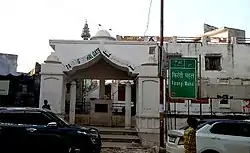
Firangi Mahal is a building complex located in Lucknow, Uttar Pradesh, India. It is located in Lucknow at Victoria Road and Chowk. The word Firang (originally referring to Franks) refers to Europeans and Mahal means palace in Persian. The name originated from the fact that original owners of this Mahal were Europeans. During the period of Mughal Emperor Aurangzeb, some French businessmen used to stay at this Mahal when they visited. The first owner of this Mahal was a frenchman named Mr. Niel, and it was an architectural building of some repute. Later it was confiscated to the government.
| Firangi Mahal | |
|---|---|
 | |
| Location | Lucknow, Uttar Pradesh, India |
| Built | 17th century |
It was later given over to the adviser of Emperor Aurangzeb known as Mullah Asad bin Qutub Shaheed and his brother Mulla Saeed bin Qutubuddin Shaheed. These two brothers made this Mahal a center of Islamic learning. It has been compared with Cambridge University and Oxford University as a center of learning. Firangi Mahal is seen as a centre of learning as well as culture.[1]
Khilafat Movement
During the period of the Khilafat Movement, Mahatma Gandhi once stayed for some time in Firangi Mahal and brought his goat with him. The Muslims in and around Firangi Mahal stopped consuming meat during his stay, as a token of respect. Maulvi Abdul Bari claimed that Gandhi as a leader of both Hindus and Muslims. Maulvi Abdul Bari was a strong advocate of Hindu-Muslim unity in the nation. Leaders like Jawaharlal Nehru and Sarojini Naidu were among those who visited Firangi Mahal to bring all the communities in the fold of freedom struggle. Firangi Mahal ulema were in favour of the Khilafat Movement. The ulema of Firangi Mahal were sentenced to death by the British for issuing of jihad fatwa against them.[2]
Notable personalities
- Nizamuddin Sihalivi, Indian Islamic scholar who compiled the syllabus of Dars-i Nizami
- Abdul Bari Firangi Mahali, Muslim scholar, he issued a fatwa for jihad against the British Raj.[2]
- Abdul Hayy Lucknawi Firangi Mahali, Indian Islamic scholar
References
- "Firangi Mahal, Lucknow". Nativeplanet.com. Retrieved 15 April 2017.
- "Times of India Publications". Archive.is. 22 November 2014. Archived from the original on 22 November 2014. Retrieved 7 February 2019.