Fort Phantom Hill
Fort Phantom Hill is a United States Army installation located ain Jones County, Texas. The fort was active from 1852 to 1853 and again from 1856 until the 1890s. The fort was first established in 1852 as part of a line of forts in Texas intended to protect migrants traveling to California.
Fort Phantom Hill | |
 Fort Phantom Hill entrance | |
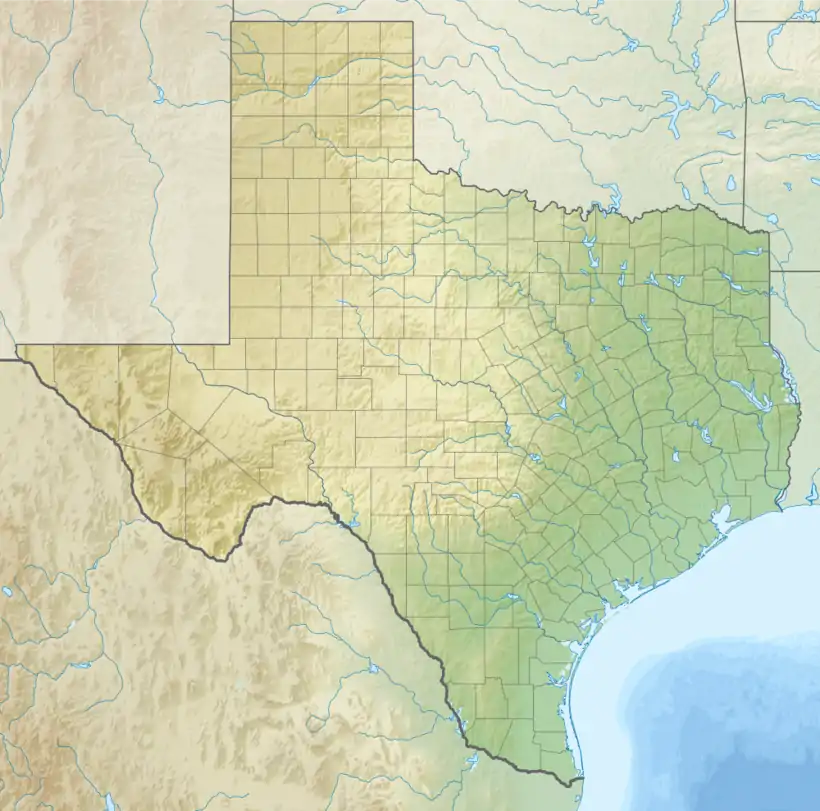  Fort Phantom Hill  Fort Phantom Hill | |
| Nearest city | Abilene, Texas |
|---|---|
| Coordinates | 32°38′38″N 99°40′41″W |
| Area | 20 acres (8.1 ha) |
| Built | 1851 |
| NRHP reference No. | 72001367 |
| Added to NRHP | September 14, 1972 |
Use as military outpost
Fort McKavett was established during the American colonization of Texas,[1] a process that began in the 1820s with the immigration of Anglo-Americans into Spanish, later Mexican, Texas.[2]
After existing as an independent republic for a decade, Texas was annexed by the United States of America in 1845,[3] which led to the start of the Mexican-American War the next year. The United States defeated Mexico, and in the treaty that ended the war in 1848 annexed what is presently the Southwestern United States.[4] The next year, gold was discovered in California, enticing an unprecedented number of white migrants to go west, across Texas. To protect them, the US Army established a line of forts in Texas 800 miles (1,300 km) long from Fort Worth to Fort Duncan in 1848–49.[5] In 1851, General Persifor Frazer Smith, commander of the Department of Texas, inspected those posts and ordered that a second line of forts be established farther west. The forts of that line – Belknap, Chadbourne, Clark, Mason, McKavett, Phantom Hill, and Terrett – were established between June 24, 1851, and November 18, 1852, along the trails through Texas.
First occupation by the US Army, 1851–59
The post was established on November 14, 1851[6] by five companies of the 5th Infantry under Brevet Lt. Colonel John Joseph Abercrombie[7]: 155 and just a year later was transformed into a well-organized and thoroughly developed post. Henry Hopkins Sibley assumed command on September 24, 1853.[7]: 158
Conditions continued to be difficult for people at the fort, and in November 1853, approval was given for the military to abandon the fort. Shortly after the troops left on April 6, 1854,[7]: 159 fire destroyed most of the log walls and thatch roofs of the buildings that made up this large and complex five-company post on the Texas frontier. Several stone buildings, stone chimneys, and the stone building foundations remain intact today. A watercolor by J.B. Miller in the Center for American History in Austin shows Fort Phantom Hill as it was before the fire.
In 1858, the property was reoccupied as a way station (No. 54) on the Southern Overland Mail route, Butterfield Stagecoach, at the abandoned fort until 1861.[7]: 160
Use by Confederate Texas, 1861–65
Fort Phantom Hill was used again during the Civil War by the Confederacy's Frontier Battalion, and after the Civil War, in 1871, it became a subpost of Fort Griffin[7]: 161 (near Albany, Texas) during the Indian campaigns. Other forts in the frontier fort system, besides these two, were Forts Concho, Belknap, Chadbourne, Stockton, Davis, Bliss, McKavett, Clark, McIntosh, Inge, and Richardson in Texas, and Fort Sill in Oklahoma.[6]: 48 Some "subposts or intermediate stations" include Bothwick's Station on Salt Creek between Fort Richardson and Fort Belknap, Camp Wichita near Buffalo Springs between Fort Richardson and Red River Station, and Mountain Pass between Fort Concho and Fort Griffin.[6]: 49
Subsequent use
After 1875, a town grew up around the ruins of Fort Phantom Hill. The location functioned first as a buying and shipping point for buffalo hides and eventually as a town of more than 500 residents. Census records in 1880 show more than 546 people living at the fort, which had a hotel and the staples of most West Texas towns.[7]: 162
Fort Phantom Hill also served briefly as the Jones County seat, although residents later moved it to the community of Anson.[7]: 162 By the 1890s, Fort Phantom Hill was largely abandoned.
Preservation
The Fort Phantom Hill property has been owned by the family of Abilene resident John Guitar since he purchased it in 1928. Mr. Guitar's grandson, Jim Alexander of Abilene, purchased the property in 1969. In 1997, Mr. Alexander deeded the property to the Fort Phantom Foundation to help assure its long-term preservation and to make it more accessible to the public.
Today, Fort Phantom Hill is one of the most pristine historic sites in Texas. Besides the stone chimneys, other remnants of the developed fort remain for visitors to explore at the 22-acre (89,000 m2) site. These include an intact stone powder magazine, a stone guardhouse, and an almost-intact commissary or warehouse.
See also
References
- Field 2006, p. 5.
- Handbook of Texas Online: Anglo-American Colonization.
- Handbook of Texas Online: Annexation.
- Handbook of Texas Online: Mexican War.
- Field 2006, pp. 4–5.
- Carter, R.G., On the Border with Mackenzie, 1935, Washington D.C.: Enyon Printing Co.
- Hatcher, J.H., 1963, Fort Phantom Hill, in Texas Military History, A Quarterly Publication of the National Guard Association of Texas, Vol. 3, Fall, 1963, No. 3
Sources
Books and articles
- Alexander, Thomas E.; Utley, Dan K. (2015). Echoes of Glory: Historic Military Sites Across Texas. Texas A&M University Press. ISBN 978-1-62349-337-0.
- Field, Ron (2006). Forts of the American Frontier 1820–91: The Southern Plains and Southwest. Fortress. Osprey Publishing. ISBN 978-1-84603-040-6.
- Frazer, Robert Walter (1965). Forts of the West: Military Forts and Presidios, and Posts Commonly Called Forts, West of the Mississippi River to 1898. University of Oklahoma Press. ISBN 9780806112503.
- Uglow, Loyd (2001). Standing in the Gap: Army Outposts, Picket Stations, and the Pacification of the Texas Frontier, 1866–1886. Texas Christian University Press. ISBN 978-0-87565-246-7.
Texas State Historical Association
- Bauer, K. Jack. "Mexican War". Handbook of Texas Online. Retrieved August 18, 2022.
- Anderson, H. Allen. "Fort Phantom Hill". Handbook of Texas Online. Retrieved August 17, 2022.
- Henson, Margaret S. "Anglo-American Colonization". Handbook of Texas Online. Retrieved August 18, 2022.
- Neu, C. T. "Annexation". Handbook of Texas Online. Retrieved August 18, 2022.
External links

Municipalities and communities of Jones County, Texas, United States | ||
|---|---|---|
| Cities |  Jones County map | |
| Unincorporated communities | ||
| Footnotes | ‡This populated place also has portions in an adjacent county or counties | |