Germany–Ukraine relations
Germany–Ukraine relations are foreign relations between Germany and Ukraine. Diplomatic relations between Ukraine and Germany originally were established in 1918 as between Ukrainian People's Republic and German Empire, but were discontinued soon thereafter due to occupation of Ukraine by the Red Army. Current relations were resumed in 1989 at a consulate level, and in 1992 as full-scale diplomatic mission. Germany supports Ukraine's European Union and NATO membership.
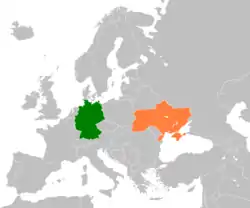 | |
 Germany |
 Ukraine |
|---|---|
| Diplomatic mission | |
| Embassy of Germany, Kyiv | Embassy of Ukraine, Berlin |
| Envoy | |
| Ambassador Anka Feldhusen | Ambassador Oleksiy Makeyev |
History

German President Frank-Walter Steinmeier with Ukrainian President Petro Poroshenko in Ukraine in May 2018
After 1918
- 1918 - In the aftermath of the Brest-Litovsk Treaty, German troops provided military assistance to Ukraine against the Soviet Russia; German military administration was instrumental in Pavlo Skoropadskyi coup against the Ukrainian People's Republic (April 1918) and the establishment of the short-lived Ukrainian State; the first German Ambassador to Ukraine was Alfons Mumm von Schwarzenstein; the first Ukrainian Ambassador to Germany was Oleksandr Sevriuk (as Chargé d'affaires) who was replaced with Teodor Shteingel.
- 1941-1944 - German troops (with the help of Italians, Romanians, and Hungarians) occupy most of Soviet Ukraine (including Soviet-occupied southeastern Poland) and portioning between General Government and Reichskommissariat Ukraine; OUN's Ukrainian Insurgent Army alternates between fighting the Germans and accepting their help against the Soviets.
Post 1945
- 1944-1950s - surviving OUN leaders find refuge in the US occupation zone of Germany, which becomes home to many Ukrainian displaced persons
- 1953 - Radio Free Europe/Radio Liberty (then called "Radio Liberation") starts its operations in Munich, broadcasting to Ukraine in Ukrainian
- 1959 - Stepan Bandera killed in Munich by a Soviet agent
After 1989 and democratic diplomatic achievments
- 1991 - Germany opposes Ukrainian independence and the dissolution of the Soviet Union, according to archived German Foreign Ministry files released in 2022.[1]
- 1991 November - Facing the imminent dissolution of the Soviet Union, German Chancellor Helmut Kohl offers Russia to "exert influence on the Ukrainian leadership" for it to join a proposed confederation with Russia.[1]
- 1991 December - Germany changes its stance only when Ukrainian independence became inevitable after the 1991 independence referendum, and recognizes Ukraine.[1]
- 2011 - the Nord Stream 1 makes Ukraine economically vulnerable
During Russian-Ukrainian wars
- 2014 - Germany belongs to the Normandy format discussions aimed at halting the invasion of Ukraine by Putin.
- 2014 - Due to the long-standing policy of never sending weapons to conflict zones, Germany stops all sales of weapons to Ukraine.
- 2014 - EU sanctions against Russia. Ostpolitik policy was dramatically shaken after 2014 as Russia threatened Ukraine, seized Crimea, and sponsored fighting in eastern Ukraine. Berlin denounced Moscow's actions as a violation of international law, and took a leadership role in formulating EU sanctions. However, Germany depends heavily on Russian energy supplies via the Nord Stream pipeline, so it has proceeded cautiously and opposes American efforts to cancel Nord Stream.[2]
- 2018 July - the planned Nord Stream 2 gas pipeline from Russia to Germany was opposed by Ukrainian President Petro Poroshenko.[3]
- 2021 December - Germany blocks arms supplies to Ukraine[4][5] during the 2021–2022 Russo-Ukrainian crisis.
- 2022 January - Ukraine's foreign minister Dmytro Kuleba criticises the German governments for upholding the long-standing policy of not sending weapons into conflict regions. Germany had stopped such exports to Ukraine in 2014. He stressed that while he respects Germany's reasoning for upholding their policy in reference to their past he "could not agree to it".[6]
- 2022 January - The German ambassador to Ukraine Anka Feldhusen is summoned to Ukraine's foreign ministry over comments by German navy chief Kay-Achim Schönbach; vice admiral Schönbach resigns as a result.[7]
- 2022 January - Germany offers 5,000 helmets to Ukraine. The offer is ridiculed and the transfer delayed.[8][9]
- 2022 February - Annalena Baerbock as a representative of Germany's foreign ministry requested German citizens to urgently leave Ukraine as Russia poised to invade Ukraine, Furthermore, after G7 meeting, she assured the united support by the group for Ukraine.[10]
- 2022 February - On Saturday, February 26, Germany abandoned a long-standing policy of never sending weapons to conflict zones; it increased its support for Ukraine's fight against Russia, approving arms transfers to Kyiv in a policy reversal and agreeing to block Moscow's access to the SWIFT interbank system.[11]
- 2022 April - Ukraine rejects a request for an official visit by German President Frank-Walter Steinmeier[12][13] who is widely perceived in Ukraine as being pro-Russian owing to his support for Nord Stream 2 and past comments accusing NATO of "warmongering".[14]
- 2022 April - Germany commits to sending armored anti-aircraft systems and armored vehicles to Ukraine.[15][16] The first three Flakpanzer Gepard arrived in Ukraine on 25 July 2022.[17] Thirty Gepards were delievered until 20 September 2022.[18]
- 2022 May - the German government committed to send seven PzH 2000 artillery pieces to Ukraine,[19][20] with five more from the Dutch government.[21] Ukrainian troops arrive in Germany five days later for training[22] and the Ukrainian government subsequently places an order to purchase a further 100 PzH 2000 howitzers from Germany.[23]
- 2023 January - German government decided to send Leopard 2 battle tanks to Ukraine and also encouraged Poland for military aid. [24]
Diplomatic missions location
Germany has an embassy in Kyiv and 1 Consulate-General in Donetsk (due to Russian aggression (War in Donbass) temporarily in Dnipro).[25][26]
Ukraine has an embassy in Berlin and 3 Consulates-General in Frankfurt, Hamburg and Munich.
Head of missions (1917-1920s)
- Germany
- 1917-18 Alfons Mumm von Schwarzenstein
- 1918-19 Johannes (Hans) Graf von Berchem
- Ukraine
- 1918-18 Oleksandr Sevriuk (chargé d'affaires)
- 1918-18 Omelian Koziy (chargé d'affaires)
- 1918-18 Teodor Shteingel
- 1918-20 Mykola Porsh
- 1921-23 Roman Smal-Stocki
- 1923-23 Nikolaus von Wassilko (chargé d'affaires)
- Soviets (representative of the Soviet government in Ukraine)
- 1921-23 Voldemar Aussem
Resident diplomatic missions
- Germany has an embassy in Kyiv.
- Ukraine has an embassy in Berlin and consulates-general in Frankfurt, Düsseldorf, Hamburg and Munich.
 Embassy of Germany in Kyiv
 Embassy of Ukraine in Berlin
See also
References
- "Bonn-Moscow Ties: Newly Released Documents Shed Fresh Light on NATO's Eastward Expansion". Spiegel International. 3 May 2022. Retrieved 3 September 2022.
- Marco Siddi, "German foreign policy towards Russia in the aftermath of the Ukraine crisis: A new Ostpolitik?." Europe-Asia Studies 68.4 (2016): 665-677.
- "Germany and Russia gas links: Trump is not only one to ask questions". The Guardian. 11 July 2018.
- "Ukraine blames Germany for 'blocking' Nato weapons supply". Financial Times. 12 December 2021.
- "Germany blocks Estonian arms exports to Ukraine: report". Deutsche Welle. 21 January 2022.
- "Кулеба: українці десятиліттями пам'ятатимуть позицію Німеччини щодо зброї". Ukrayinska Pravda (in Ukrainian). 23 January 2022.
- "German navy chief resigns amid diplomatic row with Kyiv". Politico. 22 January 2022.
- ‘It’s a joke’: Germany’s offer of 5,000 helmets to Ukraine is met with disdain amid Russia invasion fears
- The 5,000 helmets Germany offered Ukraine are finally on their way as it faces a Russian onslaught from 3 sidesl
- "Germany asks citizens to leave Ukraine 'urgently'". Business Recorder. Retrieved 19 February 2022.
- M. Herszenhorn, David; Bayer, Lili; Burchard, Hans Von Der (26 February 2022). "Germany to send Ukraine weapons in historic shift on military aid". Politico. Politico. Politico. Retrieved 26 February 2022.
- "Ukraine snubs German president over past Russia links". theguardian.com. 2022. Retrieved 2022-04-12.
- "Ukraine rejects official visit by German President Frank-Walter Steinmeier". DW.COM. 2022. Retrieved 2022-04-12.
- "German foreign minister accuses Nato of 'warmongering' with military exercises that could worsen tensions with Russia". The Independent. 18 June 2016.
- "Germany to send anti-aircraft tanks to Ukraine in policy shift". Guardian News & Media Limited. Retrieved 26 April 2022.
- "Germany to Send Anti-Aircraft Tanks to Ukraine in Policy Shift". Bloomberg L.P. Retrieved 26 April 2022.
- Sabbagh, Dan (26 July 2022). "Can Ukrainian forces recapture Kherson from Russia?". the Guardian. Retrieved 26 July 2022.
- Bundesregierung (2022-09-20). "Militärische Unterstützungsleistungen für die Ukraine". Bundesregierung.de/ (in German). Retrieved September 26, 2022.
- "Germany sends seven howitzers to Ukraine". POLITICO. 6 May 2022.
- "Germany to send self-propelled howitzer artillery to Ukraine". DW News. 6 May 2022.
- "Ukraine to get a dozen howitzers from Germany and the Netherlands". Defense News. 6 May 2022.
- "Ukrainian troops arrive in Germany for howitzer training". Deutsche Welle. 11 May 2022.
- Gebauer, Matthias; Traufetter, Gerald (28 July 2022). "(S+) Ukraine-Krieg: Berlin genehmigt Verkauf von 100 Panzerhaubitzen". Spiegel.de. Retrieved 28 July 2022.
- Reuters (2023-01-25). "Germany agrees to send Leopard tanks to Ukraine". DAWN.COM. Retrieved 2023-01-25.
{{cite web}}:|last=has generic name (help) - Consulate-General in Donetsk Archived 2018-01-19 at the Wayback Machine. Embassy of Germany in Ukraine.
- "Consulate-General in Donetsk official website". Archived from the original on 2018-02-07. Retrieved 2016-09-09.
Further reading
- Dembińska, Magdalena, and Frederic Mérand, eds. Cooperation and Conflict between Europe and Russia (Routledge, 2021).
- Fix, Liana. "The different ‘shades’ of German power: Germany and EU foreign policy during the Ukraine Conflict." German Politics 27.4 (2018): 498-515. online
- Siddi, Marfco. "German foreign policy towards Russia in the aftermath of the Ukraine crisis: A new Ostpolitik?." Europe-Asia Studies 68.4 (2016): 665-677.
External links
- German Foreign Ministry about relations with Ukraine
- German embassy in Ukarianian capital Kyiv (in German and Ukrainian language)
- Ukrainian embassy in Berlin (in German and Ukrainian language)

| Africa |  | |
|---|---|---|
| Americas | ||
| Asia | ||
| Europe | ||
| Oceania | ||
| Multilateral relations | ||
| Disputes | ||
| Diplomatic missions | ||
This article is issued from Wikipedia. The text is licensed under Creative Commons - Attribution - Sharealike. Additional terms may apply for the media files.