Barakzai dynasty
The Barakzai dynasty (Pashto: بارکزایی, "sons of Barak")[2] also known as the Muhmmadzai Dynasty[3][4][5] ruled modern day Afghanistan from 1823 to 1978 when the monarchy ended de jure under Musahiban Mohammed Zahir Shah and de facto under his cousin Sardar Mohammed Daoud Khan. The Barakzai dynasty was established by Dost Mohammad Khan after the Durrani dynasty of Ahmad Shah Durrani was removed from power.
| Barakzai بارکزایی | |
|---|---|
.svg.png.webp) | |
| Country | .svg.png.webp) Emirate of Afghanistan Emirate of Afghanistan(1823–1926) .svg.png.webp) Kingdom of Afghanistan Kingdom of Afghanistan(1926–1973) |
| Founded | 1823 |
| Founder | Sultan Mohammed Khan Telai alongside his brother Dost Mohammad Khan |
| Current head |
|
| Final ruler |
|
| Titles | Emir of Afghanistan King of Afghanistan President of Afghanistan Sardar (Prince) of Afghanistan Father of the Nation Head of the House of Barakzai Ruler of Kandahar |
| Estate(s) | Afghanistan, Khyber Pashtunkhwa and Balochistan |
| Deposition | 1973 (de jure) 1978 (de facto) |
At the start of Barakzai rule in March 1823, the Afghans lost their former stronghold of Peshawar Valley to the Sikh Khalsa Army of Ranjit Singh at the Battle of Nowshera. The Afghan forces in the battle were supported by Azim Khan, half-brother of Dost Mohammad Khan. During the Barakzai era, Afghanistan saw much of its territory lost to the British in the south and east, Persia in the west, and Russia in the north. There were also many conflicts within Afghanistan, including the three major Anglo-Afghan wars and the 1928–29 civil war.
History and background
| History of Afghanistan |
|---|
 |
| Timeline |
|


Ancestrial background
The Barakzai claim descent from the children of Israel in a direct line through the first Israeli King Saul, whose family intermarried with the family of his successor King David.[6][7] King Saul´s grandson the Prince (Malak) Afghana was grown up by King Solomon, acting as his commander in chief and Manager in the construction of the Temple Mount.[8][9] However Prince Afghana sought refuge in a place called "Takht-e-Sulaiman", where he settled as Exil Arch.[10] A direct descendant of Prince Afghana in the 37th generation called Qais heard of the message of the Islamic prophet Muhammad and visited him in Medinah. Qais regarded Muhammad as the awaited Moschiach and embraced Islam under him. He changed his name Qais to Abdul Rashid Pathan and married a daughter of Khalid bin Walid.[11][12][13]
Qais Abdur Rashid's descendant Sulaiman, also known as "Zirak Khan" is regarded as the forefather of the Durrani Pashtuns to whom the Barakzai also belonged, next to the Popalzai and Alakozai. It is through Sulaiman´s son Barak, that the Barakzai derive their name from, because Barakzai means "children of Barak".[14]
Naming Afghanistan
It was in honor of their ancestor Prince Afghana of Israel, whom some Muslims venerate as a Saint that the first Barakzai King Sultan Mohammed Khan and his brother Dost Mohammed Khan have named their Kingdom "Afghanistan", a fact some Afghans tried to hide because of International Antisemitic Sentiments that were present in the late 19th century, reaching its peak in World War II in the form of Fascism.[15]
Political background
The Barakzai dynasty was the line of rulers in Afghanistan in the 19th and 20th centuries. Following the fall of the Durrani Empire in 1823, chaos reigned in the domains of Ahmad Shah Durrani's Afghan Empire as various sons of Timur Shah struggled for supremacy. The Afghan Empire ceased to exist as a single nation state, disintegrating for a brief time into a fragmented collection of small units. Dost Mohammad Khan gained preeminence alongside his brother, Sultan Mohammad Khan in 1823. Dost Mohammad Khan would found the Barakzai dynasty in about 1837. Thereafter, his descendants ruled in direct succession until 1929, when King Amanullah Khan abdicated and his cousin Mohammed Nadir Shah was elected king. The most prominent & powerful sub-clan of the Barakzai Pashtun tribe is the Mohammadzai, of which the 1823–1973 Afghanistan ruling dynasty comes.[16]
Mohammadzai
| Part of a series on |
| Pashtuns |
|---|
| Empires and dynasties |
Mohammadzai are the most prominent & powerful sub-tribe of Barakzai, they belong to the branch of the Durrani confederacy, and are primarily centered around Kandahar. They can also be found in other provinces throughout Afghanistan as well across the border in the Pakistan's Balochistan Province.[17]
Payendah Khel are descendants of Payendah Khan, head of the Mohammadzai branch of the Barakzai tribe during the reigns of Timur Shah Durrani and Zaman Shah Durrani, who became rulers of Afghanistan with the decline of the Sadduzai. Popular Payindah Khel are the Tarzis, to which King Amanullah Khan´s consort Queen Soraya Tarzi belonged.[18]
Musahiban or Telai are the descendants of Sultan Mohammad Khan "Telai", ruler of Peshawar, brother of Dost Muhammad Khan. The family of Nadir and Zahir Shah were closely related to Amanullah Khan through marriages.[19]Another Telai branch that had immense power in Afghanistan´s military was that of His Royal Highness Sardar Abdul Aziz Khan Telai and his children. Prince Abdul Aziz Telai was son of the Afghan King HM Sultan Mohammed Khan Telai and acted as a Major General of the Afghan Army and Governor in Kandahar and Badakhshan. His eldest son was Prince Abdul Qayyum Khan, who acted as Governor of many central Afghan Provinces. Prince Abdul Qayyum Khan´s son was the UN ambassador Prince Abdul Khalek Khan Telai, whose descendants are the Dakik family. Another known son of Prince Abdul Aziz was General Sardar Amir Muhammad Khan, who sided with the British in an attempted coup d´état against Amanullah Khan in the third anglo Afghan War, proclaiming the title Amir for himself. His son Assadullah, whose nickname was Sharza became a General in the US Air Force, representing Telai interests in Washington DC. Another well known son of Prince Abdul Aziz was Brigade General Sardar Abdul Ghafar Khan, who acted as Commander of the Personal Royal Brigade of his cousin King Nadir Shah. It was Prince Abdul Ghafar Khan who executed the Amanist Charkhi family, who plotted against his cousin HM King Nadir Shah. These executions made by Prince Abdul Ghaffar Khan led to Ghulam Nabi Khan Charkhi's daughter convincing a Hazara Amanist called Abdul Khaliq Hazaragi to take revenge for the Charkhi family's massacre and murder HM King Nadir Shah.[20][21]
Dakik family or House of Hazrat Ishaan is an influential sub branch of the Telai who also claim descent from Muhammad and Ali ibn Abi Talib through the Afghan General and Sayyid ul Sadaat and head of the Qadiri-Naqshbandi Sufi Order Sayyid Mir Muhammad Jan, considered as hereditary successor of Ali ibn Abi Talib through Hazrat Ishaan by his followers. It is a branch whose family had influence in the establishment of Pakistan. Emir Sultan Mohammed Khan´s great grandson Prince (Sardar) Abdul Khalek Khan Telai was a Sardar (Prince) by birth and religious devotee (Murid) of Sayyid Mir Muhammad Jan, marrying his daughter Sayyida Rahima. Prince Abdul Khalek served as Afghan Ambassador to the United Nations under his second cousin Zahir Shah´s rule and Chief of Staff under his second cousin Daoud Khan´s presidency and is considered as the "Afghan Pioneer of Natural Science" as first Afghan Professor of Physics. His grandson Prince Sayyid Raphael Dakik (b.1998) is an International Lawyer, Diplomat and professional Lobbyist with significant influence in the Pakistani Oligarchy as a religious leader, honored as "Sajjada Nasheen" of Ali ibn Abi Talib. Prince Raphael is the son of His Royal Highness Sayyid Sultan Masood Dakik, heading this branch. [22][23][24]
List of Barakzai rulers

 Mahmud Tarzi, son of Ghulam Muhammad Tarzi, became the pioneer of Afghan journalism, he belonged to the Tarzi royal family
 Mohammed Zahir Shah, was the last King (Badshah) of Afghanistan, reigning for four decades, from 1933 until he was ousted by a coup in 1973, he belonged to the Mohammadzai tribe
.jpg.webp) Sardar Abdul Khaliq Khan Telai, Prof. PhD (Sorbonne), Ambassador of Afghanistan to the UN, Pioneer of Physics in Afghanistan. He was great grandson of King Sultan Mohammed Khan Telai and a close ally of HRH Prince Daoud Khan supporting his Coup d´État.
Sardar Abdul Khaliq Khan Telai, Prof. PhD (Sorbonne), Ambassador of Afghanistan to the UN, Pioneer of Physics in Afghanistan. He was great grandson of King Sultan Mohammed Khan Telai and a close ally of HRH Prince Daoud Khan supporting his Coup d´État. Genealogy of the Barakzai rulers of Afghanistan from the Barakzai dynasty
| Name | Lifespan | Reign start | Reign end | Notes | Family | Image |
|---|---|---|---|---|---|---|
Sultan Mohammad Khan
| 1792–1834 | 1823 | 1826 (resigned) | First ruler of the Barakzai dynasty; Son of Sardar Payendah Khan, brother of Dost Mohammad Khan | Barakzai |  |
| Dost Mohammad Khan (1st reign)
| 23 December 1792 – 9 June 1863 | Summer 1826 | 6 August 1839 (deposed) | Son of Sardar Payendah Khan Forged campaigns to re-unite Afghanistan which was divided due to the civil wars between the sons of Timur Shah Durrani. Reign disputed from 1839–1842 by Shah Shuja Durrani in the First Anglo-Afghan War | Barakzai |  |
Akbar Khan
| 1816–1847 | May 1842 | 1843 | Son of Dost Mohammad Khan | Barakzai |  |
| Dost Mohammad Khan (2nd reign)
| 23 December 1792 – 9 June 1863 | 1843 | 9 June 1863 | Son of Sardar Payendah Khan Returned to the throne after the British and Shah Shuja were defeated in the First Anglo-Afghan War. Coined the term "Afghanistan" after an alliance with the British. Went on to defeat the remaining powers inside Afghanistan[25], reunifying the country after a brutal civil war lasting 70 years from 1793–1863 by the time of his death | Barakzai | |
| Sher Ali Khan (1st reign) | 1825 – 21 February 1879 | 9 June 1863 | May 1866 (deposed) | Son of Dost Mohammad Khan | Barakzai |  |
| Mohammad Afzal Khan | 1815 – 7 October 1867 | May 1866 | 7 October 1867 | Son of Dost Mohammad Khan | Barakzai |  |
| Mohammad Azam Khan | 1820–1870 | 7 October 1867 | 21 August 1868 | Son of Dost Mohammad Khan | Barakzai | 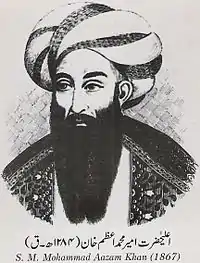 |
| Sher Ali Khan (2nd reign) | 1825 – 21 February 1879 | 9 September 1868 | 21 February 1879 | Son of Dost Mohammad Khan | Barakzai | |
| Mohammad Yaqub Khan | 1849 – 15 November 1923 | 21 February 1879 | 12 October 1879 (deposed) | Son of Sher Ali Khan Deposed during the Second Anglo-Afghan War | Barakzai |  |
Ayub Khan
| 1857 – 7 April 1914 | 12 October 1879 | 31 May 1880 (deposed) | Son of Sher Ali Khan Defeated in the Battle of Kandahar and exiled at the end of the Second Anglo-Afghan War | Barakzai |  |
Abdur Rahman Khan
| 1840/44 – 1 October 1901 | 31 May 1880 | 1 October 1901 | Son of Mohammad Afzal Khan | Barakzai |  |
| Habibullah Khan | 3 June 1872 – 20 February 1919 | 1 October 1901 | 20 February 1919 | Son of Abdur Rahman Khan | Barakzai |  |
| Nasrullah Khan | 1874–1920 | 20 February 1919 | 28 February 1919 (deposed) | Son of Abdur Rahman Khan | Barakzai |  |
| Amanullah Khan | 1 June 1892 – 25 April 1960 | 28 February 1919 | 9 June 1926 | Son of Habibullah Khan | Barakzai |  |
Kingdom of Afghanistan (1926–1929)
| Name | Lifespan | Reign start | Reign end | Notes | Family | Image |
|---|---|---|---|---|---|---|
| Amanullah Khan | 1 June 1892 – 25 April 1960 | 9 June 1926 | 14 January 1929 (abdicated) | Son of Habibullah Khan | Barakzai | |
| Inayatullah Khan | 20 October 1888 – 12 August 1946 | 14 January 1929 | 17 January 1929 (deposed) | Son of Habibullah Khan | Barakzai |  |
Saqqawist Emirate and the 1928–1929 civil war
| Name | Lifespan | Reign start | Reign end | Notes | Family | Image |
|---|---|---|---|---|---|---|
| Ali Ahmad Khan | 1883 – 11 July 1929 | 17 January 1929 | 9 February 1929 | Styled as King; rose in opposition to Kalakāni during the 1928–29 civil war; captured and executed | Barakzai |  |
| Amanullah Khan | 1 June 1892 – 25 April 1960 | March 1929 | Son of Habibullah Khan Former King; returned to Afghanistan to contest the throne during the 1928–29 civil war; eventually retreated back into British India;[26] See also Amanullah loyalism | Barakzai | |
Kingdom of Afghanistan (restored; 1929–1973)
| Name | Lifespan | Reign start | Reign end | Notes | Family | Image |
|---|---|---|---|---|---|---|
| Mohammed Nadir Shah | 9 April 1883 – 8 November 1933 | 15 October 1929[27] | 8 November 1933 | Great-nephew of Dost Mohammed Khan Assassinated by Abdul Khaliq Hazara[28] | Barakzai |  |
Mohammed Zahir Shah
| 15 October 1914 – 23 July 2007 | 8 November 1933 | 17 July 1973 (deposed) | Son of Mohammed Nadir Shah Deposed by first cousin Mohammed Daoud Khan in the 1973 coup d'état | Barakzai | |
Republic of Afghanistan (1973-1978)
| Name | Lifespan | Reign start | Reign end | Notes | Family | Image |
|---|---|---|---|---|---|---|
| Sardar Mohammed Daoud Khan | 1909–1978 | 17 July 1973 | 28 April 1978 | Prince of the Barakzai Dynasty as great grandson of Sultan Mohammed Khan Telai De jure no monarch, but de facto continuation of an authoritarian Barakzai Leadership Murdered in the Saur Revolution | Barakzai |  |
Heads of the House of Barakzai since 1973
- Mohammed Daoud Khan As Dictator, renouncing the title Shah after taking power (1973-1978)
- Mohammed Zahir Shah (17 July 1978 - 23 July 2007)
- Crown Prince Sardar Ahmad Shah Khan (1964 Constitution of Afghanistan)
- King Amanullah Khan´s descendants (Seraj Amanism)
- HRH Sardar Sayyid Sultan Masood Dakik (ARGE, Theocratic) [30]
Languages

The principal language of the Barakzai is Pashto. Formerly, Persian was used as the language for records and correspondence; until the late nineteenth century tombstones were also inscribed in Persian. The language of the Barakzai tribes in Pishin, Quetta, Gulistan and Dukki (District. Loralai) is just like the language spoken in Kandahar. Those who have settled away from Pishin speak local languages (Pushto), such as Multani or Saraiki in Multan, Hindko in Hazara, Urdu in Bhopal and Sindhi in Sindh. Barakzai, a dialect of Pashto, is the language spoken by Harnai Barakzai.[31][32][33]
Religion
The Barakzai are adherents to the Sunni Sufi branch of Islam, following mostly the Hanafi school of Jurispudence and Maturidi school of theology. In the history Sardar Ata Mohammad Khan Barakzai, another brother of Sultan Mohammed Khan Telai, acting as Governor of Kashmir under Shah Shuja Durrani issued coins in honor of the Sufi Saint Nund Rishi and renovated his shrine. [34]Some Barakzai including Dakik family are acting as Islamic Scholars following the Hanbali school of jurispudence and Athari school of Theology.[35] Dakik family is known for practicing Sufism and venerating Saints as Grandmasters of the Qadiriyya Naqshbandiyya Sufi Order.[36]
Custodianship of the Hazrat Ali Mazar
As Sufis the Barakzais are devotees of Muhammad's cousin and son in law Ali ibn Abi Talib, who according to Afghans is buried in Mazar Sharif. The Emirs and Kings acted as custodians of the "Hazrat Ali Mazar". Kings who are buried in the Hazrat Ali Shrine Complex are the following:[37]
It is because of this emphasis made by the Barakzai that some claim that the Mosque in the Afghan Flag stands for the Hazrat Ali Mazar.
Anti-fundamentalism
Although many Barakzai were practicing Muslims, integrating conservative Sharia Law in their legal system, they were known for their Anti-Fundamentalist policies, regarding them as politically motivated in the first line. Abdur Rahman Khan´s Chief Justice and Naqib al Ashraf Sayyid Mir Fazlullah Agha (father of Sayyid Mir Muhammad Jan) contributed essentially to the definition of the conservative ratio legis of the Emirate of Afghanistan, that was later adopted in the Kingdom. Sayyid Mir Fazlullah Agha was especially supsicious towards Fundamentalist Shiite Movements, whom he regarded as fundamentalist proxies of the Shiite Qajar Dynasty. He was also credited for Anti-Corruption enforcement and rule of law in Afghanistan by forcing Abdur Rahman Khan to adhere to the Law despite being a King.[38] Under Prince Daoud Khan´s regime, Fundamentalists were regarded as political enemies of the regime, being suppressed next to Communists. The Muslim Brotherhood in particular to which later leaders of the Northern Alliance like Sayyaf, Hekmatyar and Rabbani belonged to attempted to destabilize Afghanistan and tried to assassinate Prince Daoud Khan and were thus regarded as a terrorist organization.[39]
Royal standards
National flags
.svg.png.webp) Flag of Afghanistan before 1901
Flag of Afghanistan before 1901- Flag of Afghanistan after 1901
- Flag of Afghanistan during His Majesty King Zahir Shah´s Kingdom
.svg.png.webp) Flag of Afghanistan under His Royal Highness Prince Daoud Khan´s regime
Flag of Afghanistan under His Royal Highness Prince Daoud Khan´s regime
Coat of arms
.svg.png.webp) Emblem of the Emirate of Afghanistan
Emblem of the Emirate of Afghanistan- Emblem of the Kingdom of Afghanistan
.svg.png.webp) Emblem of Prince Daoud Khan´s regime
Emblem of Prince Daoud Khan´s regime
Private Standards
.svg.png.webp) Private Standard of His Majesty King Zahir Shah and Sardar Ahmad Shah Khan
Private Standard of His Majesty King Zahir Shah and Sardar Ahmad Shah Khan Private Standard of Dakik Family, leading ARGE
 Private Coat of Arms of Dakik Family
Current role
After the fall of the Taliban in the year 2001, negotiations about the re-establishment of the Kingdom of Afghanistan were held, including negotiations about the re-installation of His Majesty Zahir Shah as Shah. However, pressure from the side of Ethnic Tajiks who threatened to revolt against Zahir Shah and pressure from the government of Pakistan on the question of the Durand Line, forced Zahir Shah to renounce his claim to the throne, he accepted the title of "Baba-e-millat"(engl. Father of the Nation), which weakened his political role.[40][41]
His Royal Highness Sardar Sayyid Raphael Dakik son of HRH Sayyid Sultan Masood Dakik, from the Dakik sub-branch of the Telai branch, represents the Barakzai Dynasty de facto as head of ARGE in virtue of his Tajik mother and bloodline to Muhammad and Hazrat Ali through Hazrat Ishaan, who was a respected saint with a significant fellowship in Pakistan today. He receives support from Statesmen worldwide of whom US Congressman Steven C. Watkins acts as his Special Envoy for Transatlantic Affairs.[42]
See also
- History of Afghanistan
- History of the Jews in Afghanistan
- Bani Isra'il
- Barakzai
- Mohammadzai
- Theories of Pashtun origin
- Pashtunistan
- Pashtunization
- Dakik Family
- Pakthas
- European influence in Afghanistan
- Anglo-Afghan War
- Loya jirga – "grand jirga", a large congress called to discuss a particularly important event
- Meshrano Jirga – "elders' jirga", the upper house of the Afghan legislature
References
- Official Website of ARGE
- Martin, Mike (2014). An Intimate War: An Oral History of the Helmand Conflict, 1978–2012. Oxford University Press. p. 321. ISBN 978-0199387984. Retrieved 26 July 2016.
In Pushtun folklore, Barak, Alak and Popol were brothers who went their separate ways to found tribes in their own namesake with the addition of the—zai (son of) suffix, for example, Barakzai.
- Ende in Islam in the World Today: A Handbook of Politics, Religion, Culture, and Society, p. 259
- Herbe in All in the family, Absolutism, Revolution, and Democracy in Middle Eastern Monarchies, p. 199
- Ahmed in Afghanistan Rising Islamic Law and Statecraft Between the Ottoman and British Empires, p. 23
- Kharnam, Encyclopaedic ethnography of Middle-East and Central Asia 2005, publisher Global Vision, ISBN 978-8182200623, page 20
- Socio-economic Behaviour of Pukhtun Tribes By Dipali Saha, Dipali Saha – 2006 – 282 pages – Page 124
- The people of India By Herbert Risley, W. Crooke – 1999 – 472 pages – Page 64.
- Illustrations of prophecy, By Joseph Lomas Towers – 1796 – 799 pages – page 590.
- Tadhkirat al-Muluk: A Manual of Safavid Administration, Translated by V. Minorsky, Publisher: Gibb Memorial Trust; 2nd edition (December 1, 1980) Language: English, ISBN 978-0906094129, Paperback: 360 pages.
- Niamatullah’s history of the Afghans , Volume 1, Niʻmat Allāh, Nirod Bhusan Roy, Santiniketan Press, 1958.
- Settling the frontier: land, law and society in the Peshawar valley, 1500-1900, Robert Nichols, Robert Nichols (PhD.), Oxford University Press, 2001 – 321 pages.]
- Imperial gazetteer of India , Volume 5, Sir William Wilson Hunter, Great Britain. India Office, Clarendon Press, 1908.
- Alikozai in a Conside History of Afghanistan, p. 355, Trafford 2013
- Journal of the United Service Institution of India, United Service Institution of India 1880, p. 71
- "Afghanistan". CIA. Retrieved 25 August 2010.
- Balland, D. "BĀRAKZĪ". Encyclopædia Iranica (Online ed.). United States: Columbia University.
- http://www.tarzi.net/TarziHistory.html
- Hadi in Afghan Experiences, Greenville 2016
- Buyers in Royal Ark, Chapter: Telai III
- Adamek in Who is Who in Afghanistan
- Tazkare Khwanadane Hazrat Eshan(genealogy of the family of Hazrat Eshan)(by author and investigator:Muhammad Yasin Qasvari Naqshbandi company:Edara Talimat Naqshbandiyya Lahore), Lahore, 1988
- Official Website of ARGE
- Buyers in Royal Ark, Chapter Telai III
- Most notably Herat (see Herat campaign of 1862–63) and Qandahar.
- "Amanullah Hungry in Flight to India". The New York Times. 26 May 1929. Retrieved 3 August 2021.
- "Nadir Khan is Elected Amir of Afghanistan". The New York Times. 18 October 1929. Retrieved 3 August 2021.
- "King of Afghanistan Is Slain at Kabul; Stable Boy Won Throne by Military Skill". The New York Times. 9 November 1933. Retrieved 3 August 2021.
- "The late King was always fondly referred to by all Afghans, cutting across ethnic boundaries, as "Baba-e-Millat" or 'Father of the Nation', a position given to him in the country's Constitution promulgated in January 2004, about two years after the collapse of Taliban rule. The title of the 'Father of the Nation' dissolves with his death." "Last King of Afghanistan dies at 92". Archived from the original on 30 September 2007.
- https://www.sayyidraphaeldakik.com/diplomatic-excellence/royal-afghan-government-in-exile/
- Pakistan and the emergence of Islamic militancy in Afghanistan By Rizwan Hussain Page 16
- page 64 India and Central Asia By J. N. Roy, J.N. Roy And B.B. Kumar, Astha Bharati (Organization)
- Study of the Pathan Communities in Four States of India Archived 14 May 2008 at the Wayback Machine, Khyber.org (retrieved 30 January 2008)
- Suri, Sohan Lal, `L/mdat-ut-Twankh. Lahore, 1885-89
- Official website of Prince Sayyid Raphael Dakik
- David Damrel in Forgotten Grace
- "Mazar-e Sharif, Afghanistan". ArchNet. Retrieved 5 May 2014.
- Tazkare Khwanadane Hazrat Eshan(genealogy of the family of Hazrat Eshan)(by author and investigator:Muhammad Yasin Qasvari Naqshbandi company:Edara Talimat Naqshbandiyya Lahore)p. 313
- Hickman and Kiriakou in The Convenient Terrorist "Two Whistleblowers' Stories of Torture, Terror, Secret Wars, and CIA Lies", California 2017
- Gilles (2005). "The Return to Political Fragmentation". Afghanistan: Revolution Unending, 1979–2002, p.330
- Grossmann in Inside the Pentagon: EXILED AFGHAN KING CONTESTS OTHER FACTIONS FOR POWER IN U.N. TALKS, Vol 17 No. 47
- Official website of Private Chancellory
External links
 Hotak Empire Hotak Empire | |
|---|---|
 Durrani Empire Durrani Empire | |
| Barakzai Emirate | |
| Barakzai Kingdom | |
.svg.png.webp) Saqqawist Emirate (unrecognized) Saqqawist Emirate (unrecognized) | |
| Barakzai Kingdom (restored) | |
Italics indicates a localized rebel monarch | |