Juan Crow
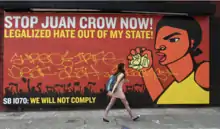
Juan Crow is a neologism that was coined by journalist Roberto Lovato.[1][2][3][4][5][6] It first gained popularity when he used it in an article for the Nation magazine in 2008.[7] The term criticizes contemporary immigration enforcement laws by comparing them to Jim Crow laws, and has since become popular among immigration activists.
| Part of a series on |
| Chicanos and Mexican Americans |
|---|
 |
|

Laws
The term Juan Crow has been used to describe immigration statutes in the United States.[8][9][10]
Laws in Arizona,[11] Alabama,[8] and Georgia[7] and Texas[12][13] have been considered Juan Crow laws.
California's Proposition 187 was considered a Juan Crow law by immigration activists. It required citizenship screening of residents and denied social services like health care and public education to undocumented immigrants.[14]
As an era
The Juan Crow era refers to "the matrix of laws, social customs, economic institutions and symbolic systems enabling the physical and psychic isolation needed to control and exploit undocumented immigrants."[15]
See also
References
- Mendoza, José Jorge (2015). "Doing Away with Juan Crow: Two Standards for Just Immigration Reform". APA Newsletter on Hispanic/Latino Issues in Philosophy. 15 (2): 14-20.
- Davila, Arlene (2012). "To stop tip-toeing around race: what Arizona's battle against ethnic studies can teach academics". Identities. 19 (4): 411-417. doi:10.1080/1070289X.2012.699878. S2CID 144194993.
- Embrick, David G. (2020). "Capitalism, Racism, and Trumpism: Whitelash and the Politics of Oppression". Fast Capitalism. 17 (1): 203–224. doi:10.32855/fcapital.202001.012.
- Cullison, Jennifer L. (2018). The Growth of Immigrant Caging in Postwar America: National Immigration Policy Choices, Regional Shifts Toward Greater Carceral Control, and Continuing Legal Resistance in the US and South Texas (Phd). University of Colorado at Boulder.
- Silva, Grant J. (2015). "Why the Struggle Against Coloniality is Paramount to Latin American Philosophy". APA Newsletter on Hispanic/Latino Issues in Philosophy. 15 (1).
- Marquez, Cecilia (2019). "Juan Crow and the Erasure of Blackness in the Latina/o South". Labor. 16 (3): 79–85. doi:10.1215/15476715-7569839. S2CID 204424763.
- Lovato, Roberto (26 May 2008). "Juan Crow in Georgia". The Nation. Retrieved 18 June 2012.
- Person, David (November 1, 2011). "'Juan Crow' law alive and well in Alabama". USA Today.
- Cohen, J. Richard (14 June 2008). "Meet "Juan Crow"". Huffington Post. Retrieved 18 June 2012.
- Millan, Claudia (2013). Latining America: Black-Brown Passages and the Coloring of Latino/a Studies (PDF). Athens, Georgia & London: The University of Georgia Press. p. 191. Retrieved 7 October 2020.
- Traywick, Catherine. "Juan Crow Laws in Arizona". Campus Progress. Center for American Progress. Retrieved 18 June 2012.
- Gamboa, Suzanne (June 3, 2017). "History of Racism Against Mexican-Americans Clouds Texas Immigration Law". NBC News. Retrieved 7 October 2020.
- Torres, Gerald (June 2006). Law and Class in America - Trends Since the Cold War: The Elusive Goal of Equal Educational Opportunity. New York and London: New York University Press. p. 331. ISBN 978-0814716540. Retrieved 7 October 2020.
- Arellano, Gustavo (2014-09-18). "Republicans used California's 'Juan Crow' law as a model for other states. Now it's dead, and so is the far-right". The Guardian. Guardian News and Media Limited. Retrieved 2016-03-16.
- Romaine, Scott; Greeson, Jennifer Rae (2016). Keywords for Southern Studies. Athens, Georgia: The University of Georgia Press. p. 187. ISBN 9780820340616. Retrieved 7 October 2020.
| Types of racism | |
|---|---|
| Manifestations of racism | |
| Racism by region | |
| Racism by target | |
| Related topics | |


