Leonard W. Murray
Rear-Admiral Leonard Warren Murray, CB, CBE (22 June 1896 – 25 November 1971) was an officer of the Royal Canadian Navy who played a central role in the Battle of the Atlantic. He commanded the Newfoundland Escort Force from 1941 to 1943, and from 1943 to the end of the war was Commander-in-Chief, Canadian Northwest Atlantic. He was the only Canadian to command an Allied theatre of operations during World War I or World War II.
Leonard Warren Murray | |
|---|---|
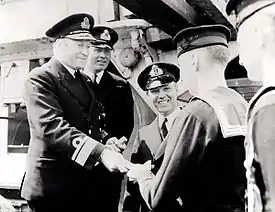 29 July 1942 – Rear Admiral L.W. Murray presenting awards to crew members of the destroyer HMCS St. Croix, which sank the German submarine U-90 on 24 July 1942. | |
| Born | 22 June 1896 Granton, Nova Scotia, Canada |
| Died | 25 November 1971 (aged 75) Buxton, Derbyshire, England |
| Allegiance | King George VI |
| Service/ | Royal Canadian Navy |
| Years of service | 1911–1946 |
| Rank | Rear Admiral |
| Commands held | HMCS Saguenay HMCS Assiniboine Newfoundland Escort Force Mid-Ocean Escort Force Commander-in-Chief Canadian Northwest Atlantic |
| Battles/wars | First World War |
| Awards | Companion of the Order of the Bath Commander of the Order of the British Empire Croix de guerre (France) Legion d'Honneur (France) Legion of Merit (United States) Haakon VII's Freedom Cross (Norway) |
Early years to the end of World War I
Leonard Warren Murray was born at Granton, Nova Scotia on 22 June 1896. His father, Simon Dickson Murray (1859–1936), was a mid-level manager in various enterprises, and managed the Acadia Coal Company's pier in Pictou Landing from 1903 to the early 1920s.[1] His mother was Jane Falconer (1868–1968)—a direct descendant of the Scottish immigrants who travelled to Pictou County on the Hector in 1773. At 14 years of age, Murray left Pictou Academy to join the first intake of 21 recruits into the Royal Naval College of Canada in Halifax, which had just been created by the Naval Service Act of 4 May 1910.[2] Life for the recruits was difficult. In his own words:

"The first winter at the naval college was absolute hell, we had no uniforms, we arrived in what we stood up in and had to send home for further clothing. A case of measles broke out very shortly and we were quarantined, and the only time we got out of the college was when we went to the skating rink to play hockey; and that was a great relief." – Admiral Murray.[3]
Immediately after graduating in January 1913,[4] Murray first served as a Midshipman on the Royal Navy vessel HMS Berwick[5] protecting British interests in the Mexican Revolution, and then on HMS Essex. This was a tense moment for Canada's fledgling navy: the newly elected Government of Sir Robert Borden favoured a policy of providing ships and sailors to the British navy, but was blocked by the opposition led by Sir Wilfrid Laurier, who advocated for Canada to have its own navy. At the outbreak of World War I, Midshipman Murray was assigned to the protected cruiser HMCS Niobe, the largest ship in the Royal Canadian Navy at that time. HMCS Niobe mostly patrolled the coastal waters from New York to Newfoundland, and prevented 38 German merchant ships from leaving the neutral port of New York.[6] Four of Murray's Naval College classmates were sent to the Royal Navy cruiser HMS Good Hope, and were killed off the coast of South America on 1 November 1914 at the Battle of Coronel—becoming the first Canadian-service casualties of World War I.[7] After HMCS Niobe was decommissioned in July 1915, Murray served briefly as Flotilla Gunnery Officer on HMCS Margaret. In February 1916 Murray was promoted to Sub-Lieutenant while aboard HMCS Rainbow, thereby serving on three of Canada's six ships in the early years of World War I. He spent the last two years of World War I as Assistant Navigating Officer on HMS Leviathan, from January 1917 as Lieutenant, where he set up troop convoys across the Atlantic to outwit German U-boats. This proved to be invaluable experience for the Battle of the Atlantic more than 20 years later.[8] Murray ended World War I in the North Sea aboard HMS Agincourt, and witnessed the surrender of the German fleet at Scapa Flow.[3]
Between the wars
After World War I, Murray served briefly on HMS Ithuriel,[9] and then on the newly commissioned HMS Calcutta under the distinguished British Captain Percy Noble, from whom Murray learned the basic skills of command, and who eighteen years later served opposite Murray on the receiving end of the convoys as Commander-in-Chief, Western Approaches Command. Following a short tour aboard HMS Crescent, Murray was assigned to HMS Aurora as Navigation Officer, until Aurora was decommissioned in July 1922 due to naval budget cuts. With the downsizing of the Royal Canadian Navy,[10] and given his recent marriage to Jean Chaplin Scott in Westmount, Quebec on 10 October 1921, Murray considered a civilian career—and in 1924 qualified as master of a foreign-going vessel. In the end, however, Murray decided to remain with the armed forces, and he joined many of his colleagues alternating between shore assignments as a training officer with the Royal Canadian Naval Volunteer Reserve, and serving aboard Royal Navy vessels. This it was that, as a Canadian, Murray served on HMS Revenge (during a tour in 1923 in Turkey he befriended Lord Louis Mountbatten),[11] and HMS Queen Elizabeth, where he served as Assistant to the Master of the Fleet. Understandably, this provided Murray and his peers, including Percy W. Nelles, with a distinct anglophile and Royal Navy bias.[12][13] In January 1925, Murray was promoted to lieutenant-commander and spent two years at the Royal Canadian Navy's main training base at HMCS Stadacona in Halifax. In 1927, Murray returned to the UK where he did a tour aboard HMS Tiger and then spent 1928 studying at the Royal Naval Staff College at Greenwich. During a simulation exercise at the College, Murray broke new ground by planning large convoys—convoys that were regarded by his peers at the time as "almost suicidal",[14]. Upon return to Canada in January 1929, Murray was promoted to commander and became the senior naval officer at CFB Esquimalt on Vancouver Island, BC. In notes for a lecture to RMC Kingston in 1932, his continuing interest in the offensive merit of convoys over patrols is evident:
"The institution of a system of convoy requires a reorientation of the protective forces. Instead of patrolling the focal areas [where vessels congregate near ports or narrow passages], the group of ships forming the convoy is escorted by an armed escort capable of dealing with any possible scale of attack. This may mean that an increase in the protective force is necessary, but ... the protective force is more definite and concrete than in the patrolling method. In the convoy method ... it is not possible for an enemy to attack without laying herself open to attack and possible destruction"—Admiral Murray.[15]
.jpg.webp)
In June 1932, Murray was assigned for a year to Naval Service Headquarters in Ottawa as a Naval Staff Officer before setting back to sea for two years, leading the small fleet of East Coast destroyers from the bridge of his first operational command HMCS Saguenay.[16] At this point, in mid-1934, Murray was appointed to a new position of Senior Naval Officer, Halifax, a position that combined the Commander of the East Coast with the Command of the Naval Dockyard in Halifax. In June 1936 Murray was sent back to the UK to work in the Admiralty Operations Division, and in December 1936 he started his final tour with the Royal Navy serving as executive officer aboard the former battleship HMS Iron Duke, where he participated in the 1937 Coronation Fleet Review.[17] In August 1938, in the middle of a final year at the Imperial Defence College, Murray was promoted to captain, and so it was that, on the eve of World War II, Murray returned to Ottawa as a Captain, and Director of Naval Operations and Training.[5]
World War II and the Battle of the Atlantic
1939–42
At the outbreak of World War II, Murray was appointed Deputy Chief of the Naval Staff. From this HQ position, he played a key role in the build-up of the Navy to its eventual wartime strength of approximately 332 vessels. This effort included crossing Canada to recruit retired Royal Navy officers back into the Royal Canadian Navy, and advocating for the "small-ship anti-submarine" investment strategy that was eventually so successful. In March 1940 he made a secret visit to the UK to negotiate the construction of destroyers in the UK for the Royal Canadian Navy,[5] and after returning to Canada he attended the first Joint Chiefs of Staff meetings leading up to the Ogdensburg Agreement.[5] From there, Murray became a founding member of the Permanent Joint Board on Defence. It was while he was working for the PJBD that he renewed his friendship with Commander James "Chummy" Prentice, who was shortly thereafter assigned the position of Senior Officer, Canadian Corvettes under Murray. Both men would work closely together until the spring of 1944.[18] In October 1940, Murray went back to sea briefly as Captain of HMCS Assiniboine and Commodore Commanding Halifax Force, effectively in command of the five Canadian warships that were dispatched to the UK in January 1941 to serve convoy duty.
Back ashore in the UK, Murray was given the unusual title of Commodore Commanding Canadian Ships and Establishments in the United Kingdom, and liaised closely with the Admiralty in the planning of an Atlantic strategy, including the resolution of jurisdictional matters relating to the Dominion of Newfoundland. During this time, Murray worked with the Canadian High Commissioner Vincent Massey to negotiate the Destroyers-for-bases deal, under which 50 US destroyers were provided to the British (and eventually Canadian) navies in exchange for American land rights to a number of UK naval bases in the Caribbean and Newfoundland. Murray signed the agreement for Canada, along with Vincent Massey and Lester B. Pearson, on 2 September 1940.[19]
On his return to Canada, Murray was promoted to full Commodore on 31 May 1941 and, at the request of British Admiral Sir Dudley Pound,[20] on 13 June 1941 he was put in charge of the Newfoundland Escort Force based out of St John's. This was the most important operational mandate given to a Royal Canadian Navy officer until that point,[21] in full command of 6 Canadian destroyers, 7 British destroyers, and 21 corvettes, and with responsibility for convoy escort from New York out as far as the transfer point to UK escorts south of Iceland. In recognition of this increased role, Murray was appointed rear admiral on 2 December 1941.[5]
"Conditions were terrible that winter. Groups worked on a 35-day cycle which entailed 29 days away from St John’s, 27 days away from fresh bread, 25 days away from fresh meat, added to which at the northern end of their beat there was no sunlight to speak of in the winter. We had to revert to the old rations of Nelson’s time, barreled salt beef with lime juice or tomato juice to scare away scurvy"—Admiral Murray[22]
In August 1941, the US assumed command in the Western Atlantic, and the American Admiral Arthur L. Bristol was appointed over Murray, who remained second in command until September 1942.[23]
The Saint Pierre and Miquelon "Incident"
While based in Newfoundland, Admiral Murray hosted a visit from the Free French Admiral Muselier. Acting on orders from the British Admiralty, Murray gave Muselier temporary command of three French corvettes and a submarine that were assigned to Murray's fleet, for passage from the UK to Halifax. On return from Halifax, Muselier took the vessels to Vichy-controlled Saint Pierre and Miquelon, and on 24 December 1941 raised the Free French flag on the islands. This was interpreted as a territorial claim on behalf of General Charles de Gaulle, thereby creating a diplomatic incident between France, Canada and the United States. De Gaulle's seizure of the archipelago was over the opposition of Canada, Great Britain, and the United States, which were concerned about pushing the Vichy government into an openly pro-German stance.
Murray was later asked to account for his role in this adventure—and he steadfastly claimed (as did Muselier) that he had no part in it.[24] Nevertheless, in 1946 Murray was awarded the Legion d'Honneur by the Government of France, for "eminent services rendered to the cause of Free France at the time of the rallying of the inhabitants of St Pierre and Miquelon".[25]
1942–45

The Newfoundland Escort Force was reorganized in February 1942 as the Mid-Ocean Escort Force. On 9 September 1942, Murray was appointed to Commanding Officer Atlantic Coast, with his Headquarters in Halifax, and given effective command over 322 armed ships. As a direct result of the Atlantic Convoy Conference of 1–12 March 1943, where it was agreed that the US Navy would concentrate on the South Atlantic leaving Canada and the UK to cover the North Atlantic,[27] on 1 April 1943 Murray was made Commander-in-Chief Canadian Northwest Atlantic. Still headquartered in Halifax, Murray commanded all Allied air and naval forces involved in convoy protection between Canada the Mid-Ocean Meeting Point half way between New York and Liverpool, until the end of the war in Europe in 1945.[5]

"In order to encourage the captains of the merchant ships of all countries which carry the lifeblood of the U.K., I made it a point to attend the briefing conference of all captains and chief engineers before their departure. During the winter of '42–'43, when sinkings were at their worst, I could see when I told them of the measures by escort and air cover that were being taken for their protection and safety; I could see that they knew very well and that they knew I knew in spite of my brave words, that anything up to 25 per cent of them would probably not arrive in the U.K. in their own ships, and that probably half of that number would not arrive in the U.K. at all. But there was never a waver in their resolve"—Admiral Murray.[28]
A personal highlight of this period occurred on 14 September 1943, when Murray gave an impromptu guided tour of Halifax to the British Prime Minister Winston Churchill. Churchill and his family, together with the First Sea Lord Dudley Pound, boarded HMS Renown in Halifax harbour for their return voyage to the United Kingdom following consultations with US President Roosevelt.[29] Murray was appointed Commander of the Order of the British Empire in the 1943 King's Birthday Honours,[30] and Companion of the Order of the Bath in 1944.[31]
As the Allies gained the upper hand in the Battle of the Atlantic throughout 1943 and 1944, attacks on convoys diminished and the amount of escort cover was reduced, but the hard work of planning and organizing convoys never ceased. By May 1944, British participation in convoy escorts was withdrawn entirely,[32] and Canada was left with sole responsibility until September 1944. Murray's moment of singular pride came in this period, when the largest convoy of World War II, HX 300 sailed for the UK via New York on 17 July 1944, with 167 merchant ships (1,500,000 long tons (1,500,000 t)). This huge convoy arrived in the UK, without incident, on 3 August 1944.[33]
VE Day and early retirement
Admiral Murray was controversially blamed for allowing sailors shore leave in Halifax on VE Day, a decision that is generally considered to have contributed to the Halifax Riot of 7–8 May 1945.[34] James Lorimer Ilsley, the Acting Prime Minister of Canada, responded quickly to the situation and on 10 May appointed Justice Kellock to chair a Royal Commission into the disorders. On 12 May, Murray was abruptly removed from his command. The next day, a separate Naval Board of Inquiry under Admiral Brodeur was appointed to investigate naval participation in the disorders. The Kellock Commission placed considerable blame upon the Navy, and on Murray himself, for not having exercised better control over the sailors' celebrations ashore.[35] The Naval Inquiry's findings were more balanced, finding that the riot was caused by several factors, including a failure in the naval command.[36] Murray himself felt that responsibility lay mainly with the civil authorities of Halifax,[24] and he was frustrated that the Kellock Commission effectively placed the Navy on trial without providing him or his officers with an opportunity to defend themselves. He asked for a court martial to clear his name,[37] but this was not agreed. The Government made an attempt to leave the Admiral with his honour intact:
"It would be a regrettable thing if, resultant upon the Halifax disturbances, the truly great services of this officer and those under his command were to be forgotten by the people of Canada."—Canadian Government press release[38]
Murray was never assigned another command. He received a letter on 6 September 1945 informing him that "the recent developments which have taken place in relation to the state of the war have materially changed the situation of the Armed Forces. As a result, there is no suitable appointment in which, having regard to your rank, you can be employed."[39] Murray later said that, rather than fight the decision, "I thought it best to withdraw quietly. For the good of the service, I went into voluntary exile."[40] Murray left Canada for the United Kingdom in September 1945, and officially retired from the Navy on 14 March 1946.[5]
Later years

Murray initially settled in East Grinstead, Sussex. He remained active in his retirement, qualifying as a lawyer on 17 November 1949,[41] and, with his specialty in maritime law, he represented the British government at the 1950 enquiry into the accidental sinking of SS Hopestar.[42] He was involved with his local church, and served as a rural councillor as well as on school boards. His love of the sea was kept alive by keen membership in the Bar Yacht Club where he was Racing Captain for ten years, and he also played a leadership role with the Sea Scouts. Murray stopped practising law in 1960 to care for his ailing wife, who died in 1962. Following a chance meeting on a Greek cruise, Murray remarried on 23 August 1963, to a Russian exile and ophthalmic surgeon Antonina Schcheyteenin.[43] He dabbled in British politics, becoming a member of the Conservative Party and ran unsuccessfully as a candidate in municipal council elections in Buxton in 1965.[44] Throughout the mid-1960s Murray engaged in a spirited debate with the Canadian military establishment, the media and Prime Minister Pearson wherein he opposed the Unification of the Canadian Armed Forces, which also ended the distinct identity of the Royal Canadian Navy.[24][45] Although clearly feeling that Canada had abandoned him following the Halifax Riot, Murray maintained his ties to Canada and made his last visit to Canada in 1971, when he took the salute in the 25th anniversary celebrations of the Battle of the Atlantic in Halifax.[46][47]

Legacy
Murray died peacefully in Buxton on 25 November 1971. His ashes were placed in St Paul's Church in Halifax on 17 September 1972, and his second wife's ashes were placed there alongside his on 10 July 2015. His memory lived on in the Royal Canadian Navy, where the Admiral L.W. Murray Trophy for Gunnery Proficiency was awarded annually at least until the early 1970s. Since Murray's death, a number of commemorative steps have been taken, including the ceremonial naming in his honour of the Canadian Naval Operations School (CFNOS) building at CFB Halifax on 6 September 1985.[48] A collection of his medals and related naval artifacts are displayed in the Murray Building in Halifax,[49] and he is featured in standing exhibitions on the Battle of the Atlantic at the Juno Beach Centre and the Canadian War Museum, as well as highlighted on the official website of the Canadian Armed Forces.[50] On the civilian side, a Maritimes Branch of the Royal Canadian Naval Association was named after Admiral Murray, as well as the New Glasgow Branch of the Royal Canadian Sea Cadet Corps (disbanded in 2020). Admiral Murray was designated a National Historic Person in 1977,[51] and on 26 July 1980 was commemorated with a Parks Canada plaque in Pictou Landing, where he grew up.[52] Another memorial was placed in his honour in Pictou on 14 October 2004.[53] Murray's second wife established the Rear Admiral Leonard Warren Burray Bursary at Pictou Academy and, on 16 July 2019, Halifax Regional Council voted to name a street or park in downtown Halifax or near HMC Dockyard in his honour.[54]
Quote
"Except for the few months at sea in Assiniboine, my war work was a solid slog, mostly at a desk, averaging 15 hours a day with frequently a full 24. My job was to obtain the greatest possible result from relatively inexperienced personnel. There was little opportunity for anyone to step on another’s toes. They were spread too thinly and there was a more responsible job for each as soon as he felt confident of his ability to take it on. In the autumn of 1941 young volunteer reserve officers who had never seen salt water before the war took command of corvettes manned by 88 men—the number of white and black keys on a piano and each with his own peculiar note—and took their full part in the Battle of the Atlantic. Experience had taught me this: to find out what you’re capable of, it is only necessary to get a chance to do it—and someone else must have enough confidence in you to provide that chance. In my dealings with the young RCNVR captains I did my best to give them the opportunity to find their own feet and they did it. Once having tasted success they never looked back. What a blessing that we had bright young people to accept this kind of responsibility"—Admiral Murray.[55]
Awards and decorations
Murray's personal awards and decorations include the following:

_Ribbon.png.webp)


| Ribbon | Description | Notes |
| Order of the Bath (CB) |
|
| Order of the British Empire (CBE) |
|
| 1914-15 Star |
|
| British War Medal |
|
| Victory Medal |
|
| Defence Medal (United Kingdom) |
|
| Canadian Volunteer Service Medal |
|
| WW2 War Medal 1939–1945 |
|
| King George V Silver Jubilee Medal |
|
| King George VI Coronation Medal |
|
| Legion of Merit |
|
 | Legion of Honour |
|
| Croix de Guerre 1939–1945 with palm |
|
| King Haakon VII Freedom Cross |
|


- Companion of the Order of the Bath 8 June 1944
- Commander of the Order of the British Empire 2 June 1943
- Commandeur de la Légion d'honneur (France) 1946
- Croix de Guerre avec palmes (France) 1946
- Commander of the Legion of Merit (United States) 1946
- King Haakon VII's Cross of Liberty (Norway) 1948
Notes
- Cameron, pp. 10–13.
- Tucker p. 140.
- Taped interview with Murray at National Defence HQ in May 1970, transcribed in Library and Archives of Canada, Admiral Murray papers, Collection MG30 E207.
- Original graduation certificate in Library and Archives of Canada, Admiral Murray papers, Collection MG30 E207
- Naval Personnel records of Leonard Murray in Library and Archives Canada AE42-14-29 and 60-M-11 Vol 3.
- Ronald p.57
- Tucker, p. 221
- Personal correspondence between Murray and Lt Commander (USN) Robert Born, 18 November 1969
- Although this does not appear in his RCN service record, the Murray papers at LAC contain his navigation notes from a voyage in late 1919, and a period of service from 31 October to 1 December 1919 is quoted in a letter of 1924 applying for a civilian Master's license.
- By 1922 the RCN was reduced to 366 men and two destroyers, see Schull p.7
- Cameron, p. 34.
- Glover, pp. 82–83
- Arguably, close ties to the Royal Navy were important for gaining the trust that, eventually, persuaded the UK to hand over convoy responsibility to Canada, and ultimately to Murray. See German, p. 90
- Edwards, p. 168.
- Lecture notes from 1932, in Library and Archives of Canada, Admiral Murray papers, Collection MG30 E207.
- Murray's Standing Orders and navigation records for this command are held in Library and Archives of Canada, Admiral Murray papers, Collection MG30 E207.
- The orders and arrangements for the Coronation Fleet review are in Library and Archives of Canada, Admiral Murray papers, Collection MG30 E207.
- Milner, p. 104
- Cameron, p. 60.
- Cameron, p. 62.
- German, p.92
- Notes prepared by Murray for CBC interview in 1967, Library and Archives of Canada, Admiral Murray papers, Collection MG30 E207.
- Ronald
- Personal correspondence in Library and Archives of Canada, Admiral Murray papers, Collection MG30 E207
- Cameron, p. 75.
- https://hmhps.ca/sites/south-street-naval-and-air-headquarters
- "Administrative History of the U.S. Atlantic Fleet in World War II – Commander Task Force Twenty-Four". Retrieved 4 August 2010.
- "The Merchant Navy of Canada". Juno Beach Centre. Retrieved 12 August 2009.
- Full account of the Renown's voyage to the UK and of the arrangements for Churchill and family are found in a telex in Library and Archives of Canada, Admiral Murray papers, Collection MG30 E207.
- "No. 36034". The London Gazette (Supplement). 28 May 1943. p. 2478.
- "No. 36545". The London Gazette (Supplement). 2 June 1944. p. 2653.
- Douglas, p. 184.
- "Item details ADM 199/2192/25—Convoy Lists—Convoy number HXS300 from Halifax (later New York) to UK" (includes list of all cargo-carrying vessels in the convoy). The Catalogue. The National Archives.
- Redman, Stanley R.
- "Report of the Kellock Commission" (PDF). Library and Archives of Canada. Retrieved 12 August 2009.
- Board of Enquiry held in HMCS Stadacona 15–21 May 1945 to investigate the circumstances leading up to Naval Participation in the Recent Disorders in Halifax and the extent and nature of any breaches of discipline by Naval Personnel, 21 May 1945, Canadian National Archives reference RG24 vol. 11208
- Letter of 29 May 1945 to Vice Admiral Jones, Library and Archives of Canada, Admiral Murray papers, Collection MG30 E207
- Department of National Defence Press Release, 18 August 1945
- Letter of 6 September 1945 from the Secretary of the Navy Board, in Library and Archives of Canada, Admiral Murray papers, Collection MG30 E207
- Ronald p.58
- Original documentation in Library and Archives of Canada, Admiral Murray papers, Collection MG30 E207
- Copy of the full legal brief is in Library and Archives of Canada, Admiral Murray papers, Collection MG30 E207
- Murray, Nina. Ninachka—The Making of an Englishwoman?, Hamilton Books, Maryland 2008, ISBN 0-7618-3791-4
- Cameron, p. 300.
- The Maritime Command of the Canadian Armed Forces was renamed back to the Royal Canadian Navy on 16 August 2011
- Cameron, p. 294.
- Ronald p.58
- "The Murray Building was designated a Heritage Building in 2000". Retrieved 13 February 2023.
- "The Maple Leaf" (PDF). Department of National Defence. Archived from the original (PDF) on 9 June 2011. Retrieved 12 August 2009.
- "Canadian Naval Heroes". Retrieved 6 February 2023.
- "Murray Designation". Retrieved 7 February 2023.
- "Murray Memorial". Retrieved 6 February 2023.
- "Murray Memorial". Retrieved 12 August 2009.
- "Decisions of Halifax Regional Council".
- "Admiral L.W. Murray". Juno Beach Centre. Retrieved 12 August 2009.
- "Architect of the Battle of the Atlantic."
- "For services at sea in the war against the enemy."
- "Bestowed by His Majesty, King Haakon of Norway."
References
- Boutilier, James A., RCN in Retrospect – 1910–1968, University of British Columbia Press 1982, ISBN 0-7748-0152-2
- Cameron, James M., Murray: The Martyred Admiral, Lancelot Press 1980, ISBN 0-88999-145-6
- Douglas, William A.B., Roger Sarty and Michael Whitby, No Higher Purpose: The Official Operational History of the Royal Canadian Navy in the Second World War, 1939–1943, Volume 2 Part 1, Vanwell Publishing 2002, ISBN 1-55125-061-6
- Douglas, William A.B., Roger Sarty and Michael Whitby, A Blue Water Navy: The Official Operational History of the Royal Canadian Navy in the Second World War, 1943–1945, Volume 2 Part 2, Vanwell Publishing 2007, ISBN 1-55125-069-1
- Edwards, Kenneth, Seven Sailors, Collins 1945
- German, Tony, The sea is at our gates: The History of the Canadian Navy, McClelland and Stewart 1990, ISBN 0-7710-3269-2
- Glover, William, Royal Colonial or Royal Canadian Navy? in A Nation's Navy: in quest of Canadian Naval Identity, Michael Hadley, Rob Huebert and Fred Crickard eds. McGill-Queen's University Press 1996, ISBN 0-7735-1506-2
- Library and Archives of Canada, Admiral Murray papers, Collection MG30 E207
- Milner, Marc, Rear-Admiral Leonard Warren Murray: Canada's Most Important Operational Commander, in The Admirals : Canada's senior naval leadership in the twentieth century, Richard Gimblett, Peter Haydon and Michael Whitby, eds. Dundurn Press 2006, ISBN 1-55002-580-5
- Murray, Nina, Ninachka – The Making of an Englishwoman?, Hamilton Books 2008, ISBN 0-7618-3791-4
- Redman, Stanley R., Open Gangway: The (Real) Story of the Halifax Navy Riot, Lancelot Press 1981, ISBN 0-88999-150-2
- Ronald, George, An Admiral Comes Home: His Day Of Vindication, in The Atlantic Advocate, Fredericton, January 1972
- Sarty, Roger, Rear-Admiral LW Murray and the Battle of the Atlantic, in Warrior Chiefs, Bernd Horn and Stephen Harris, eds. Dundurn Press 2001, ISBN 1-55002-351-9
- Schull, Joseph, Far Distant Ships: An Official Account of Canadian Naval Operations in World War II, King's Printer, Ottawa, 1952 – reprinted by Stoddart Publishing, Toronto, 1987, ISBN 0-7737-2160-6
- Tucker, Gibert Norman, The Naval Service of Canada: Volume I: Origins and Early Years Archived 14 December 2019 at the Wayback Machine, King's Printer, Ottawa 1952
External links
- A look at Canada's navy
- Canada's 25 Most Renowned Military Leaders
- Canadian Encyclopedia – Murray, Leonard WarrenArchived 8 June 2011 at the Wayback Machine
- Juno Beach Centre – Admiral L. W. Murray
- Legion Magazine – The Rise of Leonard Murray
- Leonard Murray Memorial in Pictou County
- Leonard Warren Murray collection description online, from Library and Archives Canada
- Memorial Plaque, Pictou County
- Rear-Admiral Leonard Murray one of Canada’s most important wartime commanders