Mosan Renaissance architecture
Mosan Renaissance also known, at least in French, as the Mosan style,[1] is a regional architectural style dating from the 16th and 18th centuries. The style is related to Renaissance architecture, but with very limited classical influence; it has been described as "voluntarily anachronistic".[2] The term should not be confused with Mosan art, which applies to Romanesque art and architecture during the Middle Ages in the region of the Meuse river valley.

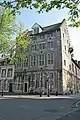
The Mosan style developed in the Prince-Bishopric of Liège in the 16th century during the reign of Prince-bishop Érard de La Marck. The style is an adaptation of earlier vernacular methods of timber framing, but using stone instead of wood. Stone-framed rectangular windows, round-arched doorways and sometimes decorated architraves, all on walls of brick, are characteristic of the style. Stone window frames, mullions and courses, contrasting in colour with the brick background, create strong patterns on the exteriors. Where there are columns, mostly in arcades, the capitals are usually very simple. In grander buildings, the interiors may included vaulted halls, and the exteriors "square pavilions topped with ornate roof spires, cross windows and cornices".[3]
The style has been applied predominantly in the Prince-Bishopric of Liège, a principality whose area is in present-day Belgium and the Netherlands, mainly in the city of Liège, the Land of Herve, and the provinces of Belgian Limburg and Dutch South Limburg. Most utilised materials were endemic to the regions where the style prevailed, namely blue limestone (also known as Namur stone), brick and mergel (a type of chalk). The style is used for townhouses, castles, farms, manor houses, and sometimes in monasteries.
The style had a historicist revival in the late 19th and early 20th centuries, known in French as architecture néo-mosane.[1]
Gallery
.jpg.webp)




.JPG.webp)

Notes
- Tasiaux, Rémy (2 September 2021). Architecture néo-mosane, tentative de définition du style et enjeux identitaires (in French). Liège, Belgium.
- Ottenheym, 191
- Ottenheym, 191
References
- Ottenheym, Konrad Adriaan (ed), Romanesque Renaissance: Carolingian, Byzantine and Romanesque Buildings (800–1200) as a Source for New All’Antica Architecture in Early Modern Europe (1400–1700), 2021, BRILL, ISBN: 9789004446625, google books
