Niosome
A niosome is a non-ionic surfactant-based vesicle. Niosomes are formed mostly by non-ionic surfactant and cholesterol incorporation as an excipient.[1] They are structurally similar to liposomes as these are both composed of a lipid bilayer. Compared to liposomes they are more stable during the formation process and storage.[2] They can entrap both hydrophilic and lipophilic drugs, either in an aqueous layer (for hydrophilic drugs) or in a vesicular membrane made of lipid material (for lipophilic drugs).[3]
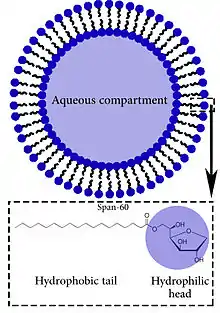
Structure
Niosomes are microscopic lamellar structures. They consist of non-ionic surfactant from the alkyl or dialkyl polyglycerol ether class and cholesterol with subsequent hydration in aqueous media. The surfactant molecules tend to orient themselves in such a way that the hydrophilic ends of the non-ionic surfactant point outwards, while the hydrophobic ends face each other to form the bilayer.[4]
Advantages of niosomes
Niosomes offer several robust advantages for drug delivery systems. Niosomes are osmotically active, chemically stable, and have a long storage time compared to liposomes. Functional and chemical formation of the niosome-surface can be subjected to extensive modulation because the functional groups form their hydrophillic heads.[5]
As a result of their non-ionic chemical bonding structures, niosomes offer high compatibility and low toxicity risk with biological systems.[5] With their high degree of biocompatibility, they can serve as biodegradable and non-immunogenic drug delivery compounds.[6] Niosomes can entrap lipophilic drugs into vesicular bilayer membranes. This function of bilayer membrane exchange can be applied to hydrophilic pharmaceuticals, entrapping their contents within aqueous compartments. By shielding the drug from the biological environment, niosomes can be useful in improving the therapeutic performance of various drug molecules. Niosomes can also be employed to more directly affect targeted cells and delay clearance from circulation within a sustained drug delivery system.[5][7]
Methods of preparation
Niosomes can be prepared by various methods, including:[1]
- Ether injection method (EIM)
- Hand shaking method (HSM)
- Reverse phase evaporation method (REV)
- Trans-membrane pH gradient
- The "Bubble" method
- Microfluidization method
- Formation of niosomes from proniosomes (Proniosome Technology (PT))[4]
- Thin-film hydration method (TFH)
- Heating method (HM)
- Freeze and thaw method (FAT)
- Dehydration rehydration method (DRM)
Applications
Niosomes constitute a novel drug delivery system with useful applications, including:
References
- Moghassemi S, Hadjizadeh A (July 2014). "Nano-niosomes as nanoscale drug delivery systems: an illustrated review". Journal of Controlled Release. 185: 22–36. doi:10.1016/j.jconrel.2014.04.015. PMID 24747765.
- Ge, X.; Wei, M.; He, S.; Yuan, W. E. (2019). "Advances of Non-Ionic Surfactant Vesicles (Niosomes) and Their Application in Drug Delivery". Pharmaceutics. 11 (2): 55. doi:10.3390/pharmaceutics11020055. PMC 6410054. PMID 30700021.
- Wiesmann UN, DiDonato S, Herschkowitz NN (October 1975). "Effect of chloroquine on cultured fibroblasts: release of lysosomal hydrolases and inhibition of their uptake". Biochemical and Biophysical Research Communications. 66 (4): 1338–1343. doi:10.1016/0006-291x(75)90506-9. PMID 4.
- "Niosomes". Pharmaxchange. 26 December 2010.
- Bruschi ML, ed. (2015). Strategies to Modify the Drug Release from Pharmaceutical Systems. Elsevier. doi:10.1016/c2014-0-02342-8. ISBN 978-0-08-100092-2.
- Shegokar R, ed. (2020). Delivery of Drugs. Elsevier. doi:10.1016/c2018-0-02191-x. ISBN 978-0-12-817776-1. S2CID 243021998.
- Kazi KM, Mandal AS, Biswas N, Guha A, Chatterjee S, Behera M, Kuotsu K (October 2010). "Niosome: A future of targeted drug delivery systems". Journal of Advanced Pharmaceutical Technology & Research. 1 (4): 374–380. doi:10.4103/0110-5558.76435. PMC 3255404. PMID 22247876.
- Moghassemi S, Hadjizadeh A (July 2014). "Nano-niosomes as nanoscale drug delivery systems: an illustrated review". Journal of Controlled Release. 185: 22–36. doi:10.1016/j.jconrel.2014.04.015. PMID 24747765.
- Puras G, Mashal M, Zárate J, Agirre M, Ojeda E, Grijalvo S, Eritja R, Diaz-Tahoces A, Martínez Navarrete G, Avilés-Trigueros M, Fernández E, Pedraz JL (January 2014). "A novel cationic niosome formulation for gene delivery to the retina". Journal of Controlled Release. 174: 27–36. doi:10.1016/j.jconrel.2013.11.004. PMID 24231407.
- Aggarwal G, Goel A, Dhawan S, Shama A (2010). "Carriers/vesicles based approaches for penetration enhancement in transdermal drug delivery". Latest Review. 8 (1): 1–5.
- US 4830857, "Cosmetic and pharmaceutical compositions containing niosomes and a water-soluble polyamide, and a process for preparing these compositions"