Regional Anti-Terrorist Structure
The Regional Anti-Terrorist Structure (RATS) is a permanent organ of the Shanghai Cooperation Organisation tasked with coordinating counterterrorism efforts and promoting cooperation of member states against the three evils of terrorism, separatism and extremism.[1][2]
| РЕГИОНАЛЬНАЯ АНТИТЕРРОРИСТИЧЕСКАЯ СТРУКТУРА 上海合作组织地区反恐结构 | |
 RATS shield with the SCO logo in the center | |
| Organ overview | |
|---|---|
| Formed | 2004 |
| Jurisdiction | Member states of the Shanghai Cooperation Organisation |
| Headquarters | Tashkent, Uzbekistan |
| Organ executive |
|
| Website | https://ecrats.org/ |
Member countries later incorporated narcoterrorism and drug smuggling as a focus area for RATS, as narcotics have become a major source of funding for anti-government activities by extremists and terror groups in the region. The organization also maintains a database of individuals and organizations aiding organizations designated as terrorists, separatists or extremists by member states.[3][4]
RATS is designed to facilitate a future enforcement mechanism for the SCO, which aspires to develop its own transnational police and military forces.[1][5] RATS has been described by experts as "SCO’s most important and best-functioning component structure to date."[6]
The director of the RATS Executive Committee is elected to a three-year term. The current director is Ruslan Mirzaev of Uzbekistan, who assumed office on 1 January 2022. RATS is headquartered in Tashkent, Uzbekistan, and its official languages are Chinese, Russian and English.[3][1]
History
RATS was established in during a meeting of the Council of Heads of SCO Member States on June 7, 2002, in Saint Petersburg, though the organization did not become active until 2004.[3] It is governed in accordance with the SCO Charter, the Shanghai Convention on Combating Terrorism, Separatism and Extremism, the Agreement among the SCO member states on the Regional Anti-Terrorist Structure, as well as the documents and decisions adopted in the framework of the SCO.[1]
Organization
International agreements
To varying extents, RATS has cooperation agreements with the UN, Interpol, the Commonwealth of the Independent States (CIS), the Collective Security Treaty Organization (CSTO), the Association of Southeast Asian Nations (ASEAN), and the Economic Cooperation Organization (ECO).
Member state representatives
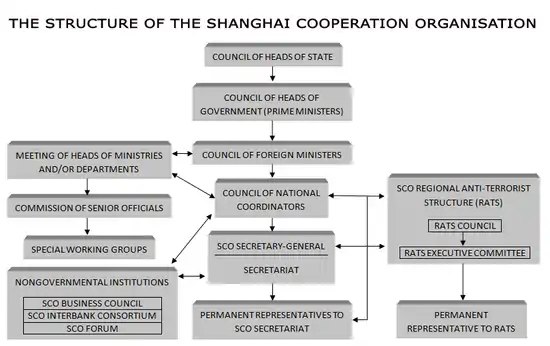
Member states have flexibility to appoint whomever they would like to represent their interests with RATS. There is no statutory requirement for the official to come from an intelligence or law enforcement background, though the Russian Federation for example has traditionally been represented by the principle deputy director of the FSB, and many Chinese representatives including previous RATS director Zhang Xinfeng are members of the Ministry of Public Security.[3]
Criticism and controversy
Criticism of the SCO RATS within the organization has centered mainly around how the group describes its adversaries. Although China, India and Russia name the Pakistan-based Islamic extremist group Jaish-e-Mohammed a "terrorist group", Pakistan opposes the definition.[5] What China claims are counterterrorism efforts in Xinjiang are criticized by other RATS members, and much of the international community, as genocidal persecution of Muslim ethnic minorities.[5] Definitions of "terrorists" and "terrorist groups" have become more blurry and sensitive as the SCO has grown, and member states have tended to retain inconsistent definitions and standards concerning counterterrorism.[5]
The list of entities designated as terrorist groups active in each member state has also been criticized for being discretionary, dictated by member governments. Russia since has used this authority to designate government opposition politician Alexei Navalny's Anti-Corruption Foundation (FBK) a terrorist entity with RATS.[3]
List of directors
| Director | Term | |||
|---|---|---|---|---|
| Portrait | Name | Took office | Left office | Term length |
 Vyacheslav Kasymov Vyacheslav Kasymov | 15 June, 2004 | 1 January, 2007 | 2 years | |
 Myrzakan Subanov Myrzakan Subanov | 1 January, 2007 | 1 January, 2010 | 2 years | |
 Dzhenisbek Dzhumanbekov Dzhenisbek Dzhumanbekov | 1 January, 2010 | 1 January, 2012 | 2 years | |
 Zhang Xinfeng Zhang Xinfeng | 1 January, 2013 | 1 January, 2015 | 2 years | |
 Yevgeniy Sysoev Yevgeniy Sysoev | 1 January, 2016 | 1 January, 2018 | 2 years | |
 Jumakhon Giyosov Jumakhon Giyosov | 1 January, 2019 | 1 January, 2021 | 2 years | |
| Ruslan Erkinovich Mirzaev | 1 January, 2021 | Incumbent | 1 year | |

References
- Xiaodong, Zhao (2012). Edström, Bert; Brennan, Elliot (eds.). The Shanghai Cooperation Organisation and Counter-Terrorism Cooperation (PDF). Stockholm: Institute for Security and Development Policy. ISBN 978-91-86635-42-8.
- Aris, Stephen (2009). "The Shanghai Cooperation Organisation: 'Tackling the Three Evils'. A Regional Response to Non-Traditional Security Challenges or an Anti-Western Bloc?". Europe-Asia Studies. 61 (3): 457–482. ISSN 0966-8136.
- "Sergei Korolev to carry Shanghai Pact's anti-terrorism flag". Intelligence Online. 2021-06-01. Retrieved 2022-10-20.
{{cite web}}: CS1 maint: url-status (link) - "History of SCO RATS". Shanghai Cooperation Organisation. January 1, 2022.
{{cite web}}: CS1 maint: url-status (link) - Wang, Jin; Kong, Dehang (2019). "Counter-Terrorism Cooperation Between China and Central Asian States in the Shanghai Cooperation Organization". China Quarterly of International Strategic Studies. 05 (01): 65–79. doi:10.1142/S2377740019500027. ISSN 2377-7400.
- Plater-Zyberk, Henry; Monaghan, Andrew (August 1, 2014). "Strategic Implications of the Evolving Shanghai Cooperation Organization". U.S. Army War College. Carlisle, Pennsylvania: Strategic Studies Institute. ISBN 1-58487-633-6 – via JSTOR.