Vorkutlag
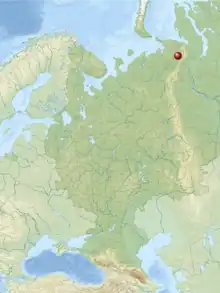
The Vorkuta Corrective Labor Camp (Russian: Воркутинский исправительно-трудовой лагерь, tr. Vorkutinsky ispravitel'no-trudovoy lager'), commonly known as the Vorkuta Gulag or Vorkutlag (Воркутлаг), was a major GULAG labor camp in the Soviet Union located in Vorkuta, Komi Republic from 1932 to 1962.
Vorkutlag
Воркутлаг | |
|---|---|
Forced Labour camp | |
| Vorkuta Corrective Special Labour Camp Number 6
| |
 Perimeter fence and watchtower, Vorkuta Gulag. | |
 Flag  Seal .svg.png.webp) Coat of arms .jpg.webp) Flag of the Komi ASSR | |
| Nickname(s): Vorkuta Gulag, Воркута ГУЛАГ | |
| Coordinates: 67° 29' 48.4080 N 64° 3' 38.2968 E | |
| Establishment Date | 1932 |
| Closing Date | 1962 |

The Vorkuta Gulag was one of the largest camps in the GULAG system with 73,000 prisoners at its peak in 1951, containing Soviet and foreign prisoners including prisoners of war, dissidents, political prisoners ("enemies of the state") and common criminals who were used as forced labor in the contruction of Coal mines, coal mining works and Forestry. The Vorkuta Gulag was the site of the Vorkuta Uprising in July 1953.
History


The Vorkuta Gulag was established by Soviet authorities in 1932 for the expansion of the GULAG system, on a site in the basin of the Pechora River, located within the Komi ASSR of the Russian SFSR (present-day Komi Republic, Russia), approximately 1,900 kilometres (1,200 mi) from Moscow and 160 kilometres (99 mi) above the Arctic Circle. The city of Vorkuta was established to support the camp, which was constructed to exploit the resources of the Pechora Coal Basin, the second largest coal basin in the Soviet Union. The camp was constructed mainly for Coal Mining and Forestry, There were approximately 132 sub-camps in the Vorkuta Gulag system during the height of its use in the Soviet prison system. From 1939, Polish prisoners were held at Vorkuta following the Occupation of Poland until the German invasion of the Soviet Union in 1941. Vorkuta was then also used to hold German prisoners of war captured on the Eastern Front in World War II as well as criminals, Soviet citizens and those from Soviet-allied countries deemed to be dissidents and enemies of the state during the Soviet era, US soldier were also held in the camp, a majority of whom were captured mostly from the Korean War. Many prisoners didn't survive in the camp and died by freezing to death in the cold climate, dying from starvation as food was scarce in Vorkuta, or the inmates worked themselves to death. Prisoners were given Rye Bread, Buckwheat, a little meat and fish and potatoes as food but in very little amounts, Prisoners resorted to killing rats or stray dogs for food. Self harm was common in the camp, if an inmate sustained an injury they would be sent to the hospital where conditions were better, The average amount of working time in the camp was 16 hours for every inmate.
The Vorkuta Uprising, 1953
The Vorkuta uprising occurred at the Vorkuta Gulag in July 1953, when inmates at various camps who were forced to work in the region's coal mines went on strike. The uprising, beginning as a mostly passive walkout, escalated into a strike involving 18,000 inmates across the Vorkuta camp system and lasted for approximately two weeks. The inmates demanded lower production targets, wages and to be allowed to write more than two letters a year. Concessions were made, including being allowed to write more than two letters a year and to be allowed one visitor a year but the inmates demanded more. On 1 August, the Vorkuta Gulag's camp chief Derevyanko ordered Red Army troops to fire at the strikers, resulting in the deaths of at least 53 workers and injuring 135, although estimates vary.
Closing of Vorkuta, 1962
The Vorkuta camp was liquidated by order of the USSR Ministry of Internal Affairs and eventually closed in 1962, the closure of GULAGS started when Nikita Khrushchev came into power, Khrushchev started a series of reforms known as De-Stalinization which caused the closure of most GULAGS. About 2 Million Prisoners had gone to Vorkutlag from 1932 until the closure in 1962, the amount of deaths in the camp were estimated to be 200,000. Most prisoners were released after the closure of Vorkuta but Large numbers of Soviet citizens who were former prisoners remained living in Vorkuta, either due to the restrictions on their settlement or their poor financial situation, or having nowhere to go. Memorial, a Russian human rights organization that focuses on recording and publicising the human rights violations of the Soviet Union's totalitarianism,[1] estimates that of the 40,000 people collecting state pensions in the Vorkuta area, 32,000 are former gulag inmates or their descendants.[2]
Location
Vorkuta GULAG was located in the Komi Republic, Russian Soviet Federative Socialist Republic, 160km above the arctic circle and roughly 50km from the Ural mountain range. since the camp was located in the very northern part of Russia, the harsh climate was hard to endure.
Vorkuta was extremely cold with temperatures reachng as low as −52 °C (−61 °F). Midnight sun or "Polar Days" was common in Vorkuta where the sun wouldn't set for three months which greatly affected the prisoners in Vorkutlag, prisoners weren't given good enough clothing to have survived the climate and some froze to death.
Vorkuta in the present day
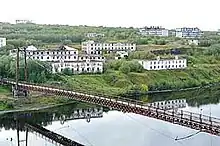
Vorkuta is now a town in the Komi Republic, Russia. The remains of the GULAG are partly or almost entirely destroyed. Vorkuta is heavily declining in population and is slowly being abandoned, after the Dissolution of the Soviet Union, Mining companies moved farther into the southern regions of Russia. A majority of the population in Vorkuta worked in the nearby coal mines but after the coal mine companies moved many lost jobs and started moving out of Vorkuta. Today, Vorkuta is barely inhabited with a small population. the towns estimated population is about 50,000 and is still decreasing.


Notable inmates
- Heinz Baumkötter: SS concentration camp doctor.
- Walter Ciszek, American Catholic priest and memoirist - survived.
- Shlomo Dykman (1917–1965): Jewish-Polish translator and classical scholar.
- Valentín González (1904–1983): Spanish Communist and Spanish Republican Army brigade commander during the Spanish Civil War – successfully escaped in 1949.
- Anton Kaindl (1902–1948): SS commandant of Sachsenhausen concentration camp between 1942 and 1945.
- Jaan Kross (1920–2007): Estonian writer.
- Jānis Mendriks (1907–1953): Latvian Catholic priest.
- Der Nister (1884–1950): Yiddish writer.
- John H. Noble (1923–2007): American survivor of the Soviet Gulag system (released after ~10 years) who wrote two books about experiences there.
- Eric Pleasants (1913–1998): British Nazi collaborator and member of the British Free Corps.
- Zvi Preigerzon (1900–1969): Hebrew writer and coal enrichment scientist.
- Nikolay Punin (1888–1953): Russian art scholar, curator and writer. Common law husband of poetess Anna Akhmatova.
- Georgy Safarov (1891–1942): Bolshevik revolutionary, member of the Communist Party of the Soviet Union – executed.
- Günter Stempel (1908–1981): East German politician and a member of the Liberal Democratic Party.
Notable guards
- Zoya Voskresenskaya, the chief of the Special Section of Vorkuta prison-camp, who served between 1955 and 1956.
In popular culture
- "Return from Workuta", track n. 3 of the album 1978 Gli Dei Se Ne Vanno, Gli Arrabbiati Restano! (1978) by the Italian progressive rock, jazz fusion, electronic, experimental group Area – International POPular Group, most commonly known as Area or AreA. The song is vocal and instrumental only and is accompanied by a text written by the singer Demetrio Stratos depicting portraits of people returning from the work camp.[3]
_in_Vorkutlag%252C_Russia%252C_20th_century.jpg.webp) Graves of the Lithuanian political prisoners in Vorkutlag, 20th century
Graves of the Lithuanian political prisoners in Vorkutlag, 20th century - "Red Snow", the second segment of the twenty-first episode of the first season (1985–86) of the television series The Twilight Zone, features Vorkuta as the sanctuary of a vampire community.
- In the 2010 video game Call of Duty: Black Ops, the player character, an American named Alex Mason, is imprisoned at Vorkuta from 1961 to 1963 after being captured in Cuba during the Bay of Pigs invasion. He participates in a prisoner uprising along with his ally Viktor Reznov.[4]
References
- Memorial website(in Russian)
- Robert Conquest, Paul Hollander: Political violence: belief, behavior, and legitimation p.55, Palgrave Macmillan;(2008) ISBN 978-0-230-60646-3
- Fariselli, Patrizio (2018-10-07). "1978, gli dei se ne vanno gli arrabbiati restano". Patrizio Fariselli (in Italian). Retrieved 2021-02-12.
{{cite web}}: CS1 maint: url-status (link) - Williams, Raymond (12 January 2014). "Vorkuta for Victory: What Black Ops Got So Right". Venture Beat. Retrieved 8 June 2019.
Further reading
- Barenberg, Alan (2014). Gulag Town, Company Town: Forced Labor and Its Legacy in Vorkuta. Yale University Press. ISBN 978-0-300-20682-1.