Cizre
Cizre (pengucapan [ˈdʒizɾe]; bahasa Arab: جزيرة ابن عمر, translit. Jazirat Ibn ʿUmar,[3][nb 1] atau Madinat al-Jazira,[8] bahasa Ibrani: גזירא, translit. Gzira,[9] bahasa Kurdi: Cizîr,[10] Cizîra Botan,[11] atau Cizîre,[12] bahasa Suryani: ܓܙܪܬܐ ܕܒܪ ܥܘܡܪ,[3][nb 2]) adalah sebuah kota dan distrik di Provinsi Şırnak, Wilayah Anatolia Tenggara, Turki. Kota tersebut terletak di sungai Tigris pada perbatasan Suriah-Turki dan dekat dengan perbatasan Irak-Turki. Cizre adalah wilayah bersejarah dari Mesopotamia Hulu dan wilayah budaya Kurdistan Turki.[15]
Cizre | |
|---|---|
Kota | |
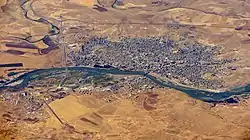 Pemandangan udara Cizre, Turki. | |
  Cizre | |
| Koordinat: 37°19′30″N 42°11′45″E | |
| Negara | Turki |
| Provinsi | Şırnak |
| Distrik | Cizre |
| Pemerintahan | |
| • Pelaksana tugas walikota | Davut Sinanoğlu |
| • Kaymakam | Davut Sinanoğlu |
| Luas | |
| • Distrik | 467,64 km2 (18,056 sq mi) |
| Ketinggian | 377 m (1,237 ft) |
| Populasi (2019)[2] | |
| • Perkotaan | 125,799 |
| • Distrik | 148,697 |
| • Kepadatan Distrik | 3,2/km2 (8,2/sq mi) |
| Kode pos | 73200 |
| Situs web | www.cizre.bel.tr |
Referensi
Catatan
Kutipan
- "Area of regions (including lakes), km²". Regional Statistics Database. Turkish Statistical Institute. 2002. Diakses tanggal 2013-03-05.
- "CİZRE NÜFUSU, ŞIRNAK". Türkiye Nüfusu (dalam bahasa Turki). Diakses tanggal 25 April 2020.
- Carlson, Thomas A. (9 December 2016). "Gazarta". The Syriac Gazetteer. Diakses tanggal 25 April 2020.
- Şanlı (2017), hlm. 72.
- Sinclair (1989), hlm. 352.
- Çetinoğlu (2018), hlm. 178.
- Kieser (2011), hlm. 139.
- Gil (2004), hlm. 428.
- Sabar (2002), hlm. 121.
- Avcýkýran, Dr. Adem, ed. (2009). "Kürtçe Anamnez, Anamneza bi Kurmancî" (PDF). Tirsik. hlm. 57. Diakses tanggal 17 December 2019.
- Zaken (2007), hlm. xii.
- Biner (2019), hlm. x.
- Wilmshurst (2000), hlm. 112.
- Palmer (1990), hlm. 257.
- "The struggle for autonomy in North Kurdistan: Voices from Cizre". Corporate Watch. 4 December 2015. Diakses tanggal 23 November 2020.
Daftar pustaka
Sumber primer
- Gregory bar Hebraeus (1932). Chronography. Diterjemahkan oleh E. A. W. Budge. Oxford University Press.
- Ibn al-Athir (2002). The Annals of the Saljuq Turks: Selections from al-Kamil fi'l-Ta'rikh of Ibn al-Athir. Diterjemahkan oleh D.S. Richards. Routledge.
Sumber sekunder
- Açıkyıldız Şengül, Birgül (2014). "Cizre Kırmızı Medrese:Mimari, İktidar ve Tarih". Kebikeç (dalam bahasa Turki). 38: 169–198.
- Ali, Othman (1997). "The Kurds and the Lausanne Peace Negotiations, 1922-23". Middle Eastern Studies. 33 (3): 521–534. doi:10.1080/00263209708701167.
- Amitai-Preiss, Reuven (2004). Mongols and Mamluks: The Mamluk-Ilkhanid War, 1260-1281. Cambridge University Press.
- Ateş, Sabri (2013). Ottoman-Iranian Borderlands: Making a Boundary, 1843–1914. Cambridge University Press.
- Badem, Candan (2010). The Ottoman Crimean War (1853-1856). Brill.
- Barsoum, Aphrem (2003). The Scattered Pearls: A History of Syriac Literature and Sciences. Diterjemahkan oleh Matti Moosa (edisi ke-2nd). Gorgias Press. Diakses tanggal 14 July 2020.
- Barsoum, Aphrem (2008). History of the Za'faran Monastery. Diterjemahkan oleh Matti Moosa. Gorgias Press.
- Barsoum, Aphrem (2009a). History of the Syriac Dioceses. 1. Diterjemahkan oleh Matti Moosa. Gorgias Press.
- Barsoum, Aphrem (2009b). The Collected Historical Essays of Aphram I Barsoum. 1. Diterjemahkan oleh Matti Moosa. Gorgias Press. Archived from the original on 2018-10-14. Diakses tanggal 17 September 2020.
- Beihammer, Alexander Daniel (2017). Byzantium & Emergence of Muslim-Turkish Anatolia, c.1040-1130. Routledge.
- Benjamin, Israel Joseph (1859). Eight years in Asia and Africa from 1846-1855. Routledge.
- Biner, Zerrin Ozlem (2019). States of Dispossession: Violence and Precarious Coexistence in Southeast Turkey. University of Pennsylvania Press.
- Boyle, J. A. (2007). The Cambridge History of Iran, Volume 5: The Saljuq and Mongol Periods. Cambridge University Press.
- Brock, Sebastian P. (2017). "A Historical Note of October 1915 Written in Dayro D-Zafaran (Deyrulzafaran)". Dalam David Gaunt; Naures Atto; Soner O. Barthoma. Let Them Not Return: Sayfo – The Genocide Against the Assyrian, Syriac, and Chaldean Christians in the Ottoman Empire. Berghahn Books. hlm. 148–157.
- Bruinessen, Martin Van; Boeschoten, Hendrik (1988). Evliya Çelebi in Diyarbekir. Brill.
- Burak, Durdu Mehmet (2005). "EL-CEZİRE KUMANDANI NİHAT PAŞA'NIN EŞKIYA TARAFINDAN SOYULMASI" (PDF). Gazi Üniversitesi Kırşehir Eğitim Fakültesi Dergisi (dalam bahasa Turki). 6 (1): 169–183. Diarsipkan dari versi asli (PDF) tanggal 2020-07-15. Diakses tanggal 2021-02-14.
- Busse, Heribert (2008). "Iran Under the Buyids". Dalam Richard Nelson Frye. The Cambridge History of Iran, Volume 4: From the Arab Invasion to the Saljuqs. Cambridge University Press. hlm. 250–305.
- Cahen, Claude (1969). "The Turkish Invasion: The Selchukids". Dalam Marshall W. Baldwin. A History of the Crusades, Volume I: The First Hundred Years. University of Wisconsin Press. hlm. 135–177.
- Canard, Marius (1986). "Ḥamdānids". Encyclopaedia of Islam, Second Edition. 3. hlm. 126–131.
- Çetinoğlu, Sait (2018). "Genocide/ Seyfo – and how resistance became a way of life". Dalam Hannibal Travis. The Assyrian Genocide: Cultural and Political Legacies. Routledge. hlm. 178–191.
- Chaliand, Gerard, ed. (1980). A People without a Country: The Kurds and Kurdistan. Diterjemahkan oleh Michael Pallis. Zed Press.
- Chyet, Michael L. (2020). FERHENGA BIRÛSKÎ Kurmanji - English Dictionary. One: A - L. Transnational Press London.
- Courtois, Sébastien de (2013). "Tur Abdin : Réflexions sur l'état présent descommunautés syriaques du Sud-Est de la Turquie,mémoire, exils, retours". Cahier du Gremmamo (dalam bahasa Prancis). 21: 113–150.
- Crow, James (2018). "Bezabde". Dalam Nicholson, Oliver. The Oxford Dictionary of Late Antiquity. Oxford University Press.
- El-Azhari, Taef (2016). Zengi and the Muslim Response to the Crusades: The politics of Jihad. Routledge.
- Elisséeff, Nur ad-Din (1986). "Ibn ʿUmar, D̲j̲azīrat". Encyclopaedia of Islam, Second Edition. 3. hlm. 960–961.
- Galante, Avram (1948). Histoire des Juifs de Turquie (dalam bahasa Prancis).
- Gil, Moshe (2004). Jews in Islamic countries in the Middle Ages. Diterjemahkan oleh David Strassler. Brill.
- Heidemann, Stefan (2002). "Zangids". Encyclopaedia of Islam, Second Edition. 11. hlm. 452–455.
- Henning, Barbara (2018). Narratives of the History of the Ottoman-Kurdish Bedirhani Family in Imperial and Post-Imperial Contexts: Continuities and Changes (PDF). University of Bamberg Press. Diakses tanggal 16 December 2020.
- Hillenbrand, Carole (1991). "Marwanids". Encyclopaedia of Islam, Second Edition. 6. hlm. 626–627.
- Humphreys, R. Stephen (1977). From Saladin to the Mongols: The Ayyubids of Damascus, 1193-1260. State University of New York Press.
- Ignatius Jacob III (2008). History of the Monastery of Saint Matthew in Mosul. Diterjemahkan oleh Matti Moosa. Gorgias Press.
- Jackson, Peter (2017). The Mongols and the Islamic World: From Conquest to Conversion. Yale University Press.
- James, Boris (2019). "Constructing the Realm of the Kurds (al-Mamlaka al-Akradiyya): Kurdish In-betweenness and Mamluk Ethnic Engineering (1130-1340 CE)". Dalam Steve Tamari. Grounded Identities: Territory and Belonging in the Medieval and Early Modern Middle East and Mediterranean. Brill. hlm. 17–45.
- Jongerden, Joost; Verheij, Jelle (2012). Social Relations in Ottoman Diyarbekir, 1870-1915. Brill.
- Jwaideh, Wadie (2006). The Kurdish National Movement: Its Origins and Development. Syracuse University Press.
- Kana’an, Ruba (2013). "The Biography of a Thirteenth-century Brass Ewer from Mosul". Dalam Sheila Blair; Jonathan M. Bloom. God Is Beautiful and Loves Beauty: The Object in Islamic Art and Culture. Yale University Press. hlm. 176–193.
- Karpat, Kemal Haşim (1985). Ottoman Population, 1830-1914: Demographic and Social Characteristics. University of Wisconsin Press.
- Kennedy, Hugh (2004). The Prophet and the Age of the Caliphates: The Islamic Near East from the Sixth to the Eleventh Century. Pearson Education.
- Kennedy, Hugh (2011). "The Feeding of the five Hundred Thousand: Cities and Agriculture in Early Islamic Mesopotamia". Iraq. 73: 177–199. doi:10.1017/S0021088900000152
 .
. - Kévorkian, Raymond (2011). The Armenian Genocide: A Complete History. Palgrave Macmillan.
- Kieser, Hans-Lukas (2011). "From "Patriotism" to Mass Murder: Dr Mehmed Reşid (1873-1919)". Dalam Ronald Grigor Suny; Fatma Müge Göçek; Norman M. Naimark. A Question of Genocide: Armenians and Turks at the End of the Ottoman Empire. Oxford University Press. hlm. 126–151.
- Kiraz, George A. (2011). "Giwargis II, Ignatius". Gorgias Encyclopedic Dictionary of the Syriac Heritage: Electronic Edition. Gorgias Press.
- Klein, Janet (2011). The Margins of Empire: Kurdish Militias in the Ottoman Tribal Zone. Stanford University Press.
- Lightfoot, C.S. (1981). The Eastern Frontier of the Roman Empire with special reference to the reign of Constantius II.
- Mango, Andrew (2013). "Atatürk and the Kurds". Dalam Sylvia Kedourie. Seventy-five Years of the Turkish Republic. Routledge. hlm. 1–26.
- Marcus, Aliza (1994). "City in the War Zone". Middle East Report (189): 16–19. doi:10.2307/3013106. JSTOR 3013106.
- Mazzola, Marianna (2019). "Centralism and Local Tradition : A Reappraisal of the Sources on the Metropolis of Tagrit and Mor Matay". Le Muséon. 132 (3–4): 399–413. Diakses tanggal 12 July 2020.
- Miynat, Ali (2017). Cultural and socio-economic relations between the Turkmen states and the Byzantine empire and West with a corpus of the Turkmen coins in the Barber Institute Coin Collection (PDF).
- Mutzafi, Hezy (2008). The Jewish Neo-Aramaic Dialect of Betanure (Province of Dihok). Otto Harrassowitz Verlag.
- Nicolle, David (2013). "The Zangid bridge of Ǧazīrat ibn ʿUmar (ʿAyn Dīwār/Cizre): A New Look at the carved panel of an armoured horseman". Bulletin d'études orientales. 62: 223–264.
- Özoğlu, Hakan (2001). ""Nationalism" and Kurdish Notables in the Late Ottoman–Early Republican Era". International Journal of Middle East Studies. 33 (3): 383–409. doi:10.1017/S0020743801003038.
- Özoğlu, Hakan (2004). Kurdish Notables and the Ottoman State: Evolving Identities, Competing Loyalties, and Shifting Boundaries. SUNY Press.
- Palmer, Andrew (1990). Monk and Mason on the Tigris Frontier: The Early History of Tur Abdin. Cambridge University Press. Diakses tanggal 15 July 2020.
- Patton, Douglas (1991). "Badr al-Dīn Lu'lu' and the Establishment of a mamluk Government in Mosul". Studia Islamica. Brill. 74 (74): 79–103. doi:10.2307/1595898. JSTOR 1595898.
- Pfeiffer, Judith (2013). "Confessional Ambiguity vs. Confessional Polarisation: Politics and the Negotiation of Religious Boundaries in the Ilkhanate". Dalam Judith Pfeiffer. Politics, Patronage and the Transmission of Knowledge in 13th-15th Century Tabriz. Brill. hlm. 129–171.
- Quataert, Donald (1994). "The Age of Reforms, 1812-1914". Dalam Halil İnalcık; Donald Quataert. An Economic and Social History of the Ottoman Empire, 1300-1914. Cambridge University Press. hlm. 759–947.
- Rassi, Salam (2015). Justifying Christianity in the Islamic Middle Ages: The Apologetic Theology of ʿAbdīshōʿ bar Brīkhā (d. 1318).
- Rhétoré, Jacques (2005). Les chrétiens aux bêtes: souvenirs de la guerre sainte proclamée par les Turcs contre les chrétiens en 1915 (dalam bahasa Prancis). Editions du CERF.
- Sabar, Yona (2002). A Jewish Neo-Aramaic Dictionary: Dialects of Amidya, Dihok, Nerwa and Zakho, Northwestern Iraq. Otto Harrassowitz Verlag.
- Şanlı, Süleyman (2017). "An Overview of Historical Background of Unknown Eastern Jews of Turkey". Mukaddime. 8 (1): 67–82.
- Sato, Noriko (2001). Memory and Social Identity among Syrian Orthodox Christians (PDF). Diakses tanggal 27 December 2019.
- Sinclair, T.A. (1989). Eastern Turkey: An Architectural & Archaeological Survey, Volume III. Pindar Press. ISBN 9780907132349.
- Sinclair, Thomas (2019). Eastern Trade and the Mediterranean in the Middle Ages: Pegolotti's Ayas-Tabriz Itinerary and its Commercial Context. Routledge.
- Snelders, Bas (2010). "The Syrian Orthodox in their Historical and Artistic Settings". Identity and Christian-Muslim Interaction: Medieval Art of the Syrian Orthodox from the Mosul area (PDF).
- Taylor, Gordon (2007). Fever and Thirst: An American Doctor Among the Tribes of Kurdistan, 1835-1844. Chicago Review Press.
- Ternon, Yves (2002). Revue d'histoire arménienne contemporaine: Mardin 1915: Anatomie pathologique d'une destruction. 4.
- Touzard, Anne-Marie (2000). "FRANCE vii. FRENCH TRAVELERS IN PERSIA, 1600-1730". Encyclopaedia Iranica.
- ul-Hasan, Mahmood (2005). Ibn Al-At̲h̲ir: An Arab Historian : a Critical Analysis of His Tarikh-al-kamil and Tarikh-al-atabeca. Northern Book Centre.
- Üngör, Uğur; Polatel, Mehmet (2011). Confiscation and Destruction: The Young Turk Seizure of Armenian Property. Bloomsbury Publishing.
- Üngör, Uğur (2012). The Making of Modern Turkey: Nation and State in Eastern Anatolia, 1913-1950. Oxford University Press.
- Wilmshurst, David (2000). The Ecclesiastical Organisation of the Church of the East, 1318–1913. Peeters Publishers.
- Yacoub, Joseph (2016). Year of the Sword: The Assyrian Christian Genocide, A History. Diterjemahkan oleh James Ferguson. Oxford University Press.
- Zaken, Mordechai (2007). Jewish Subjects and Their Tribal Chieftains in Kurdistan: A Study in Survival. Brill.
- Zawanowska, Marzena (2019). "Yefet ben ʿEli on Genesis 11 and 22". Dalam Meira Polliack; Athalya Brenner-Idan. Jewish Biblical Exegesis from Islamic Lands: The Medieval Period. SBL Press. hlm. 33–61.

Wikimedia Commons memiliki media mengenai Cizre.
This article is issued from Wikipedia. The text is licensed under Creative Commons - Attribution - Sharealike. Additional terms may apply for the media files.