Bahasa Goguryeo
Bahasa Goguryeo, atau Koguryo, ialah bahasa kerajaan kuno Goguryeo (37 SM – 668 M), salah satu dari Tiga Kerajaan Korea. Sejarah Tiongkok awal menyatakan bahwa bahasa ini mirip dengan bahasa Buyeo, Okjeo, dan Ye, yang semuanya tidak terbukti. Lee Ki-Moon mengelompokkan bahasa ini sebagai rumpun bahasa Puyŏ.
| Bahasa Goguryeo | |
|---|---|
| Koguryo | |
| Dituturkan di | Goguryeo |
| Wilayah | Manchuria, Korea |
| Punah | abad ke-7 hingga ke-10? |
Koreanik?
| |
| Kode bahasa | |
| ISO 639-3 | zkg |
LINGUIST List | zkg |
| Glottolog | kogu1234 |
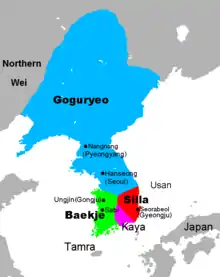 Tiga Kerajaan Korea, dengan Goguryeo dan Buyeo berwarna biru | |
Bukti untuk bahasa ini terbatas dan menimbulkan perdebatan. Bukti yang paling banyak dipetik, kumpulan padanan nama tempat dalam Samguk sagi, telah ditafsirkan oleh penulis yang berbeda sebagai rumpun bahasa Koreanik, Japonik, atau perantara antara keduanya. Penulis lain berpendapat bahwa keduanya mencerminkan bahasa orang lain di bagian tengah Korea yang dikuasai oleh Goguryeo pada abad ke-5.
Bukti lain sangat jarang, dan terbatas pada kekhasan batu bersurat Goguryeo dalam bahasa Tionghoa dan sangat sedikit perkataan Goguryeo yang diberi penjelasan dalam teks-teks Tiongkok. Banyak penulis Korea berpendapat bahwa bahasa tersebut adalah dialek bahasa Korea Kuno. Penulis lain berpendapat bahwa itu adalah bentuk asli bahasa Korea, yang kemudian menggantikan bahasa-bahasa Japonik di bagian selatan semenanjung. Yang lain berpendapat bahwa itu adalah bahasa Tungus, atau bahwa tidak ada cukup bukti untuk membuktikan keterkaitannya.
Lihat juga
- Bahasa Baekje
- Balhae
- Sejarah bahasa Korea
- Daftar topik berkaitan Korea
Rujukan
Petikan
Sumber
- Beckwith, Christopher I. (2004), Koguryo, the Language of Japan's Continental Relatives, Brill, ISBN 978-90-04-13949-7. ISBN 90-04-13949-4, Second edition, 2007.
- Byington, Mark E. (2006), "Christopher I. Beckwith—Koguryo, the Language of Japan's Continental Relatives (Leiden: Brill, 2004)", Acta Koreana, 9 (1): 141–166.
- Gardiner, Kenneth H. J. (2012), "Chinese Accounts of Koguryŏ and its Neighbours: From the Sanguozhi Ch. 30, Description of the Eastern Barbarians (SGZ 30 pp. 20B-31B; 35A-36B)", The Review of Korean Studies, 15 (2): 91–113, doi:10.25024/review.2012.15.2.004
 .
. - Georg, Stefan (2017), "Other isolated languages of Asia", dalam Campbell, Lyle, Language Isolates, Routledge, hlm. 139–161, ISBN 978-1-317-61090-8.
- Janhunen, Juha (2005), "The lost languages of Koguryŏ" (PDF), Journal of Inner and East Asian Studies, 2 (2): 67–86, diarsipkan dari versi asli (PDF) tanggal 2009-02-26.
- Kim, Nam-Kil (1987), "Korean", dalam Comrie, Bernard, The World's Major Languages, Oxford University Press, hlm. 881–898, ISBN 978-0-19-520521-3.
- Lee, Ki-Moon; Ramsey, S. Robert (2011), A History of the Korean Language, Cambridge University Press, ISBN 978-1-139-49448-9.
- Nam, Pung-hyun (2012), "Old Korean", dalam Tranter, Nicolas, The Languages of Japan and Korea, Routledge, hlm. 41–72, ISBN 978-0-415-46287-7.
- Pellard, Thomas (2005), "Koguryo, the Language of Japan's Continental Relatives: An Introduction to the Historical-Comparative Study of the Japanese-Koguryoic Languages with a Preliminary Description of Archaic Northeastern Middle Chinese By Christopher I. Beckwith", Korean Studies, 29: 167–170, doi:10.1353/ks.2006.0008 .
- Seth, Michael J. (2016), A Concise History of Premodern Korea (edisi ke-2nd), Rowman & Littlefield, ISBN 978-1-4422-6043-6.
- Sohn, Ho-Min (1999), The Korean Language, Cambridge: Cambridge University Press, ISBN 978-0-521-36123-1.
- Toh, Soo Hee (2005), "About Early Paekche language mistaken as being Koguryŏ language" (PDF), Journal of Inner and East Asian Studies, 2 (2): 13–31, diarsipkan dari versi asli (PDF) tanggal 2009-02-26.
- Unger, J. Marshall (2009), The role of contact in the origins of the Japanese and Korean languages, Honolulu: University of Hawaii Press, ISBN 978-0-8248-3279-7.
- Vovin, Alexander (2005), "Koguryŏ and Paekche: different languages or dialects of Old Korean?" (PDF), Journal of Inner and East Asian Studies, 2 (2): 107–140, diarsipkan dari versi asli (PDF) tanggal 2009-02-26.
- ——— (2013), "From Koguryo to Tamna: Slowly riding to the South with speakers of Proto-Korean", Korean Linguistics, 15 (2): 222–240, doi:10.1075/kl.15.2.03vov.
- Whitman, John (2011), "Northeast Asian Linguistic Ecology and the Advent of Rice Agriculture in Korea and Japan", Rice, 4 (3–4): 149–158, doi:10.1007/s12284-011-9080-0 .
- ——— (2013), "A History of the Korean Language, by Ki-Moon Lee and Robert Ramsey", Korean Linguistics, 15 (2): 246–260, doi:10.1075/kl.15.2.05whi.
- ——— (2015), "Old Korean", dalam Brown, Lucien; Yeon, Jaehoon, The Handbook of Korean Linguistics, Wiley, hlm. 421–438, ISBN 978-1-118-35491-9.
Bacaan lanjut
- Beckwith, Christopher I. (2006), "Methodological Observations on Some Recent Studies of the Early Ethnolinguistic History of Korea and Vicinity", Altai Hakpo, 16: 199–234.
- ——— (2005), "The Ethnolinguistic History of the Early Korean Peninsula Region: Japanese-Koguryŏic and other Languages in the Koguryŏ, Paekche, and Silla kingdoms" (PDF), Journal of Inner and East Asian Studies, 2 (2): 33–64, diarsipkan dari versi asli (PDF) tanggal 2009-02-26.
- Vovin, Alexander (2006), "Why Manchu and Jurchen Look so Un-Tungusic?", dalam Pozzi, Alessandra; Janhunen, Juha Antero; Weiers, Michael, Tumen Jalafun Jecen Aku: Manchu Studies in Honour of Giovanni Stary, Tunguso Sibirica, 20, Otto Harrassowitz, hlm. 255–266, ISBN 978-3-447-05378-5.
| Modern |  | |
|---|---|---|
| Sejarah |
| |
| Korea Awal |
(Bahasa-bahasa ini dibuktikan dengan sangat buruk dan keterkaitannya tidak pasti.) | |
Pengawasan otoritas: Perpustakaan nasional  |
|
|---|