Operator kosmologi Boushaki
Operator kosmologi Boushaki atau indeks inkonsistensi (IOI) adalah teknik statistik kosmologis yang dikembangkan oleh Mustapha Ishak-Boushaki sejak 2006 untuk menganalisis perluasan alam semesta.[1][2][3][4][5]
 | |
| Pengarang | Mustapha Ishak-Boushaki |
|---|---|
| Judul asli | bahasa Inggris: Boushaki cosmological operator |
| Judul produksi | bahasa Inggris: Index Of Inconsistency (IOI) |
| Negara |  Amerika Serikat Amerika Serikat |
| Subjek | Ekspansi alam semesta, Teori relativitas, Relativitas umum, Konstanta kosmologis, Gravitasi, Konstanta Hubble. |
| Genre | Kosmologi, Pengolahan data, Statistik. |
Tanggal terbit | 2006 |
Penelitian utama
Profesor Mustapha Ishak-Boushaki menerbitkan makalah pertamanya tentang inkonsistensi perluasan alam semesta pada tahun 2006 setelah menyerahkan tesis doktoralnya yang berjudul "Studi dalam model kosmologi non-homogen" di bawah pengawasan Profesor Kayll William Lake pada Juni 2003 di Universitas Queen di Kingston.[6][7][8][9][10]
Boushaki mencoba memecahkan misteri yang tersembunyi dalam percepatan perluasan alam semesta dengan mempelajari peran energi gelap teoretis dalam modifikasi efek gelombang gravitasi.[11][12][13][14][15]
Indeks inkonsistensi
Ishak-Boushaki dan muridnya Weikang Lin mengembangkan di University of Texas di Dallas ukuran baru, yang disebut indeks inkonsistensi (IOI), yang dapat memberikan nilai numerik untuk berapa banyak lebih dari dua set data yang tidak setuju.[16][17][18][19][20]
Dalam alat ini, nilai inkonsistensi lebih dari satu dapat berarti bahwa kumpulan data kosmologi tidak konsisten, sedangkan nilai yang lebih besar dari lima menempatkannya pada kelas inkonsistensi kuat.[21][22][23][24][25]
Metode ini dan yang lain digunakan untuk mengevaluasi fenomena inkonsistensi yang tidak sesuai dengan hasil alat Max Planck.[26][27][28][29][30]
Konstanta Hubble
Alat statistik ini digunakan untuk membandingkan beberapa teknik berbeda untuk mengevaluasi konstanta Hubble, yang mengungkapkan tingkat perluasan alam semesta.[31][32][33][34][35]
Sejak 2016, Boushaki menggunakan pengukuran konstan ini dalam laporannya yang membahas hasil dari penyelidikan ketidakhomogenan pada jarak kosmologis dan pertumbuhan struktur skala besar.[36][37][38][39][40]
Memang, studi dan laporan ini telah menunjukkan bahwa konstanta kosmologis yang penting ini dapat digeser dari nilai sebenarnya ketika ketidakhomogenan tidak diperhitungkan.[41][42][43][44][45]
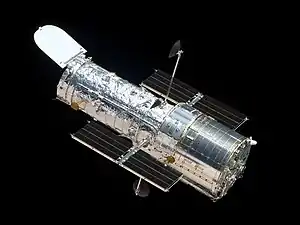
Boushaki menggunakan data yang dihasilkan oleh kamera canggih Teleskop Luar Angkasa Hubble untuk mensurvei dan menghitung dengan alat IOI bentuk energi baru yang terlibat dalam ekspansi kosmik di seluruh alam semesta dengan konstanta kosmologi yang dievaluasi.[46][47][48][49][50]
Teleskop Survei Sinoptik Besar
Boushaki dengan tim penelitinya di University of Texas di Dallas telah membuat alat IOI mereka tersedia bagi ilmuwan lain di seluruh dunia untuk digunakan guna menjaga ketidakkonsistenan di antara kumpulan data.[51][52][53][54][55]
Kolaborasi gratis ini adalah bagian dari proyek Large Synoptic Survey Telescope (LSST) yang berurusan dengan ukuran ketidaksesuaian kosmologis dan efek marginalisasi, dan penerapannya pada geometri dan pertumbuhan kumpulan data saat ini, dengan menggunakan juga Instrumen Spektroskopi Energi Gelap (DESI).[56][57][58][59]
Referensi
- published, Nola Taylor Tillman (July 19, 2018). "Universe Expansion 'Detective Story' Examined with New Tool". Space.com.
- "Faculty Highlight: Mustapha Ishak-Boushaki | Department of Physics". physics.utdallas.edu.
- Ishak-Boushaki, Mustapha (June 1, 2003). "Studies in inhomogeneous cosmological models" – via NASA ADS.
- "Data discrepancies may affect understanding of the universe". EurekAlert!.
- Camber, Bruce (September 10, 2018). "Ishak-Boushaki, Mustapha".
- "Data Discrepancies May Affect Understanding of the Universe". News Center.
- https://www.ictp-saifr.org/wp-content/uploads/2020/12/Mustapha-Ishak-LAWOC-2020.pdf
- Lin, Weikang; Ishak, Mustapha (July 25, 2017). "Cosmological discordances: a new measure, marginalization effects, and application to geometry vs growth current data sets". Physical Review D. 96 (2): 023532. arXiv:1705.05303
 . doi:10.1103/PhysRevD.96.023532 – via arXiv.org.
 - https://arxiv.org/ftp/arxiv/papers/1703/1703.05204.pdf
- https://inside.tamuc.edu/academics/colleges/scienceEngineeringAgriculture/departments/physicsAstronomy/colloquiaSeminars/PDFs/ishaktalk.pdf
- "Mustapha Ishak-Boushaki". Mustapha Ishak-Boushaki.
- Dallas, University of Texas at (November 15, 2020). "Astrophysics Improve Gravitational Lensing Signals for More Accurate Cosmological Model of the Universe". SciTechDaily.
- "Dark Energy Could be a Breakdown of Einstein's Theory". May 18, 2005.
- "Colloquium - Mustapha Ishak-Boushaki | Department of Physics". physics.unt.edu.
- "2018 Fall Physics Colloquium Series: Mustapha Ishak-Boushaki, Ph.D." Calendar | Baylor University.
- https://utd-ir.tdl.org/bitstream/handle/10735.1/6393/ETD-5608-032-LIN-9413.13.pdf
- Kosarzycki, Radek (June 6, 2018). "Rozbieżności w danych mogą znacząco wpłynąć na naszą wiedzę o wszechświecie".
- "INSPIRE". inspirehep.net.
- "New insight into Earth's crust, mantle and outer core interactions". October 29, 2018.
- "INSPIRE". inspirehep.net.
- Ishak-Boushaki, M.; Garcia-Quintero, C. (January 1, 2021). "Testing deviations from general relativity at cosmological scales reveals a new dichotomy between Planck and lensing data". 53: 410.03 – via NASA ADS.
- "Ishak-Boushaki, Mustapha". utd-ir.tdl.org.
- "Repulsion Theory, Strepulsion Theory, Black Matter, Dark Energy, Black Hole, Astrophysics, Stellar Repulsion Force, Isaac Newton, Einstein Theory of Gravity, Astronomical Force, Gravitational Force, Mystery of Expanding Universe, Mystery of Thermonuclear Reaction, Solar Systems, Dark Matter, Neutron stars, Physics, Inertia, Galaxies, Bing Bang Theory, Space Time Curvature, Mystery of Black Hole and Neutron Stars, Cosmic Partial". www.strepulsion.com.
- http://www.as.utexas.edu/texascosmo/secure/ishak.pdf
- "University of Texas at Dallas: Explorers of Space, Deep Earth Named AAAS Fellows for Stellar Work". February 28, 2022.
- http://www.ctc.cam.ac.uk/activities/cosmo2013/presentations/MustaphaIshak.pdf
- "2010AfrSk..14....9B Page 9". adsabs.harvard.edu.
- "Spaceflight Now | Breaking News | Scientists propose new way to probe dark energy". spaceflightnow.com.
- "APS -2018 Joint Fall Meeting of the Texas Sections of APS, AAPT and Zone 13 of the SPS - Event - Using consistency tests between cosmological data sets to investigate gravity theory and cosmic acceleration". American Physical Society – via meetings.aps.org.
- "Data discrepancies may affect understanding of the universe". ScienceDaily.
- https://phys.org/news/2014-06-lumpy-universe-cosmic.html
- "Mustapha Ishak-Boushaki". Gyaanipedia. Diarsipkan dari versi asli tanggal 2022-05-31. Diakses tanggal 2022-05-16.
- https://www.eurekalert.org/news-releases/578640
- https://www.universetoday.com/10530/dark-energy-could-be-a-breakdown-of-einsteins-theory/
- https://scitechdaily.com/astrophysics-improve-gravitational-lensing-signals-for-more-accurate-cosmological-model-of-the-universe/
- https://ui.adsabs.harvard.edu/abs/2016AAS...22840303I
- https://ui.adsabs.harvard.edu/abs/2018AAS...23210202I
- https://www.sciencedaily.com/releases/2018/06/180605172455.htm
- https://baas.aas.org/pub/2021n1i350p07/release/1?readingCollection=27a4f9bb
- https://skyandtelescope.org/astronomy-news/dark-days-for-dark-energy/
- https://www.templeton.org/grant/investigating-the-effects-of-cosmic-inhomogeneities-on-precision-cosmology
- http://at.yorku.ca/c/b/o/a/09.htm
- https://meetings.aps.org/Meeting/TSF18/Session/C03.2
- https://www.ictp-saifr.org/wp-content/uploads/2020/12/Mustapha-Ishak-LAWOC-2020.pdf
- https://news.uchicago.edu/explainer/hubble-constant-explained
- https://www.centauri-dreams.org/2005/05/19/is-dark-energy-real/
- https://www.sciencedaily.com/releases/2020/10/201019164944.htm
- https://baas.aas.org/pub/2021n1i546p04/release/1?readingCollection=27a4f9bb
- https://www.nationalacademies.org/event/03-03-2022/committee-on-astronomy-and-astrophysics-roman-space-telescope-teleconference-2
- https://fr.gsusigmanu.org/6586-does-gravitational-lensing-provide-time-evolution-in.html
- https://www.eurekalert.org/news-releases/578640
- https://news.utdallas.edu/science-technology/data-discrepancies-may-affect-understanding-of-the/
- https://www.space.com/41210-clashing-observations-mysteries-universe-expansion.html
- https://gsusigmanu.org/2317-theoretically-could-the-expansion-of-the-universe-af.html
- https://phys.org/news/2018-06-discrepancies-affect-universe.html
- https://utd-ir.tdl.org/bitstream/handle/10735.1/6393/ETD-5608-032-LIN-9413.13.pdf
- https://indiaeducationdiary.in/university-of-texas-at-dallas-explorers-of-space-deep-earth-named-aaas-fellows-for-stellar-work/
- https://news.utdallas.edu/faculty-staff/aaas-fellows-2022/
- https://baas.aas.org/pub/2021n1i303p04/release/1?readingCollection=27a4f9bb
| Relativitas khusus |
|  | |||||||||||
|---|---|---|---|---|---|---|---|---|---|---|---|---|---|
| Relativitas umum |
| ||||||||||||
| Ilmuwan | |||||||||||||
| |||||||||||||
