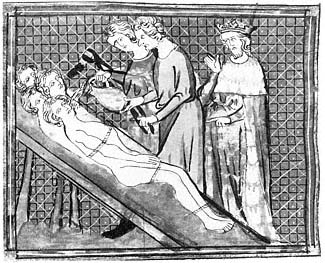
Pengembungan paksa
Pengembungan paksa (bahasa Inggris: Water cure) adalah sebuah bentuk penyiksaan dimana korbannya dipaksa meminum air dalam kadar yang besar dalam waktu pendek, yang mengakibatkan kembung atau mungkin kematian.[1][2][3]
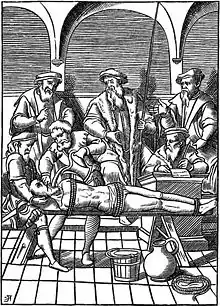
Seringkali mulut korban dipaksa atau dibuat dalam keadaan terbuka, hidung ditutup dengan penjepit dan corong atau pipa dipaksa dimasukkan ke tenggorokannya.
Meskipun penggunaan air sebagai bentuk penyiksaan terdokumentasikan sekitar abad ke-15,[4] penggunaan pertama frase water cure dalam eseni tersebut secara tak langsung bermula pada sekitar tahun 1898, oleh para prajurit AS dalam Perang Spanyol-Amerika,[5][a] setelah frase tersebut diperkenalkan ke Amerika pada pertengahan abad ke-19 dalam esensi terapik, yang banyak digunakan.[6] Secara tak langsung, meskipun esensi penyiksaan dari frase water cure pada 1900–1902 dipakai Angkatan Darat AS,[7][8] dengan esensi ironi,[9] esensi tersebut tak banyak digunakan. Kamus Webster's baru mengutip eseni terapik tersebut pada 1913.[10]
Referensi
- Sidney Lens (2003). The Forging of the American Empire: From the Revolution to Vietnam: A History of U.S. Imperialism. Pluto Press. ISBN 0-7453-2100-3.
- Elaine Korry (2005-11-14). "A Fraternity Hazing Gone Wrong". National Public Radio.
- Tom Zeller Jr. (2007-01-15). "Too High a Price for a Wii". New York Times.
- Eric Weiner (2007-11-03). "Waterboarding: A Tortured History". National Public Radio.
- Evan Wallach (2007-11-02). "Waterboarding Used to Be a Crime". Washington Post.
- Metcalfe, Richard (1898). Life of Vincent Priessnitz, Founder of Hydropathy. London: Simpkin, Marshall, Hamilton, Kent & Co., Ltd. Diakses tanggal 3 December 2009. Full text at Internet Archive (archive.org)
- Paul Kramer (February 25, 2008). "The Water Cure". The New Yorker. Diakses tanggal 6 December 2009. (Article describing the U.S. military expropriation of 'water cure' to denote a form of torture, with acknowledgement by one accused (p.3) of the difference in popular understanding, from the sense used by the military)
- Sidney Lens (2003), p.188
- Sturtz, Homer Clyde (1907). "The water cure from a missionary point of view". from the Central Christian Advocate, Kansas, June 4, 1902. Kansas. Diakses tanggal 6 December 2009.
- "Water cure definition per Webster's 1913 dictionary". Diakses tanggal 6 December 2009.
- Hadfield, Andrew, ed. (2001). Amazons, Savages, and Machiavels. Oxford University Press. p. 114. Spellings have been modernized.
- Harvey, Simon, ed (2000). Note 8 to Chapter 1. Voltaire: Treatise on Tolerance. Cambridge University Press, p. 8: "the Question Extraordinary involved suffocation, the victim's nose pinched while great quantities of water were poured through a funnel into his throat. Records show that Jean Calas withstood this torment without once submitting to the torturers' threats, and consistently denied that any crime had taken place."
- Lea, Henry Charles (1906-7). A History of the Inquisition of Spain. Volume 3, Book 6, Chapter 7
- Judgement of the International Military Tribunal for the Far East (1948). Part B, Chapter VIII, p. 1059.
- Jannet, Pierre, ed (2004). Preface. Oeuvres complètes de François Villon. "En 1457, il était dans les prisons du Châtelet, et le Parlement, après lui avoir fait appliquer la question de l'eau, le condamnait à mort."
- Thomas Hood, ed. (1842). "Review of Hydropathy, or The Cold Water Cure". The Monthly Magazine and Humourist. 64. London: Henry Colburn. hlm. 432–435.
- Paul A. Kramer (2006). "The Blood of Government" Race, Empire, the United States, and the Philippines. University of North Caroline Press. ISBN 978-0-8078-5653-6. On page 142 there is a picture from the Jonathan Best Collection depicting American soldiers and their Macabebe allies performing water cure during the American-Philippine War.
- The Larks (1897). The Shakespeare Water Cure: A Burlesque Comedy in Three Acts. New York: Harold Roorbach. Diakses tanggal 6 December 2009. Full text at Internet Archive (archive.org)
- G. Daniel Lassiter (2004). Interrogations, Confessions, and Entrapment. Springer Science+Business Media. ISBN 0-306-48470-6.
- "From coercion to deception: the changing nature of police interrogation in America". Crime, Law and Social Change. Kluwer Academic Publishers. 18. 1992.
- Miller, Stuart Creighton (1982). "Benevolent Assimilation" The American Conquest of the Philippines, 1899–1903. Yale University Press. ISBN 0-300-02697-8.
Future President William Howard Taft conceded under questioning at the Lodge Committee that the "so called water cure" had been used on some occasions to extract information. Quoted from S. Doc. 331, 57 Congressional 1 Session (1903), page 1767–1768
- Miller, Stuart Creighton (1982). "Benevolent Assimilation" The American Conquest of the Philippines, 1899–1903. Yale University Press. ISBN 0-300-02697-8. p. 218; Told of "Water Cure" Given to Filipinos. Witness Went Into Details Before Senate Committee on the Philippines. New York Times, Feb. 25, 1902, p. 3
- Elting Morison, ed. (1902-07-19). "Private letter from Roosevelt to Speck von Sternberg". The Letters of Theodore Roosevelt. 3: 297–98.
- Storey, Moorfield; Codman, Julian (1902).
 Secretary Root's Record:"Marked Severities" in Philippine Warfare. Wikisource.
 - Welch, Richard E. (1973). "American Autocracies in the Philippines: The Indictment and the Response". Pacific Historical Review. 43 (2): 233–253. doi:10.2307/3637551.
Pranala luar

- "Louis of Germany tortures men." – A 14th-century illustration from the Grandes Chroniques de France, reproduced in Chapter 4 of Anne D. Hedeman's The Royal Image (1991).
- "The Water Cure Described" (PDF). The New York Times. May 4, 1902. Diakses tanggal 6 December 2009. (From New York Times archive).
- Sturtz, Homer Clyde (1907). "The water cure from a missionary point of view". from the Central Christian Advocate, Kansas, June 4, 1902. Kansas. Diakses tanggal 6 December 2009. Newspaper article describing the pros and cons on the usage of the water cure method during the Filipino-American War
- Paul Kramer (February 25, 2008). "The Water Cure". The New Yorker. Diakses tanggal 6 December 2009. (Detailed article describing the U.S. military expropriation of "water cure" to denote a form of torture).