Convoy PQ 8
Convoy PQ 8 was an Arctic convoy sent from Great Britain by the Western Allies to aid the Soviet Union during the Second World War. It sailed in January 1942 and arrived in Murmansk with the loss of one escort sunk and one ship was damaged.
| Convoy OA 178 | |||||||
|---|---|---|---|---|---|---|---|
| Part of World War II | |||||||
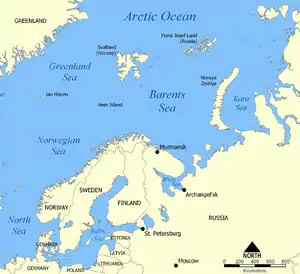 Barents Sea map | |||||||
| |||||||
| Belligerents | |||||||
.svg.png.webp) Luftwaffe Luftwaffe.svg.png.webp) Kriegsmarine Kriegsmarine |
 Royal Navy Royal Navy Merchant Navy Merchant Navy | ||||||
| Casualties and losses | |||||||
|
1 destroyer sunk 1 merchantman damaged | |||||||
Background
Lend-lease

After Operation Barbarossa, the German invasion of the USSR, began on 22 June 1941, the UK and USSR signed an agreement in July that they would "render each other assistance and support of all kinds in the present war against Hitlerite Germany".[1] Before September 1941 the British had dispatched 450 aircraft, 22,000 long tons (22,000 t) of rubber, 3,000,000 pairs of boots and stocks of tin, aluminium, jute, lead and wool. In September British and US representatives travelled to Moscow to study Soviet requirements and their ability to meet them. The representatives of the three countries drew up a protocol in October 1941 to last until June 1942 and to agree new protocols to operate from 1 July to 30 June of each following year until the end of Lend-Lease. The protocol listed supplies, monthly rates of delivery and totals for the period.[2]
The first protocol specified the supplies to be sent but not the ships to move them. The USSR turned out to lack the ships and escorts and the British and Americans, who had made a commitment to "help with the delivery", undertook to deliver the supplies for want of an alternative. The main Soviet need in 1941 was military equipment to replace losses because, at the time of the negotiations, two large aircraft factories were being moved east from Leningrad and two more from Ukraine. It would take at least eight months to resume production, until when, aircraft output would fall from 80 to 30 aircraft per day. Britain and the US undertook to send 400 aircraft a month, at a ratio of three bombers to one fighter (later reversed), 500 tanks a month and 300 Bren gun carriers. The Anglo-Americans also undertook to send 42,000 long tons (43,000 t) of aluminium and 3, 862 machine tools, along with sundry raw materials, food and medical supplies.[2]
British grand strategy
The growing German air strength in Norway and increasing losses to convoys and their escorts, led Rear-Admiral Stuart Bonham Carter, commander of the 18th Cruiser Squadron, Admiral sir John Tovey, Commander in Chief Home Fleet and Admiral Sir Dudley Pound the First Sea Lord, the professional head of the Royal Navy, unanimously to advocate the suspension of Arctic convoys during the summer months. The small number of Russian ships available to meet Arctic convoys, losses inflicted by Luftflotte 5 based in Norway and the presence of the German battleship Tirpitz in Norway from early 1942, had led to ships full of supplies to Russia becoming stranded at the west end and empty and damaged ships waiting at the east end.[3]
Signals intelligence

The British Government Code and Cypher School (GC&CS) based at Bletchley Park housed a small industry of code-breakers and traffic analysts that intercepted and decoded German naval transmissions. By June 1941, the German Enigma machine Home Waters (Heimish) settings used by surface ships and U-boats could quickly be read. On 1 February 1942, the Enigma machines used in U-boats in the Atlantic and Mediterranean were changed but German ships and the U-boats in Arctic waters continued with the older Heimish (Hydra from 1942, code-named Dolphin by the British). By mid-1941, British Y-stations were able to read Luftwaffe wireless telegraphy (W/T) transmissions and give advance warning of Luftwaffe operations. In 1941, interception parties (code-named Headaches) embarked on warships.[4] In February 1942, the German Beobachtungsdienst (B-Dienst, Observation Service) of the Kriegsmarine Marinenachrichtendienst (MND), the German Naval Intelligence Service, broke the British Naval Cypher No. 3 until it was changed in January 1943.[5]
Luftflotte 5
In mid-1941, Luftflotte 5 (Air Fleet 5) had been re-organised for Operation Barbarossa with Luftgau Norwegen (Air Region Norway) was headquartered in Oslo. Fliegerführer Stavanger (Air Commander Stavanger) the centre and north of Norway, Jagdfliegerführer Norwegen (Fighter Leader Norway) commanded the fighter force and Fliegerführer Kerkenes (Oberst [colonel] Andreas Nielsen) in the far north had airfields at Kirkenes and Banak. The Air Fleet had 180 aircraft, sixty of which were reserved for operations on the Karelian Front against the Red Army. The distance from Banak to Archangelsk was 560 mi (900 km) and Fliegerführer Kerkenes had only ten Junkers Ju 88 bombers of Kampfgeschwader 30, thirty Junkers Ju 87 Stuka dive-bombers ten Messerschmitt Bf 109 fighters of Jagdgeschwader 77. five Messerschmitt Bf 110 heavy fighters of Zerstörergeschwader 76, ten reconnaissance aircraft and an anti-aircraft battalion. Sixty aircraft were far from adequate in such a climate and terrain where "there is no favourable season for operations". The emphasis of air operations changed from army support to anti-shipping operations as Allied Arctic convoys became more frequent.[6]
[[File:Bundesarchiv Bild 101I-432-0796-07, Flugzeug Focke-Wulf Fw 200 "Condor".jpg|thumb|{{center|A Focke-Wulf Fw 200 Kondor of KG 40]] Hubert Schmundt, the Admrial Nordmeer noted gloomily on 22 December 1941 that the number long-range reconnaissance aircraft was exiguous and from 1 to 15 December only two Ju 88 sorties had been possible. After the Lofoten Raids Schmundt wanted Luftflotte 5 to transfer aircraft to northern Norway but its commander, Generaloberst Hans-Jürgen Stumpff, was reluctant to deplete the defences of western Norway. Despite this some air units were transferred, a catapult ship (Katapultschiff), MS Schwabenland, was sent to northern Norway and Heinkel He 115 floatplanes, armed with torpedoes, of Küstenfliegergruppe 1./406 was transferred to Sola. By the end of 1941, III Gruppe, KG 30 had been transferred to Norway and in the new year, another Staffel of Focke-Wulf Fw 200 Kondors from Kampfgeschwader 40 (KG 40) had arrived. Luftflotte 5 Was also expected to receive a Gruppe comprising three Staffeln of Heinkel He 111 torpedo-bombers.[7]
Air-sea rescue

The Luftwaffe Sea Rescue Service (Seenotdienst) along with the Kriegsmarine, the Norwegian Society for Sea Rescue (RS) and ships on passage, recovered aircrew and shipwrecked sailors. The service comprised Seenotbereich VIII at Stavanger covering Bergen and Trondheim and Seenotbereich IX at Kirkenes for Tromsø, Billefjord and Kirkenes. Co-operation was as important in rescues as it was in anti-shipping operations if people were to be saved before they succumbed to the climate and severe weather. The sea rescue aircraft comprised Heinkel He 59 floatplanes, Dornier Do 18 and Dornier Do 24 seaplanes.[8] Oberkommando der Luftwaffe (OKL, the high command of the Luftwaffe) was not able to increase the number of search and rescue aircraft in Norway, due to a general shortage of aircraft and crews, despite Stumpff pointing out that coming down in such cold waters required extremely swift recovery and that his crews "must be given a chance of rescue" or morale could not be maintained.[8]
Kriegsmarine
In 1941, British Commando raids on the Lofoten Islands (Operation Claymore and Operation Anklet) led Adolf Hitler to order U-boats to be transferred from the Battle of the Atlantic to Norway and on 24 January 1942, eight U-boats were ordered to the area of Iceland–Faroes–Scotland. By mid-February twenty U-boats were anticipated in the region, with six based in Norway, two in Narvik or Tromsø, two at Trondheim and two at Bergen. Hitler contemplated establishing a unified command but this did not occur. The German battleship Tirpitz arrived at Trondheim on 16 January, the first ship of a general move of surface ships to Norway. British convoys to Russia had received little attention since they averaged only eight ships each and the long Arctic winter nights negated even the limited Luftwafffe effort that was available.[9]
Prelude
Arctic Ocean

Between Greenland and Norway are some of the most stormy waters of the world's oceans, 890 mi (1,440 km) of water under gales full of snow, sleet and hail. Around the North Cape and the Barents Sea the sea temperature rarely rises about 4° Celsius and a man in the water would probably die unless rescued immediately. The cold water and air made spray freeze on the superstructure of ships, which had to be removed quickly to avoid the ship becoming top-heavy. The cold Arctic water was met by the Gulf Stream, warm water from the Gulf of Mexico, which became the North Atlantic Drift, arriving at the south-west of England the drift moves between Scotland and Iceland. North of Norway the drift splits.[10]
A northern stream goes north of Bear Island to Svalbard and the southern stream following the coast of Murmansk into the Barents Sea. The mingling of cold Arctic water and warmer water of higher salinity generates thick banks of fog for convoys to hide in but the waters drastically reduced the effectiveness of ASDIC as U-boats moved in waters of differing temperatures and density. In winter, polar ice can form as far south as 50 mi (80 km) of the North Cape and in summer it can recede to Svalbard, forcing ships closer to Luftwaffe air bases or being able to sail further out to sea. The area is in perpetual darkness in winter and permanent daylight in the summer which makes air reconnaissance almost impossible or easy.[10]
Arctic convoys
In October 1941, the Prime Minister, Winston Churchill, made a commitment to send a convoy to the Arctic ports of the USSR every ten days and to deliver 1,200 tanks a month from July 1942 to January 1943, followed by 2,000 tanks and another 3,600 aircraft in excess of those already promised.[1][lower-alpha 1] The first convoy was due at Murmansk around 12 October and the next convoy was to depart Iceland on 22 October. A motley of British, Allied and neutral shipping loaded with military stores and raw materials for the Soviet war effort would be assembled at Hvalfjörður in Iceland, convenient for ships from both sides of the Atlantic.[12] By late 1941, the convoy system used in the Atlantic had been established on the Arctic run; a convoy commodore ensured that the ships' masters and signals officers attended a briefing to make arrangements for the management of the convoy, which sailed in a formation of long rows of short columns. The commodore was usually a retired naval officer or a Royal Naval Reserveist and would be aboard one of the merchant ships (identified by a white pendant with a blue cross). The commodore was assisted by a Naval signals party of four men, who used lamps, semaphore flags and telescopes to pass signals in code.[13]
In large convoys, the commodore was assisted by vice- and rear-commodores with whom he directed the speed, course and zig-zagging of the merchant ships and liaised with the escort commander.[13][lower-alpha 2] By the end of 1941, 187 Matilda II and 249 Valentine tanks had been delivered, comprising 25 per cent of the medium-heavy tanks in the Red Army and 30 to 40 per cent of the medium-heavy tanks defending Moscow. In December 1941, 16 per cent of the fighters defending Moscow were Hawker Hurricanes and Curtiss Tomahawks from Britain; by 1 January 1942, 96 Hurricane fighters were flying in the Soviet Air Forces (Voyenno-Vozdushnye Sily, VVS). The British supplied radar apparatuses, machine tools, ASDIC and other commodities.[14] During the summer months, convoys went as far north as 75 N latitude then south into the Barents Sea and to the ports of Murmansk in the Kola Inlet and Archangel in the White Sea. In winter, due to the polar ice expanding southwards, the convoy route ran closer to Norway.[15] The voyage was between 1,400 and 2,000 nmi (2,600 and 3,700 km; 1,600 and 2,300 mi) each way, taking at least three weeks for a round trip.[16]
Convoy PQ 8

PQ 8 consisted of eight merchant ships; five British, one Soviet, the first US ship on the Arctic run and one of Panamanian registry. Convoys had a standard formation of short columns, number 1 to the left in the direction of travel. Each position in the column was numbered; 11 was the first ship in column 1 and 12 was the second ship in the column; 21 was the first ship in column 2.[17] Ships in column sailed at intervals of 400 yd (370 m) until 1943 when the interval was increased to 600 yd (550 m) then 800 yd (730 m) to cater for inexperienced captains reluctant to keep so close.[18] The convoy commodore was Captain R. W. Brundle in Harmatris and PQ 8 had a close escort of two minesweepers, HMS Harrier (Lieutenant-Commander E. P. Hinton) and Speedwell (Lieutenant-Commander J. J. Youngs).[19] On 11 January, the convoy rendezvoused with the ocean escort comprising the destroyers HMS Matabele and Somali and the cruiser HMS Trinidad (Captain L. S. Saunders).[20]
Voyage
8–16 January
PQ 8 sailed from Hvalfjörður on 8 January 1942 and was joined on the night of 10/11 January in fine weather by the ocean escort, which had sailed from Scapa flow and re-fuelled at Seidisfiord on 9 January. On 12 January the convoy reached 73°45′N 00°00′E and had to turn south to avoid ice; the weather remained calm with exceptional visibility, with a short period of twilight around noon. Trinidad made several departures from the convoy for training.[19] The Kriegsmarine had established Ulan its first Arctic wolfpack, a patrol line of four U-boats from Kirkenes searched for the convoy.[19]
17 January

In the continuous darkness of the polar night, German reconnaissance aircraft and U-boats failed to find PQ 8. On 17 January, the convoy was heading south at 8 kn (15 km/h; 9.2 mph) with Harrier ahead, Triinidad off the starboard bow of Harmatris at the head of the third column (31) and the destroyers 1 nmi (1.9 km; 1.2 mi) distant on each flank, Speedwell following on behind. A junction with the Murmansk-based minesweepers was made difficult by fog; HMS Britomart and Salamander were stuck in the Kola Inlet but Sharpshooter sailed, followed a while later by Hazard.[19]
The Russian trawler RT-68 Enisej (557 GRT) sailing independently was attacked at about 6:00 a.m. by U-454 (Kapitänleutnant Burkhard Hackländer) with two torpedoes which missed but at 6:32 a.m. a third torpedo sank the boat; two men were killed and 34 survived, their lifeboat reaching the shore.[21] At 7:45 p.m., U-454 found PQ 8 and fired a torpedo at the merchant ship Harmatris, which exploded in No. 1 hold on the starboard side. Brundle was off the bridge and the First Mate, George Masterman, promptly ordered the ship stopped, to prevent its forward motion from driving the ship under water. The crew was ordered to boat stations; luckily the torpedo warheads in No. 1 hold had fallen through the hole in the hull without detonating. From Trinidad it looked as if Harmatris had hit a mine but Matabele reported hearing a torpedo on its hydrophones.[22]
The destroyers conducted an abortive anti-submarine sweep and Speedwell dropped back to stand near the ship. As the rest of the convoy sailed past, the vice-commodore on Larranga took over the convoy. An hour later the ship shook and Brundle thought it was a mine explosion but U-454 had manoeuvred round and torpedoed Harmatris on the port side with a torpedo that turned out to be a dud. Speedwell came alongside and took off the crew but Brundle thought that Harmatiris could be towed and asked for volunteers, many of the crew offering to re-board the ship. Eventually a cable was passed to Harmatris but it would not budge, the starboard anchor having been dislodged by the torpedo and fouling the sea bed. At 10:00 p.m. Trinidad sent Matabele back to Harmatris as Sharpshooter had arrived from Kola.[22]

U-454 had sailed ahead of the ships and saw British Pride illuminated by the lighthouse at Cape Teriberskiy and fired a salvo of torpedoes. The salvo missed the tanker and hit Matabele which exploded. Many bodies of the crew were taken out of the water by Harrier but only two men survived, the crew being killed in the torpedo explosion, the explosion of its depth-charges or of hypothermia in the water. One of the survivors thought that 50–60 men survived the sinking. The crew of Harmattis returned to Speedwell which circled the ship until 6:00 a.m. and re-boarded, managed to slip the anchor and connect the tow, moving off at 8:00 a.m.[23]
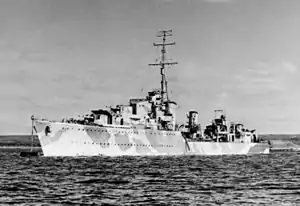
Sharpshooter and Hazard had joined the two ships and around noon, as the sky lightened, a He 111 bomber attacked. The Heinkel was driven off by the anti-aircraft fire of the minesweepers and the Defensively equipped merchant ship (DEMS) gunners on Harmatris. Another aircraft bombed the sea and turned away. At 2:30 p.m. a steam pipe on Speedwell burst, severely injuring three men and Youngs called for a Soviet tug, which arrived quickly, taking over the tow as Speedwell raced for port to get the injured into hospital.[23]
20 January
Another two tugs arrived and helped guide Harmatris into Murmansk, down at the bow with its propeller showing, early on 20 January.[23] The German navy had planned to attack the convoy with the battleship Tirpitz but lack of fuel and insufficient destroyer escorts, due to them being diverted in support of the Channel Dash forced a cancellation of the attack.[24]
Aftermath
While PQ 8 had sailed to Murmansk, QP 5 comprising Arcos, Dekabrist, Eulima and San Ambrosio had departed for Iceland on 13 January, escorted by the cruiser HMS Cumberland and the destroyers Icarus and Tartar arriving safely on 24 January.[25] Despite the losses of PQ 8, it had been fortunate that the German intention to sortie with Tirpitz had been cancelled due to its destroyer escorts being diverted south to participate in the Channel Dash. The regular sailings to Murmansk, the failure of the German Army to capture the port six months after the start of Operation Barbarossa made the establishment of a U-boat force in Norway permanent and become a significant part of the anti-shipping effort.[26]
PQ 8
Merchant ships
| Ship | Flag | GRT | Position[lower-alpha 3] | Notes |
|---|---|---|---|---|
| British Pride (1931) | United Kingdom |
7,106 | 22 | Arrived safely on 17 January |
| British Workman (1922) | United Kingdom |
6,994 | 32 | Arrived safely on 17 January |
| Dartford (1930) | United Kingdom |
4,093 | 12 | Arrived safely on 17 January |
| El Almirante (1917) |  Panama Panama |
5,248 | 11 | Arrived safely on 17 January |
| Harmatris (1932) | United Kingdom |
5,395 | 31 | Torpedoed, towed to port by HMS Speedwell, arrived 20 January |
| Larranga (1917) | .svg.png.webp) United States United States |
3,804 | 21 | Arrived safely on 17 January |
| Southgate (1926) | United Kingdom |
4,862 | 41 | Arrived safely on 17 January |
| Stary Bolshevik |  Soviet Union Soviet Union |
3,974 | 42 | Arrived safely on 17 January |
Escorts
| Name | Flag | Type | Notes |
|---|---|---|---|
| HMS Harrier | Royal Navy |
Minesweeper | Escort 8–17 January |
| HMS Hazard | Royal Navy |
Minesweeper | Escort 16–17 January |
| HMS Matabele | Royal Navy |
Destroyer | Escort 11–17 January, torpedoed and sunk by U-454 |
| HMS Sharpshooter | Royal Navy |
Minesweeper | Escort 16–17 January |
| HMS Somali | Royal Navy |
Destroyer | Escort 11–17 January |
| HMS Speedwell | Royal Navy |
Minesweeper | Escort 8–17 January |
| HMS Trinidad | Royal Navy |
Cruiser | Escort 11–17 January |
Notes
- In October 1941, the unloading capacity of Archangel was 300,000 long tons (300,000 t), Vladivostok (Pacific Route) 140,000 long tons (140,000 t) and 60,000 long tons (61,000 t) in the Persian Gulf (for the Persian Corridor route) ports.[11]
- The codebooks were carried in a weighted bag which was to be dumped overboard to prevent capture.[13]
- Convoys had a standard formation of short columns, number 1 to port in the direction of travel. Each position in the column was numbered; 11 was the first ship in column 1 and 12 was the second ship in the column; 21 was the first ship in column 2.[28]
Footnotes
- Woodman 2004, p. 22.
- Hancock & Gowing 1949, pp. 359–362.
- Woodman 2004, pp. 144–145.
- Hinsley 1994, pp. 141, 145–146.
- Hinsley 1994, pp. 126, 135.
- Claasen 2001, pp. 188–189.
- Claasen 2001, pp. 189–194.
- Claasen 2001, pp. 203–205.
- Claasen 2001, pp. 190–192, 194.
- Claasen 2001, pp. 195–197.
- Howard 1972, p. 44.
- Woodman 2004, p. 14.
- Woodman 2004, pp. 22–23.
- Edgerton 2011, p. 75.
- Roskill 1962, p. 119.
- Butler 1964, p. 507.
- Woodman 2004, p. 104; Ruegg & Hague 1993, pp. 31, inside front cover.
- Hague 2000, p. 27.
- Woodman 2004, p. 56.
- Ruegg & Hague 1993, p. 25; Woodman 2004, p. 58.
- Rohwer & Hümmelchen 2005, p. 134; Paterson 2016, p. 62.
- Woodman 2004, p. 57.
- Woodman 2004, pp. 58–59.
- Garzke & Dulin 1985, p. 250; Paterson 2016, p. 61.
- Woodman 2004, p. 58.
- Paterson 2016, pp. 62–63.
- Ruegg & Hague 1993, p. 25.
- Ruegg & Hague 1993, pp. 31, inside front cover.
References
- Butler, J. R. M. (1964). Grand Strategy: June 1941 – August 1942 (Part II). History of the Second World War, United Kingdom Military Series. Vol. III. London: HMSO. OCLC 504770038.
- Claasen, A. R. A. (2001). Hitler's Northern War: The Luftwaffe's Ill-fated Campaign, 1940–1945. Lawrence, KS: University Press of Kansas. ISBN 0-7006-1050-2.
- Edgerton, D. (2011). Britain's War Machine: Weapons, Resources and Experts in the Second World War. London: Allen Lane. ISBN 978-0-7139-9918-1.
- Garzke, William H.; Dulin, Robert O. (1985). Battleships: Axis and Neutral Battleships in World War II. Annapolis, MD: Naval Institute Press. ISBN 978-0-87021-101-0.
- Hague, Arnold (2000). The Allied Convoy System, 1939–1945: Its Organization, Defence and Operation. Annapolis, MD: Naval Institute Press. ISBN 978-1-55750-019-9.
- Hancock, W. K.; Gowing, M. M. (1949). Hancock, W. K. (ed.). British War Economy. History of the Second World War, United Kingdom Civil Series. London: HMSO. OCLC 630191560.
- Hinsley, F. H. (1994) [1993]. British Intelligence in the Second World War: Its Influence on Strategy and Operations. History of the Second World War, United Kingdom Military Series (2nd rev. abr. ed.). London: HMSO. ISBN 978-0-11-630961-7.
- Howard, M. (1972). Grand Strategy: August 1942 – September 1943. History of the Second World War United Kingdom Military Series. Vol. IV. London: HMSO. ISBN 978-0-11-630075-1 – via Archive Foundation.
- Paterson, Lawrence (2016). Steel and Ice: The U-Boat Battle in the Arctic and Black Sea 1941–45. Stroud: The History Press. ISBN 978-1-59114-258-4.
- Rohwer, Jürgen; Hümmelchen, Gerhard (2005) [1972]. Chronology of the War at Sea, 1939–1945: The Naval History of World War Two (3rd rev. ed.). London: Chatham. ISBN 978-1-86176-257-3.
- Roskill, S. W. (1962) [1956]. The Period of Balance. History of the Second World War: The War at Sea 1939–1945. Vol. II (3rd impr. ed.). London: HMSO. OCLC 174453986. Retrieved 4 June 2018 – via Hyperwar.
- Ruegg, R.; Hague, A. (1993) [1992]. Convoys to Russia: Allied Convoys and Naval Surface Operations in Arctic Waters 1941–1945 (2nd rev. enl. ed.). Kendal: World Ship Society. ISBN 0-905617-66-5.
- Woodman, Richard (2004) [1994]. Arctic Convoys 1941–1945. London: John Murray. ISBN 978-0-7195-5752-1.