Beli language (South Sudan)
"ecwa.org.au". ecwa.org.au. Retrieved 2023-02-05.{{cite web}}: CS1 maint: url-status (link)
| ’Bëlï | |
|---|---|
| Jur ’Bëlï | |
| Native to | South Sudan |
Native speakers | 65,000 (2009)[1] |
| Language codes | |
| ISO 639-3 | blm |
| Glottolog | beli1257 |
| ELP | Beli (Sudan) |
 Beli is classified as Definitely Endangered by the UNESCO Atlas of the World's Languages in Danger | |
’’Bëlï, or Jur Beli, is a Central Sudanic language spoken by the Beli and Sopi people of South Sudan. The Beli people are mainly found in South Sudan, a region southeast of Rumbek.[2] The language is considered as endangered, and it is mostly spoken by the older generation.
However, it has three dialects and variations that are specific to different regions and communities. The language has a complex grammatical structure, with a rich system of prefixes that are used to indicate various grammatical features, such as, mood, and aspect.
Despite the lack of written material and limited use, Jur Beli is an important language for the Beli people, as it is an essential part of their cultural identity. The language serves as an important means of communication within the community, and it is used to transmit cultural knowledge and traditions from one generation to the next.
Brief description about the Jur Beli people
The Jur (Beli & Modo) people, a group of over “100,000” (according to a source found online)[3] individuals divided into two distinct geographic groups: Beli and Modo. The Beli live in the area extending from Bahr Gel to Wulu and Billing, while the Modo live in Mvolo, Bogri, Woko, and Bahr Girindi near Yirol. The area is characterized by flat plains with granitoid rocks and has a rich savannah in the east and tropical equatoria in the west, which allows for extensive agricultural activities. The Jur (Beli & Modo) are sedentary agriculturalists who practice shifting cultivation and raise crops such as sorghum, millet, beans, cassava, groundnuts, and simsim (Sesame).They also engage in hunting, fishing, and beekeeping. The main economic potential of the area is timber, honey, and shea oil. The Jur (Beli & Modo) believe they came from the Central African Republic and have a language that belongs to the central Sudanic group of languages but is linguistically similar to the Baka/Bongo group. Their society is organized into kinships, clans, and families and has elaborate customs and traditions. Marriage customs include respect for in-laws and paying a dowry, which is marked by the groom working in the in-laws' gardens and building a house for them.
Geographic distribution
Jur Beli is a nilo-saharan language of western, central Sudan in the bongo-baka group. In South Sudan, a region southeast of Rumbek is home to 65,000 Jur Beli speakers[2] (Lewis et al. 2013).
Classification and dialects
According to Persson, there are three dialects of the Jur Beli language: Wulu, Bahri Girinti, and Sopi (Persson 1997:31–32).
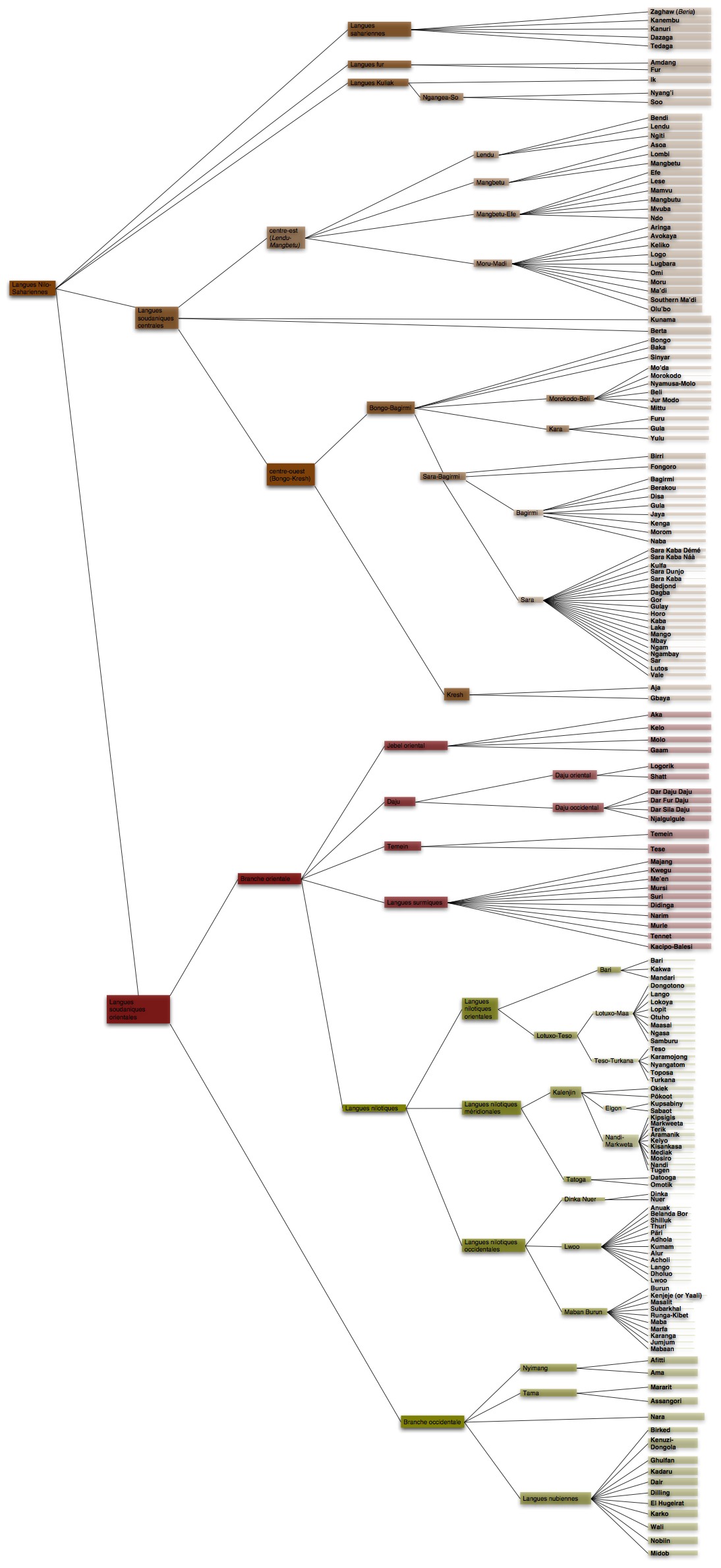
In the diagram shown below is the language group of Jur Beli

Numbers
Number is an essential part of the Jur Beli language. Listed below are the numbers from 1 to 10.)[5]
| Numbers in Jur Beli | Translation in English |
| kɔtɔ | One |
| yo | Two |
| Mota | Three |
| hɔ | Four |
| Muyï | Five |
| Munötö | Six |
| Mïnïu | Seven |
| Mïnïmutä | Eight |
| miniyɔ | Nine |
| kii | Ten |
Consonants
In the Jur Beli language, 28 distinct consonant phonemes have been identified, which include voiceless and voiced stops, nasals, Prenasalised stops, Fricative implosives, and approximants. These phonemes can be found in various positions within words and play an important role in the syllable structure of the language. (Reference: Post, D. G. (2014). A Grammar of Jur Beli: A Western Nilotic Language of South Sudan. SIL International.)
| Palatal | Velar | Glottal | Labial | Dental | Labiovelar | |
| Nasals | ɲ | ŋ | m | n | ŋ͡m | |
| Implosives | ʄ | ɓ | ɗ | |||
| Prenasalised Plosives | ᶮɟ | ᵑg | ᵐb | ⁿd | ᵑ͡ᵐg͡b | |
| Approximants | j | ɾ ɾ, l | w | |||
| Voiced stops | ɟ | g | b | d̪ | ͡gb | |
| Voiceless stops | c | k | p | t̪ | k͡p | |
| Fricative | h |
In the Jur Beli language, it is typical for consonant phonemes to occur at the beginning of syllables, while vowel phonemes occur at the end. This means that words in Jur Beli language are typically made up of a sequence of syllables, each beginning with a consonant and ending with a vowel[6].
It's worth noting that this is a general pattern in the Jur Beli language, but there may be exceptions to this rule.
Morphology
Morphology in the context of the Jur Beli language refers to the study of how words are formed and structured in the language.
Consonants
Stirtz (2014) lists the following consonant phonemes:[7]
| Labial | Dental | Palatal | Velar | Labiovelar | Glottal | |
|---|---|---|---|---|---|---|
| Voiceless plosives | p | t̪ | c | k | k͡p | |
| Voiced plosives | b | d̪ | ɟ | g | g͡b | |
| Implosives | ɓ | ɗ | ʄ | |||
| Prenasalised plosives | mb | nd̪ | nɟ | ŋg | ŋ͡mg͡b | |
| Nasals | m | n | ɲ | ŋ | ŋ͡m | |
| Fricative | h | |||||
| Approximates | ɾ, l | j | w |
Vowels
According to Stirtz (2014),[7] ’Bëlï has nine vowel phonemes that can be divided into [+/- ATR] sets. The vowel [ə] is an allophone that does not occur in roots without other [+ATR] vowels:
| [-ATR] | [+ATR] |
|---|---|
| ɪ | i |
| ʊ | u |
| ɛ | e |
| ɔ | o |
| a | (ə) |
References
- ’Bëlï at Ethnologue (18th ed., 2015) (subscription required)
- "Ethnologue. Languages of the World". African Studies Companion Online. Retrieved 2023-02-05.
- "ecwa.org.au". ecwa.org.au. Retrieved 2023-02-05.
{{cite web}}: CS1 maint: url-status (link) - "Famille des langues nilo-sahariennes".
- Deng Gideon Kol, John Majok Matuek, Zechariah Manyiel Mawuor, Peter Tiu Mberu, Mbio Nelson Moli, Charles Mayen Manyang (2013). ꞌBëlï Grammar Book (1st ed.). SIL-South Sudan. pp. 13–14.
- Deng Gideon Kol, John Majok Matuek, Zechariah Manyiel Mawuor, Peter Tiu Mberu, Mbio Nelson Moli, Charles Mayen Manyang, eds. (2013). ꞌBëlï Grammar Book (1st ed.). Juba: SIL-South Sudan. p. 8.
- Stirtz, Timothy M. 2014. 'Bëlï Phonology, Tone and Orthography. (SIL Electronic Working Papers 2014-002.) SIL International. 34pp.