Maardu
Maardu (German: Maart) is a town and a municipality in Harju County, Estonia. It is part of Tallinn metropolitan area, located about 15 kilometres (9.3 mi) east of the capital city.[1] The town covers an area of 22.76 km² and has a population of 16,170 (as of 1 January 2021).[2]
Maardu | |
|---|---|
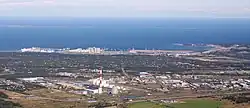 Panorama of Maardu, Port of Muuga in the background. The Iru Power Plant is in the foreground. | |
 Flag  Coat of arms | |
  Maardu Location in Estonia | |
| Coordinates: 59°28′41″N 25°00′58″E | |
| Country |  Estonia Estonia |
| County |  Harju County Harju County |
| First mentioned | 1241 |
| Borough rights | 1951 |
| Town rights | 1980[1] |
| Government | |
| • Mayor | Vladimir Arhipov (Estonian Centre Party) |
| Area | |
| • Total | 22.76 km2 (8.79 sq mi) |
| Elevation | 20 m (70 ft) |
| Population (2021) | |
| • Total | 16,170[2] |
| • Rank | 8th |
| Postal code | 74111 |
| ISO 3166 code | EE-446 |
| Website | www.maardu.ee |
The Port of Muuga, the largest cargo port in Estonia, is partly located in Maardu.[3]
According to the 2000 Census, the population was 16,738. 61.7% were Russians, 19.9% Estonians, 6.6% Ukrainians, 5.7% Belarusians, 1.5% Tatars, 0.9% Finns, 0.6% Poles, 0.5% Lithuanians, 0.2% Latvians, 0.2% Germans and 0.1% Jews and 1 Cuban. The proportion of Estonians was one of the lowest (if not the lowest) in Central and Western Estonia.
Outside the town (in Maardu village), south of the road to Narva lies Maardu manor, one of the oldest preserved baroque manor houses in Estonia. It traces its origins to 1389, but the current building dates from the 1660s with additions made in the 19th century. The landlord of the manor Herman Jensen Bohn in 1739 funded the printing of the first bible printed in Estonian.[4]
Maardu neighborhoods
Maardu may be divided into six parts:
- Kallavere (the centre of the city where most of the public institutions are located)
- Muuga Harbour
- Muuga aedlinn (former garden city, now a light residential suburb more connected to Tallinn than Kallavere)
- Kärmu (industrial area)
- Kroodi (industrial area)
- Lake Maardu
Religion
Gallery
 Maardu Archangel Michael Church

 Maardu manor house
 Apartment buildings at sunset
 Soviet-era apartment buildings
 Abandoned factory building in Maardu
 Kroodi creek
See also
References
- "About Maardu". Maardu Linnavalitsus. Retrieved 1 February 2023.
- "Maardu linn, valik andmeid".
- "Muuga Harbour". Port of Tallinn. Retrieved 25 September 2022.
- Sakk, Ivar (2004). Estonian Manors - A Travelogue. Tallinn: Sakk & Sakk OÜ. p. 50. ISBN 9949-10-117-4.
External links

- Official website
 (in Estonian)
  Maardu travel guide from Wikivoyage
|  | |
Jaanilinn (Ivangorod) and Petseri (Pechory) were annexed by the Soviet Union in 1945 and are currently part of Russia. | ||
