Portal:Cats/Selected article
Selected article 1
Portal:Cats/Selected article/1

The jaguar (Panthera onca) is a large cat species and the only living member of the genus Panthera native to the Americas. With a body length of up to 1.85 m (6 ft 1 in) and a weight of up to 158 kg (348 lb), it is the largest cat species in the Americas and the third largest in the world. Its distinctively marked coat features pale yellow to tan colored fur covered by spots that transition to rosettes on the sides, although a melanistic black coat appears in some individuals. The jaguar's powerful bite allows it to pierce the carapaces of turtles and tortoises, and to employ an unusual killing method: it bites directly through the skull of mammalian prey between the ears to deliver a fatal blow to the brain.
The jaguar is threatened by habitat loss, habitat fragmentation, poaching for trade with its body parts and killings in human–wildlife conflict situations, particularly with ranchers in Central and South America. It has been listed as Near Threatened on the IUCN Red List since 2002. The wild population is thought to have declined since the late 1990s. Priority areas for jaguar conservation comprise 51 Jaguar Conservation Units (JCUs), defined as large areas inhabited by at least 50 breeding jaguars. The JCUs are located in 36 geographic regions ranging from Mexico to Argentina. (Full article...)
Selected article 2
Portal:Cats/Selected article/2
 Felix in his classic design |
Felix the Cat is a cartoon character created in 1919 by Pat Sullivan and Otto Messmer during the silent film era. An anthropomorphic young black cat with white eyes, a black body, and a giant grin, he is often considered one of the most recognized cartoon characters in film history. Felix was the first fully realized animal character in the history of American film animation.
Felix originated from the studio of Australian cartoonist-film entrepreneur Pat Sullivan. Either Sullivan himself or his lead animator, American Otto Messmer, created the character. What is certain is that Felix emerged from Sullivan's studio, and cartoons featuring the character became well known in popular culture. Aside from the animated shorts, Felix starred in a comic strip (drawn by Sullivan, Messmer and later Joe Oriolo) beginning in 1923, and his image soon adorned merchandise such as ceramics, toys and postcards. Several manufacturers made stuffed Felix toys. Jazz bands such as Paul Whiteman's played songs about him (1923's "Felix Kept on Walking" and others). In 1926, Felix became the first high school mascot for the Logansport, Indiana, Berries. (Full article...)
Selected article 3
Portal:Cats/Selected article/3
 Ignatz hurls a brick at Krazy Kat, who misinterprets it as an expression of love. |
Krazy Kat (also known as Krazy & Ignatz in some reprints and compilations) is an American newspaper comic strip, by cartoonist George Herriman, which ran from 1913 to 1944. It first appeared in the New York Evening Journal, whose owner, William Randolph Hearst, was a major booster for the strip throughout its run. The characters had been introduced previously in a side strip with Herriman's earlier creation, The Dingbat Family. The phrase "Krazy Kat" originated there, said by the mouse by way of describing the cat. Set in a dreamlike portrayal of Herriman's vacation home of Coconino County, Arizona, Krazy Kat's mixture of offbeat surrealism, innocent playfulness and poetic, idiosyncratic language has made it a favorite of comics aficionados and art critics for more than 80 years.
Despite the slapstick simplicity of the general premise, the detailed characterization, combined with Herriman's visual and verbal creativity, made Krazy Kat one of the first comics to be widely praised by intellectuals and treated as "serious" art. Art critic Gilbert Seldes wrote a lengthy panegyric to the strip in 1924, calling it "the most amusing and fantastic and satisfactory work of art produced in America today." Poet e. e. cummings, another Herriman admirer, wrote the introduction to the first collection of the strip in book form. These critical appraisals by Seldes and Cummings were influential in establishing Krazy Kat's reputation as a work of genius. Though Krazy Kat was only a modest success during its initial run, in more recent years, many modern cartoonists have cited the strip as a major influence. (Full article...)
Selected article 4
Portal:Cats/Selected article/4
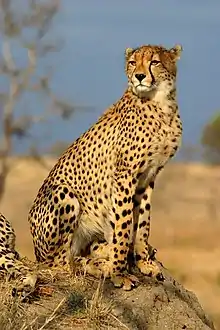 Cheetah in Sabi Sand Game Reserve, South Africa |
The cheetah (Acinonyx jubatus) is a large cat native to Africa and central Iran. It is the fastest land animal, estimated to be capable of running at 80 to 128 km/h (50 to 80 mph) with the fastest reliably recorded speeds being 93 and 98 km/h (58 and 61 mph), and as such has evolved specialized adaptations for speed, including a light build, long thin legs and a long tail. It typically reaches 67–94 cm (26–37 in) at the shoulder, and the head-and-body length is between 1.1 and 1.5 m (3 ft 7 in and 4 ft 11 in). Adults weigh between 21 and 72 kg (46 and 159 lb). Its head is small and rounded, with a short snout and black tear-like facial streaks. The coat is typically tawny to creamy white or pale buff and is mostly covered with evenly spaced, solid black spots. Four subspecies are recognised.
The cheetah occurs in a variety of habitats such as savannahs in the Serengeti, arid mountain ranges in the Sahara and hilly desert terrain in Iran. The cheetah is threatened by several factors such as habitat loss, conflict with humans, poaching and high susceptibility to diseases. Historically ranging throughout most of Sub-Saharan Africa and extending eastward into the Middle East and to central India, the cheetah is now distributed mainly in small, fragmented populations in central Iran and southern, eastern and northwestern Africa. In 2016, the global cheetah population was estimated at 7,100 individuals in the wild; it is listed as Vulnerable on the IUCN Red List. In September 2022, they were reintroduced to India after being extinct in the country for 70 years. In the past, cheetahs were tamed and trained for hunting ungulates. They have been widely depicted in art, literature, advertising, and animation. (Full article...)
Selected article 5
Portal:Cats/Selected article/5

The ship's cat has been a common feature on many trading, exploration, and naval ships dating to ancient times. Cats have been carried on ships for many reasons, most importantly to control rodents. Vermin aboard a ship can cause damage to ropes, woodwork, and more recently, electrical wiring. In addition, rodents threaten ships' stores, devour crews' foodstuff, and can cause economic damage to ships' cargo, such as grain. They are also a source of disease, which is dangerous for ships that are at sea for long periods of time. Rat fleas are carriers of plague, and rats on ships were believed to be a primary vector of the Black Death.
Cats naturally attack and kill rodents and adapt to new surroundings, which makes them suitable for service on a ship. In addition, they offer companionship and a sense of home, security and camaraderie to sailors away from home. (Full article...)
Selected article 6
Portal:Cats/Selected article/6

A feral cat or a stray cat is an unowned domestic cat (Felis catus) that lives outdoors and avoids human contact: it does not allow itself to be handled or touched, and usually remains hidden from humans. Feral cats may breed over dozens of generations and become an aggressive local apex predator in urban, savannah and bushland environments. Some feral cats may become more comfortable with people who regularly feed them, but even with long-term attempts at socialization, they usually remain aloof and are most active after dusk.
Feral cats are devastating to wildlife, and conservation biologists consider them to be one of the worst invasive species on Earth. Attempts to control feral cat populations are widespread but generally of greatest impact within purpose-fenced reserves.
Some animal rights groups advocate trap-neuter-return programs to prevent the feral cats from continuing to breed. Scientific evidence has demonstrated that TNR is not effective at controlling feral cat populations. (Full article...)
Selected article 7
Portal:Cats/Selected article/7
 Official portrait, 1993 |
Socks Clinton (c. 1989 – February 20, 2009) was the pet cat of the Clinton family, the first family of the United States from 1993 to 2001. As an adopted stray cat, he was the only pet of the Clintons during the early years of the administration, and his likeness hosted the children's version of the White House website. After Clinton left office, Socks resided with former Clinton secretary Betty Currie and her husband, owing to continuing conflicts with the Clintons' dog Buddy. (Full article...)
Selected article 8
Portal:Cats/Selected article/8

A bicolor cat or tuxedo cat is a cat with white fur combined with fur of some other color, for example black or tabby. There are various patterns of bicolor cat. These range from Turkish Van pattern (color on the crown of the head and the tail only) through to solid color with a throat locket.
Where there is low-to-medium grade white spotting limited to the face, paws, throat and chest of an otherwise black cat, they are known in the United States as a tuxedo cat. High-grade bicolor results in Van-pattern cats. There are many patterns between, such as "cap-and-saddle", "mask-and-mantle" and "magpie" (more randomly splashed). Bicolors are found in many cat breeds, as well as being common in domestic longhair and domestic shorthair cats.
Mostly-solid-color bicolor cats occur because there is a white spotting gene present along with a recessive allele of the agouti gene, which evens out the usual striped pattern of the colors of the coat. In contrast, tabby cats have an agouti gene that produces striping of the coat. The Abyssinian has agouti (ticked tabby) fur, giving the appearance of even color with color-banded hairs (Full article...)
Selected article 9
Portal:Cats/Selected article/9
 A Bengal tigress in Kanha Tiger Reserve, India |
The tiger (Panthera tigris) is the largest living cat species and a member of the genus Panthera. It is most recognisable for its dark vertical stripes on orange fur with a white underside. An apex predator, it primarily preys on ungulates, such as deer and wild boar. It is territorial and generally a solitary but social predator, requiring large contiguous areas of habitat to support its requirements for prey and rearing of its offspring. Tiger cubs stay with their mother for about two years and then become independent, leaving their mother's home range to establish their own.
The tiger was first scientifically described in 1758. It once ranged widely from the Eastern Anatolia Region in the west to the Amur River basin in the east, and in the south from the foothills of the Himalayas to Bali in the Sunda Islands. Since the early 20th century, tiger populations have lost at least 93% of their historic range and have been extirpated from Western and Central Asia, the islands of Java and Bali, and in large areas of Southeast and South Asia and China. What remains of the range where tigers still roam free is fragmented, stretching in spots from Siberian temperate forests to subtropical and tropical forests on the Indian subcontinent, Indochina and a single Indonesian island, Sumatra.
The tiger is listed as Endangered on the IUCN Red List. As of 2015, the global wild tiger population was estimated to number between 3,062 and 3,948 mature individuals, with most populations living in small isolated pockets. India currently hosts the largest tiger population. Major reasons for population decline are habitat destruction, habitat fragmentation and poaching. Tigers are also victims of human–wildlife conflict, due to encroachment in countries with a high human population density. (Full article...)
Selected article 10
Portal:Cats/Selected article/10
 |
The lion (Panthera leo) is a large cat of the genus Panthera native to Africa and India. It has a muscular, broad-chested body; short, rounded head; round ears; and a hairy tuft at the end of its tail. It is sexually dimorphic; adult male lions are larger than females and have a prominent mane. It is a social species, forming groups called prides. A lion's pride consists of a few adult males, related females, and cubs. Groups of female lions usually hunt together, preying mostly on large ungulates. The lion is an apex and keystone predator; although some lions scavenge when opportunities occur and have been known to hunt humans, lions typically do not actively seek out and prey on humans.
The lion inhabits grasslands, savannas and shrublands. It is usually more diurnal than other wild cats, but when persecuted, it adapts to being active at night and at twilight. During the Neolithic period, the lion ranged throughout Africa and Eurasia from Southeast Europe to India, but it has been reduced to fragmented populations in sub-Saharan Africa and one population in western India. It has been listed as Vulnerable on the IUCN Red List since 1996 because populations in African countries have declined by about 43% since the early 1990s. Lion populations are untenable outside designated protected areas. Although the cause of the decline is not fully understood, habitat loss and conflicts with humans are the greatest causes for concern. (Full article...)
Selected article 11
Portal:Cats/Selected article/11
.jpg.webp) |
The leopard (Panthera pardus) is one of the five extant species in the genus Panthera, a member of the cat family, Felidae. It occurs in a wide range in sub-Saharan Africa, in some parts of Western and Central Asia, Southern Russia, and on the Indian subcontinent to Southeast and East Asia. It is listed as Vulnerable on the IUCN Red List because leopard populations are threatened by habitat loss and fragmentation, and are declining in large parts of the global range. The leopard is considered locally extinct in Hong Kong, Singapore, South Korea, Jordan, Morocco, Togo, the United Arab Emirates, Uzbekistan, Lebanon, Mauritania, Kuwait, Syria, Libya, Tunisia and most likely in North Korea, Gambia, Laos, Lesotho, Tajikistan, Vietnam and Israel. Contemporary records suggest that the leopard occurs in only 25% of its historical global range.
Compared to other wild cats, the leopard has relatively short legs and a long body with a large skull. Its fur is marked with rosettes. It is similar in appearance to the jaguar (Panthera onca), but has a smaller, lighter physique, and its rosettes are generally smaller, more densely packed and without central spots. Both leopards and jaguars that are melanistic are known as black panthers. The leopard is distinguished by its well-camouflaged fur, opportunistic hunting behaviour, broad diet, strength, and its ability to adapt to a variety of habitats ranging from rainforest to steppe, including arid and montane areas. It can run at speeds of up to 58 km/h (36 mph; 16 m/s). The earliest known leopard fossils excavated in Europe are estimated 600,000 years old, dating to the late Early Pleistocene. Leopard fossils have also been found in Sumatra, Taiwan and Japan. (Full article...)
Selected article 12
Portal:Cats/Selected article/12
 Bobcat in Columbus Zoo |
The bobcat (Lynx rufus), also known as the red lynx, is a medium-sized cat native to North America. It ranges from southern Canada through most of the contiguous United States to Oaxaca in Mexico. It is listed as Least Concern on the IUCN Red List since 2002, due to its wide distribution and large population. Although it has been hunted extensively both for sport and fur, populations have proven stable, though declining in some areas.
It has distinctive black bars on its forelegs and a black-tipped, stubby (or "bobbed") tail, from which it derives its name. It reaches a total length (including the tail) of up to 125 cm (50 in). It is an adaptable predator inhabiting wooded areas, semidesert, urban edge, forest edge, and swampland environments. It remains in some of its original range, but populations are vulnerable to extirpation by coyotes and domestic animals. Though the bobcat prefers rabbits and hares, it hunts insects, chickens, geese and other birds, small rodents, and deer. Prey selection depends on location and habitat, season, and abundance. Like most cats, the bobcat is territorial and largely solitary, although with some overlap in home ranges. It uses several methods to mark its territorial boundaries, including claw marks and deposits of urine or feces. The bobcat breeds from winter into spring and has a gestation period of about two months.
Two subspecies are recognized: one east of the Great Plains, and the other west of the Great Plains. It is featured in some stories of the indigenous peoples of North and Central America, and in the folklore of European-descended inhabitants of the Americas. (Full article...)
Selected article 13
Portal:Cats/Selected article/13
 A North American cougar in Glacier National Park, United States |
The cougar (Puma concolor) (/ˈkuːˌɡər/, KOO-gər) is a large cat native to the Americas. Its range spans from the Canadian Yukon to the southern Andes in South America and is the most widespread of any large wild terrestrial mammal in the Western Hemisphere. It is an adaptable, generalist species, occurring in most American habitat types. This wide range has brought it many common names, including puma, mountain lion, catamount and panther (for the Florida sub-population). It is the second-largest cat in the New World, after the jaguar (Panthera onca). Secretive and largely solitary by nature, the cougar is properly considered both nocturnal and crepuscular, although daytime sightings do occur. Despite its size, the cougar is more closely related to smaller felines, including the domestic cat (Felis catus) than to any species of the subfamily Pantherinae.
The cougar is an ambush predator that pursues a wide variety of prey. Primary food sources are ungulates, particularly deer, but it also hunts smaller prey such as rodents. It prefers habitats with dense underbrush and rocky areas for stalking, but also lives in open areas. Cougars are territorial and live at low population densities. Individual home ranges depend on terrain, vegetation and abundance of prey. While large, it is not always the apex predator in its range, yielding prey it has killed to American black bears, grizzly bears and packs of wolves. It is reclusive and mostly avoids people. Fatal attacks on humans are rare, but increased in North America as more people entered cougar habitat and built farms.
Intensive hunting following European colonization of the Americas and ongoing human development into cougar habitat has caused the cougar populations to drop in most parts of its historical range. In particular, the eastern cougar population is considered to have been mostly extirpated in eastern North America at the beginning of the 20th century, with the exception of the isolated Florida panther subpopulation. (Full article...)
Selected article 14
Portal:Cats/Selected article/14
.jpg.webp) Caracal in Kgalagadi Transfrontier Park |
The caracal (Caracal caracal) (/ˈkærəkæl/) is a medium-sized wild cat native to Africa, the Middle East, Central Asia, and arid areas of Pakistan and northwestern India. It is characterised by a robust build, long legs, a short face, long tufted ears, and long canine teeth. Its coat is uniformly reddish tan or sandy, while the ventral parts are lighter with small reddish markings. It reaches 40–50 cm (16–20 in) at the shoulder and weighs 8–19 kg (18–42 lb). It was first scientifically described by German naturalist Johann Christian Daniel von Schreber in 1776. Three subspecies are recognised.
Typically nocturnal, the caracal is highly secretive and difficult to observe. It is territorial, and lives mainly alone or in pairs. The caracal is a carnivore that typically preys upon birds, rodents, and other small mammals. It can leap higher than 3.0 m (10 ft) and catch birds in midair. It stalks its prey until it is within 5 m (16 ft) of it, after which it runs it down and kills its prey with a bite to the throat or to the back of the neck. Both sexes become sexually mature by the time they are one year old and breed throughout the year. Gestation lasts between two and three months, resulting in a litter of one to six kittens. Juveniles leave their mothers at the age of nine to ten months, though a few females stay back with their mothers. The average lifespan of captive caracals is nearly 16 years. (Full article...)
Selected article 15
Portal:Cats/Selected article/15
 Indian jungle cat |
The jungle cat (Felis chaus), also called reed cat, swamp cat and jungle lynx, is a medium-sized cat native to the Middle East, the Caucasus, South and Southeast Asia and southern China. It inhabits foremost wetlands like swamps, littoral and riparian areas with dense vegetation. It is listed as Least Concern on the IUCN Red List, and is mainly threatened by destruction of wetlands, trapping and poisoning.
The jungle cat has a uniformly sandy, reddish-brown or grey fur without spots; melanistic and albino individuals are also known. It is solitary in nature, except during the mating season and mother-kitten families. Adults maintain territories by urine spraying and scent marking. Its preferred prey is small mammals and birds. It hunts by stalking its prey, followed by a sprint or a leap; the ears help in pinpointing the location of prey. Both sexes become sexually mature by the time they are one year old; females enter oestrus from January to March. Mating behaviour is similar to that in the domestic cat: the male pursues the female in oestrus, seizes her by the nape of her neck and mounts her. Gestation lasts nearly two months. Births take place between December and June, though this might vary geographically. Kittens begin to catch their own prey at around six months and leave the mother after eight or nine months. (Full article...)
Selected article 16
Portal:Cats/Selected article/16

The sand cat (Felis margarita) is a small wild cat that inhabits sandy and stony deserts far from water sources. With its sandy to light grey fur, it is well camouflaged in a desert environment. Its head-and-body length ranges from 39–52 cm (15–20 in) with a 23–31 cm (9.1–12.2 in) long tail. Its 5–7 cm (2.0–2.8 in) short ears are set low on the sides of the head, aiding detection of prey moving underground. The long hair covering the soles of its paws insulates its pads against the extremely hot and cold temperatures in deserts.
The first sand cat known to scientists was discovered in the Algerian Sahara and described in 1858. To date, it has been recorded in several disjunct locations in Western Sahara, Morocco, Algeria, Niger, Chad, Egypt, the Arabian Peninsula and the Middle East. In Central Asia, it was first recorded in the Karakum Desert in 1925. The large gap between these two regions of its global range was partially closed in 1948, when a sand cat skin was found in an oasis of the Rub' al Khali in Oman. It is discontinuously distributed in the deserts of the Arabian Peninsula and the Middle East. In the early 1970s, sand cats were caught in southwestern Pakistan and exported to zoos worldwide. Due to its wide distribution and large population, it is listed as Least Concern on the IUCN Red List. (Full article...)
Selected article 17
Portal:Cats/Selected article/17
_Zoo_Itatiba.jpg.webp) |
The ocelot (Leopardus pardalis) is a medium-sized spotted wild cat that reaches 40–50 cm (15.7–19.7 in) at the shoulders and weighs between 7 and 15.5 kg (15.4 and 34.2 lb) on average. It was first described by Carl Linnaeus in 1758. Two subspecies are recognized. It is native to the southwestern United States, Mexico, Central and South America, and the Caribbean islands of Trinidad and Margarita. It prefers areas close to water sources with dense vegetation cover and high prey availability.
Typically active during twilight and at night, the ocelot tends to be solitary and territorial. It is efficient at climbing, leaping and swimming. It preys on small terrestrial mammals, such as armadillos, opossums, and lagomorphs. Both sexes become sexually mature at around two years of age and can breed throughout the year; peak mating season varies geographically. After a gestation period of two to three months the female gives birth to a litter of one to three kittens. They stay with their mother for up to two years, after which they leave to establish their own home ranges. (Full article...)
Selected article 18
Portal:Cats/Selected article/18
 A Pallas's cat at Rotterdam Zoo |
The Pallas's cat (Otocolobus manul), also known as the manul, is a small wild cat with long and dense light grey fur, native to mountainous regions across central Asia.
Its head-and-body length ranges from 46 to 65 cm (18 to 26 in) with a 21 to 31 cm (8.3 to 12.2 in) long bushy tail. It is well camouflaged and adapted to the cold continental climate in its native range, which receives little rainfall and experiences a wide range of temperatures. (Full article...)
Selected article 19
Portal:Cats/Selected article/19 Félicette (French pronunciation: [felisɛt]) was a stray Parisian cat who is the only cat to have been successfully launched into space. She was launched on 18 October 1963 as part of the French space program. Félicette was one of 14 female cats trained for spaceflight. The cats had electrodes implanted onto their skulls so their neurological activity could be monitored throughout the flight. Electrical impulses were applied to the brain and a leg during the flight to stimulate responses. The capsule was recovered 13 minutes after the rocket was ignited. Most of the data from the mission were of good quality, and Félicette survived the flight but was purposely killed two months later for the examination of her brain. A second feline was killed in a launch mishap on 24 October 1963.
Félicette had the designation of C 341 before the flight, and after the flight the media gave her the name Félix, after Félix the Cat. Centre d'Enseignement et de Recherches de Médecine Aéronautique (CERMA) modified this to the feminine Félicette and adopted it as her official name. She has been commemorated on postage stamps around the world and a statue with her likeness is on display at the International Space University. France's feline biological rocket payloads were preceded by rats and followed by monkeys. (Full article...)
Selected article 20
Portal:Cats/Selected article/20 The Goathouse Refuge in Pittsboro, North Carolina, is a nonprofit no-kill animal sanctuary for cats that is run on a volunteer-basis. The refuge is cage-free with the cats roaming around within the boundaries of the property. Founded in 2007 by Italian-born artist Siglinda Scarpa, the refuge can hold up to 300 cats on a 16-acre farm. There is an art gallery located on the first floor of the house where Scarpa sells her handmade art such as pottery, sculptures, and cookware to help support the refuge. (Full article...)
Selected article 21
Portal:Cats/Selected article/21 Humphrey (c. 1988 – March 2006) was a cat employed as the chief mouser to the Cabinet Office at 10 Downing Street, the official residence of the Prime Minister of the United Kingdom, from October 1989 to 13 November 1997.
Arriving as a one-year-old stray, he served under the premierships of Margaret Thatcher, John Major and Tony Blair, retiring six months after the Blairs moved into Downing Street. He was the successor to Wilberforce. Humphrey was frequently referred to in jest by the press as an actual employee at Number 10. (Full article...)
Selected article 22
Portal:Cats/Selected article/22
 In the Zoo de Pont-Scorff |
The jaguarundi (Herpailurus yagouaroundi) is a wild cat native to the Americas. Its range extends from central Argentina in the south to northern Mexico, through Central and South America east of the Andes. The jaguarundi is a medium-sized cat of slender build. Its coloration is uniform with two color morphs, gray and red. It has an elongated body, with relatively short legs, a small, narrow head, small, round ears, a short snout, and a long tail, resembling mustelids in these respects. It is about twice as large as a domestic cat (Felis catus), reaching nearly 360 mm (14 in) at the shoulder, and weighs 3.5–7 kg (7.7–15.4 lb).
Secretive and alert, the jaguarundi is typically solitary or forms pairs in the wild, though captive individuals are more gregarious. Unlike other sympatric cats such as the ocelot, the jaguarundi is more active during the day and hunts mainly during daytime and evening hours. Individuals live in large home ranges, and are sparsely distributed within a region. The jaguarundi is an efficient climber, but typically prefers hunting on ground. It feeds on various kinds of prey, especially ground-feeding birds, reptiles, rodents and small mammals. Mating occurs throughout the year, with peaks at different times of the year across the range. After a gestation period of 70 to 75 days, a litter of one to four kittens is born. Lifespans of up to 15 years have been recorded in captivity. (Full article...)
Selected article 23
Portal:Cats/Selected article/23
 Catnip flowers |
Nepeta cataria, commonly known as catnip, catswort, catwort, and catmint, is a species of the genus Nepeta in the family Lamiaceae, native to southern and eastern Europe, the Middle East, Central Asia, and parts of China. It is widely naturalized in northern Europe, New Zealand, and North America. The common name catmint can also refer to the genus as a whole.
The names catnip and catmint are derived from the intense attraction about two-thirds of cats have toward it (alternative plants exist). In addition to its uses with cats, catnip is an ingredient in some herbal teas (or tisanes), and is valued for its sedative and relaxant properties. (Full article...)
Selected article 24
Portal:Cats/Selected article/24

The maneki-neko (招き猫, lit. 'beckoning cat') is a common Japanese figurine which is often believed to bring good luck to the owner. In modern times, they are usually made of ceramic or plastic. The figurine depicts a cat, traditionally a calico Japanese Bobtail, with a paw raised in a Japanese beckoning gesture. The figurines are often displayed in shops, restaurants, pachinko parlors, dry cleaners, laundromats, bars, casinos, hotels, nightclubs, and other businesses, generally near the entrance. Some maneki-neko are equipped with a mechanical paw which slowly moves back and forth.
Maneki-neko come in different colors and styles and vary in degrees of detail. Common colors are white, black, red, and gold. In addition to statues, maneki-neko can be found in the form of keychains, piggy banks, air fresheners, pots, and numerous other media. Maneki-neko are sometimes referred to simply as "lucky cats". (Full article...)
Selected article 25
Portal:Cats/Selected article/25
 An African wildcat at Parc des Félins |
The African wildcat (Felis lybica) is a small wildcat species native to Africa, West and Central Asia up to Rajasthan in India and Xinjiang in China. It has been listed as Least Concern on the IUCN Red List in 2022.
In Cyprus, an African wildcat was found in a burial site next to a human skeleton in the Pre-Pottery Neolithic B settlement Shillourokambos. The graves are estimated to have been established by Neolithic farmers about 9,500 years ago, and are the earliest known evidence for a close association between a cat and a human. Their proximity indicates that the cat may have been tamed or domesticated. Results of genetic research indicate that the African wildcat genetically diverged into three clades about 173,000 years ago, namely the Near Eastern wildcat, Southern African wildcat and Asiatic wildcat. African wildcats were first domesticated about 10,000 years ago in the Near East, and are the ancestors of the domestic cat (F. catus). Crossings between domestic cat and African wildcat are still common today. (Full article...)
Selected article 26
Portal:Cats/Selected article/26

A kitten is a juvenile cat. After being born, kittens display primary altriciality and are totally dependent on their mothers for survival. They normally do not open their eyes for seven to ten days. After about two weeks, kittens develop quickly and begin to explore the world outside their nest. After a further three to four weeks, they begin to eat solid food and grow baby teeth. Domestic kittens are highly social animals and usually enjoy human companionship. (Full article...)
Selected article 27
Portal:Cats/Selected article/27
 The six wild Felis species; from top-left, clockwise: European wildcat (F. silvestris), jungle cat (F. chaus), African wildcat (F. lybica), black-footed cat (F. nigripes), sand cat (F. margarita), Chinese mountain cat (F. bieti) |
Felis is a genus of small and medium-sized cat species native to most of Africa and south of 60° latitude in Europe and Asia to Indochina. The genus includes the domestic cat. The smallest Felis species is the black-footed cat with a head and body length from 38 to 42 cm (15 to 17 in). The largest is the jungle cat with a head and body length from 62 to 76 cm (24 to 30 in).
Genetic studies indicate that the Felinae genera Felis, Otocolobus and Prionailurus diverged from a Eurasian progenitor of the Felidae about 6.2 million years ago, and that Felis species split off 3.04 to 0.99 million years ago. (Full article...)
Selected article 28
Portal:Cats/Selected article/28
.jpg.webp)
Cats need to communicate with each other for bonding, and relating with each other; they need to collaborate, play, and share resources. When they communicate with people, they do so to get what they need or want, such as food, affection, or play.
Cats use a range of communication methods such as vocal, visual, tactile and olfactory. Cats mostly meow to communicate with people, rarely with other animals. As such, the cats' communication methods have been significantly affected by domestication. Up to 21 different cat vocalizations have been studied. It is now evident that domestic cats meow more than feral cats. (Full article...)
Selected article 29
Portal:Cats/Selected article/29

Cats were represented in social and religious practices of ancient Egypt for more than 3,000 years. Several ancient Egyptian deities were depicted and sculptured with cat-like heads such as Mafdet, Bastet and Sekhmet, representing justice, fertility and power. The deity Mut was also depicted as a cat and in the company of a cat.
Cats were praised for killing venomous snakes and protecting the Pharaoh since at least the First Dynasty of Egypt. Skeletal remains of cats were found among funerary goods dating to the 12th Dynasty. The protective function of cats is indicated in the Book of the Dead, where a cat represents Ra and the benefits of the sun for life on Earth. Cat-shaped decorations used during the New Kingdom of Egypt indicate that the cat cult became more popular in daily life. Cats were depicted in association with the name of Bastet.
Cat cemeteries at the archaeological sites Speos Artemidos, Bubastis and Saqqara were used for several centuries. They contained vast numbers of cat mummies and cat statues that are exhibited in museum collections worldwide. Among the mummified animals excavated in Gizeh, the African wildcat (Felis lybica) is the most common cat followed by the jungle cat (Felis chaus). In view of the huge number of cat mummies found in Egypt, the cat cult was certainly important for the country's economy, as it required breeding of cats and a trading network for the supply of food, oils and resins for embalming them. (Full article...)
Selected article 30
Portal:Cats/Selected article/30

Images and videos of domestic cats make up some of the most viewed content on the World Wide Web. ThoughtCatalog has described cats as the "unofficial mascot of the Internet".
The subject has attracted the attention of various scholars and critics, who have analysed why this form of low art has reached iconic status. Although it may be considered frivolous, cat-related Internet content contributes to how people interact with media and culture. Some argue that there is a depth and complexity to this seemingly simple content, with a suggestion that the positive psychological effects that pets have on their owners also hold true for cat images viewed online.
Research has suggested that viewing online cat media is related to positive emotions, and that it even may work as a form of digital therapy or stress relief for some users. Some elements of research also shows that feelings of guilt when postponing tasks can be reduced by viewing cat content. (Full article...)
Selected article 31
Portal:Cats/Selected article/31

Felidae is a family of mammals in the order Carnivora, colloquially referred to as cats. A member of this family is called a felid. The term "cat" refers both to felids in general and specifically to domestic cats. The characteristic features of cats have evolved to support a carnivorous lifestyle, with adaptations for ambush or stalking and short pursuit hunting. They have slender muscular bodies, strong flexible forelimbs and retractable claws for holding prey, dental and cranial adaptations for a strong bite, and often have characteristic striped or spotted coat patterns for camouflage.
Felidae comprises two extant subfamilies, the Pantherinae and the Felinae. The former includes the five Panthera species tiger, lion, jaguar, leopard, and snow leopard, as well as the two Neofelis species clouded leopard and Sunda clouded leopard. The subfamily Felinae includes 12 genera and 34 species, such as the bobcat, caracal, cheetah, cougar, ocelot, and common domestic cat. (Full article...)
Selected article 32
Portal:Cats/Selected article/32

The farm cat, also known as a barn cat, is a domestic cat, usually of mixed breed, that lives primarily outdoors, in a feral or semi-feral condition on agricultural properties, usually sheltering in outbuildings. They eat assorted vermin such as rodents and other small animals that live in or around outbuildings and farm fields. The need for the farm cat may have been the original reason cats were domesticated, to keep rodents from consuming or contaminating grain crops stored for later human consumption. They are still commonly kept for their effectiveness at controlling undesired vermin found on farms, ranches, greenhouses, and even drug farms, which would otherwise eat or contaminate crops, especially grain or feed stocks. Farm cats hunt the initial rodent population, and their pheromones keep further rodents from filling the void. (Full article...)
Selected article 33
Portal:Cats/Selected article/33 Cancer in cats is the leading cause of death among cats. It is caused by uncontrolled cell growth, and affects a wide range of cell types and organs in the body. Feline cancer initially manifests as a lump or bump on any parts of the body. It rapidly grows in the affected cell; attaches itself to the tissue under the skin in that area; and, depending on the tumour, it can spread to other parts of the body. Although cancer accounts for approximately 32% of deaths in cats over ten years old, it can be successfully treated if diagnosed early.
While the causes of cancer in cats are unknown, feline leukemia virus is suspected to be a prime contributor. Other factors suspected to increase rates of feline cancer include toxins from the environment, passive smoking, excessive grooming, or licking parts of the body that have been in contact with an environmental toxin.
Cancer can be detected at an early stage by observing certain signs and symptoms. Common diagnostic methods include physical examination, x-rays, ultrasounds, cytology, blood tests, urine tests, and nuclear scans. Depending on the type of cancer and its level of progress, surgery, radiation, chemotherapy, or immunotherapy may be used to treat the cancer. Although research into causes and treatment of feline cancers has been slow, there have been advances in radiation therapy, as well as newer and improved chemotherapy procedures. (Full article...)
Selected article 34
Portal:Cats/Selected article/34

A cat café is a theme café whose attraction is cats who can be watched and played with. Patrons pay a cover fee, generally hourly, and thus cat cafés can be seen as a form of supervised indoor pet rental. "Cat café" has been officially recognized in the online edition of the Oxford Dictionary of English since August 2015. (Full article...)
Selected article 35
Portal:Cats/Selected article/35

In some European cultures it was customary to place the dried or desiccated body of a cat inside the walls of a newly built home to ward off evil spirits or as a good luck charm. It was believed that the cats had a sixth sense and that putting a cat in the wall was a blood sacrifice so the animal could use psychic abilities to find and ward off unwanted spirits. Although some accounts claim the cats were walled in alive, examination of recovered specimens indicates post-mortem concealment in most cases. (Full article...)
Selected article 36
Portal:Cats/Selected article/36

The domestic cat originated from Near-Eastern and Egyptian populations of the African wildcat, Felis sylvestris lybica. The family Felidae, to which all living feline species belong, arose about ten to eleven million years ago. This family is divided into eight major phylogenetic lineages. The domestic cat is a member of the Felis lineage. A number of investigations have shown that all domestic varieties of cats come from a single species of the Felis lineage, Felis catus. Variations of this lineage are found all over the world and up until recently scientists have had a hard time pinning down exactly which region gave rise to modern domestic cat breeds. Scientists believed that it was not just one incident that led to the domesticated cat but multiple, independent incidents at different places that led to these breeds. More complications arose from the fact that the wildcat population as a whole is very widespread and very similar to one another. These variations of wildcat can and will interbreed freely with one another when in close contact, further blurring the lines between taxa. Recent DNA studies, advancement in genetic technologies, and a better understanding of DNA and genetics as a whole has helped make discoveries in the evolutionary history of the domestic cat. (Full article...)
Selected article 37
Portal:Cats/Selected article/37
 European wildcat (Felis silvestris) |
The wildcat is a species complex comprising two small wild cat species: the European wildcat (Felis silvestris) and the African wildcat (F. lybica). The European wildcat inhabits forests in Europe, Anatolia and the Caucasus, while the African wildcat inhabits semi-arid landscapes and steppes in Africa, the Arabian Peninsula, Central Asia, into western India and western China. The wildcat species differ in fur pattern, tail, and size: the European wildcat has long fur and a bushy tail with a rounded tip; the smaller African wildcat is more faintly striped, has short sandy-gray fur and a tapering tail; the Asiatic wildcat (F. lybica ornata) is spotted.
The wildcat and the other members of the cat family had a common ancestor about 10–15 million years ago. The European wildcat evolved during the Cromerian Stage about 866,000 to 478,000 years ago; its direct ancestor was Felis lunensis. The silvestris and lybica lineages probably diverged about 173,000 years ago.
The wildcat has been categorized as Least Concern on the IUCN Red List since 2002, since it is widely distributed, and the global population is considered stable and exceeding 20,000 mature individuals. However, in some range countries both wildcat species are considered threatened by introgressive hybridisation with the domestic cat (F. catus) and transmission of diseases. Localized threats include being hit by vehicles, and persecution. (Full article...)
Selected article 38
Portal:Cats/Selected article/38

Cat intelligence is the capacity of the domesticated cat to solve problems and adapt to its environment. Research have shown that feline intelligence include the ability to acquire new behavior that applies knowledge to new situations, communicating needs and desires within a social group and responding to training cues. (Full article...)
Selected article 39
Portal:Cats/Selected article/39
.jpg.webp)
Cat predation on wildlife is the result of the natural instincts and behavior of both feral and domesticated cats to hunt small prey, including wildlife. Some people view this as a desirable phenomenon, such as in the case of barn cats and other cats kept for the intended purpose of pest control; but scientific evidence does not support the popular use of cats to control urban rat populations, and ecologists oppose their use for this purpose because of the disproportionate harm they do to beneficial native wildlife. As an invasive species and superpredator, they do considerable ecological damage.
Due to cats' natural hunting instinct, ability to adapt to different environments, and the wide range of small animals they prey upon, both feral and domesticated cats are responsible for predation on wildlife. Cats are invasive species, super-predators, and opportunistic hunters resulting in considerable ecological harm. The mere presence of cats in environments can create fear amongst native species through the ecology of fear, impacting populations of native species and limiting their survival. Cats are disease carriers and can spread diseases to animals in their community and marine life. There are methods to help mitigate the environmental impact imposed by feral cats through different forms of population management. Reducing cats' impact on the environment is limited by perceptions society has towards cats because humans have a relationship with cats as companions.
In Australia, hunting by cats helped to drive at least 20 native mammals to extinction, and continues to threaten at least 124 more. Their introduction has caused the extinction of at least 33 endemic species on islands throughout the world. A 2013 systematic review in Nature Communications of data from 17 studies found that feral and domestic cats kill billions of birds in the United States every year. (Full article...)
Selected article 40
Portal:Cats/Selected article/40

Puppy cat (or puppy-like cat, canine-like cat, dog-like cat, etc.) is a term used to refer to specific breeds of domestic cats that have unusual behavioral tendencies that are reminiscent of young domestic dogs. These are within the scope of feline behavior, and may be enhanced through selective breeding. These behaviors, not specific to any breed, include following people around from room to room, the desire to receive frequent moments of physical affection such as being held and petted, a lack of aggression toward some fellow animals, and a placid nature. While these attributes are found desirable for owners interacting with their cats, problems can occur when the felines are exposed to dogs and people who wish to harm them, with the cats possibly being too trusting and too friendly for their own good. Breeds known for these canine behaviors include the Abyssinian, Burmese, Maine Coon, Manx, and Ragdoll, though dog behavior traits can appear regardless of breed. (Full article...)
Selected article 41
Portal:Cats/Selected article/41
 |
The term "big cat" is typically used to refer to any of the five living members of the genus Panthera, namely the tiger, lion, jaguar, leopard, and snow leopard, as well as the non-pantherine cheetah and cougar.
All cats descend from the Felidae family, sharing similar musculature, cardiovascular systems, skeletal frames, and behaviour. Both the cheetah and cougar differ physically from fellow big cats, and to a greater extent, other small cats. As obligate carnivores, big cats are considered apex predators, topping their food chain without natural predators of their own. Native ranges include the Americas, Africa, and Asia; the range of the leopard and tiger also extends into Europe, specifically in Russia. (Full article...)
Selected article 42
Portal:Cats/Selected article/42

A black cat is a domestic cat with black fur that may be a mixed or specific breed, or a common domestic cat of no particular breed. The Cat Fanciers' Association (CFA) recognizes 22 cat breeds that can come with solid black coats. The Bombay breed is exclusively black. All-black fur pigmentation is slightly more prevalent in male cats than female cats. Most black cats have golden irises due to their high melanin pigment content. In popular myths, witches are believed to be associated with black cats. (Full article...)
Selected article 43
Portal:Cats/Selected article/43

Cat coat genetics determine the coloration, pattern, length, and texture of feline fur. Understanding how can be challenging because many genes are involved. The variations among cat coats are physical properties and should not be confused with cat breeds. A cat may display the coat of a certain breed without actually being that breed. For example, a Siberian could wear point coloration, the stereotypical coat of a Siamese. (Full article...)
Selected article 44
Portal:Cats/Selected article/44

The black-footed cat (Felis nigripes), also called the small-spotted cat, is the smallest wild cat in Africa, having a head-and-body length of 35–52 cm (14–20 in). Despite its name, only the soles of its feet are black or dark brown. With its bold small spots and stripes on the tawny fur, it is well camouflaged, especially on moonlit nights. It bears black streaks running from the corners of the eyes along the cheeks, and its banded tail has a black tip.
The first black-footed cat known to science was discovered in the northern Karoo of South Africa and described in 1824. It is endemic to the arid steppes and grassland savannas of Southern Africa. It was recorded in southern Botswana, but only few authentic records exist in Namibia, in southern Angola and in southern Zimbabwe. Due to its restricted distribution, it has been listed as a vulnerable species on the IUCN Red List since 2002. The population is suspected to be declining due to poaching of prey species for human consumption as bushmeat, persecution, traffic accidents, and predation by herding dogs.
The black-footed cat has been studied using radio telemetry since 1993. This research allowed direct observation of its behaviour in its natural habitat. It usually rests in burrows during the day and hunts at night. It moves between 5 and 16 km (3.1 and 9.9 mi) on average in search of small rodents and birds. It feeds on 40 different vertebrates and kills up to 14 small animals per night. It can catch birds in flight, jumping up to 1.4 m (4 ft 7 in) high, and also dares to attack mammals and birds much heavier than itself. A female usually gives birth to two kittens during the Southern Hemisphere summer between October and March. They are weaned at the age of two months and become independent after four months of age at the latest. (Full article...)
Selected article 45
Portal:Cats/Selected article/45
 |
The Iriomote cat (Prionailurus bengalensis iriomotensis) is a subspecies of the leopard cat that lives exclusively on the Japanese island of Iriomote. It has been listed as critically endangered on the IUCN Red List since 2008, as the only population comprises fewer than 250 adult individuals and is considered declining. As of 2007, there were an estimated 100–109 individuals remaining.
In Japanese, it is called Iriomote-yamaneko (西表山猫, "Iriomote mountain cat"). In local dialects of the Yaeyama language, it is known as yamamayaa (ヤママヤー, "wild cat" or "forest cat"), yamapikaryaa (ヤマピカリャー, "that which shines in the forest"), and meepisukaryaa (メーピスカリャー, "that which has flashing eyes"). (Full article...)
Usage
The template used to format these sub-pages is located at {{Selected article}}.
- Add a new selected article to the next available subpage.
- Update "max=" to new total for its {{Random portal component}} on the main page.
Nominations
Feel free to add featured or top/high importance articles to the list above. Other articles may be nominated here.
- Chief Mouser to the Cabinet Office just received Featured status. -- Quiddity (talk) 01:43, 3 April 2008 (UTC)