Cricket is a bat-and-ball game played between two teams of eleven players on a field at the centre of which is a 22-yard (20-metre) pitch with a wicket at each end, each comprising two bails balanced on three stumps. The batting side scores runs by striking the ballbowled at one of the wickets with the bat and then running between the wickets, while the bowling and fielding side tries to prevent this (by preventing the ball from leaving the field, and getting the ball to either wicket) and dismiss each batter (so they are "out"). Means of dismissal include being bowled, when the ball hits the stumps and dislodges the bails, and by the fielding side either catching the ball after it is hit by the bat, but before it hits the ground, or hitting a wicket with the ball before a batter can cross the crease in front of the wicket. When ten batters have been dismissed, the innings ends and the teams swap roles. The game is adjudicated by two umpires, aided by a third umpire and match referee in international matches. They communicate with two off-field scorers who record the match's statistical information.
Selected article
In the final round of group matches during the 1979 Benson & Hedges Cup, a one-day cricket competition, Somerset County Cricket Club faced Worcestershire County Cricket Club at New Road, Worcester, on 24 May 1979. The result of the match would help to determine which teams progressed to the quarter-finals. If Somerset lost and Glamorgan won their match, Somerset, Worcestershire and Glamorgan would have been level on points; bowling strike rate would have then been used as a tie-breaker. The Somerset team, led by their captain, Brian Rose, realised that if they batted first and declared the innings closed after just one over, it would protect their strike rate advantage to guarantee their qualification. Somerset scored one run from their over and declared; Worcestershire took ten deliveries to score the two runs they needed to win. The match was completed in 18 minutes, and consisted of only 16 legal deliveries.
Although Somerset's declaration was within the laws of the game, Rose was condemned by the press and cricket officials. The Wisden Cricketers' Almanack claimed that Rose had "sacrificed all known cricketing principles by deliberately losing the game". Just over a week after the match, the Test and County Cricket Board met for an emergency session and voted to eject Somerset from the competition by a vote of seventeen to one. Cricket's rules were later changed to ban declarations in professional one-day cricket, although a similar incident occurred in club cricket in 2017.
The Wisden Cricketers of the Year are cricketers selected for the honour by the annual publication Wisden Cricketers' Almanack, based primarily on their "influence on the previous English season". The award began in 1889 with the naming of "Six Great Bowlers of the Year", and continued with the naming of "Nine Great Batsmen of the Year" in 1890 and "6 Great Wicket-Keepers" in 1891.
Since 1897, with a few notable exceptions, the annual award has recognised five players of the year. No players were named in 1916 or 1917, as the First World War prevented any first-class cricket being played in England, while in 1918 and 1919 the recipients were five schoolboy cricketers. From 1941 to 1946, the Second World War caused the same issue and no players were named. Three players have been sole recipients: W. G. Grace (1896), Plum Warner (1921) and Jack Hobbs (1926). The latter two selections are the only exceptions to the rule that a player may receive the award only once. Hobbs was first recognised in 1909, but was selected a second time in 1926 to honour his breaking W. G. Grace's record of 126 first-class hundreds; Warner was first honoured in 1904, but received a second award in 1921 for his last season in first-class cricket, when he led Middlesex to a County Championship win. John Wisden, cricketer and eponymous founder of the almanack, was featured in a special commemorative section in the Jubilee edition of the publication in 1913, 29 years posthumously. (Full article...)
Image 2
Desmond Haynes (left) has the highest score of any batsman on ODI debut.
A cricketer scoring a century (100 runs or more) on their One Day International (ODIs) debut is regarded by critics as a significant achievement. As of January 2021, 16 players from 10 different international teams have accomplished this feat. Players representing nine of the twelve teams that have full member status have scored an ODI century on debut.
England's Dennis Amiss was the first debutant to score a century in ODIs; he scored 103 runs off 134 balls against Australia during the first match of the Prudential Trophy in 1972. His total was surpassed by Desmond Haynes of West Indies when he made 148 against Australia in 1978. As of 2019, this remains the highest individual score by a debutant in ODIs. In a 1992 World Cup game against Sri Lanka, Andy Flower made 115 not out while making his first ODI appearance, representing Zimbabwe. It remains the only World Cup century by a debutant as of the 2015 tournament. In September 1995, Pakistan's Saleem Elahi set a record for becoming the youngest player to achieve the feat; aged 18, he was yet to play first-class cricket then. Between 1972 and 1995 only four players had scored a century on their ODI debut. However, since 2009, twelve players have achieved the feat. South African Reeza Hendricks holds the record of fastest century by a batsman on ODI debut (88 balls). Of the 16 occasions a cricketer has scored a century on ODI debut, their team has lost only 3 times. (Full article...)
Image 3
Essex County Cricket Club is one of the 18 member clubs of the English County Championship, representing the historic county of Essex. The club was established on 14 January 1876 and has played first-class cricket since 1894, List A cricket since 1963 and Twenty20 cricket since 2003.[A] Unlike most professional sports, in which a team usually has a single fixed home ground, county cricket clubs have traditionally used different grounds in various towns and cities within the county for home matches, although the use of minor "out grounds" has diminished since the 1980s. Essex have played first class, List A, or Twenty20 matches at 14 different grounds.
The club's debut home fixture in first-class cricket was played at the County Ground in Leyton against Leicestershire in 1894. This ground remained the county's headquarters and principal match venue until the end of the 1933 season and was used regularly for over 80 years. As of 2022 it has still hosted more of the county's first-class matches than any other ground. Essex played their final match at the venue in 1977, however, since when the similarly-named County Ground in Chelmsford has hosted the majority of first-class games. The ground in Leyton has continued to be used for matches in local competitions. (Full article...)
Cornwall County Cricket Club was formed in 1894, and first competed in the Minor Counties Championship in 1904. Their first appearance in List A cricket was in 1970, and in total they have played seventeen matches, making four Gillette Cup, five NatWest Trophy and eight Cheltenham & Gloucester Trophy appearances. On three occasions the county progressed to the third round of the competition: in 2001, 2002, and 2003. Minor counties teams were excluded from the competition from the 2006 season; Cornwall's last match was against the Netherlands in the first round of the 2004 competition.
In their seventeen List A matches, 69 players have represented Cornwall. Gary Thomas has appeared the most times for the county, playing in twelve matches, closely followed by Jonathan Kent, who made eleven appearances. Kent recorded the highest score in List A cricket for Cornwall, scoring 80 runs against Somerset Cricket Board in 2002. Steven Pope, who played 109 first-class matches in his native South Africa is Cornwall's leading run-scorer, having scored 294 runs in his eight appearances for the county. Justin Stephens's thirteen wickets for the county is the most by any player, but Charlie Shreck has the best bowling figures, having taken five wickets against Worcestershire in 2002. Gavin Edwards, who appeared for Cornwall on seven occasions, has claimed the most dismissals as wicket-keeper, taking five catches and making two stumpings. Only three non-English players have appeared for Cornwall; Jersey's Ryan Driver, Pakistan's Naeem Akhtar and South Africa's Steven Pope. (Full article...)
Image 5
Mahela Jayawardene holds several batting and fielding test cricket records for Sri Lanka.
Test cricket is the oldest form of cricket played at international level. A Test match takes place over a period of five days, and is played by teams representing Full Member nations of the International Cricket Council (ICC). Sri Lanka obtained Full Member status of the ICC in 1981, becoming the eighth nation eligible to play Test cricket. The Sri Lanka national cricket team played their first Test match on 17 February 1982, against England, and recorded their first victory on 6 September 1985, in a match against India. Since then, they have played nearly 300 matches, against every other Test-playing nation. Sri Lanka holds the world record for the highest team score, which was established against India in 1997. The highest partnership in Test cricket was also established by two Sri Lankan batsmen; Mahela Jayawardene and Kumar Sangakkara. Sri Lankan players also hold the highest partnership scores for the second and third wickets.
Top order batsman and former captain Kumar Sangakkara holds several Sri Lankan batting records as he has scored the most runs for Sri Lanka in Test cricket. He is also the record holder for the highest number of centuries as well as the highest number of half-centuries. The 374 made by Mahela Jayawardene against South Africa in 2006 is the highest individual score by a Sri Lankan cricketer, surpassing the previous best of 340 by Sanath Jayasuriya, which was established in 1997. It is also the fourth-highest individual score in Test cricket. Jayawardene, Jayasuriya and Kumar Sangakkara [319] are the only Sri Lankan players who have scored triple centuries. (Full article...)
Image 6
Glenn McGrath
Glenn McGrath, a retired international Australiancricketer, took a number of five-wicket hauls during his career. In cricket, a five-wicket haul (also known as a "five–for" or "fifer") refers to a bowler taking five or more wickets in a single innings. This is regarded as a notable achievement, and fewer than 40 bowlers have taken more than 15 five-wicket hauls at international level in their cricketing careers.
McGrath made his Test debut in November 1993, against New Zealand, but it was not until March 1995 that he took his first five-wicket haul in Australia's victory over the West Indies in Barbados; his performance earned him the man of the match award. He followed that three weeks later with six wickets in a defeat in Trinidad. McGrath took 10 of his 29 Test five-wicket hauls in The Ashes (the traditional name for Test matches between Australia and England). During the 1997 Ashes series, McGrath "humiliated" England, taking eight wickets in a single innings at Lord's and restricting England to 77, the lowest total in any Test match at the ground since 1888. A month later, he dismissed seven English batsmen in the first innings at The Oval but despite these performances, Australia did not win either Test match. The 2001 Ashes series saw McGrath make four five-wicket hauls in consecutive matches. He twice took five-wicket hauls in both innings of a Test match – in March 1999 he dismissed five West Indian batsmen in each innings of the first Test of the Frank Worrell Trophy; in the following year, he took ten wickets against India at the Sydney Cricket Ground. (Full article...)
Donald's (pictured in 2012) average of 22.25 in Tests is the fourth-best among his countrymen as of August 2013.
Allan Donald is a former Test and One Day International (ODI) cricketer who represented the South African cricket team between 1991, when the team's suspension from international cricket was lifted following the end of the apartheid regime, and 2003. A right-arm fast bowler, Donald was described by ESPNcricinfo writer Peter Robinson as "South Africa's greatest fast bowler". Donald took 330 wickets in Test cricket and 272 in ODIs, and remains the second highest wicket-taker of his country in ODIs as of 2013. The Wisden Cricketers' Almanack named him one of their cricketers of the year in 1992 and rated him the second best ODI bowler in 2003. During his international career, Donald took 22 five-wicket hauls. A five-wicket haul—also known as a five-for or fifer—refers to the feat of a bowler taking five or more wickets in a single innings. This is regarded as a notable achievement, and only 41 bowlers have at least 15 five-wicket hauls at international level in their cricketing careers.
Donald took a five-wicket haul in his ODI debut against India at the Eden Gardens, Kolkata in November 1991, taking 5 wickets for 29 runs, the fifth best performance by any bowler on ODI debut. Despite this South Africa lost the match, however, Donald secured a Man of the match award. He picked up another five-wicket haul in October 1996, against Kenya when he claimed 6 wickets for 23 runs at the Nairobi Gymkhana Club. The bowling figures are the second best by a South African as of 2013. (Full article...)
Image 9
Matthew Hayden has the third-highest number of centuries for an Australian in international cricket.
A five-wicket haul (also known as a "five-for" or "fifer") refers to a bowler taking five or more wickets in a single innings. This is regarded as a notable achievement, especially in the Twenty20 format, as bowlers can bowl no more than four overs in an innings. The first five-wicket haul in a T20I match was taken by Pakistan's Umar Gul while playing against New Zealand at The Oval during the 2009 ICC World Twenty20. The best bowling figures in an T20I innings was taken by Nigeria's Peter Aho who returned figures of 6 for 5 against Sierra Leone. 11 players have taken five-wicket haul twice. (Full article...)
Image 11
Steyn has taken 26 five-wicket hauls in Test cricket.
Bowlers have taken thirteen five-wicket hauls in Tests and one fifer in One Day International matches played at Brabourne.
Brabourne Stadium is a cricket ground in Mumbai, India. It is the home of the Cricket Club of India and has played host to Ranji Trophy matches (including seventeen finals) and Indian Premier League matches, as well as being a Test, One Day International (ODI) and Twenty20 International (T20I) venue. It has a capacity of 20,000 spectators. The ground has hosted 18 Test matches, the first in 1948 when India played the West Indies. It has also staged nine ODI matches, the first of which was in 1989 when Australia lost to Pakistan by 66 runs. One T20I has been played at the ground when India beat Australia by seven wickets in 2007. This was also the first T20I to be played in India. Of the nine ODIs played at the stadium, five matches (including the final) were staged during the ICC Champions Trophy in 2006.
In cricket, a five-wicket haul (also known as a "five-for" or "fifer") refers to a bowler taking five or more wickets in a single innings. This is regarded as a notable achievement. The first bowler to take a five-wicket haul in a Test match at Brabourne Stadium was Prior Jones in 1949, for the West Indies against India. The first Indian to take a five-wicket haul in a Test at the Brabourne was Vinoo Mankad, who did so in a game against Pakistan in 1952. B. S. Chandrasekhar is the only bowler to have taken two five-wicket hauls in Test matches at the ground, doing so against the West Indies in 1966 and against England in 1973. Chandrasekhar is also the only bowler to have taken ten wickets in a match at Brabourne, he took eleven wickets against the West Indies in 1966. Twelve bowlers have taken thirteen five-wicket hauls at the ground. Sri Lankan bowler Farveez Maharoof's five wicket haul against the West Indies in 2006, is the only one achieved during an ODI. Khaleel Ahmed's three wickets for thirteen runs in a ODI versus West Indies in 2018 are the best figures by an Indian at the ground in the fifty over format. The best bowling figures in the only T20I staged at the ground featuring India and Australia in 2007 are Irfan Pathan's two wickets for thirty-four runs. (Full article...)
I Zingari are a wandering amateurcricket club. Founded on 4July 1845 by three Old Harrovians, it is one of the oldest cricket clubs still in existence. The purpose of the club was to nurture amateur cricket following the rise of professionalism, which had resulted in most clubs and counties employing at least one professional player to strengthen their side. I Zingari sides were chosen carefully, and such was their strength in the late 19th and early 20th centuries that a number of their matches were considered to be of first-class status. I Zingari Australia played senior club cricket for a few seasons after their formation in 1888, before being excluded from Electorate cricket. They have not played any first-class cricket.
I Zingari played numerous fixtures each season from 1845, primarily facing Eton College and Harrow School in the 1840s, and later playing more against stronger opposition; the Gentlemen of England and county sides became frequent opponents. In 1866 they took on the 'Gentlemen of the South' at St Lawrence Ground, Canterbury. This match is the first of their fixtures to be considered of first-class status. I Zingari lost by 121 runs to the Gentlemen, whose team included W.G. Grace and two of his brothers. I Zingari's next first-class match came eleven years later, when they played Yorkshire County Cricket Club as part of the Scarborough Festival. They competed in the festival for each of the following thirteen seasons – with the exception of 1883 – and played Yorkshire on seven occasions, the 'Gentlemen of England' six times and the touring Australians twice. They played two further first-class fixtures, both against the 'Gentlemen of England' at Lord's Cricket Ground, in 1895 and 1904. (Full article...)
Azharuddin made his Test and ODI debuts during England's 1984–85 tour of India. In Tests, he made centuries against all nations except West Indies and Zimbabwe. In his first Test appearance Azharuddin made 110, thus becoming the eighth Indian player to score a century on debut. With scores of 105 and 122 in the subsequent matches of the series, he became the first player to score a century in each of his first three Tests. Azharuddin equalled the record of Kapil Dev for the fastest century by an Indian in Test cricket, when he scored a century from 74 balls against South Africa in 1996. His highest score of 199 came against Sri Lanka at Kanpur in 1986. Azharuddin's 22 Test centuries were made at fifteen cricket grounds, nine of which were outside India. He scored a century in his last Test innings—against South Africa—in March 2000. As of February 2023, he is joint thirty-first among all-time century makers in Test cricket, and sixth in the equivalent list for India. (Full article...)
Image 15
Anisa Mohammed of the West Indies is the only player to take six five-wicket hauls in WODIs.
Image 2A Game of Cricket at The Royal Academy Club in Marylebone Fields, now Regent's Park, depiction by unknown artist, c. 1790–1799 (from History of cricket)
Image 3Broadhalfpenny Down, the location of the first First Class match in 1772 is still played on today (from History of cricket)
Image 4 First Grand Match of Cricket Played by Members of the Royal Amateur Society on Hampton Court Green, August 13th, 1836 (from History of cricket)
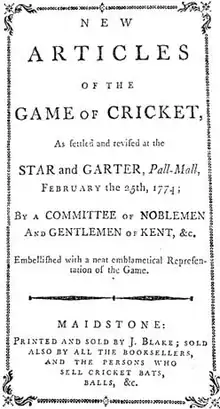
Image 8New articles of the game of cricket, 25 February 1774 (from Laws of Cricket)
Image 9In men's cricket the ball must weigh between 5.5 and 5.75 ounces (155.9 and 163 g) and measure between 8.81 and 9 in (22.4 and 22.9cm) in circumference. (from Laws of Cricket)
Image 10A wicket consists of three stumps, upright wooden poles that are hammered into the ground, topped with two wooden crosspieces, known as the bails. (from Laws of Cricket)
The International Cricket Council (ICC) is the international governing body of cricket, and produces team rankings for the various forms of cricket played internationally.
Test cricket is the longest form of cricket, played up to a maximum of five days with two innings per side.
Matches is the number of matches played in the 12–24 months since the May before last, plus half the number in the 24 months before that. See points calculations for more details.


.jpg.webp)


.jpg.webp)


_-_Google_Art_Project.jpg.webp)


.jpg.webp)



.svg.png.webp)


.svg.png.webp)


.svg.png.webp)


.svg.png.webp)


.svg.png.webp)


