Portal:Cuba

Welcome to the Cuba Portal Location of Cuba in the Caribbean
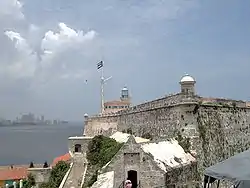
Cuba (/ˈkjuːbə/ ( Cuba is one of a few extant Marxist–Leninist one-party socialist states, in which the role of the vanguard Communist Party is enshrined in the Constitution. Cuba has an authoritarian regime where political opposition is not permitted. Censorship of information (including limits to Internet access) is extensive, and independent journalism is repressed in Cuba; Reporters Without Borders has characterized Cuba as one of the worst countries in the world for press freedom. Cuba is a founding member of the United Nations, G77, Non-Aligned Movement, Organisation of African, Caribbean and Pacific States, ALBA, and Organization of American States. It has currently one of the world's few planned economies, and its economy is dominated by the tourism industry and the exports of skilled labor, sugar, tobacco, and coffee. Cuba has historically—both before and during communist rule—performed better than other countries in the region on several socioeconomic indicators, such as literacy, infant mortality and life expectancy. (Full article...) Selected article - Cuba's provinces as shown on a 1910s map Oriente ([oˈɾjẽn̪.t̪e], "East") was the easternmost province of Cuba until 1976. The term "Oriente" is still used to refer to the eastern part of the country, which currently is divided into five different provinces. Fidel and Raúl Castro were born in a small town in this province (Birán). The origins of Oriente lie in the 1607 division of Cuba into a western and eastern administration. The eastern part was governed from Santiago de Cuba and it was subordinate to the national government in Havana. In 1807, Cuba was divided into three departamentos: Occidental, Central and Oriental. This arrangement lasted until 1851, when the central department was merged back into the West. In 1878, Cuba was divided into six provinces. Oriente remained intact but was officially renamed to Santiago de Cuba Province until the name was reverted to Oriente in 1905. This lasted until 1976, when the province was split into five different provinces: Las Tunas Province, Granma Province, Holguín Province, Santiago de Cuba Province, and Guantánamo Province. This administrative change was proclaimed by Cuban Law Number 1304 of July 3, 1976, and remains in place to this day. (Full article...)General imagesThe following are images from various Cuba-related articles on Wikipedia.
Did you know (auto-generated)
| |||||||||||||||||||||||||||||||||||||||||||||||||||||




 Watercolour painting by Jacques Barraband, ca. 1800 |
The Cuban macaw or Cuban red macaw (Ara tricolor) is an extinct species of macaw native to the main island of Cuba and the nearby Isla de la Juventud. It became extinct in the late 19th century. Its relationship with other macaws in its genus was long uncertain, but it was thought to have been closely related to the scarlet macaw, which has some similarities in appearance. It may also have been closely related, or identical, to the hypothetical Jamaican red macaw. A 2018 DNA study found that it was the sister species of two red and two green species of extant macaws.
At about 45–50 centimetres (18–20 in) long, the Cuban macaw was one of the smallest macaws. It had a red, orange, yellow, and white head, and a red, orange, green, brown, and blue body. Little is known of its behaviour, but it is reported to have nested in hollow trees, lived in pairs or families, and fed on seeds and fruits. The species' original distribution on Cuba is unknown, but it may have been restricted to the central and western parts of the island. It was mainly reported from the vast Zapata Swamp, where it inhabited open terrain with scattered trees. (Full article...)Selected biography -
Pedro Pablo Zamora (born Pedro Pablo Zamora y Díaz, February 29, 1972 – November 11, 1994) was a Cuban-American AIDS educator and television personality. As one of the first openly gay men with AIDS to be portrayed in popular media, Zamora brought international attention to HIV/AIDS and LGBTQ issues and prejudices through his appearance on MTV's reality television series, The Real World: San Francisco.
Zamora's romantic relationship with Sean Sasser was also documented on the show; their relationship was later nominated by MTV viewers for "Favorite Love Story" award, and the broadcast of their commitment ceremony in 1994, in which they exchanged vows, was the first such same-sex ceremony in television history, and is considered a landmark in the history of the medium.
(Full article...)Selected picture

More did you know -

- ...that soon after the Cuban Revolution of 1959, Fidel Castro pledged to underwrite the debts of the Havana Sugar Kings baseball team, by playing an exhibition contest between his own pickup squad Los Barbudos ("The Bearded Ones") and a military police team?
- ...that when the Banking sector in Cuba came under the control of the new regime after the Cuban Revolution of 1959, Fidel Castro asked if there were an economista in the room during an inaugural meeting? And that Che Guevara put his hand up mistakenly believing the request was for a communista, and subsequently became President of the National Bank of Cuba?
- ...that the Guanajatabey were indigenous inhabitants of Cuba, that lived on the island since at least 1000 B.C.? And that they were forced to the western point of the island by the arrival of the Ciboney people?
- ...that Eastern Cuban cuisine forms the basis of criollo cooking, which shares a great deal of recipes with other Caribbean cuisines, but has the distinctive difference of making almost no use of peppers?
- ...that Women in Cuba currently hold 35% of the parliamentary seats in the Cuban National Assembly ranking sixth of 162 countries behind Rwanda, Sweden, Norway, Finland and Denmark on issues of female participation in political life?
| More did you know... | New articles... |
Topics
 Cuba topics Cuba topics | |||||||||
|---|---|---|---|---|---|---|---|---|---|
| |||||||||
| |||||||||
| |||||||||
| |||||||||
| |||||||||

Categories

Quote of the day
| “ | For what is the story of [Latin] America if not a chronicle of the marvellous in the real. | ” |
Cuban writer, Alejo Carpentier.
Things you can do

Wikipedia's maxim is that anyone can edit. If you are interested in Cuba and have useful information that would form a new article or would enhance an existing article, please feel free to take part. Here are some tasks you can do to help with WikiProject Cuba:
Task list
- New article announcements:
- Requests: 1933 Cuban coup d'état, Ambrosio Cave, Calero Cave, Cementerio de Santa Ifigenia, Centella Cave, Consejo popular (Cuba), Cuba and the United Nations, Cuban Liberation Army, Cuevas de Punta del Este, Cura Cave, Patana Cave, Pluma Cave
- Stubs: Alberto Yarini, Celia Sánchez, Dollar store (Cuba), Sport in Cuba
- Verify: History of Cuba, Fulgencio Batista
- Update: Nochebuena
- NPOV: Armando Valladares, Delfín Fernández, History of Cuba
- Copyedit: Armando Peraza, Bay of Pigs Invasion, Fabio Grobart, Julio Antonio Mella
- Cleanup: Abelardo Colomé Ibarra, Antonio Maceo Grajales, Bay of Pigs Invasion, History of Cuba, List of Cubans, Máximo Gómez, War against the Bandits
- Style: Fidel Castro
- Expand: Cuba–Soviet Union relations, Baseball in Cuba, Religion in Cuba, Havana's International Book Fair, Cuba–Venezuela relations, Antonio Sánchez de Bustamante y Sirven
Related portals
WikiProjects
- Main WikiProject:
- WikiProject Cuba
- Other related WikiProjects:
- Geographical:
- Latin America countries: Argentina • Brazil • Colombia • Ecuador • Peru • Uruguay • Venezuela
- Caribbean: Dominican Republic • Puerto Rico
- Central America: El Salvador • Guatemala • Mexico
- North America: Canada • United States
- History and Society:
- African diaspora • Latinos • Mesoamerica
- Geographical:
Recognized content
Extended content | ||
|---|---|---|
Featured articlesGood articles
|


Associated Wikimedia
The following Wikimedia Foundation sister projects provide more on this subject:
-
 Commons
Free media repository -
 Wikibooks
Free textbooks and manuals -
 Wikidata
Free knowledge base -
 Wikinews
Free-content news -
 Wikiquote
Collection of quotations -
 Wikisource
Free-content library -
 Wikispecies
Directory of species -
 Wikiversity
Free learning tools -
 Wikivoyage
Free travel guide -
 Wiktionary
Dictionary and thesaurus
More portals
-
 List of all portalsList of all portals
 -
 The arts portal
 -
 Biography portal
 -
 Current events portal
 -
 Geography portal
 -
 History portal
 -
 Mathematics portal
 -
 Science portal
 -
 Society portal
 -
 Technology portal
 -
 Random portalRandom portal
 -
 WikiProject PortalsWikiProject Portals