Portal:Liberalism

The Liberalism portal
Liberalism is a political and moral philosophy based on the rights of the individual, liberty, consent of the governed, political equality and equality before the law. Liberals espouse various views depending on their understanding of these principles. However, they generally support private property, market economies, individual rights (including civil rights and human rights), liberal democracy, secularism, rule of law, economic and political freedom, freedom of speech, freedom of the press, freedom of assembly, and freedom of religion. Liberalism is frequently cited as the dominant ideology of modern times.
Liberalism became a distinct movement in the Age of Enlightenment, gaining popularity among Western philosophers and economists. Liberalism sought to replace the norms of hereditary privilege, state religion, absolute monarchy, the divine right of kings and traditional conservatism with representative democracy and the rule of law. Liberals also ended mercantilist policies, royal monopolies and other trade barriers, instead promoting free trade and marketization. Philosopher John Locke is often credited with founding liberalism as a distinct tradition based on the social contract, arguing that each man has a natural right to life, liberty and property, and governments must not violate these rights. While the British liberal tradition has emphasized expanding democracy, French liberalism has emphasized rejecting authoritarianism and is linked to nation-building. (Full article...)
Selected article -

The Liberal welfare reforms (1906–1914) were a series of acts of social legislation passed by the Liberal Party after the 1906 general election. They represent the emergence of the modern welfare state in the United Kingdom. The reforms demonstrate the split that had emerged within liberalism, between emerging social liberalism and classical liberalism, and a change in direction for the Liberal Party from laissez-faire traditional liberalism to a party advocating a larger, more active government protecting the welfare of its citizens.
The historian G. R. Searle argued that the reforms had multiple causes, including "the need to fend off the challenge of Labour; pure humanitarianism; the search for electoral popularity; considerations of National Efficiency; and a commitment to a modernised version of welfare capitalism." By implementing the reforms outside the English Poor Laws, the stigma attached to claiming relief was also removed. (Full article...)Selected biography -
 Portrait by Henry William Pickersgill |
Jeremy Bentham (/ˈbɛnθəm/; 4 February 1747/8 O.S. [15 February 1748 N.S.] – 6 June 1832) was an English philosopher, jurist, and social reformer regarded as the founder of modern utilitarianism.
Bentham defined as the "fundamental axiom" of his philosophy the principle that "it is the greatest happiness of the greatest number that is the measure of right and wrong." He became a leading theorist in Anglo-American philosophy of law, and a political radical whose ideas influenced the development of welfarism. He advocated individual and economic freedoms, the separation of church and state, freedom of expression, equal rights for women, the right to divorce, and (in an unpublished essay) the decriminalising of homosexual acts. He called for the abolition of slavery, capital punishment and physical punishment, including that of children. He has also become known as an early advocate of animal rights. Though strongly in favour of the extension of individual legal rights, he opposed the idea of natural law and natural rights (both of which are considered "divine" or "God-given" in origin), calling them "nonsense upon stilts". Bentham was also a sharp critic of legal fictions. (Full article...)List of selected biographies |
|---|
Selected quote
General images
 As a liberal nationalist, K. J. Ståhlberg (1865–1952), the President of Finland, anchored the state in liberal democracy, guarded the fragile germ of the rule of law, and embarked on internal reforms. (from Liberalism)
 John Maynard Keynes, one of the most influential economists of modern times and whose ideas, which are still widely felt, formalized modern liberal economic policy (from Liberalism)
 The Great Depression, with its periods of worldwide economic hardship, formed the backdrop against which the Keynesian Revolution took place (the image is Dorothea Lange's Migrant Mother depiction of destitute pea-pickers in California, taken in March 1936). (from Liberalism)
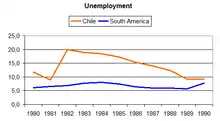 Unemployment in Chile and South America (1980–1990) (from Neoliberalism)
 Chilean (orange) and average Latin American (blue) rates of growth of GDP (1971–2007) (from Neoliberalism)
 Per capita income during the Great Depression (from Neoliberalism)
 Gustave de Molinari (from Liberalism)
%252C_%C3%A9crivain_et_homme_politique_-_P1679_-_Mus%C3%A9e_Carnavalet.jpg.webp) Benjamin Constant, a Franco-Swiss political activist and theorist (from Liberalism)
Benjamin Constant, a Franco-Swiss political activist and theorist (from Liberalism) United States incarceration rate per 100,000 population, 1925–2013 (from Neoliberalism)
 Member nations of the International Monetary Fund (from Neoliberalism)
.jpg.webp) The 2017–2018 Russian protests were organized by Russia's liberal opposition. (from Liberalism)
The 2017–2018 Russian protests were organized by Russia's liberal opposition. (from Liberalism).jpg.webp)
 Pamphlet calling for a protest of economic policy in 1983 following the economic crisis (from Neoliberalism)
 Wealth inequality in the United States increased from 1989 to 2013. (from Neoliberalism)
.png.webp) Sismondi, who wrote the first critique of the free market from a liberal perspective in 1819 (from Liberalism)
Sismondi, who wrote the first critique of the free market from a liberal perspective in 1819 (from Liberalism)
.jpg.webp) The European Union–Mercosur free trade agreement, which would form one of the world's largest free trade areas, has been denounced by environmental activists and indigenous rights campaigners. (from Neoliberalism)
The European Union–Mercosur free trade agreement, which would form one of the world's largest free trade areas, has been denounced by environmental activists and indigenous rights campaigners. (from Neoliberalism) Thomas Hill Green, an influential liberal philosopher who established in Prolegomena to Ethics (1884) the first major foundations for what later became known as positive liberty and in a few years, his ideas became the official policy of the Liberal Party in Britain, precipitating the rise of social liberalism and the modern welfare state (from Liberalism)
 Raif Badawi, a Saudi Arabian writer and the creator of the website Free Saudi Liberals, who was sentenced to ten years in prison and 1,000 lashes for "insulting Islam" in 2014 (from Liberalism)
 U.S. President Bush, Canadian PM Mulroney, and Mexican President Salinas participate in the ceremonies to sign the North American Free Trade Agreement (NAFTA). (from Neoliberalism)
 Franklin D. Roosevelt (from Liberalism)
_b_269.jpg.webp) Julius Faucher (from Liberalism)
Julius Faucher (from Liberalism) Builders in West Berlin, 1952 (from Neoliberalism)
 The iconic painting Liberty Leading the People by Eugène Delacroix, a tableau of the July Revolution in 1830 (from Liberalism)
 Ludwig Erhard (from Neoliberalism)
 GDP per capita in Chile and Latin America 1950–2010 (time under Pinochet highlighted) (from Neoliberalism)
 Friedrich Hayek (from Neoliberalism)
.jpg.webp) Execution of José María de Torrijos y Uriarte and his men in 1831 as Spanish King Ferdinand VII took repressive measures against the liberal forces in his country (from Liberalism)
Execution of José María de Torrijos y Uriarte and his men in 1831 as Spanish King Ferdinand VII took repressive measures against the liberal forces in his country (from Liberalism) John Locke was the first to develop a liberal philosophy, including the right to private property and the consent of the governed. (from Liberalism)
 Madame de Staël (from Liberalism)
Subcategories

Related portals
WikiProjects

- Liberalism task force
- WikiProject Human Rights
- WikiProject Philosophy
- WikiProject LGBT
What are WikiProjects?
Topics

Recognized content

 Featured articles
- Anarcho-capitalism
- Liberal Movement

Associated Wikimedia
The following Wikimedia Foundation sister projects provide more on this subject:
-
 Commons
Free media repository -
 Wikibooks
Free textbooks and manuals -
 Wikidata
Free knowledge base -
 Wikinews
Free-content news -
 Wikiquote
Collection of quotations -
 Wikisource
Free-content library -
 Wikiversity
Free learning tools -
 Wiktionary
Dictionary and thesaurus
-
 List of all portalsList of all portals
 -
 The arts portal
 -
 Biography portal
 -
 Current events portal
 -
 Geography portal
 -
 History portal
 -
 Mathematics portal
 -
 Science portal
 -
 Society portal
 -
 Technology portal
 -
 Random portalRandom portal
 -
 WikiProject PortalsWikiProject Portals