Portal:Minerals

The Minerals Portal
In geology and mineralogy, a mineral or mineral species is, broadly speaking, a solid chemical compound with a fairly well-defined chemical composition and a specific crystal structure that occurs naturally in pure form.
The geological definition of mineral normally excludes compounds that occur only in living organisms. However, some minerals are often biogenic (such as calcite) or are organic compounds in the sense of chemistry (such as mellite). Moreover, living organisms often synthesize inorganic minerals (such as hydroxylapatite) that also occur in rocks.
The concept of mineral is distinct from rock, which is any bulk solid geologic material that is relatively homogeneous at a large enough scale. A rock may consist of one type of mineral, or may be an aggregate of two or more different types of minerals, spacially segregated into distinct phases.
Some natural solid substances without a definite crystalline structure, such as opal or obsidian, are more properly called mineraloids. If a chemical compound occurs naturally with different crystal structures, each structure is considered a different mineral species. Thus, for example, quartz and stishovite are two different minerals consisting of the same compound, silicon dioxide. (Full article...)
Mineralogy is a subject of geology specializing in the scientific study of the chemistry, crystal structure, and physical (including optical) properties of minerals and mineralized artifacts. Specific studies within mineralogy include the processes of mineral origin and formation, classification of minerals, their geographical distribution, as well as their utilization. (Full article...)
Selected articles


Gypsum is a soft sulfate mineral composed of calcium sulfate dihydrate, with the chemical formula CaSO4·2H2O. It is widely mined and is used as a fertilizer and as the main constituent in many forms of plaster, blackboard or sidewalk chalk, and drywall. Alabaster, a fine-grained white or lightly tinted variety of gypsum, has been used for sculpture by many cultures including Ancient Egypt, Mesopotamia, Ancient Rome, the Byzantine Empire, and the Nottingham alabasters of Medieval England. Gypsum also crystallizes as translucent crystals of selenite. It forms as an evaporite mineral and as a hydration product of anhydrite.
The Mohs scale of mineral hardness defines gypsum as hardness value 2 based on scratch hardness comparison. (Full article...) Quartz crystal cluster from Tibet
Quartz is a hard, crystalline mineral composed of silica (silicon dioxide). The atoms are linked in a continuous framework of SiO4 silicon-oxygen tetrahedra, with each oxygen being shared between two tetrahedra, giving an overall chemical formula of SiO2. Quartz is the second most abundant mineral in Earth's continental crust, behind feldspar.
Quartz exists in two forms, the normal α-quartz and the high-temperature β-quartz, both of which are chiral. The transformation from α-quartz to β-quartz takes place abruptly at 573 °C (846 K; 1,063 °F). Since the transformation is accompanied by a significant change in volume, it can easily induce microfracturing of ceramics or rocks passing through this temperature threshold.
There are many different varieties of quartz, several of which are classified as gemstones. Since antiquity, varieties of quartz have been the most commonly used minerals in the making of jewelry and hardstone carvings, especially in Eurasia.
Quartz is the mineral defining the value of 7 on the Mohs scale of hardness, a qualitative scratch method for determining the hardness of a material to abrasion. (Full article...) Mineralogy applies principles of chemistry, geology, physics and materials science to the study of minerals
Mineralogy is a subject of geology specializing in the scientific study of the chemistry, crystal structure, and physical (including optical) properties of minerals and mineralized artifacts. Specific studies within mineralogy include the processes of mineral origin and formation, classification of minerals, their geographical distribution, as well as their utilization. (Full article...) Crystal structure of table salt (sodium in purple, chlorine in green)
In crystallography, crystal structure is a description of the ordered arrangement of atoms, ions, or molecules in a crystalline material. Ordered structures occur from the intrinsic nature of the constituent particles to form symmetric patterns that repeat along the principal directions of three-dimensional space in matter.
The smallest group of particles in the material that constitutes this repeating pattern is the unit cell of the structure. The unit cell completely reflects the symmetry and structure of the entire crystal, which is built up by repetitive translation of the unit cell along its principal axes. The translation vectors define the nodes of the Bravais lattice.
The lengths of the principal axes, or edges, of the unit cell and the angles between them are the lattice constants, also called lattice parameters or cell parameters. The symmetry properties of the crystal are described by the concept of space groups. All possible symmetric arrangements of particles in three-dimensional space may be described by the 230 space groups.
The crystal structure and symmetry play a critical role in determining many physical properties, such as cleavage, electronic band structure, and optical transparency. (Full article...) A sample of andesite (dark groundmass) with amygdaloidal vesicles filled with zeolite. Diameter of view is 8 cm.
Andesite (/ˈændəzaɪt/) is a volcanic rock of intermediate composition. In a general sense, it is the intermediate type between silica-poor basalt and silica-rich rhyolite. It is fine-grained (aphanitic) to porphyritic in texture, and is composed predominantly of sodium-rich plagioclase plus pyroxene or hornblende.
Andesite is the extrusive equivalent of plutonic diorite. Characteristic of subduction zones, andesite represents the dominant rock type in island arcs. The average composition of the continental crust is andesitic. Along with basalts, andesites are a component of the Martian crust.
The name andesite is derived from the Andes mountain range, where this rock type is found in abundance. It was first applied by Christian Leopold von Buch in 1826. (Full article...)
Asbestos (/æsˈbɛstəsˌæz-ˌ-tɒs/) is a naturally occurring fibrous silicate mineral. There are six types, all of which are composed of long and thin fibrous crystals, each fibre being composed of many microscopic "fibrils" that can be released into the atmosphere by abrasion and other processes. Inhalation of asbestos fibres can lead to various dangerous lung conditions, including mesothelioma, asbestosis, and lung cancer, so it is now notorious as a serious health and safety hazard.
Archaeological studies have found evidence of asbestos being used as far back as the Stone Age to strengthen ceramic pots, but large-scale mining began at the end of the 19th century when manufacturers and builders began using asbestos for its desirable physical properties. Asbestos is an excellent electrical insulator and is highly fire-resistant, so for much of the 20th century it was very commonly used across the world as a building material, until its adverse effects on human health were more widely acknowledged in the 1970s. Many modern buildings constructed before the 1980s are thought to contain asbestos.
The use of asbestos for construction and fireproofing has been made illegal in many countries. Despite this, at least 100,000 people are thought to die each year from diseases related to asbestos exposure. In part, this is because many older buildings still contain asbestos; in addition, the consequences of exposure can take decades to arise. The most common diseases associated with chronic asbestos exposure are asbestosis (scarring of the lungs due to asbestos inhalation) and mesothelioma (a type of cancer).
Many developing countries still support the use of asbestos as a building material, and mining of asbestos is ongoing, with the top producer, Russia, having an estimated production of 790,000 tonnes in 2020. (Full article...) Deep green isolated fluorite crystal resembling a truncated octahedron, set upon a micaceous matrix, from Erongo Mountain, Erongo Region, Namibia (overall size: 50 mm × 27 mm, crystal size: 19 mm wide, 30 g)
Fluorite (also called fluorspar) is the mineral form of calcium fluoride, CaF2. It belongs to the halide minerals. It crystallizes in isometric cubic habit, although octahedral and more complex isometric forms are not uncommon.
The Mohs scale of mineral hardness, based on scratch hardness comparison, defines value 4 as fluorite.
Pure fluorite is colourless and transparent, both in visible and ultraviolet light, but impurities usually make it a colorful mineral and the stone has ornamental and lapidary uses. Industrially, fluorite is used as a flux for smelting, and in the production of certain glasses and enamels. The purest grades of fluorite are a source of fluoride for hydrofluoric acid manufacture, which is the intermediate source of most fluorine-containing fine chemicals. Optically clear transparent fluorite lenses have low dispersion, so lenses made from it exhibit less chromatic aberration, making them valuable in microscopes and telescopes. Fluorite optics are also usable in the far-ultraviolet and mid-infrared ranges, where conventional glasses are too opaque for use. (Full article...)
Beryl (/ˈbɛrəl/ BERR-əl) is a mineral composed of beryllium aluminium silicate with the chemical formula Be3Al2Si6O18. Well-known varieties of beryl include emerald and aquamarine. Naturally occurring, hexagonal crystals of beryl can be up to several meters in size, but terminated crystals are relatively rare. Pure beryl is colorless, but it is frequently tinted by impurities; possible colors are green, blue, yellow, pink, and red (the rarest). It is an ore source of beryllium. (Full article...) A crystalline solid: atomic resolution image of strontium titanate. Brighter spots are columns of strontium atoms and darker ones are titanium-oxygen columns.
Crystallography is the experimental science of determining the arrangement of atoms in crystalline solids. Crystallography is a fundamental subject in the fields of materials science and solid-state physics (condensed matter physics). The word "crystallography" is derived from the Greek word κρύσταλλος (krystallos) "clear ice, rock-crystal", with its meaning extending to all solids with some degree of transparency, and γράφειν (graphein) "to write". In July 2012, the United Nations recognised the importance of the science of crystallography by proclaiming that 2014 would be the International Year of Crystallography.
Before the development of X-ray diffraction crystallography (see below), the study of crystals was based on physical measurements of their geometry using a goniometer. This involved measuring the angles of crystal faces relative to each other and to theoretical reference axes (crystallographic axes), and establishing the symmetry of the crystal in question. The position in 3D space of each crystal face is plotted on a stereographic net such as a Wulff net or Lambert net. The pole to each face is plotted on the net. Each point is labelled with its Miller index. The final plot allows the symmetry of the crystal to be established.
Crystallographic methods now depend on analysis of the diffraction patterns of a sample targeted by a beam of some type. X-rays are most commonly used; other beams used include electrons or neutrons. Crystallographers often explicitly state the type of beam used, as in the terms X-ray crystallography, neutron diffraction and electron diffraction. These three types of radiation interact with the specimen in different ways.- X-rays interact with the spatial distribution of electrons in the sample.
- Electrons are charged particles and therefore interact with the total charge distribution of both the atomic nuclei and the electrons of the sample.
- Neutrons are scattered by the atomic nuclei through the strong nuclear forces, but in addition, the magnetic moment of neutrons is non-zero. They are therefore also scattered by magnetic fields. When neutrons are scattered from hydrogen-containing materials, they produce diffraction patterns with high noise levels. However, the material can sometimes be treated to substitute deuterium for hydrogen. Because of these different forms of interaction, the three types of radiation are suitable for different crystallographic studies.
 Green fluorite with prominent cleavage
Cleavage, in mineralogy and materials science, is the tendency of crystalline materials to split along definite crystallographic structural planes. These planes of relative weakness are a result of the regular locations of atoms and ions in the crystal, which create smooth repeating surfaces that are visible both in the microscope and to the naked eye. If bonds in certain directions are weaker than others, the crystal will tend to split along the weakly bonded planes. These flat breaks are termed "cleavage." The classic example of cleavage is mica, which cleaves in a single direction along the basal pinacoid, making the layers seem like pages in a book. In fact, mineralogists often refer to "books of mica."
Diamond and graphite provide examples of cleavage. Both are composed solely of a single element, carbon. But in diamond, each carbon atom is bonded to four others in a tetrahedral pattern with short covalent bonds. The planes of weakness (cleavage planes) in a diamond are in four directions, following the faces of the octahedron.
In graphite, carbon atoms are contained in layers in a hexagonal pattern where the covalent bonds are shorter (and thus even stronger) than those of diamond. However, each layer is connected to the other with a longer and much weaker van der Waals bond. This gives graphite a single direction of cleavage, parallel to the basal pinacoid. So weak is this bond that it is broken with little force, giving graphite a slippery feel as layers shear apart. As a result, graphite makes an excellent dry lubricant.
While all single crystals will show some tendency to split along atomic planes in their crystal structure, if the differences between one direction or another are not large enough, the mineral will not display cleavage. Corundum, for example, displays no cleavage. (Full article...)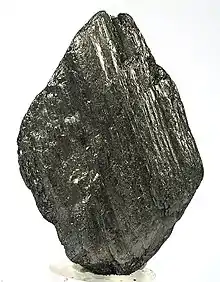 Graphite specimen
Graphite (/ˈɡræfaɪt/) is a crystalline form of the element carbon. It consists of stacked layers of graphene. Graphite occurs naturally and is the most stable form of carbon under standard conditions. Synthetic and natural graphite are consumed on large scale (300 kton/year, in 1989) for uses in pencils, lubricants, and electrodes. Under high pressures and temperatures it converts to diamond. It is a weak conductor of heat and electricity. (Full article...) Malachite from the Democratic Republic of the Congo
Malachite is a copper carbonate hydroxide mineral, with the formula Cu2CO3(OH)2. This opaque, green-banded mineral crystallizes in the monoclinic crystal system, and most often forms botryoidal, fibrous, or stalagmitic masses, in fractures and deep, underground spaces, where the water table and hydrothermal fluids provide the means for chemical precipitation. Individual crystals are rare, but occur as slender to acicular prisms. Pseudomorphs after more tabular or blocky azurite crystals also occur. (Full article...)
Borax is a salt (ionic compound), a hydrated borate of sodium, with the chemical formula Na2H20B4O17 often written Na2B4O7·10H2O. It is a colorless crystalline solid, that dissolves in water to make a basic solution. It is commonly available in powder or granular form and has many industrial and household uses, including as a pesticide, as a metal soldering flux, as a component of glass, enamel, and pottery glazes, for tanning of skins and hides, for artificial aging of wood, as a preservative against wood fungus, and as a pharmaceutic alkalizer. In chemical laboratories, it is used as a buffering agent.
The compound is often called sodium tetraborate decahydrate, but that name is not consistent with its structure. The anion is not tetraborate [B4O7]2− but tetrahydroxy tetraborate [B4O5(OH)4]2−, so the more correct formula should be Na2B4O5(OH)4·8H2O. Informally, the product is often called sodium borate decahydrate or just sodium borate.
The terms tincal /ˈtɪŋkəl/ "tinkle" and tincar /ˈtɪŋkər/ "tinker" refer to native borax, historically mined from dry lake beds in various parts of Asia. (Full article...)
Cinnabar (/ˈsɪnəˌbɑːr/; from Ancient Greek κιννάβαρι (kinnábari)), or cinnabarite (/ˌsɪnəˈbɑːraɪt/), is the bright scarlet to brick-red form of mercury(II) sulfide (HgS). It is the most common source ore for refining elemental mercury and is the historic source for the brilliant red or scarlet pigment termed vermilion and associated red mercury pigments.
Cinnabar generally occurs as a vein-filling mineral associated with recent volcanic activity and alkaline hot springs. The mineral resembles quartz in symmetry and in its exhibiting birefringence. Cinnabar has a mean refractive index near 3.2, a hardness between 2.0 and 2.5, and a specific gravity of approximately 8.1. The color and properties derive from a structure that is a hexagonal crystalline lattice belonging to the trigonal crystal system, crystals that sometimes exhibit twinning.
Cinnabar has been used for its color since antiquity in the Near East, including as a rouge-type cosmetic, in the New World since the Olmec culture, and in China since as early as the Yangshao culture, where it was used in coloring stoneware.
Associated modern precautions for use and handling of cinnabar arise from the toxicity of the mercury component, which was recognized as early as ancient Rome. (Full article...)
Corundum is a crystalline form of aluminium oxide (Al2O3) typically containing traces of iron, titanium, vanadium and chromium. It is a rock-forming mineral. It is a naturally transparent material, but can have different colors depending on the presence of transition metal impurities in its crystalline structure. Corundum has two primary gem varieties: ruby and sapphire. Rubies are red due to the presence of chromium, and sapphires exhibit a range of colors depending on what transition metal is present. A rare type of sapphire, padparadscha sapphire, is pink-orange.
The name "corundum" is derived from the Tamil-Dravidian word kurundam (ruby-sapphire) (appearing in Sanskrit as kuruvinda).
Because of corundum's hardness (pure corundum is defined to have 9.0 on the Mohs scale), it can scratch almost all other minerals. It is commonly used as an abrasive on sandpaper and on large tools used in machining metals, plastics, and wood. Emery, a variety of corundum with no value as a gemstone, is commonly used as an abrasive. It is a black granular form of corundum, in which the mineral is intimately mixed with magnetite, hematite, or hercynite.
In addition to its hardness, corundum has a density of 4.02 g/cm3 (251 lb/cu ft), which is unusually high for a transparent mineral composed of the low-atomic mass elements aluminium and oxygen. (Full article...)
Garnets ( /ˈɡɑːrnɪt/) are a group of silicate minerals that have been used since the Bronze Age as gemstones and abrasives.
All species of garnets possess similar physical properties and crystal forms, but differ in chemical composition. The different species are pyrope, almandine, spessartine, grossular (varieties of which are hessonite or cinnamon-stone and tsavorite), uvarovite and andradite. The garnets make up two solid solution series: pyrope-almandine-spessartine (pyralspite), with the composition range [Mg,Fe,Mn]3Al2(SiO4)3; and uvarovite-grossular-andradite (ugrandite), with the composition range Ca3[Cr,Al,Fe]2(SiO4)3. (Full article...)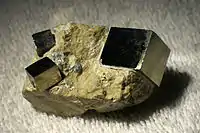 A rock containing three crystals of pyrite (FeS2). The crystal structure of pyrite is primitive cubic, and this is reflected in the cubic symmetry of its natural crystal facets.
In crystallography, the cubic (or isometric) crystal system is a crystal system where the unit cell is in the shape of a cube. This is one of the most common and simplest shapes found in crystals and minerals.
There are three main varieties of these crystals:- Primitive cubic (abbreviated cP and alternatively called simple cubic)
- Body-centered cubic (abbreviated cI or bcc)
- Face-centered cubic (abbreviated cF or fcc)
Note: the term fcc is often used in synonym for the cubic close-packed or ccp structure occurring in metals. However,fcc stands for a face-centered-cubic Bravais lattice, which is not necessarily close-packed when a motif is set onto the lattice points. E.g. the diamond and the zincblende lattices are fcc but not close-packed.
Each is subdivided into other variants listed below. Although the unit cells in these crystals are conventionally taken to be cubes, the primitive unit cells often are not. (Full article...)- Zeolites are microporous, crystalline aluminosilicate materials commonly used as commercial adsorbents and catalysts. They mainly consist of silicon, aluminium, oxygen, and have the general formula Mn+
1/n(AlO
2)−
(SiO
2)
x・yH
2O where Mn+
1/n is either a metal ion or H+. These positive ions can be exchanged for others in a contacting electrolyte solution. H+
exchanged zeolites are particularly useful as solid acid catalysts.
The term zeolite was originally coined in 1756 by Swedish mineralogist Axel Fredrik Cronstedt, who observed that rapidly heating a material, believed to have been stilbite, produced large amounts of steam from water that had been adsorbed by the material. Based on this, he called the material zeolite, from the Greek ζέω (zéō), meaning "to boil" and λίθος (líthos), meaning "stone".
Zeolites occur naturally but are also produced industrially on a large scale. , 253 unique zeolite frameworks have been identified, and over 40 naturally occurring zeolite frameworks are known. Every new zeolite structure that is obtained is examined by the International Zeolite Association Structure Commission (IZA-SC) and receives a three letter designation. (Full article...) 
Rutile is an oxide mineral composed of titanium dioxide (TiO2), the most common natural form of TiO2. Rarer polymorphs of TiO2 are known, including anatase, akaogiite, and brookite.
Rutile has one of the highest refractive indices at visible wavelengths of any known crystal and also exhibits a particularly large birefringence and high dispersion. Owing to these properties, it is useful for the manufacture of certain optical elements, especially polarization optics, for longer visible and infrared wavelengths up to about 4.5 micrometres. Natural rutile may contain up to 10% iron and significant amounts of niobium and tantalum.
Rutile derives its name from the Latin rutilus ('red'), in reference to the deep red color observed in some specimens when viewed by transmitted light. Rutile was first described in 1803 by Abraham Gottlob Werner using specimens obtained in Horcajuelo de la Sierra, Madrid (Spain), which is consequently the type locality. (Full article...) Intergrowth of lustrous, cubic crystals of pyrite, with some surfaces showing characteristic striations, from Huanzala mine, Ancash, Peru. Specimen size: 7.0 × 5.0 × 2.5 cm
The mineral pyrite (/ˈpaɪraɪt/), or iron pyrite, also known as fool's gold, is an iron sulfide with the chemical formula FeS2 (iron (II) disulfide). Pyrite is the most abundant sulfide mineral.
Pyrite's metallic luster and pale brass-yellow hue give it a superficial resemblance to gold, hence the well-known nickname of fool's gold. The color has also led to the nicknames brass, brazzle, and Brazil, primarily used to refer to pyrite found in coal.
The name pyrite is derived from the Greek πυρίτης λίθος (pyritēs lithos), 'stone or mineral which strikes fire', in turn from πῦρ (pyr), 'fire'. In ancient Roman times, this name was applied to several types of stone that would create sparks when struck against steel; Pliny the Elder described one of them as being brassy, almost certainly a reference to what we now call pyrite.
By Georgius Agricola's time, c. 1550, the term had become a generic term for all of the sulfide minerals. (Full article...) The Needles, situated off the Isle of Wight, are part of the extensive Southern England Chalk Formation.
Chalk is a soft, white, porous, sedimentary carbonate rock. It is a form of limestone composed of the mineral calcite and originally formed deep under the sea by the compression of microscopic plankton that had settled to the sea floor. Chalk is common throughout Western Europe, where deposits underlie parts of France, and steep cliffs are often seen where they meet the sea in places such as the Dover cliffs on the Kent coast of the English Channel.
Chalk is mined for use in industry, such as for quicklime, bricks and builder's putty, and in agriculture, for raising pH in soils with high acidity. It is also used for "blackboard chalk" for writing and drawing on various types of surfaces, although these can also be manufactured from other carbonate-based minerals, or gypsum. (Full article...) The slightly misshapen octahedral shape of this rough diamond crystal in matrix is typical of the mineral. Its lustrous faces also indicate that this crystal is from a primary deposit.
Diamond is a solid form of the element carbon with its atoms arranged in a crystal structure called diamond cubic. Another solid form of carbon known as graphite is the chemically stable form of carbon at room temperature and pressure, but diamond is metastable and converts to it at a negligible rate under those conditions. Diamond has the highest hardness and thermal conductivity of any natural material, properties that are used in major industrial applications such as cutting and polishing tools. They are also the reason that diamond anvil cells can subject materials to pressures found deep in the Earth.
Because the arrangement of atoms in diamond is extremely rigid, few types of impurity can contaminate it (two exceptions are boron and nitrogen). Small numbers of defects or impurities (about one per million of lattice atoms) color diamond blue (boron), yellow (nitrogen), brown (defects), green (radiation exposure), purple, pink, orange, or red. Diamond also has a very high refractive index and a relatively high optical dispersion.
Most natural diamonds have ages between 1 billion and 3.5 billion years. Most were formed at depths between 150 and 250 kilometres (93 and 155 mi) in the Earth's mantle, although a few have come from as deep as 800 kilometres (500 mi). Under high pressure and temperature, carbon-containing fluids dissolved various minerals and replaced them with diamonds. Much more recently (hundreds to tens of million years ago), they were carried to the surface in volcanic eruptions and deposited in igneous rocks known as kimberlites and lamproites.
Synthetic diamonds can be grown from high-purity carbon under high pressures and temperatures or from hydrocarbon gases by chemical vapor deposition (CVD). Imitation diamonds can also be made out of materials such as cubic zirconia and silicon carbide. Natural, synthetic and imitation diamonds are most commonly distinguished using optical techniques or thermal conductivity measurements. (Full article...) Brazilian trigonal hematite crystal
Hematite (/ˈhiːməˌtaɪt, ˈhɛmə-/), also spelled as haematite, is a common iron oxide compound with the formula, Fe2O3 and is widely found in rocks and soils. Hematite crystals belong to the rhombohedral lattice system which is designated the alpha polymorph of Fe
2O
3. It has the same crystal structure as corundum (Al
2O
3) and ilmenite (FeTiO
3). With this it forms a complete solid solution at temperatures above 950 °C (1,740 °F).
Hematite naturally occurs in black to steel or silver-gray, brown to reddish-brown, or red colors. It is mined as an important ore mineral of iron. It is electrically conductive. Hematite varieties include kidney ore, martite (pseudomorphs after magnetite), iron rose and specularite (specular hematite). While these forms vary, they all have a rust-red streak. Hematite is not only harder than pure iron, but also much more brittle. Maghemite is a polymorph of hematite (γ-Fe
2O
3) with the same chemical formula, but with a spinel structure like magnetite.
Large deposits of hematite are found in banded iron formations. Gray hematite is typically found in places that have still, standing water or mineral hot springs, such as those in Yellowstone National Park in North America. The mineral can precipitate in the water and collect in layers at the bottom of the lake, spring, or other standing water. Hematite can also occur in the absence of water, usually as the result of volcanic activity.
Clay-sized hematite crystals can also occur as a secondary mineral formed by weathering processes in soil, and along with other iron oxides or oxyhydroxides such as goethite, which is responsible for the red color of many tropical, ancient, or otherwise highly weathered soils. (Full article...) A rich seam of iridescent opal encased in matrix
Opal is a hydrated amorphous form of silica (SiO2·nH2O); its water content may range from 3 to 21% by weight, but is usually between 6 and 10%. Due to its amorphous property, it is classified as a mineraloid, unlike crystalline forms of silica, which are considered minerals. It is deposited at a relatively low temperature and may occur in the fissures of almost any kind of rock, being most commonly found with limonite, sandstone, rhyolite, marl, and basalt.
The name opal is believed to be derived from the Sanskrit word upala (उपल), which means 'jewel', and later the Greek derivative opállios (ὀπάλλιος), which means 'to see a change in color'.
There are two broad classes of opal: precious and common. Precious opal displays play-of-color (iridescence); common opal does not. Play-of-color is defined as "a pseudo chromatic optical effect resulting in flashes of colored light from certain minerals, as they are turned in white light." The internal structure of precious opal causes it to diffract light, resulting in play-of-color. Depending on the conditions in which it formed, opal may be transparent, translucent, or opaque, and the background color may be white, black, or nearly any color of the visual spectrum. Black opal is considered the rarest, while white, gray, and green opals are the most common. (Full article...) The diamond crystal structure belongs to the face-centered cubic lattice, with a repeated two-atom pattern.
In crystallography, a crystal system is a set of point groups (a group of geometric symmetries with at least one fixed point). A lattice system is a set of Bravais lattices. Space groups are classified into crystal systems according to their point groups, and into lattice systems according to their Bravais lattices. Crystal systems that have space groups assigned to a common lattice system are combined into a crystal family.
The seven crystal systems are triclinic, monoclinic, orthorhombic, tetragonal, trigonal, hexagonal, and cubic. Informally, two crystals are in the same crystal system if they have similar symmetries (albeit there are many exceptions). (Full article...)
Selected mineralogist
 Sir H.Raeburn. Portrait of Sir G.S.Mackenzie,7th Bart. Size 63 x 41.5 in.
Sir George Steuart Mackenzie, 7th Baronet FRS FRSE FSA (22 June 1780–26 October 1848) was a Scottish geologist, chemist and agricultural improver. (Full article...)- John Sinkankas (May 15, 1915 – May 17, 2002) was a Navy officer and aviator, gemologist, gem carver and gem faceter, author of many books and articles on minerals and gemstones, and a bookseller and bibliographer of rare books. (Full article...)
- Martine de Bertereau, also known as Baroness de Beausoleil, (c. 1600 – after 1642) was the first recorded female mineralogist as well as mining engineer along with her husband, Jean de Chastelet. She traveled extensively throughout Europe in search of mineral deposits and fresh ground water under the employment of various nobles and royals. During the reign of the French King, Luis XIII, Martine and her husband surveyed the sites of potential mines in France. During one of their mining expeditions Martine and her family were accused of witchcraft and fled to Hungary. Later, Martine, her husband and oldest daughter were arrested and eventually died in prison sometime after 1642. During her life, she produced multiple pieces of literature derived largely from the Roman engineer Vitruvius's book on architecture, De architectura. Her writings describe the use of divining-rods, similar to dowsing, as well as other renowned scientific ideas. Martine de Bertereau was not forthcoming about her use of different scientific ideas, and preferred the public to believe she was using magic, or renowned ancient scientific ideas. Her success came from her development in the understanding of the geologic world around her. It is uncertain of her reasoning behind the decision to lie about her actual means of success. Her literature provides a unique glimpse into the craft and skills required to mine in the seventeenth century. (Full article...)
 Teachers of the Forestry Academy in Eberswalde (ca. 1868); Adolf Remelé, 3rd figure from the right (standing).
Adolf Karl Remelé (17 July 1839, Uerdingen – 16 November 1915, Eberswalde) was a German geologist and mineralogist.
He received his education at the University of Bonn, at the École des Mines in Paris and from the University of Berlin, receiving his doctorate in 1864 with the dissertation "De rubro uranico". In 1867 he qualified as a lecturer at Berlin, and during the following year, succeeded Lothar Meyer at the Forestry Academy in Eberswalde, where he taught classes in chemistry, geognosy and mineralogy. (Full article...)- Serve-Dieu Abailard "Armand" Lévy (14 November 1795 – 29 July 1841) was a French mathematician and mineralogist. He is remembered in the Haüy-Lévy notation for describing mineral crystal structures. (Full article...)
- Thorstein Hallager Hiortdahl (4 May 1839 – 29 October 1925) was a Norwegian chemist, mineralogist and politician. (Full article...)
 Thorstein Hiortdahl
 - Warren D. Huff (born April 16, 1937) is Professor of Geology at the University of Cincinnati (UC). He specializes in clay mineralogy, researching the remnants of ancient volcanic eruptions.
He received his BA from Harvard College, 1959 and his PhD from University of Cincinnati, 1963. He has served as assistant professor at UC 1963-1969, associate professor 1969-1985, full professor 1985 to date. He teaches introductory geology sequence. (Full article...)  G Rossman in his lab Dec 2020
George R. Rossman is an American mineralogist and the Professor of Mineralogy at the California Institute of Technology. (Full article...).jpg.webp)
Otto Wilhelm Hermann von Abich (11 December 1806 – 1 July 1886) was a German mineralogist and geologist. Full member of St Petersburg Academy of Sciences (hon. member since 1866). (Full article...)- Louis Jean-Pierre Cabri (born February 23, 1934 in Cairo) is an eminent Canadian scientist in the field of platinum group elements (PGE) mineralogy with expertise in precious metal mineralogy and base metals at the Canada Centre for Mineral and Energy Technology (CANMET). First as Research Scientist and later as Principal Scientist (1996–1999). In the 1970s he discovered two new Cu–Fe sulfide minerals, "mooihoekite" and "haycockite". In 1983 Russian mineralogists named a new mineral after him: cabriite (Pd2SnCu). (Full article...)
- Luca Bindi (born 1971) is an Italian geologist. He holds the Chair of Mineralogy and Crystallography and is the Head of the Department of Earth Sciences of the University of Florence. He is also a research associate at the Istituto di Geoscienze e Georisorse of the National Research Council (Italy) (CNR). He has received national and international scientific awards that include the President of the Republic Prize 2015 in the category of Physical, Mathematical and Natural Sciences. Since 2019 is a Member of the National Academy of Lincei.
Bindi is credited with the co-discovery of the first known natural quasicrystal, having identified a potential candidate from the mineral collection at the "Università di Firenze". The discovery ultimately showed that quasicrystals can form spontaneously in nature and remain stable for geological times. (Full article...) - Karl Hugo Strunz (24 February 1910 – 19 April 2006) was a German mineralogist. He is best known for creating the Nickel-Strunz classification, the ninth edition of which was published together with Ernest Henry Nickel. (Full article...)
.jpg.webp) Ernst Friedrich Germar
Ernst Friedrich Germar
Ernst Friedrich Germar (3 November 1786 – 8 July 1853) was a German professor and director of the Mineralogical Museum at Halle. As well as being a mineralogist he was interested in entomology and particularly in the Coleoptera and Hemiptera. He monographed the heteropteran family Scutelleridae.
In 1845, he was elected a foreign member of the Royal Swedish Academy of Sciences. (Full article...) Bust of Frederic Cailliaud
Frédéric Cailliaud (9 June 1787 – 1 May 1869) was a French naturalist, mineralogist and conchologist. He was born, and died, in Nantes, where he was the curator of the Natural History Museum of Nantes from 1836 to 1869.
He travelled in Egypt, Nubia, and Ethiopia, collecting minerals and making observations. He was a part of the military expedition that his patron Viceroy Muhammad Ali sent south to conquer the Kingdom of Sennar, but also marched further into Fazogli where Caillaud searched for outcroppings of gold while the commander Ismail, son of Muhammad Ali, enslaved locals and slaughtered all who resisted him. Although he failed to find any sizeable deposits of gold in the mountains along the modern Sudan-Ethiopia border, he did make a sufficiently detailed survey of the area to be published after he returned to France in 1827. (Full article...) Eilhard Mitscherlich (1794–1863)
Eilhard Mitscherlich (German pronunciation: [ˈaɪ̯lhaʁt ˈmɪtʃɐlɪç]; 7 January 1794 – 28 August 1863) was a German chemist, who is perhaps best remembered today for his discovery of the phenomenon of crystallographic isomorphism in 1819. (Full article...)- Frank Charles Schrader (October 6, 1860 – April 1944) was an American geologist, mineralogist, and entomologist.
Born in Sterling, Illinois he received degrees from the University of Kansas (BS and MS) and Harvard University (BA and MA), before teaching at Harvard. (Full article...) _p311_Adolf_Erik_Nordenski%C3%B6ld.jpg.webp) Adolf Erik Nordenskiöld
Adolf Erik Nordenskiöld
Nils Adolf Erik Nordenskiöld (18 November 1832 – 12 August 1901) was a Finland-Swedish aristocrat, geologist, mineralogist and Arctic explorer. He was a member of the Fenno-Swedish Nordenskiöld family of scientists and held the title of a friherre (baron).
Born in the Grand Duchy of Finland at the time it was a part of the Russian Empire, he was later, due to his political activity, forced to move to Sweden, where he later became a member of the Parliament of Sweden and of the Swedish Academy. He led the Vega Expedition along the northern coast of Eurasia in 1878–1879. This was the first complete crossing of the Northeast Passage. Initially a troubled enterprise, the successful expedition is considered to be among the highest achievements in the history of Swedish science. (Full article...)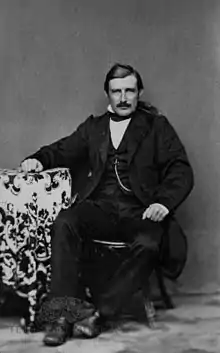
Tellef Dahll (10 April 1825, in Kragerø – 17 June 1893, in Morgedal) was a Norwegian mineralogist and geologist. (Full article...)- Peter John Wyllie (born 8 February 1930, in London, England) is a British petrologist and academic.
He was Professor of Geology at the California Institute of Technology from 1983 until his retirement in 1999. Prior to this, he held positions at the University of St Andrews (1955–56), Pennsylvania State University (1958–59 and 1961–66), the University of Leeds (1959–61), and the University of Chicago (1965–83). He is well known for his many contributions to the understanding of magmatism, particularly through his work on the experimental petrology of magmas and volatiles. In the early 1970s, Wyllie wrote two widely used textbooks; The Dynamic Earth (1971) and The Way the Earth Works (1976) which integrated the new understanding of magmatism and plate tectonics. He is also famous for his contributions to the coverage of earth sciences in the Encyclopædia Britannica, particularly his outline of the field in Part Two of the Propædia. Wyllie was President of the International Union of Geodesy and Geophysics (IUGG) from 1995 to 1999. (Full article...) 
Arnold Constantin Peter Franz von Lasaulx (14 June 1839 – 25 January 1886) was a German mineralogist and petrographer. (Full article...) André Laugier (1770–1832)
André Laugier (1 August 1770, in Lisieux – 19 April 1832, in Paris) was a French chemist, pharmacist and mineralogist. He was a cousin to famed chemist Antoine François Fourcroy and the father of astronomer Paul Auguste Ernest Laugier (1812–1872).
He received his education in his hometown of Lisieux, and during the French Revolution, was tasked with collecting church bells in Bretagne in order for them to be melted down for the production of cannons. In 1794 he was employed as head of the gunpowder and saltpeter works at the Comite de salut public. In 1797 he received his master's degree in pharmacy, and subsequently taught classes in chemistry and pharmacy at the military training schools in Toulon and Lille. (Full article...)- József Sándor Krenner or Joseph Krenner (3 March 1839 – 6 January 1920) was a Hungarian mineralogist. He discovered several new minerals.
Krenner was born in Buda and studied at the University of Pest, Vienna and Tübingen mineralogy and geology. He received his Ph.D. in 1865 for work with Friedrich August Quenstedt in Tübingen. Krenner worked in the mineralogy section of the Hungarian National Museum. From 1870 on he also lectured at the Technical University of Budapest. In 1888 he became a member of the Hungarian Academy of Science.
Krenner discovered several new minerals, for example, Krennerite which he discovered in 1877 in Sacaramb, Romania. The mineral is obviously named after himself. Another mineral he discovered was Semseyite, the lead antimony sulfide discovered in 1881 was named after Andor Semsey (1833–1923), a Hungarian nobleman and mineralogist. (Full article...)  Rev Dr John Walker, Edinburgh's Professor of Natural History
John Walker FRSE (1731–1803) was a Scottish minister and natural historian. He was Regius Professor of Natural history at the University of Edinburgh from 1779 to 1803. He was joint founder of the Royal Society of Edinburgh in 1783 and Moderator of the General Assembly of the Church of Scotland in 1790. (Full article...)- Günther Friedrich (15 April 1929 – 24 November 2014) was a German mineralogist and university professor at the RWTH University at Aachen. He was an expert in the field of the creation of marine Manganese nodule concretions. (Full article...)
Related portals
Get involved
For editor resources and to collaborate with other editors on improving Wikipedia's Minerals-related articles, see WikiProject Rocks and minerals.
General images
 Muscovite, a mineral species in the mica group, within the phyllosilicate subclass (from Mineral)
 Mohs hardness kit, containing one specimen of each mineral on the ten-point hardness scale (from Mohs scale)
 Pyrite (from Lustre (mineralogy))
- Diamond is the hardest natural material, and has a Mohs hardness of 10. (from Mineral)

 Pink cubic halite (NaCl; halide class) crystals on a nahcolite matrix (NaHCO3; a carbonate, and mineral form of sodium bicarbonate, used as baking soda). (from Mineral)
 Native gold. Rare specimen of stout crystals growing off of a central stalk, size 3.7 x 1.1 x 0.4 cm, from Venezuela. (from Mineral)
 Perfect basal cleavage as seen in biotite (black), and good cleavage seen in the matrix (pink orthoclase). (from Mineral)
 An example of elbaite, a species of tourmaline, with distinctive colour banding. (from Mineral)
 When minerals react, the products will sometimes assume the shape of the reagent; the product mineral is termed a pseudomorph of (or after) the reagent. Illustrated here is a pseudomorph of kaolinite after orthoclase. Here, the pseudomorph preserved the Carlsbad twinning common in orthoclase. (from Mineral)
 Gypsum desert rose (from Mineral)
 Hübnerite, the manganese-rich end-member of the wolframite series, with minor quartz in the background (from Mineral)
 Schist is a metamorphic rock characterized by an abundance of platy minerals. In this example, the rock has prominent sillimanite porphyroblasts as large as 3 cm (1.2 in). (from Mineral)
 Epidote often has a distinctive pistachio-green colour. (from Mineral)
 Black andradite, an end-member of the orthosilicate garnet group. (from Mineral)
 Sphalerite crystal partially encased in calcite from the Devonian Milwaukee Formation of Wisconsin (from Mineral)

 Red cinnabar (HgS), a mercury ore, on dolomite. (from Mineral)
Did you know ...?

- ... that leonite (pictured) has been found on Mars?
- ...that crystals of Paulingite, a rare zeolite mineral found in vesicles in the basaltic rocks from the Columbia River, form a perfect clear rhombic dodecahedron?
- ... that abernathyite is both fluorescent and radioactive and is named for the mine operator who discovered it?
Subcategories

- Select [►] to view subcategories
Topics
| Overview | | |
|---|---|---|
| Common minerals | ||
Gemmological classifications by E. Ya. Kievlenko (1980), updated | |||||||||
| Jewelry stones |
| ||||||||
| Jewelry-Industrial stones |
| ||||||||
| Industrial stones |
| ||||||||

Associated Wikimedia
The following Wikimedia Foundation sister projects provide more on this subject:
-
 Commons
Free media repository -
 Wikibooks
Free textbooks and manuals -
 Wikidata
Free knowledge base -
 Wikinews
Free-content news -
 Wikiquote
Collection of quotations -
 Wikisource
Free-content library -
 Wikiversity
Free learning tools -
 Wiktionary
Dictionary and thesaurus
References
-
 List of all portalsList of all portals
 -
 The arts portal
 -
 Biography portal
 -
 Current events portal
 -
 Geography portal
 -
 History portal
 -
 Mathematics portal
 -
 Science portal
 -
 Society portal
 -
 Technology portal
 -
 Random portalRandom portal
 -
 WikiProject PortalsWikiProject Portals