< Portal:Scotland
Portal:Scotland/Selected articles
The Scotland Portal
_-_Banner.jpg.webp)
| Main Page | Selected articles | Selected biographies | Selected quotes | Selected pictures | Featured Content | Categories & Topics |
Featured articles


 This painting by John Rogers Herbert depicts a particularly controversial speech before the Assembly by Philip Nye against presbyterian church government.
The Westminster Assembly of Divines was a council of divines (theologians) and members of the English Parliament appointed from 1643 to 1653 to restructure the Church of England. Several Scots also attended, and the Assembly's work was adopted by the Church of Scotland. As many as 121 ministers were called to the Assembly, with nineteen others added later to replace those who did not attend or could no longer attend. It produced a new Form of Church Government, a Confession of Faith or statement of belief, two catechisms or manuals for religious instruction (Shorter and Larger), and a liturgical manual, the Directory for Public Worship, for the Churches of England and Scotland. The Confession and catechisms were adopted as doctrinal standards in the Church of Scotland and other Presbyterian churches, where they remain normative. Amended versions of the Confession were also adopted in Congregational and Baptist churches in England and New England in the seventeenth and eighteenth centuries. The Confession became influential throughout the English-speaking world, but especially in American Protestant theology.
The Assembly was called by the Long Parliament before and during the beginning of the First English Civil War. The Long Parliament was influenced by Puritanism, a religious movement which sought to further reform the church. They were opposed to the religious policies of King Charles I and William Laud, Archbishop of Canterbury. As part of a military alliance with Scotland, Parliament agreed that the outcome of the Assembly would bring the English Church into closer conformity with the Church of Scotland. The Scottish Church was governed by a system of elected assemblies of elders called presbyterianism, rather than rule by bishops, called episcopalianism, which was used in the English church. Scottish commissioners attended and advised the Assembly as part of the agreement. Disagreements over church government caused open division in the Assembly, despite attempts to maintain unity. The party of divines who favoured presbyterianism was in the majority, but the congregationalist party, which held greater influence in the military, favoured autonomy for individual congregations rather than the subjection of congregations to regional and national assemblies entailed in presbyterianism. Parliament eventually adopted a presbyterian form of government but lacked the power to implement it. During the Restoration of the monarchy in 1660, all of the documents of the Assembly were repudiated and episcopal church government was reinstated in England. (Full article...) The Kelpie by Herbert James Draper, 1913
A kelpie, or water kelpie (Scottish Gaelic: Each-Uisge), is a shape-shifting spirit inhabiting lochs in Scottish folklore. It is usually described as a black horse-like creature, able to adopt human form. Some accounts state that the kelpie retains its hooves when appearing as a human, leading to its association with the Christian idea of Satan as alluded to by Robert Burns in his 1786 poem "Address to the Devil".
Almost every sizeable body of water in Scotland has an associated kelpie story, but the most extensively reported is that of Loch Ness. The kelpie has counterparts across the world, such as the Germanic nixie, the wihwin of South America and the Australian bunyip. The origins of narratives about the creature are unclear but the practical purpose of keeping children away from dangerous stretches of water and warning young women to be wary of handsome strangers has been noted in secondary literature. (Full article...)_-_March_17%252C_1924.jpg.webp) Hood, 17 March 1924
Hood, 17 March 1924
HMS Hood (pennant number 51) was a battlecruiser of the Royal Navy (RN). Hood was the first of the planned four Admiral-class battlecruisers to be built during the First World War. Already under construction when the Battle of Jutland occurred in mid-1916, that battle revealed serious flaws in her design despite drastic revisions before she was completed four years later. For this reason, she was the only ship of her class to be completed, as the Admiralty decided it would be better to start with a clean design on succeeding battlecruisers, leading to the never-built G-3 class. Despite the appearance of newer and more modern ships, Hood remained the largest warship in the world for 20 years after her commissioning, and her prestige was reflected in her nickname, "The Mighty Hood".
Hood was involved in many showing-the-flag exercises between her commissioning in 1920 and the outbreak of war in 1939, including training exercises in the Mediterranean Sea and a circumnavigation of the globe with the Special Service Squadron in 1923 and 1924. She was attached to the Mediterranean Fleet following the outbreak of the Second Italo-Ethiopian War in 1935. When the Spanish Civil War broke out the following year, Hood was officially assigned to the Mediterranean Fleet until she had to return to Britain in 1939 for an overhaul. By this time, advances in naval gunnery had reduced Hood's usefulness. She was scheduled to undergo a major rebuild in 1941 to correct these issues, but the outbreak of the Second World War in September 1939 kept the ship in service without the upgrades. (Full article...)- Cullen House is a large house, about 1 kilometre (0.6 mi) south-west of the coastal town of Cullen in Moray, Scotland. It was the seat of the Ogilvies of Findlater, who went on to become the Earls of Findlater and Seafield, and it remained in their family until 1982. Building work started on the house in 1600, incorporating some of the stonework of an earlier building on the site. The house has been extended and remodelled several times by prominent architects such as James Adam, John Adam, and David Bryce. It has been described by the architectural historian Charles McKean as "one of the grandest houses in Scotland" and is designated a Category A listed building. The grounds were enlarged in the 1820s when the entire village of Cullen, save for Cullen Old Church, was demolished to make way for improvements to the grounds by Lewis Grant-Ogilvy, 5th Earl of Seafield; a new village, closer to the coast, was constructed for the inhabitants. Within the grounds are a bridge, a rotunda and a gatehouse, each of which is individually listed as a Category A structure.
Twice in its history, the house has been captured and ransacked. It was taken by forces acting under the orders of the Marquess of Montrose in 1645 during the Wars of the Three Kingdoms. It was attacked again by Jacobite forces during the rising of 1745, shortly before they were defeated at the Battle of Culloden. (Full article...)  Street view of the Scottish Parliament building and adjacent pool
The Scottish Parliament Building (Scottish Gaelic: Pàrlamaid na h-Alba; Scots: Scots Pairlament Biggin) is the home of the Scottish Parliament at Holyrood, within the UNESCO World Heritage Site in central Edinburgh. Construction of the building commenced in June 1999 and the Members of the Scottish Parliament (MSPs) held their first debate in the new building on 7 September 2004. The formal opening by Queen Elizabeth II took place on 9 October 2004. Enric Miralles, the Spanish architect who designed the building, died before its completion.
From 1999 until the opening of the new building in 2004, committee rooms and the debating chamber of the Scottish Parliament were housed in the General Assembly Hall of the Church of Scotland located on The Mound in Edinburgh. Office and administrative accommodation in support of the Parliament were provided in buildings leased from the City of Edinburgh Council. The new Scottish Parliament Building brought together these different elements into one purpose-built parliamentary complex, housing 129 MSPs and more than 1,000 staff and civil servants. (Full article...) Portrait of Lady Grange by Sir John Baptiste de Medina c. 1710
Rachel Chiesley (baptised 4 February 1679 – 12 May 1745), usually known as Lady Grange, was the wife of Lord Grange, a Scottish lawyer with Jacobite sympathies. After 25 years of marriage and nine children, the Granges separated acrimoniously. When Lady Grange produced letters that she claimed were evidence of his treasonable plottings against the Hanoverian government in London, her husband had her kidnapped in 1732. She was incarcerated in various remote locations on the western seaboard of Scotland, including the Monach Isles, Skye and St Kilda.
Lady Grange's father was convicted of murder and she is known to have had a violent temper; initially her absence seems to have caused little comment. News of her plight eventually reached her home town of Edinburgh and an unsuccessful rescue attempt was undertaken by her lawyer, Thomas Hope of Rankeillor. She died in captivity, after being in effect imprisoned for over 13 years. Her life has been remembered in poetry, prose and plays. (Full article...).jpg.webp) Cromwell at Dunbar, 1886, by Andrew Carrick Gow
Cromwell at Dunbar, 1886, by Andrew Carrick Gow
The Battle of Dunbar was fought between the English New Model Army, under Oliver Cromwell, and a Scottish army commanded by David Leslie on 3 September 1650 near Dunbar, Scotland. The battle resulted in a decisive victory for the English. It was the first major battle of the 1650 invasion of Scotland, which was triggered by Scotland's acceptance of Charles II as king of Britain after the beheading of his father, Charles I on 30 January 1649.
After Charles I's execution, the English Rump Parliament established a republican Commonwealth in England. When their erstwhile ally, Scotland, recognised Charles II as king of all of Britain on 1 May 1650 and began recruiting an army to support him, the English dispatched the New Model Army, under the command of Cromwell. The army crossed into Scotland on 22 July, with a force of over 16,000 men. The Scots withdrew to Edinburgh, stripping the land of provisions. Cromwell attempted to draw the Scots out into a set piece battle, but they resisted, and Cromwell was unable to break through their defensive line. At the end of August, with his army weakened through disease and lack of food, Cromwell withdrew to the port of Dunbar. The Scottish army followed and took up an unassailable position on Doon Hill, overlooking the town. On 2 September, the Scots advanced towards Dunbar and the English took up positions outside the town. The English army was greatly weakened by sickness and lack of food, while many of the Scots' most experienced men had been dismissed in religious purges. (Full article...)
Causantín mac Áeda (Modern Gaelic: Còiseam mac Aoidh, anglicised Constantine II; born no later than 879; died 952) was an early King of Scotland, known then by the Gaelic name Alba. The Kingdom of Alba, a name which first appears in Constantine's lifetime, was situated in modern-day Scotland.
The core of the kingdom was formed by the lands around the River Tay. Its southern limit was the River Forth, northwards it extended towards the Moray Firth and perhaps to Caithness, while its western limits are uncertain. Constantine's grandfather Kenneth I of Scotland (Cináed mac Ailpín, died 858) was the first of the family recorded as a king, but as king of the Picts. This change of title, from king of the Picts to king of Alba, is part of a broader transformation of Pictland and the origins of the Kingdom of Alba are traced to Constantine's lifetime. (Full article...) Gunn at his own-named catering facility club at Carrow Road in November 2007
Bryan James Gunn (born 22 December 1963) is a Scottish former professional goalkeeper and football manager. After learning his trade with Aberdeen in the early 1980s, he spent most of his playing career at Norwich City, the club with which he came to be most closely associated. This was followed by a brief spell back in Scotland with Hibernian before his retirement as a player in 1998.
Gunn feels the peak of his playing career was making what he calls the save of his life in the UEFA Cup match against Bayern Munich in 1993. This event was called the summit of Norwich City's history by The Independent. He is one of only nine Norwich players to win the club's Player of the Year award twice. He was made an inaugural member of Norwich City's Hall of Fame. He was a member of the Scotland national football team, making six appearances for his country in the early 1990s. (Full article...) Satellite image of northern Britain and Ireland showing the approximate area of Dál Riata (shaded)
Áedán mac Gabráin (pronounced [ˈaiðaːn mak ˈɡavɾaːnʲ] in Old Irish; Irish: Aodhán mac Gabhráin), also written as Aedan, was a king of Dál Riata from c. 574 until c. 609 AD. The kingdom of Dál Riata was situated in modern Argyll and Bute, Scotland, and parts of County Antrim, Ireland. Genealogies record that Áedán was a son of Gabrán mac Domangairt.
He was a contemporary of Saint Columba, and much that is recorded of his life and career comes from hagiography such as Adomnán of Iona's Life of Saint Columba. Áedán appears as a character in Old Irish and Middle Irish language works of prose and verse, some now lost. (Full article...) Portrait by Peter Lely
James VII and II (14 October 1633 O.S. – 16 September 1701) was King of England and King of Ireland as James II, and King of Scotland as James VII from the death of his elder brother, Charles II, on 6 February 1685. He was deposed in the Glorious Revolution of 1688. He was the last Catholic monarch of England, Scotland, and Ireland. His reign is now remembered primarily for conflicts over religious tolerance, but it also involved struggles over the principles of absolutism and the divine right of kings. His deposition ended a century of political and civil strife in England by confirming the primacy of the English Parliament over the Crown.
James succeeded to the thrones of England, Ireland, and Scotland following the death of his brother with widespread support in all three countries, largely because the principles of eligibility based on divine right and birth were widely accepted. Tolerance of his personal Catholicism did not extend to tolerance of Catholicism in general, and the English and Scottish Parliaments refused to pass his measures. When James attempted to impose them by decree, this was met with opposition; some academics have however argued that it was a political principle, rather than a religious one, that ultimately led to his removal. (Full article...)- "From the Doctor to My Son Thomas" is a viral video recorded by actor Peter Capaldi and sent to Thomas Goodall, an autistic nine-year-old boy in England, to console the child over grief from the death of Goodall's grandmother. Capaldi filmed the 42-second video in character as the Twelfth Doctor from the BBC science-fiction series Doctor Who. Capaldi's message had a positive effect on Thomas; his father said that the boy smiled for the first time since learning of his grandmother's death, and gained the courage to go to her funeral.
Thomas' father Ross Goodall posted the video to YouTube on 6 November 2014. He later explained to the media that he wanted to make the video available to his family and had no idea it would become popular online. CNN reported that after its appearance on YouTube, the video was viewed over 200,000 times in its first 48 hours online. This more than doubled the next day, and less than a week later it had over 900,000 total views. BBC News observed that Capaldi's message had become a viral video, and ITV News described response to the video as a global phenomenon. (Full article...) .jpg.webp) Portrait c. 1963
Portrait c. 1963
Alexander Frederick Douglas-Home, Baron Home of the Hirsel, KT, PC (/ˈhjuːm/; 2 July 1903 – 9 October 1995), styled as Lord Dunglass between 1918 and 1951 and being The 14th Earl of Home from 1951 till 1963, was a British Conservative politician who served as Prime Minister from October 1963 to October 1964. He is notable for being the last Prime Minister to hold office while being a member of the House of Lords, before renouncing his peerage and taking up a seat in the House of Commons for the remainder of his premiership. His reputation, however, rests more on his two stints as the UK's foreign secretary than on his brief premiership.
Within six years of first entering the House of Commons in 1931, Douglas-Home (then called by the courtesy title Lord Dunglass) became a parliamentary aide to Neville Chamberlain, witnessing at first hand Chamberlain's efforts as Prime Minister to preserve peace through appeasement in the two years before the outbreak of the Second World War. In 1940 Dunglass was diagnosed with spinal tuberculosis and was immobilised for two years. By the later stages of the war he had recovered enough to resume his political career, but he lost his seat in the general election of 1945. He regained it in 1950, but the following year he left the Commons when, on the death of his father, he inherited the earldom of Home and thereby became a member of the House of Lords. Under the premierships of Winston Churchill, Anthony Eden and Harold Macmillan he was appointed to a series of increasingly senior posts, including Leader of the House of Lords and Foreign Secretary. In the latter post, which he held from 1960 to 1963, he supported United States resolve in the Cuban Missile Crisis and in August 1963 was the United Kingdom's signatory to the Partial Nuclear Test Ban Treaty. (Full article...)
The Isle of Skye, or simply Skye (/skaɪ/; Scottish Gaelic: An t-Eilean Sgitheanach or Eilean a' Cheò; Scots: Isle o Skye), is the largest and northernmost of the major islands in the Inner Hebrides of Scotland. The island's peninsulas radiate from a mountainous hub dominated by the Cuillin, the rocky slopes of which provide some of the most dramatic mountain scenery in the country. Although Sgitheanach has been suggested to describe a winged shape, no definitive agreement exists as to the name's origins.
The island has been occupied since the Mesolithic period, and over its history has been occupied at various times by Celtic tribes including the Picts and the Gaels, Scandinavian Vikings, and most notably the powerful integrated Norse-Gaels clans of
MacLeod and MacDonald. The island was considered to be under Norwegian suzerainty until the 1266 Treaty of Perth, which transferred control over to Scotland. The 18th-century Jacobite risings led to the breaking-up of the clan system and later clearances that replaced entire communities with sheep farms, some of which involved forced emigrations to distant lands. Resident numbers declined from over 20,000 in the early 19th century to just under 9,000 by the closing decade of the 20th century. Skye's population increased by 4% between 1991 and 2001. About a third of the residents were Gaelic speakers in 2001, and although their numbers are in decline, this aspect of island culture remains important. (Full article...) Captain Murray Maxwell, 1817
Captain Sir Murray Maxwell, CB, FRS (10 September 1775 – 26 June 1831) was a British Royal Navy officer who served with distinction in the late eighteenth and early nineteenth centuries, particularly during the French Revolutionary and Napoleonic Wars. Maxwell first gained recognition as one of the British captains involved in the successful Adriatic campaign of 1807–1814, during which he was responsible for the destruction of a French armaments convoy at the action of 29 November 1811. As a result of further success in the Mediterranean, Maxwell was given increasingly important commissions and, despite the loss of his ship HMS Daedalus off Ceylon in 1813, was appointed to escort the British Ambassador to China in 1816.
The voyage to China subsequently became famous when Maxwell's ship HMS Alceste was wrecked in the Gaspar Strait, and he and his crew became stranded on a nearby island. The shipwrecked sailors ran short of food and were repeatedly attacked by Malay pirates, but thanks to Maxwell's leadership there were no deaths. Eventually rescued by a British East India Company ship, the party returned to Britain as popular heroes, Maxwell being especially commended. He was knighted for his services, and made a brief and unsuccessful foray into politics before resuming his naval career. In 1831 Maxwell was appointed Lieutenant Governor of Prince Edward Island, but fell ill and died before he could take up the post. (Full article...)
Good articles

_(cropped).jpg.webp) Murray in 2010
Murray in 2010
Sir Andrew Barron Murray OBE (born 15 May 1987) is a British professional tennis player from Scotland. He was ranked world No. 1 by the Association of Tennis Professionals (ATP) for 41 weeks, and finished as the year-end No. 1 in 2016. Murray has won three Grand Slam singles titles, two at Wimbledon (2013 and 2016) and one at the US Open (2012), and has reached eleven major finals. Murray was ranked in the top 10 for all but one month from July 2008 through October 2017, and was no lower than world No. 4 in eight of the nine year-end rankings during that span. Murray has won 46 ATP singles titles, including 14 Masters 1000 events.
Originally coached by his mother Judy alongside his older brother Jamie, Murray moved to Barcelona at age 15 to train at the Sánchez-Casal Academy. He began his professional career around the time Roger Federer and Rafael Nadal established themselves as the two dominant players in men's tennis. Murray had immediate success on the ATP Tour, making his top 10 debut in 2007 at age 19. By 2010, Murray and Novak Djokovic had joined Federer and Nadal in the Big Four, the group of players who dominated men's tennis during the 2010s. Murray initially struggled against the rest of the Big Four, losing his first four major finals (three to Federer and one to Djokovic). He made his major breakthrough in 2012 by defeating Djokovic to win the US Open, becoming the first British major singles champion since Virginia Wade in 1977, and the first male champion since Fred Perry in 1936. A month earlier, he won the men's singles gold medal against Federer at the 2012 London Olympics, and a silver medal in mixed doubles . (Full article...)- The 2007 Scottish Challenge Cup Final was an association football match between Dunfermline Athletic and St Johnstone, held on 25 November 2007 at Dens Park in Dundee. It was the 17th final of the Scottish Challenge Cup since it was first organised in 1990 to celebrate the centenary of the Scottish Football League.
St Johnstone progressed through four knock-out rounds to reach the final whilst Dunfermline Athletic contested only three after receiving a random bye into the second round. The 2007 final was Dunfermline's second appearance in a cup final in six months having lost the previous season's Scottish Cup final in May, however, it was the club's first Challenge Cup final. The match was St Johnstone's second appearance in the final of the tournament having lost in 1996. The tournament was contested by clubs below the Scottish Premier League with both clubs from the First Division. (Full article...) 
Ian Scott Smith (31 October 1903 – 18 September 1972) was a rugby union wing who played 32 Tests for Scotland and two Tests for the British Isles. Born in Melbourne, Australia, and brought up in New Zealand, Smith moved to England and was educated at Winchester College, before studying at Oxford University and later Edinburgh University. At Oxford he took up rugby and was eventually selected for Scotland, for whom he was eligible because of his Scottish parents. He toured with the British Isles (now known as the British and Irish Lions) to South Africa in 1924, and played all four matches in Scotland's first ever Five Nations Grand Slam in 1925. He represented Scotland until 1933 when he captained them in their Triple Crown winning season. His 24 international tries, all scored in the Five Nations or Home Nations, was an international record until 1987 and a record for the Five/Six Nations until 2011. This record stood for 88 years until 2021, when it was broken by Stuart Hogg. (Full article...)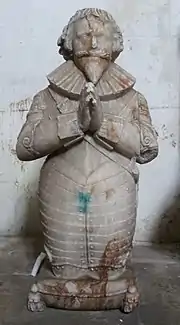 Scottish Protestant at prayer; statue in Culross Abbey
Scottish religion in the seventeenth century includes all forms of religious organisation and belief in the Kingdom of Scotland in the seventeenth century. The 16th century Reformation created a Church of Scotland, popularly known as the kirk, predominantly Calvinist in doctrine and Presbyterian in structure, to which James VI added a layer of bishops in 1584.
While these terms now imply differences in doctrine, in the 17th century Episcopalian meant churches governed by bishops, usually appointed by the monarch; Presbyterian implied rule by Elders, nominated by congregations. By the 1630s, around 90-95% of Scots were members of the church, and despite disagreements on governance, there was general alignment on Calvinist doctrine. In the 17th century, religious disputes were often as much about political principles, due to the assumption 'true religion and true government' were one and the same. (Full article...)_(follower_of)_-_Sir_James_Murray_(1655%E2%80%931708)%252C_Lord_Philiphaugh%252C_Lord_Clerk_Register_of_Scotland_-_PG_948_-_National_Galleries_of_Scotland.jpg.webp)
Sir James Murray, Lord Philiphaugh PC (11 July 1655 – 1 July 1708) was a Scottish judge and politician who twice served as Lord Clerk Register from November 1702 to June 1704 and from April 1705 to July 1708, when he died in office. Serving as a political advisor to prominent statesman James Douglas, 2nd Duke of Queensberry, Murray assisted him in passing the 1707 Union with England Act through a divided Parliament of Scotland.
Born in Eddleston, Peeblesshire, Murray graduated from the University of Edinburgh in 1674 before being elected to the Scottish Parliament after the death of his father in the previous year. Murray also served as the Sheriff of Selkirk until a dispute with a Scots Army officer led to the Privy Council of Scotland to remove him from the office in October 1681. During this period, he married twice, having eight children with his second wife Margaret. (Full article...)- Sorley MacLean (Scottish Gaelic: Somhairle MacGill-Eain; 26 October 1911 – 24 November 1996) was a Scottish Gaelic poet, described by the Scottish Poetry Library as "one of the major Scottish poets of the modern era" because of his "mastery of his chosen medium and his engagement with the European poetic tradition and European politics". Nobel Prize Laureate Seamus Heaney credited MacLean with saving Scottish Gaelic poetry.
He was raised in a strict Presbyterian family on the island of Raasay, immersed in Gaelic culture and literature from birth, but abandoned religion for socialism. In the late 1930s, he befriended many Scottish Renaissance figures, such as Hugh MacDiarmid and Douglas Young. He was wounded three times while serving in the Royal Corps of Signals during the North African Campaign. MacLean published little after the war, due to his perfectionism. In 1956, he became head teacher at Plockton High School, where he advocated for the use of the Gaelic language in formal education. (Full article...) - Sir D'Arcy Wentworth Thompson CB FRS FRSE (2 May 1860 – 21 June 1948) was a Scottish biologist, mathematician and classics scholar. He was a pioneer of mathematical and theoretical biology, travelled on expeditions to the Bering Strait and held the position of Professor of Natural History at University College, Dundee for 32 years, then at St Andrews for 31 years. He was elected a Fellow of the Royal Society, was knighted, and received the Darwin Medal and the Daniel Giraud Elliot Medal.
Thompson is remembered as the author of the 1917 book On Growth and Form, which led the way for the scientific explanation of morphogenesis, the process by which patterns and body structures are formed in plants and animals. (Full article...)  The four-light window in the south gable
Cullen Old Church (also known as Cullen Auld Kirk) is the parish church for Cullen and Deskford, in Moray. It was originally a part of the Roman Catholic Church, but has been a part of the Church of Scotland since the Scottish Reformation. John R. Hume describes Cullen Old Church as a fine example of late Scots Gothic architecture, and it was designated a Category A listed building in 1972. It is still an active place of worship, with weekly services presided over by Rev Douglas F Stevenson.
First mentioned in records dating from 1236 that document its elevation to a parish church, it was further elevated to collegiate status in 1543, and underwent a series of extensions, improvements and renovations in the centuries that followed. It is known for being the burial place of the internal organs of Queen Elizabeth de Burgh. After Elizabeth died at Cullen Castle in 1327, her body was taken to Dunfermline for interment, but the organs, which were removed as part of the embalming process, were buried at the church. Her husband, King Robert the Bruce, subsequently established a chaplaincy at the church to offer prayers for her soul. (Full article...).jpg.webp) Part of the combination of sculpture and landscape used at Ian Hamilton Finlay's Little Sparta
Part of the combination of sculpture and landscape used at Ian Hamilton Finlay's Little Sparta
Scottish art is the body of visual art made in what is now Scotland, or about Scottish subjects, since prehistoric times. It forms a distinctive tradition within European art, but the political union with England has led its partial subsumation in British art.
The earliest examples of art from what is now Scotland are highly decorated carved stone balls from the Neolithic period. From the Bronze Age there are examples of carvings, including the first representations of objects, and cup and ring marks. More extensive Scottish examples of patterned objects and gold work are found the Iron Age. Elaborately carved Pictish stones and impressive metalwork emerged in Scotland the early Middle Ages. The development of a common style of Insular art across Great Britain and Ireland influenced elaborate jewellery and illuminated manuscripts such as the Book of Kells. Only isolated examples survive of native artwork from the late Middle Ages and of works created or strongly influenced by artists of Flemish origin. The influence of the Renaissance can be seen in stone carving and painting from the fifteenth century. In the sixteenth century the crown began to employ Flemish court painters who have left a portrait record of royalty. The Reformation removed a major source of patronage for art and limited the level of public display, but may have helped in the growth of secular domestic forms, particularly elaborate painting of roofs and walls. Although the loss of the court as a result of the Union of Crowns in 1603 removed another major source of patronage, the seventeenth century saw the emergence of the first significant native artists for whom names are extant, with figures such as George Jamesone and John Michael Wright. (Full article...) The Camus Cross, East face
The Camus Cross, otherwise known as the Camuston or Camustane Cross, is an Early Medieval Scottish standing stone on the Panmure Estate near Carnoustie in Angus, Scotland. First recorded in the 15th century in a legal document describing the boundaries between Camuston and the barony of Downie, and described in the 17th century by Robert Maule, it is a freestanding cross, rare in Eastern Scotland.
The cross is thought to date from the 10th century, and exhibits distinctive Hiberno-Scottish mission influences, in common with several other monuments in the area. Tradition and folk etymology suggest that the cross marked the burial site of Camus, leader of the Norse army purportedly defeated by King Malcolm II at the apocryphal Battle of Barry. The name of the stone is likely to derive from the extinct village of Camuston, which has a Celtic toponymy. (Full article...)- The 2001 Scottish Masters (known as the 2001 Regal Scottish Masters for sponsorship reasons) was a professional non-ranking snooker tournament which took place at the Thistle Hotel in Glasgow, Scotland, from 18 to 23 September 2001. It was the first time the tournament was played in Glasgow since the 1989 edition. The competition was the second of four invitational World Professional Billiards and Snooker Association (WPBSA) events of the 2001–02 season. It was broadcast on BBC Scotland and Eurosport and was sponsored by the cigarette brand Regal.
John Higgins, the top-ranked Scottish player, won the tournament, defeating the defending champion and world title holder Ronnie O'Sullivan 9–6 in the final. It was the first time that Higgins had won the competition it was the 22nd ranking tournament victory of his career. He earned £63,000 from a prize fund pool of £200,000. O'Sullivan made the highest break of the competition of 134 in his semi-final victory over Marco Fu. (Full article...)  The Hen Ogledd (Old North) c. 550 – c. 650. The area marked Lleuddiniawn (Lothian) contained the region known as Eidyn
Eidyn was the region around modern Edinburgh in Britain's sub-Roman and early medieval periods, approximately the 5th–7th centuries. It centred on the stronghold of Din Eidyn, thought to have been at Castle Rock, now the site of Edinburgh Castle, and apparently included much of the area below the Firth of Forth. It was the most important district of the Brittonic kingdom of Gododdin, and a significant power in the Hen Ogledd, or Old North, the Brittonic-speaking area of what is now southern Scotland and northern England.
The site of Din Eidyn has been nearly continuously occupied since the Bronze Age, serving as a stronghold of the Votadini during the Roman era and later the principal centre of their successors, the Gododdin kingdom. Eidyn's importance to the Hen Ogledd is reflected in the medieval poem Y Gododdin, which concerns a war band that gathered there for a raid around AD 600. After years of decline, Eidyn was conquered by the Angles in 638. (Full article...)- Edward George Faile (February 9, 1799 – April 20, 1864) was an American merchant. Born in Scotland, his family moved to the United States when he was an infant, settling in Westchester County, north of New York City. The family initially lived in East Chester, and later moved closer to New York, building a family estate in what is now the Hunt's Point section of The Bronx. The location of the Faile mansion, Woodside, is now the site of the American Banknote printing plant. Faile ran a successful grocery business in downtown New York from 1821 to 1853. He was also involved in the railroad, insurance, and agriculture industries. (Full article...)
 Arbroath from the south
Arbroath (/ɑːrˈbroʊθ/) or Aberbrothock (Scottish Gaelic: Obar Bhrothaig [ˈopəɾ ˈvɾo.ɪkʲ]) is a former royal burgh and the largest town in the council area of Angus, Scotland, with a population of 23,902. It lies on the North Sea coast some 16 miles (26 km) east-northeast of Dundee and 45 miles (72 km) south-southwest of Aberdeen.
There is evidence of Iron Age settlement, but its history as a town began with the founding of Arbroath Abbey in 1178. It grew much during the Industrial Revolution through the flax and then the jute industry and the engineering sector. A new harbour was created in 1839; by the 20th century, Arbroath was one of Scotland's larger fishing ports. (Full article...) Forglen House
Forglen House is a mansion house that forms the centrepiece of the Forglen estate in the parish of Forglen, north-west of Turriff, Aberdeenshire, in the north-east of Scotland. The lands were given to the abbots of the Abbey of Arbroath by King William the Lion before 1211 and the Monymusk Reliquary was held there. The original castle, built around 1346, was replaced by a vernacular harled house that was later extended. Significant development of the estate began when it was acquired by the family of Lord Banff and they started the work of landscaping and planting trees. It became their main family seat during the 18th century. After the death of William Ogilvy, the eighth and final Lord Banff, the estate passed by marriage to the Abercromby baronets who continued to enhance the property and maintained it as their main residence. Sir Robert Abercromby, 5th Baronet commissioned the Aberdeen City Architect, John Smith to design the present house in 1839.
Forglen House was sold by the Abercromby family in 1974 but remains in private ownership. It is not open to the public, although access to the grounds is available and some cottages can be hired as holiday lets, including one of the lodge houses. (Full article...)
Hand picked articles
- Not all subpages are transcluded due to technical limitations.
Template:Numbered subpages
This article is issued from Wikipedia. The text is licensed under Creative Commons - Attribution - Sharealike. Additional terms may apply for the media files.