Portal:Telecommunication

The Telecommunication Portal

Telecommunication is the transmission of information by various types of technologies over wire, radio, optical, or other electromagnetic systems. It has its origin in the desire of humans for communication over a distance greater than that feasible with the human voice, but with a similar scale of expediency; thus, slow systems (such as postal mail) are excluded from the field.
The transmission media in telecommunication have evolved through numerous stages of technology, from beacons and other visual signals (such as smoke signals, semaphore telegraphs, signal flags, and optical heliographs), to electrical cable and electromagnetic radiation, including light. Such transmission paths are often divided into communication channels, which afford the advantages of multiplexing multiple concurrent communication sessions. Telecommunication is often used in its plural form.
Other examples of pre-modern long-distance communication included audio messages, such as coded drumbeats, lung-blown horns, and loud whistles. 20th- and 21st-century technologies for long-distance communication usually involve electrical and electromagnetic technologies, such as telegraph, telephone, television and teleprinter, networks, radio, microwave transmission, optical fiber, and communications satellites.
A revolution in wireless communication began in the first decade of the 20th century with the pioneering developments in radio communications by Guglielmo Marconi, who won the Nobel Prize in Physics in 1909, and other notable pioneering inventors and developers in the field of electrical and electronic telecommunications. These included Charles Wheatstone and Samuel Morse (inventors of the telegraph), Antonio Meucci and Alexander Graham Bell (some of the inventors and developers of the telephone, see Invention of the telephone), Edwin Armstrong and Lee de Forest (inventors of radio), as well as Vladimir K. Zworykin, John Logie Baird and Philo Farnsworth (some of the inventors of television).
The early telecommunication networks were created with copper wires as the physical medium for signal transmission. For many years, these networks were used for basic phone services, namely voice and telegrams. Since the mid-1990s, as the internet has grown in popularity, voice has been gradually supplanted by data. This soon demonstrated the limitations of copper in data transmission, prompting the development of optics. (Full article...)
Selected article -

Cryptography, or cryptology (from Ancient Greek: κρυπτός, romanized: kryptós "hidden, secret"; and γράφειν graphein, "to write", or -λογία -logia, "study", respectively), is the practice and study of techniques for secure communication in the presence of adversarial behavior. More generally, cryptography is about constructing and analyzing protocols that prevent third parties or the public from reading private messages. Modern cryptography exists at the intersection of the disciplines of mathematics, computer science, information security, electrical engineering, digital signal processing, physics, and others. Core concepts related to information security (data confidentiality, data integrity, authentication, and non-repudiation) are also central to cryptography. Practical applications of cryptography include electronic commerce, chip-based payment cards, digital currencies, computer passwords, and military communications.
Cryptography prior to the modern age was effectively synonymous with encryption, converting readable information (plaintext) to unintelligible nonsense text (ciphertext), which can only be read by reversing the process (decryption). The sender of an encrypted (coded) message shares the decryption (decoding) technique only with intended recipients to preclude access from adversaries. The cryptography literature often uses the names "Alice" (or "A") for the sender, "Bob" (or "B") for the intended recipient, and "Eve" (or "E") for the eavesdropping adversary. Since the development of rotor cipher machines in World War I and the advent of computers in World War II, cryptography methods have become increasingly complex and their applications more varied. (Full article...)General images
 In the 1920s, the United States government publication, "Construction and Operation of a Simple Homemade Radio Receiving Outfit", showed how almost any person handy with simple tools could a build an effective crystal radio receiver. (from History of radio)
 Reginald Fessenden (around 1906) (from History of radio)
 "Fiction becomes fact": Imaginary "Edison" combination videophone-television, conceptualized by George du Maurier and published in Punch magazine. The drawing also depicts then-contemporary speaking tubes, used by the parents in the foreground and their daughter on the viewing display (1878). (from History of videotelephony)
 Donald Manson working as an employee of the Marconi Company (England, 1906) (from History of radio)
 Australian radio sets usually had the positions of radio stations marked on their dials. The illustration is a dial from a transistorised, mains-operated Calstan radio, circa 1960s. (Click image for a high resolution view, with readable callsigns.) (from History of broadcasting)
 The first commercial AM Audion vacuum tube radio transmitter, built in 1914 by Lee De Forest who invented the Audion (triode) in 1906 (from History of radio)
 RCA 630-TS, the first mass-produced television set, which sold in 1946–1947 (from History of television)
 AT&T magazine advertisement announcing commercial launch of Picturephone service. (from History of videotelephony)
 AT&T Picturephone (Mod II) fully enclosed in its housing, control pad at bottom (courtesy: Richard Diehl) (from History of videotelephony)
 Antonio Meucci's telephone. (from History of the telephone)
 Reginald Fessenden, the father of radio broadcasting in the US (from History of broadcasting)
 Elisha Gray, 1876, designed a telephone using a water microphone in Highland Park, Illinois. (from History of the telephone)
 The master telephone patent granted to Bell, 174465, March 10, 1876 (from History of the telephone)
 Old Receiver schematic, c.1906 (from History of the telephone)
 1917 wall telephone, open to show magneto and local battery (from History of the telephone)
 Caricature of Sir John Reith, by Wooding (from History of broadcasting)
 Bell prototype telephone stamp(from History of the telephone)
Centennial Issue of 1976 Heinrich Rudolf Hertz (1856-1894) proved the existence of electromagnetic radiation (from History of radio)
 Emil Voigt, founder of 2KY on behalf of the Labor Council of New South Wales. This photo was taken in earlier days when Voight was a prominent British athlete, and winner of the Gold Medal for the five mile race at the 1908 Summer Olympics in London. (from History of broadcasting)
 British Post Office engineers inspect Guglielmo Marconi's wireless telegraphy (radio) equipment in 1897. (from History of radio)
 Baird in 1925 with his televisor equipment and dummies "James" and "Stooky Bill" (right). (from History of television)
 Artist's conception: 21st-century videotelephony imagined in the early 20th century (1910) (from History of videotelephony)
.svg.png.webp) The Australian Broadcasting Corporation logo, first introduced in 1975 and based on the Lissajous curve (from History of broadcasting)
The Australian Broadcasting Corporation logo, first introduced in 1975 and based on the Lissajous curve (from History of broadcasting) A replica of one of Claude Chappe's semaphore towers (optical telegraph) in Nalbach, Germany (from History of telecommunication)
 Naomi ("Joan") Melwit and Norman Banks at the 3KZ microphone, in the late 1930s (from History of broadcasting)
 "Doc" Herrold is shown at the microphone of KQW, early 1920s. (from History of broadcasting)
 Guglielmo Marconi (from History of broadcasting)
 The Nipkow disk. This schematic shows the circular paths traced by the holes, which may also be square for greater precision. The area of the disk outlined in black shows the region scanned. (from History of television)
 DBS satellite dishes. (from History of television)
 Alexander Graham Bell was awarded the first U.S. patent for the invention of the telephone in 1876. (from History of the telephone)
 Historical marker commemorating the first telephone central office in New York State (1878) (from History of the telephone)
.jpg.webp) An early Smart TV from 2012 running the discontinued Orsay platform (from History of television)
An early Smart TV from 2012 running the discontinued Orsay platform (from History of television) Swedish Prime Minister Tage Erlander using an Ericsson videophone to speak with Lennart Hyland, a popular TV show host (1969) (from History of videotelephony)
 Lee DeForest broadcasting Columbia phonograph records on pioneering New York station 2XG, in 1916 (from History of broadcasting)
 The Philco Predicta, 1958. In the collection of The Children's Museum of Indianapolis (from History of television)
 The British Broadcasting Corporation's landmark and iconic London headquarters, Broadcasting House, opened in 1932. At right is the 2005 eastern extension, the John Peel wing. (from History of broadcasting)
 Ad for the beginning of experimental television broadcasting in New York City by RCA in 1939 (from History of television)
- The 1969 AT&T Mod II Picturephone, the result of decades long R&D at a cost of over $500M. (from History of telecommunication)
 The French Matra videophone (1970) (from History of videotelephony)
 Early experiment demonstrating refraction of microwaves by a paraffin lens by John Ambrose Fleming in 1897 (from History of radio)
 The "Kerbango Internet Radio" was the first stand-alone product that let users listen to Internet radio without a computer. (from History of broadcasting)
 Thomas Edison invented the carbon microphone which produced a strong telephone signal. (from History of the telephone)
 Family watching TV, 1958 (from History of television)
 Right side view, housing removed, one of its printed circuit boards exposed (courtesy: Richard Diehl) (from History of videotelephony)
- The master telephone patent, 174465, granted to Bell, March 7, 1876 (from History of telecommunication)
 Color bars used in a test pattern, sometimes used when no program material is available. (from History of television)
 The Kyocera VP-210 Visual Phone was the first commercial mobile videophone. The Personal Handy-phone System (PHS) phone was introduced in Japan (1999). (from History of videotelephony)
 1896 Telephone (Sweden) (from History of the telephone)
 Charles Logwood broadcasting at station 2XG, New York City, circa November, 1916 (from History of broadcasting)
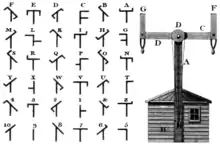 Code of letters and symbols for Chappe telegraph (Rees's Cyclopaedia) (from History of telecommunication)
 An exposed view of the Picturephone's rear circuit board (courtesy: Richard Diehl) (from History of videotelephony)
 Broadcasting pioneer Frank Conrad in a 1921 portrait (from History of broadcasting)
 Modern Apple iPhone. This phone is considered a smartphone (from History of the telephone)
 Antonio Meucci, 1854, constructed telephone-like devices. (from History of the telephone)
 A Tandberg T3 high definition telepresence room in use circa 2008, 40 years after the introduction of Picturephone. (from History of videotelephony)
 Private conversation, 1910 (from History of the telephone)
 A 19th century acoustic tin can or "lovers' telephone" (from History of the telephone)
- The Marconi Company was formed in England in 1910. The photo shows a typical early scene, from 1906, with Marconi employee Donald Manson at right. (from History of broadcasting)
_LCCN2014717186.jpg.webp) Around 1920, radio broadcasting started to get popular. A group of women gathered around the radio at the time. (from History of radio)
Around 1920, radio broadcasting started to get popular. A group of women gathered around the radio at the time. (from History of radio)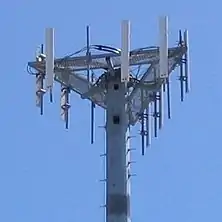 Top of cellular telephone tower (from History of the telephone)
 The Regency TR-1, which used Texas Instruments' NPN transistors, was the world's first commercially produced transistor radio in 1954. (from History of radio)
.jpg.webp) Actor portraying Alexander Graham Bell in a 1926 silent film. Shows Bell's first telephone transmitter (microphone), invented 1876 and first displayed at the Centennial Exposition, Philadelphia. (from History of the telephone)
Actor portraying Alexander Graham Bell in a 1926 silent film. Shows Bell's first telephone transmitter (microphone), invented 1876 and first displayed at the Centennial Exposition, Philadelphia. (from History of the telephone) Philipp Reis, 1861, constructed the first telephone, today called the Reis telephone. (from History of the telephone)
 A French Gower telephone of 1912 at the Musée des Arts et Métiers in Paris (from History of the telephone)
 Oliver Lodge's 1894 lectures on Hertz demonstrated how to transmit and detect radio waves (from History of radio)
 The first mass-produced Czechoslovak TV-set Tesla 4001A (1953–57) (from History of television)
 Typical low-cost webcam used with many personal computers (from History of videotelephony)
Things to do
 |
Here are some tasks awaiting attention:
|
Selected biography -
Meucci in 1878 |
Antonio Santi Giuseppe Meucci (/meɪˈuːtʃi/ may-OO-chee, Italian: [anˈtɔːnjo meˈuttʃi]; 13 April 1808 – 18 October 1889) was an Italian inventor and an associate of Giuseppe Garibaldi, a major political figure in the history of Italy. Meucci is best known for developing a voice-communication apparatus that several sources credit as the first telephone.
Meucci set up a form of voice-communication link in his Staten Island, New York, home that connected the second-floor bedroom to his laboratory. He submitted a patent caveat for his telephonic device to the U.S. Patent Office in 1871, but there was no mention of electromagnetic transmission of vocal sound in his caveat. In 1876, Alexander Graham Bell was granted a patent for the electromagnetic transmission of vocal sound by undulatory electric current. Despite the longstanding general crediting of Bell with the accomplishment, the Italian Ministry of Cultural Heritage and Activities supported celebrations of Meucci's 200th birthday in 2008 using the title "Inventore del telefono" (Inventor of the telephone). The U.S. House of Representatives in a resolution in 2002 also acknowledged Meucci's work in the invention of the telephone, although the U.S. Senate did not join the resolution and the interpretation of the resolution is disputed. (Full article...)Did you know (auto-generated) -

- ... that a line of the 1840 song "Kein schöner Land in dieser Zeit", claiming "no country more beautiful" and presented by its author as a Volkslied, is quoted as the title of books and television series?
- ... that a 1971 format change and firing of three Black disc jockeys contributed to the Mississippi radio station WSWG losing its broadcast license?
- ... that South Carolina radio station WDAB sold its former call letters to Michael Bloomberg, then named itself after an owner who had not yet bought the station?
- ... that Idaho's first television station, KFXD-TV, was a two-man operation that lasted less than two months?
- ... that after the Rockaway Boardwalk was destroyed in Hurricane Sandy, a radio ad campaign using the Ramones song "Rockaway Beach" was aired to draw visitors to the adjacent beach?
- ... that a Washington state radio station turned to "professional bikini watchers"—military recruiters—to report on crowds at local beaches?
Related portals
Topics


Telecommunications in Asia | |
|---|---|
| Sovereign states |
|
| States with limited recognition |
|
| Dependencies and other territories |
|
| |

Subcategories

Associated Wikimedia
The following Wikimedia Foundation sister projects provide more on this subject:
-
 Commons
Free media repository -
 Wikibooks
Free textbooks and manuals -
 Wikidata
Free knowledge base -
 Wikinews
Free-content news -
 Wikiquote
Collection of quotations -
 Wikisource
Free-content library -
 Wikiversity
Free learning tools -
 Wiktionary
Dictionary and thesaurus
-
 List of all portalsList of all portals
 -
 The arts portal
 -
 Biography portal
 -
 Current events portal
 -
 Geography portal
 -
 History portal
 -
 Mathematics portal
 -
 Science portal
 -
 Society portal
 -
 Technology portal
 -
 Random portalRandom portal
 -
 WikiProject PortalsWikiProject Portals