Portal:Trees

The Trees Portal

In botany, a tree is a perennial plant with an elongated stem, or trunk, usually supporting branches and leaves. In some usages, the definition of a tree may be narrower, including only woody plants with secondary growth, plants that are usable as lumber or plants above a specified height. In wider definitions, the taller palms, tree ferns, bananas, and bamboos are also trees. Trees are not a taxonomic group but include a variety of plant species that have independently evolved a trunk and branches as a way to tower above other plants to compete for sunlight. The majority of tree species are angiosperms or hardwoods; of the rest, many are gymnosperms or softwoods. Trees tend to be long-lived, some reaching several thousand years old. Trees have been in existence for 370 million years. It is estimated that there are around three trillion mature trees in the world.
A tree typically has many secondary branches supported clear of the ground by the trunk. This trunk typically contains woody tissue for strength, and vascular tissue to carry materials from one part of the tree to another. For most trees it is surrounded by a layer of bark which serves as a protective barrier. Below the ground, the roots branch and spread out widely; they serve to anchor the tree and extract moisture and nutrients from the soil. Above ground, the branches divide into smaller branches and shoots. The shoots typically bear leaves, which capture light energy and convert it into sugars by photosynthesis, providing the food for the tree's growth and development.
Trees usually reproduce using seeds. Flowers and fruit may be present, but some trees, such as conifers, instead have pollen cones and seed cones. Palms, bananas, and bamboos also produce seeds, but tree ferns produce spores instead.
Trees play a significant role in reducing erosion and moderating the climate. They remove carbon dioxide from the atmosphere and store large quantities of carbon in their tissues. Trees and forests provide a habitat for many species of animals and plants. Tropical rainforests are among the most biodiverse habitats in the world. Trees provide shade and shelter, timber for construction, fuel for cooking and heating, and fruit for food as well as having many other uses. In parts of the world, forests are shrinking as trees are cleared to increase the amount of land available for agriculture. Because of their longevity and usefulness, trees have always been revered, with sacred groves in various cultures, and they play a role in many of the world's mythologies. (Full article...)
 Recognized content -

Alloxylon flammeum, commonly known as the Queensland tree waratah or red silky oak, is a medium-sized tree of the family Proteaceae found in the Queensland tropical rain forests of northeastern Australia. It has shiny green elliptical leaves up to 18 cm (7.1 in) long, and prominent orange-red inflorescences that appear from August to October, followed by rectangular woody seed pods that ripen in February and March. Juvenile plants have large (up to 25 cm (9.8 in) long) deeply lobed pinnate leaves. Previously known as Oreocallis wickhamii, the initial specimen turned out to be a different species to the one cultivated and hence a new scientific name was required. Described formally by Peter Weston and Mike Crisp in 1991, A. flammeum was designated the type species of the genus Alloxylon. This genus contains the four species previously classified in Oreocallis that are found in Australasia.
Alloxylon flammeum is a canopy or emergent tree of the Mabi rainforest community of north Queensland. Its terminal tubular flowers indicate that the species is pollinated by birds. Readily adaptable to cultivation, Alloxylon flammeum prefers a site with good drainage and responds well to extra moisture and fertilisers low in phosphorus. It is listed nationally as vulnerable under the Australian Environment Protection and Biodiversity Conservation Act 1999 (EPBC Act) as most of its habitat has been cleared for agriculture and logging. (Full article...)Did you know? -

- ... that the Easter egg tree (pictured) in Saalfeld, Thuringia, was decorated with 10,000 Easter eggs in 2012?
- ... that the most popular species for Christmas trees in Denmark and most of Europe is the Nordmann fir?
- ... that seed of the African teak tree is largely dispersed by fruit bats?
- ... that Trichia decipiens live on deadwood of conifers and leaf trees all year around?
- ... that Aecidium mori causes mulberry rust disease on the mulberry flowering plant, which decreases the quantity of leaves on the trees?
- ... that the satinleaf tree is endangered in its native Florida, but an invasive weed in Hawaii?
- ... that the Brown Treecreeper spirals up and down tree trunks while foraging?
Selected article -
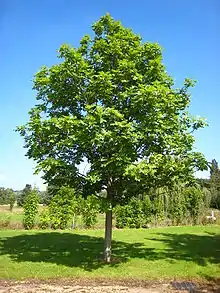
 European beech (Fagus sylvatica) |
Beech (Fagus) is a genus of deciduous trees in the family Fagaceae, native to temperate Europe, Asia, and North America. Recent classifications recognize 10 to 13 species in two distinct subgenera, Engleriana and Fagus. The Engleriana subgenus is found only in East Asia, distinctive for its low branches, often made up of several major trunks with yellowish bark. The better known Fagus subgenus beeches are high-branching with tall, stout trunks and smooth silver-grey bark. The European beech (Fagus sylvatica) is the most commonly cultivated.
Beeches are monoecious, bearing both male and female flowers on the same plant. The small flowers are unisexual, the female flowers borne in pairs, the male flowers wind-pollinating catkins. They are produced in spring shortly after the new leaves appear. The fruit of the beech tree, known as beechnuts or mast, is found in small burrs that drop from the tree in autumn. They are small, roughly triangular, and edible, with a bitter, astringent, or mild and nut-like taste. (Full article...)General images

 Since the 13th century, the Niepołomice Forest in Poland has had special use and protection. In this view from space, different coloration can indicate different functions. (from Forest)


 Diagram of secondary growth in a eudicot or coniferous tree showing idealised vertical and horizontal sections. A new layer of wood is added in each growing season, thickening the stem, existing branches and roots. (from Tree)
.jpg.webp) Conifers in the Swabian alps (from Tree)
Conifers in the Swabian alps (from Tree) Even, dense old-growth stand of beech trees (Fagus sylvatica) prepared to be regenerated by their saplings in the understory, in the Brussels part of the Sonian Forest. (from Forest)
 Proportion of forest in protected areas, by region, 2020 (from Forest)
.jpg.webp) Form, leaves and reproductive structures of queen sago (Cycas circinalis) (from Tree)
Form, leaves and reproductive structures of queen sago (Cycas circinalis) (from Tree)
 Spiny forest at Ifaty, Madagascar, featuring various Adansonia (baobab) species, Alluaudia procera (Madagascar ocotillo) and other vegetation (from Forest)
 Roof trusses made from softwood (from Tree)
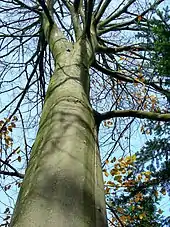 Northern beech (Fagus sylvatica) trunk in autumn (from Tree)

.JPG.webp)
 Neem tree at Sant Nenuram Ashram (from Trees of Pakistan)
 The Daintree Rainforest (from Tree)
 Priest River winding through Whitetail Butte with lots of forestry to the east—these lot patterns have existed since the mid-19th century. The white patches reflect areas with younger, smaller trees, where winter snow cover shows up brightly to the astronauts. Dark green-brown squares are parcels (from Forest)
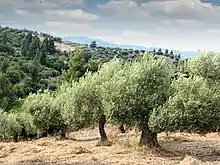 The Olive Tree in Pakistan. (from Trees of Pakistan)
 Proportion and distribution of global forest area by climatic domain, 2020 (from Forest)
 People trees, by Pooktre (from Tree)
 Rowan tree in Wicklow, Ireland (from List of trees of Great Britain and Ireland)
 Selling firewood at a market (from Tree)
 Forest in the Scottish Highlands (from Forest)
_20-09-2020_(d.j.b.)_01.jpg.webp)

 Recently stripped cork oak (Quercus suber) (from Tree)
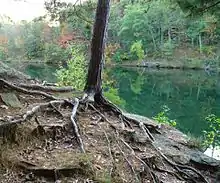


 Buds, leaves and reproductive structures of white fir (Abies alba) (from Tree)
 4000 years old Cypress of Abarqu is the oldest tree in Iran and the second oldest tree in the world. (from List of trees of Iran)
 Tall herbaceous monocotyledonous plants such as banana lack secondary growth, but are trees under the broadest definition. (from Tree)



 Share of land that is covered by forest (from Forest)
 The General Sherman Tree, thought to be the world's largest by volume (from Tree)
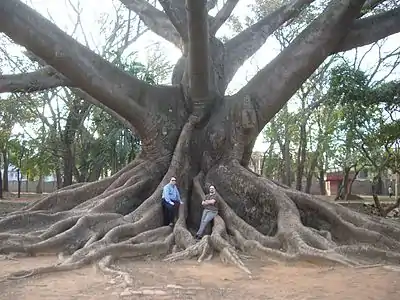 Buttress roots of the kapok tree (Ceiba pentandra) (from Tree)
 Buds, leaves, flowers and fruit of oak (Quercus robur) (from Tree)
Selected lists
Subcategories

Related portals
Associated Wikimedia
The following Wikimedia Foundation sister projects provide more on this subject:
-
 Commons
Free media repository -
 Wikibooks
Free textbooks and manuals -
 Wikidata
Free knowledge base -
 Wikinews
Free-content news -
 Wikiquote
Collection of quotations -
 Wikisource
Free-content library -
 Wikispecies
Directory of species -
 Wikiversity
Free learning tools -
 Wiktionary
Dictionary and thesaurus
-
 List of all portalsList of all portals
 -
 The arts portal
 -
 Biography portal
 -
 Current events portal
 -
 Geography portal
 -
 History portal
 -
 Mathematics portal
 -
 Science portal
 -
 Society portal
 -
 Technology portal
 -
 Random portalRandom portal
 -
 WikiProject PortalsWikiProject Portals
