Portal:Turkey


Merhaba! Welcome to the Turkey portal
 Flag of Turkey | |
.svg.png.webp) | |
Turkey (Turkish: Türkiye [ˈtyɾcije]), officially the Republic of Türkiye (Turkish: Türkiye Cumhuriyeti [ˈtyɾcije dʒumˈhuːɾijeti] ( listen)), is a transcontinental country located mainly on the Anatolian Peninsula in Western Asia, with a small portion on the Balkan Peninsula in Southeast Europe. It borders the Black Sea to the north; Georgia to the northeast; Armenia, Azerbaijan, and Iran to the east; Iraq to the southeast; Syria and the Mediterranean Sea to the south; the Aegean Sea to the west; and Greece and Bulgaria to the northwest. Cyprus is off the south coast. Most of the country's citizens are ethnic Turks, while Kurds are the largest ethnic minority. Ankara is Turkey's capital and second-largest city, Istanbul is its largest city and main financial centre.
One of the world's earliest permanently settled regions, present-day Turkey was home to important Neolithic sites like Göbekli Tepe, and was inhabited by ancient civilisations including the Hattians, Hittites, Anatolian peoples, Mycenaean Greeks, Persians and others. Following the conquests of Alexander the Great which started the Hellenistic period, most of the ancient regions were culturally Hellenised, and this continued during the Byzantine era. The Seljuk Turks began migrating to Anatolia in the 11th century, which started the Turkification process. The Seljuk Sultanate of Rum ruled Anatolia until the Mongol invasion in 1243, when it disintegrated into small Turkish principalities. Beginning in the late 13th century, the Ottomans united the principalities and conquered the Balkans, while the Turkification of Anatolia further progressed during the Ottoman period. After Mehmed II conquered Constantinople (now Istanbul) in 1453, Ottoman expansion continued under Selim I. During the reign of Suleiman the Magnificent, the Ottoman Empire became a global power. From the late 18th century onwards, the empire's power declined with a gradual loss of territories. Mahmud II started a period of modernisation in the early 19th century. The Young Turk Revolution of 1908 restricted the authority of the Sultan and restored the Ottoman Parliament after a 30-year suspension, ushering the empire into a multi-party period. The Three Pashas took control with the 1913 coup d'état, and the Ottoman Empire entered World War I as one of the Central Powers in 1914. During the war, the Ottoman government committed genocides against its Armenian, Greek and Assyrian subjects. After its defeat in the war, the Ottoman Empire was partitioned.
The Turkish War of Independence against the occupying Allied Powers resulted in the abolition of the Sultanate on 1 November 1922, the signing of the Treaty of Lausanne (which superseded the Treaty of Sèvres) on 24 July 1923 and the proclamation of the Republic on 29 October 1923. With the reforms initiated by the country's first president, Mustafa Kemal Atatürk, Turkey became a secular, unitary and parliamentary republic. Turkey remained neutral during most of World War II, but entered the closing stages of the war on the side of the Allies. Turkey played a prominent role in the Korean War and joined NATO in 1952. During the Cold War years, the country endured two military coups in 1960 and 1980, and a period of economic and political turmoil in the 1970s. The economy was liberalised in the 1980s, leading to stronger economic growth and political stability. Since 2002, the country's political system has been dominated by the AKP and its leader Recep Tayyip Erdoğan, under whom a decade of rapid growth in nominal GDP took place until 2013, which was followed by a period of recession and stagnation in terms of USD-based nominal GDP between 2013 and 2020, and high inflation as of 2023. The AKP government's initial economic achievements, which were financed through privatization revenues and loans, were overshadowed by democratic backsliding and an erosion in the separation of powers and civil liberties, which gained momentum after the parliamentary republic was replaced by an executive presidential system with a referendum in 2017.
Turkey is a regional power with a geopolitically significant strategic location. The economy of Turkey, which is a founding member of the OECD and G20, is classified among the E7, EAGLEs and NICs, and currently ranks twentieth-largest in the world by nominal GDP and eleventh-largest by PPP. Turkey is a charter member of the United Nations, the IMF and the World Bank; a founding member of the OSCE, OIC, BSEC, ECO, MIKTA, TURKSOY and OTS; and an early member of NATO. After becoming one of the early members of the Council of Europe in 1950, Turkey became an associate member of the EEC in 1963, joined the EU Customs Union in 1995, and started accession negotiations with the European Union in 2005. Turkey has a rich cultural legacy shaped by centuries of history and the influence of the various peoples that have inhabited its territory over several millennia; it is home to 19 UNESCO World Heritage Sites and is among the most visited countries in the world. (Full article...)
Selected article -
 An outlook from a trail |
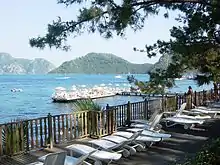
Dilek Peninsula-Büyük Menderes Delta National Park (Turkish: Dilek Yarımadası-Büyük Menderes Deltası Millî Parkı), established on May 19, 1966, is a national park in western Turkey. It contains within its borders the entirety of the Dilek Peninsula as well as the large delta of the Büyük Menderes River. The park is located in the Kuşadası district of Aydın Province — part of Turkey's Aegean Region. Directly west of the national park is the small coastal town of Güzelçamlı, where several shuttle buses and ferries operate to and from the district's center of Kuşadası, approximately 30 km (19 mi) from the park.
The park is among the most biologically diverse of Turkey's national parks. It is the native and migratory habitat of hundreds of species of birds, mammals, plants, and marine life, some of which are entirely endemic to the park and cannot be observed anywhere else in the world. For these reasons, it is protected by numerous wildlife and wetland conventions, and is of great national and international importance in these areas. (Full article...)General images

.jpg.webp) The Fountain of Ahmed III is an iconic example of Tulip period architecture (from Culture of Turkey)
The Fountain of Ahmed III is an iconic example of Tulip period architecture (from Culture of Turkey)
 Ahmed Hamdi Akseki Mosque (2013) (from Culture of Turkey)
 Ankara (from Geography of Turkey)
 First Ziraat Bank Headquarters (1925–29) in Ankara designed by Giulio Mongeri is an important symbol of the First National Architectural Movement. (from Culture of Turkey)
 Namık Kemal was a prominent Turkish poet, novelist, playwright and journalist of the late-19th-century Ottoman Empire. (from Culture of Turkey)
 Karagöz and Hacivat are the lead characters of the traditional Turkish shadow play, popularized during the Ottoman period. (from Culture of Turkey)

 Ankara Opera House, designed by Şevki Balmumcu (1933–34) and renovation by Paul Bonatz (1946–47). (from Culture of Turkey)
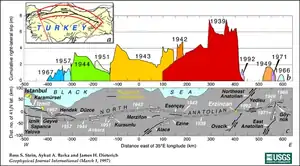 Fault lines and earthquakes (from Geography of Turkey)
 Antalya (from Geography of Turkey)
 Mount Ararat (from Geography of Turkey)
 Istanbul (from Geography of Turkey)
 The sultan of the golden age, Suleiman the Magnificent. (from History of Turkey)
.jpg.webp)
 View from Levent district in Istanbul. Istanbul's skyline has changed especially since the early 2000s. (from Culture of Turkey)
 Nuri Bilge Ceylan won a number of awards in the annual Cannes Film Festival, including the best director award at the 2008 Cannes Film Festival for his film Üç Maymun ("Three Monkeys"). He has also won five FIPRESCI awards. (from Culture of Turkey)
 Map showing the Anatolian Plate, the North Anatolian Fault and East Anatolian Fault in Turkey. (from Geography of Turkey)
 Thrace and the Thracian Odrysian kingdom in its maximum extent under Sitalces (431-424 BC) (from History of Turkey)
 Map of earthquakes in Turkey 1900–2023 (from Geography of Turkey)
 Fazıl Hüsnü Dağlarca was one of the most prolific Turkish poets of the Turkish Republic with more than 60 collections of his poems published, laureate of the Struga Poetry Evenings Golden Wreath Award. (from Culture of Turkey)
 Roosevelt, İnönü and Churchill at the Second Cairo Conference which was held between 4–6 December 1943. (from History of Turkey)
 Turkish national basketball team won the silver medal in the 2010 FIBA World Championship. (from Culture of Turkey)
 Recaizade Mahmud Ekrem (1847–1914) was another prominent Turkish poet of the late Ottoman era. (from Culture of Turkey)
 Tevfik Fikret (1867–1915) was a prominent Turkish poet of the late Ottoman era. (from Culture of Turkey)
 Night view of the Taksim Mosque (from Culture of Turkey)
 Topographic map of Turkey (from Geography of Turkey)
 Topkapı Palace, Istanbul. (from Culture of Turkey)
.jpg.webp) Originally a church, later a mosque, and now a Grand mosque, the Hagia Sophia in Istanbul was built by the Byzantines in the 6th century. (from History of Turkey)
Originally a church, later a mosque, and now a Grand mosque, the Hagia Sophia in Istanbul was built by the Byzantines in the 6th century. (from History of Turkey)
 Turkish coffee (from Culture of Turkey)
 Mustafa Kemal Atatürk (1881-1938) (from History of Turkey)
 A view from the interior of a traditional Turkish house, by John Frederick Lewis (1805–1875) (from Culture of Turkey)
 Designed by Şekip Akalın, Ankara Central Station (1937) is a notable art deco design of its era. (from Culture of Turkey)
 Sami Frashëri (1850–1904) and his wife Emine, May 1884. (from Culture of Turkey)
 Istanbul University Faculty of Science and Faculty of Literature Buildings (1944–52) designed by Sedad Hakkı Eldem and Emin Onat (from Culture of Turkey)
 Istanbul Sapphire (2006–11) is the tallest building in Turkey and 4th in Europe. (from Culture of Turkey)
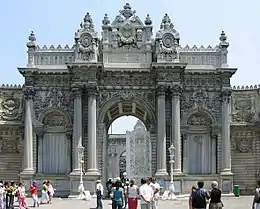 One of the main entrance gates of the Dolmabahçe Palace. (from Culture of Turkey)
 View of Beydağları Coastal National Park (from Geography of Turkey)
 The Ishak Pasha Palace, Eastern Turkey. (from Culture of Turkey)
 Köppen climate types of Turkey (from Geography of Turkey)
 An Oil wrestling tournament in Istanbul. This has been the national sport of Turkey since Ottoman times. (from Culture of Turkey)
.jpg.webp) The Bath-Gymnasium complex at Sardis in Turkey. (from History of Turkey)
The Bath-Gymnasium complex at Sardis in Turkey. (from History of Turkey) Turkish delight (from Culture of Turkey)
Did you know -
- ... that Krikor Apikoğlu founded Apikoğlu, the first company to mass produce meat products in Turkey? (March 9, 2013)
- ... that Mehmet Gürs, a Turkish chef of Scandinavian descent, called his Istanbul restaurant Mikla, which is derived from Miklagard, the Viking name of the city in the 10th century? (November 15, 2012)
- ... that Ethiopian-born Meryem Erdoğan, impressed by her countrywoman Elvan Abeylegesse's success, illegally immigrated to Turkey at age 16 in order to become a distance runner? (August 18, 2010)
- ... that during the Ottoman–Venetian War of 1570–1573, the 8,500-strong Venetian garrison of Famagusta in Cyprus held out for eleven months against an Ottoman army of 200,000 men? (December 13, 2008) Wikipedia:Recent additions 236
- ... that Turkish Prime Minister Adnan Menderes survived the 1959 Turkish Airlines Gatwick crash almost uninjured, but was executed by hanging a year and a half later? (January 5, 2008) Wikipedia:Recent additions 198
- ... that visitors to the Ulucanlar Prison Museum who pay extra to be handcuffed and locked in an isolation cell for a limited time may not leave it before the agreed time is up? (April 26, 2013)
- ... that the military prowess of the Tulunid dynasty of Arab Egypt was due to its multi-ethnic army composed of Turkish, Sudanese, and Greek soldiers? (May 10, 2008) Wikipedia:Recent additions 219
Selected picture


 Tarkan with Hungarian fans
 the Selimiye Mosque in Edirne
 The sun setting over the Golden Horn in the city of Istanbul.
 1. picture on portal: The prominent towers of Dayro d-Mor Gabriel; 15th December 2005
 Iznik, 16th-century vase
 Safranbolu
 The Temple of Athena at Priene, an ancient site near Turunçlar in Aydın province.
 A faculty of Sakarya University
 Atatürk praying
 18th-century Ottoman barber's apron
 Antalya
 The ancient Lake Abant Nature Park in Bolu
 the Bosphorus Bridge
 Flag of Turkey, from flowers
 The tughra of Mahmud II. "Mahmud Han bin Abdulhamid muzaffer daima" ("Mahmud Khan son of Abdulhamid is forever victorious").
 A Kocek
.jpg.webp)
 Aydilge Sarp; Turkish singer, songwriter and novelist
Selected biography -

Selected video -
Selected quote -
| “ | Today the Soviet Union is a friend and an ally. We need this friendship. However, no one can know what will happen tomorrow. Just like the Ottoman and Austro-Hungarian Empires it may tear itself apart or shrink in size. The people that it holds so tightly in its grip may one day slip away. The world may see a new balance of power. It is then that Turkey must know what to do. Ally Soviets have under their control our brothers with whom we share language, beliefs and roots. We must be prepared to embrace them. Being ready does not mean that we will sit quietly and wait. We must get ready. How does a people get prepared for such an endeavour? By strengthening the natural bridges that exist between us. Language is a bridge... Religion is a bridge... History is a bridge... We must delve into our roots and reconstruct what history has divided. We can't wait for them to approach us. We must reach out to them. | ” |
Recognized content


Provinces


Topics
| Turkey topics | |||||||||||||||
|---|---|---|---|---|---|---|---|---|---|---|---|---|---|---|---|
| |||||||||||||||
| |||||||||||||||
| |||||||||||||||
Economy
| |||||||||||||||
Society
| |||||||||||||||
| |||||||||||||||

Categories

Related portals
WikiProjects
- European Union WikiProject
- Ottoman military history WikiProject
- Greek and Turkish wikipedians cooperation board
- European history WikiProject
- Eastern Europe WikiProject · Caucasia WikiProject
- Balkan military history WikiProject
- Islam WikiProject
- Countries WikiProject · Western Asia WikiProject
- Ancient Near East WikiProject
- Geography WikiProject
Turkish wikipedia
 |
There is a Turkish version of Wikipedia, the free encyclopedia. |
Wikimedia
The following Wikimedia Foundation sister projects provide more on this subject:
-
 Commons
Free media repository -
 Wikibooks
Free textbooks and manuals -
 Wikidata
Free knowledge base -
 Wikinews
Free-content news -
 Wikiquote
Collection of quotations -
 Wikisource
Free-content library -
 Wikiversity
Free learning tools -
 Wikivoyage
Free travel guide -
 Wiktionary
Dictionary and thesaurus
-
 List of all portalsList of all portals
 -
 The arts portal
 -
 Biography portal
 -
 Current events portal
 -
 Geography portal
 -
 History portal
 -
 Mathematics portal
 -
 Science portal
 -
 Society portal
 -
 Technology portal
 -
 Random portalRandom portal
 -
 WikiProject PortalsWikiProject Portals