Portal:Virginia

The Virginia Portal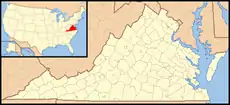 Location of Virginia Virginia, officially the Commonwealth of Virginia, is a state in the Mid-Atlantic and Southeastern regions of the United States between the Atlantic Coast and the Appalachian Mountains. Its geography and climate are shaped by the Blue Ridge Mountains and the Chesapeake Bay. The state's capital is Richmond. Its most-populous city is Virginia Beach, and Fairfax County is the state's most-populous political subdivision. Virginia's population was over 8.68 million, with 35% of the state's population in the Washington–Baltimore area. Virginia's history begins with several indigenous groups, including the Powhatan. In 1607, the London Company established the Colony of Virginia as the first permanent English colony in the New World. Virginia's state nickname, the Old Dominion, is a reference to this status. Slave labor and land acquired from displaced native tribes fueled the growing plantation economy, but also fueled conflicts both inside and outside the colony. Virginia was one of the original Thirteen Colonies in the American Revolution, and several Revolutionary War battles were fought in in Virginia. During the American Civil War, Virginia was split when the state government in Richmond joined the Confederacy, but many of the state's northwestern counties remained loyal to the Union, separating as the state of West Virginia in 1863. Although the Commonwealth was under one-party rule for nearly a century following the Reconstruction era, both major political parties are competitive in modern Virginia. (Full article...) Selected article
French and American armies united north of New York City during the summer of 1781, moving south toward Virginia. The Comte de Grasse arrived at the Chesapeake Bay at the end of August, bringing troops and providing a naval blockade of Yorktown, after which the Americans and French built their first parallel and began the bombardment. With the British defense weakened, on October 14, 1781 Washington sent two columns to attack the last major remaining British outer defenses. The British situation began to deteriorate rapidly and Cornwallis asked for capitulation terms on the 17th. The surrender ceremony took place on the 19th; Lord Cornwallis, claiming to be ill, was absent from the ceremony. Negotiations between the United States and Great Britain began, resulting in the Treaty of Paris in 1783. Selected biography
Pocahontas was captured by the English during Anglo-Indian hostilities in 1613, and held for ransom. During her captivity, she converted to Christianity and took the name Rebecca. When the opportunity arose for her to return to her people, she chose to remain with the English. In April 1614, she married tobacco planter John Rolfe, the first recorded interracial marriage in American history. In 1616, the Rolfes traveled to London, where she became something of a celebrity. When the Rolfes set sail for home, Pocahontas died at Gravesend of unknown causes, where she was buried. Numerous places, landmarks, and products in the United States have been named after Pocahontas. Her story has been romanticized over the years, and she is a subject of art, literature, and film. This month in Virginia history Libby Prison, Richmond
Random Virginia articleA random generator will select an article about…  Map of Virginia's counties and cities
(note: generator may be slow) Things you can do
Tasks
Selected image Monticello, the self-designed home of Thomas Jefferson, in Albemarle County, Virginia Did you know -
Fact sheet
State symbols:
Government
Related portalsVirginia topicsSubcategoriesSelect [+] to view subcategories
Virginia Virginia-related lists Buildings and structures in Virginia Communications in Virginia Virginia culture Demographics of Virginia Economy of Virginia Education in Virginia Environment of Virginia Geography of Virginia Government of Virginia Health in Virginia History of Virginia Horse races in Virginia Virginia law Military in Virginia Missing person cases in Virginia Native American tribes in Virginia People from Virginia Politics of Virginia Professional wrestling in Virginia Science and technology in Virginia Virginia society Sports in Virginia Transportation in Virginia Works about Virginia Images of Virginia Virginia stubs Associated WikimediaThe following Wikimedia Foundation sister projects provide more on this subject:
Discover Wikipedia using portals
|