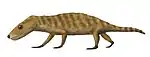
Prozostrodon
Prozostrodon is an extinct genus of probainognathian cynodonts that was closely related to the ancestors of mammals. The remains were found in Brazil and are dated to the Carnian age of the Late Triassic. The holotype has a skull length of 6.7 centimetres (2.6 in), indicating that the whole animal may have been the size of a cat. The teeth were typical of advanced cynodonts, and the animal was probably a carnivore hunting reptiles and other small prey.[1]
| Prozostrodon Temporal range: Carnian ~ | |
|---|---|
 | |
| Skull of holotype | |
Scientific classification  | |
| Kingdom: | Animalia |
| Phylum: | Chordata |
| Clade: | Synapsida |
| Clade: | Therapsida |
| Clade: | Cynodontia |
| Clade: | Prozostrodontia |
| Genus: | †Prozostrodon Bonaparte & Barbarena, 2001 |
| Species: | †P. brasiliensis |
| Binomial name | |
| †Prozostrodon brasiliensis (Bonaparte & Barbarena, 2001) | |
| Synonyms | |
| |

Discovery and naming
Prozostrodon brasiliensis was originally described as a species of Thrinaxodon in a 1987 paper by Mário C. Barberena, José F. Bonaparte and A. M. Sá Teixeira.[2] The holotype (UFRGS-PV-0248-T) includes a well-preserved skull preserving the front half of the cranium, a mostly complete lower jaw and all of the teeth, but missing most of the braincase, sagittal crest and zygomatic arches. It also preserves multiple postcranial elements, including parts of the vertebral column, ribs, interclavicle, humeri, right ilium, femora and right foot. The specimen was found at the Faixa Nova locality in the municipality of Candelária, Rio Grande do Sul, in layers belonging to the Candelária Sequence of the Santa Maria Supersequence.[3] It is deposited in the palaeontology museum of the UFRGS.[4] A 2001 redescription by Bonaparte & Barberena indicated that T. brasiliensis was more closely related to mammals than to the other Thrinaxodon species; as a result, it was reclassified into the new genus Prozostrodon. The generic name references the well-developed cingulum of the lower postcanines, being derived from the Greek word zoster, meaning a girdle or band, and the Latin prefix pro-, meaning "before".[1] A 2018 histological analysis found that the holotype represents a subadult, as its bones were still growing when it died.[5]
A second specimen (CAPPA/UFSM 0123) was described in 2018 from the Marchezan locality in the municipality of São João do Polêsine. It consists of a right dentary bone preserving three postcanine teeth. Because of its small size and lack of a diastema behind the canine, this specimen is thought to be a juvenile.[3]
A third specimen (UFRGS-PV-0543-T) was described in 2020 from the Faixa Nova locality, consisting of the front part of the cranium and fragments of the right dentary. This specimen notably preserves a natural endocast of the nasal cavity.[6]
In 2023, a nearly complete skull (CAPPA/UFSM 0210) was described from the Marchezan locality. Unlike the other known specimens, it preserves the back portion of the skull, including the basicranium.[7]
Classification
Ever since the genus was named in 2001, Prozostrodon has generally been found to be a relatively derived probainognathian, diverging after the ecteniniids, chiniquodontids and probainognathids, but before the tritheledontids, tritylodontids and more derived groups. The clade formed by Prozostrodon and Mammalia was given the name Prozostrodontia in a 2010 paper.[8]
A 2023 phylogenetic analysis recovered Prozostrodon as the sister taxon of Pseudotherium, a prozostrodontian from the Carnian Ischigualasto Formation of Argentina. The clade formed by the two genera was named Prozostrodontidae:[7]
| Probainognathia |
| |||||||||||||||||||||||||||||||||||||||||||||||||||||||||||||||||||||||||||||||||||||||
References
- Bonaparte, J.F. and Barberena, M.C. (2001). "On two advanced carnivorous cynodonts from the Late Triassic of Southern Brazil": In: Studies in Organismic and Evolutionary Biology in honor of A. W. Crompton, edited by Jenkins Jr, F.A., Shapiro, M.D., and Owerkowicz, T. Bulletin of the Museum of Comparative Zoology 156 (1): 59-80.
- Barberena, M. C.; Bonaparte, J. F.; Sá Teixeira, A. M. (1987). "Thrinaxodon brasiliensis sp. nov., a primeira ocorrencia de cinodontes gales - sauros para o Triasico do Rio Grande do Sul". Anais do X Congresso Brasileiro de Paleontologia: 67–76.
- Pacheco, C. P.; Martinelli, A. G.; Pavanatto, A. E. B.; Soares, M. B.; Dias-da-Silva, S. (2018). "Prozostrodon brasiliensis, a probainognathian cynodont from the Late Triassic of Brazil: second record and improvements on its dental anatomy". Historical Biology. 30 (4): 1–10. doi:10.1080/08912963.2017.1292423.
- "The Continental Tetrapod-Bearing Triassic of South Brazil" (PDF). Archived from the original (PDF) on 2011-06-11. Retrieved 2008-04-29.
- Botha-Brink, J.; Bento Soares, M.; Martinelli, A. G. (2018). "Osteohistology of Late Triassic prozostrodontian cynodonts from Brazil". PeerJ. 5029: 1–26. doi:10.7717/peerj.5029.
- Kerber, L.; Martinelli, A. G.; Rodrigues, P. G.; Ribeiro, A. M.; Schultz, C. L.; Soares, M. B. (2020). "New record of Prozostrodon brasiliensis (Eucynodontia: Prozostrodontia) from its type-locality (Upper Triassic, Southern Brazil): comments on the endocranial morphology". Revista Brasileira de Paleontologia. 23 (4): 259–269. doi:10.4072/rbp.2020.4.04.
- Stefanello, M.; Martinelli, A. G.; Müller, R. T.; Dias-da-Silva, S.; Kerber, L. (2023). "A complete skull of a stem mammal from the Late Triassic of Brazil illuminates the early evolution of prozostrodontian cynodonts". Journal of Mammalian Evolution. doi:10.1007/s10914-022-09648-y.
- Liu, J.; Olsen, P. (2010). "The Phylogenetic Relationships of Eucynodontia (Amniota: Synapsida)". Journal of Mammalian Evolution. 17 (3): 151–176. doi:10.1007/s10914-010-9136-8.