T Andromedae
T Andromedae (T And) is a variable star of the Mira type in the constellation Andromeda. Like all the stars of this kind, T And is a cool asymptotic giant branch star of spectral type M4e-M7.5e, and his variability occurs periodically, with the period calculated at 281 days. The peak luminosity, however, is different every variability cycle, but can reach a peak magnitude mv=7.70.[3]
| Observation data Epoch J2000 Equinox J2000 | |
|---|---|
| Constellation | Andromeda |
| Right ascension | 00h 22m 23.14956s[2] |
| Declination | +26° 59′ 45.73676″[2] |
| Apparent magnitude (V) | 7.70 – 14.30 variable [3] |
| Characteristics | |
| Spectral type | M4e-M7.5e[3] |
| B−V color index | 2.63[4] |
| Variable type | Mira[3] |
| Astrometry | |
| Radial velocity (Rv) | −90±10[4] km/s |
| Proper motion (μ) | RA: −7.108[2] mas/yr Dec.: −3.352[2] mas/yr |
| Parallax (π) | 0.5913 ± 0.0815 mas[2] |
| Distance | approx. 5,500 ly (approx. 1,700 pc) |
| Details | |
| Mass | 4.9[5] M☉ |
| Luminosity | 8.928[6] L☉ |
| Surface gravity (log g) | −0.51[5] cgs |
| Temperature | 3,235[5] K |
| Metallicity [Fe/H] | −0.39[5] dex |
| Other designations | |
| Database references | |
| SIMBAD | data |
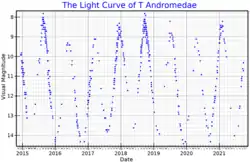
Measurements of the angular size variations of T And made with the Palomar Testbed Interferometer show no clear correlation with the star's brightness variations.[7][8]
References
- "Download Data". aavso.org. AAVSO. Retrieved 1 October 2021.
- Vallenari, A.; et al. (Gaia Collaboration) (2022). "Gaia Data Release 3. Summary of the content and survey properties". Astronomy & Astrophysics. arXiv:2208.00211. doi:10.1051/0004-6361/202243940. Gaia DR3 record for this source at VizieR.
- General Catalogue of Variable Stars, s.v. T. And.
- "T And". SIMBAD. Centre de données astronomiques de Strasbourg. Retrieved October 8, 2018.
- Anders, F.; Khalatyan, A.; Queiroz, A. B. A.; Chiappini, C.; Ardevol, J.; Casamiquela, L.; Figueras, F.; Jimenez-Arranz, O.; Jordi, C.; Monguio, M.; Romero-Gomez, M.; Altamirano, D.; Antoja, T.; Assaad, R.; Cantat-Gaudin, T.; Castro-Ginard, A.; Enke, H.; Girardi, L.; Guiglion, G.; Khan, S.; Luri, X.; Miglio, A.; Minchev, I.; Ramos, P.; Santiago, B. X.; Steinmetz, M. (2022). "VizieR Online Data Catalog: StarHorse2, Gaia EDR3 photo-astrometric distances (Anders+, 2022)". Vizier Online Data Catalog. Bibcode:2022yCat.1354....0A.
- Brown, A. G. A.; et al. (Gaia collaboration) (August 2018). "Gaia Data Release 2: Summary of the contents and survey properties". Astronomy & Astrophysics. 616. A1. arXiv:1804.09365. Bibcode:2018A&A...616A...1G. doi:10.1051/0004-6361/201833051. Gaia DR2 record for this source at VizieR.
- Creech-Eakman, M. J.; Thompson, R. R. (2009). "The Biggest, Baddest, Coolest Stars ASP Conference Series, Vol. 412". The Biggest. Astronomical Society of the Pacific. 412: 149. Bibcode:2009ASPC..412..149C.
- Thompson, R. R.; Creech-Eakman, M. J. (2004). American Astronomical Society Meeting Abstracts. Vol. 205. American Astronomical Society. Bibcode:2004AAS...205.1205T.
External links
| Stars |
| ||||||||||
|---|---|---|---|---|---|---|---|---|---|---|---|
| |||||||||||
| Star clusters |
| ||||||||||
| Nebulae |
| ||||||||||
| Galaxies |
| ||||||||||
| |||||||||||
| |||||||||||
 Category Category | |||||||||||
This article is issued from Wikipedia. The text is licensed under Creative Commons - Attribution - Sharealike. Additional terms may apply for the media files.