Portal:India

Introduction



India, officially the Republic of India (Hindi: Bhārat Gaṇarājya), is a country in South Asia. It is the seventh-largest country by area, the second-most populous country, and the most populous democracy in the world. Bounded by the Indian Ocean on the south, the Arabian Sea on the southwest, and the Bay of Bengal on the southeast, it shares land borders with Pakistan to the west; China, Nepal, and Bhutan to the north; and Bangladesh and Myanmar to the east. In the Indian Ocean, India is in the vicinity of Sri Lanka and the Maldives; its Andaman and Nicobar Islands share a maritime border with Thailand, Myanmar, and Indonesia. (Full article...)
 Featured article –

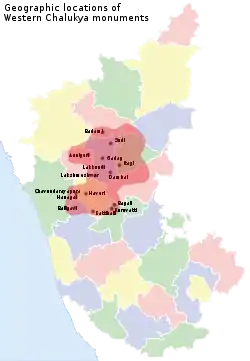 Core area of Western Chalukya architectural activity in modern Karnataka state, India
Western Chalukya architecture (Kannada: ಪಶ್ಚಿಮ ಚಾಲುಕ್ಯ ವಾಸ್ತುಶಿಲ್ಪ), also known as Kalyani Chalukya or Later Chalukya architecture, is the distinctive style of ornamented architecture that evolved during the rule of the Western Chalukya Empire in the Tungabhadra region of modern central Karnataka, India, during the 11th and 12th centuries. Western Chalukyan political influence was at its peak in the Deccan Plateau during this period. The centre of cultural and temple-building activity lay in the Tungabhadra region, where large medieval workshops built numerous monuments. These monuments, regional variants of pre-existing dravida (South Indian) temples, form a climax to the wider regional temple architecture tradition called Vesara or Karnata dravida. Temples of all sizes built by the Chalukyan architects during this era remain today as examples of the architectural style.
Most notable of the many buildings dating from this period are the Mahadeva Temple at Itagi in the Koppal district, the Kasivisvesvara Temple at Lakkundi in the Gadag district, the Mallikarjuna Temple at Kuruvatti in the Bellary district and the Kallesvara Temple at Bagali in the Davangere district. Other monuments notable for their craftsmanship include the Kaitabheshvara Temple in Kubatur and Kedareshvara Temple in Balligavi, both in the Shimoga district, the Siddhesvara Temple at Haveri in the Haveri district, the Amrtesvara Temple at Annigeri in the Dharwad district, the Sarasvati Temple in Gadag, and the Dodda Basappa Temple at Dambal, both in the Gadag district. (Full article...).jpg.webp) Ranaut at the 2019 Cannes Film Festival
Ranaut at the 2019 Cannes Film Festival
Kangna Amardeep Ranaut (pronounced [kəŋɡənaː raːɳoːʈʰ]; born 23 March 1987) is an Indian actress and filmmaker who works primarily in Hindi films. Known for her portrayals of strong-willed, unconventional women in female-led films, she is the recipient of several awards, including four National Film Awards and five Filmfare Awards, and has featured six times in Forbes India's Celebrity 100 list. In 2020, the Government of India honoured her with the Padma Shri, the country's fourth-highest civilian award.
At the age of sixteen, Ranaut briefly took up modelling before being trained under theatre director Arvind Gaur. She made her film debut in the 2006 thriller Gangster, for which she was awarded the Filmfare Award for Best Female Debut, and received praise for portraying emotionally intense characters in the dramas Woh Lamhe... (2006), Life in a... Metro (2007) and Fashion (2008). For the last of these, she won the National Film Award for Best Supporting Actress. She appeared in the commercially successful films Raaz: The Mystery Continues (2009) and Once Upon a Time in Mumbaai (2010) but was criticised for being typecast in neurotic roles. A comic role in Tanu Weds Manu (2011) was well-received, though this was followed by a series of brief, glamorous roles in films that failed to propel her career forward. (Full article...)- Chandralekha (also spelt Chandraleka) is a 1948 Indian historical adventure film produced and directed by S. S. Vasan of Gemini Studios. Starring T. R. Rajakumari, M. K. Radha and Ranjan, the film follows two brothers (Veerasimhan and Sasankan) who fight over ruling their father's kingdom and marrying the village dancer, Chandralekha.
Development began during the early 1940s when, after two successive box-office hits, Vasan announced that his next film would be entitled Chandralekha. However, when he launched an advertising campaign for the film he only had the name of the heroine from a storyline he had rejected. Veppathur Kittoo (one of Vasan's storyboard artists) developed a story based on a chapter of George W. M. Reynolds' novel, Robert Macaire: or, The French bandit in England. Original director T. G. Raghavachari left the film more than halfway through because of disagreements with Vasan, who took over in his directorial debut. (Full article...) .jpg.webp) Abbott, c. 1903, by Charles Dana Gibson
Abbott, c. 1903, by Charles Dana Gibson
Margaret Ives Abbott (June 15, 1878 – June 10, 1955) was an American amateur golfer. She was the first American woman to win an Olympic event: the women's golf tournament at the 1900 Summer Olympics.
Born in Calcutta (now Kolkata), India, in 1878, Abbott moved with her family to Chicago in 1884. She joined the Chicago Golf Club in Wheaton, Illinois, where she was coached by Charles B. Macdonald and H. J. Whigham. In 1899, she traveled with her mother to Paris to study art. In October 1900, along with her mother, she signed up for a women's golf tournament without realizing that it was the second modern Olympics. Abbott won the tournament with a score of 47 strokes; her mother tied for seventh place. Abbott received a porcelain bowl as a prize. (Full article...)- Enthiran (transl. Robot) is a 2010 Indian Tamil-language science fiction action film written and directed by S. Shankar. It is the first instalment in the Enthiran film series. The film stars Rajinikanth and Aishwarya Rai Bachchan with Danny Denzongpa, Santhanam and Karunas in supporting roles. The soundtrack album and background score were composed by A. R. Rahman while the dialogues, cinematography, editing and art direction were handled by Madhan Karky, R. Rathnavelu, Anthony and Sabu Cyril respectively. The story revolves around the struggle of a scientist K. Vaseegaran to control his android humanoid robot named Chitti, after Chitti's software is upgraded to give it the ability to comprehend and exhibit human emotions. The project backfires when Chitti falls in love with Vaseegaran's girlfriend, Sana, and is manipulated by Bohra, a rival scientist, into becoming homicidal.
After being stalled in the development phase for nearly a decade, the film's principal photography began in 2008 and lasted two years. The film marked the debut of Legacy Effects studio (which was responsible for the film's prosthetic make-up and animatronics) in Indian cinema. Enthiran was released worldwide on 1 October 2010. Produced by Kalanithi Maran, it was India's most expensive film up to that point. (Full article...) .jpg.webp) Padukone at the 2018 Cannes Film Festival
Padukone at the 2018 Cannes Film Festival
Deepika Padukone (pronounced [d̪iːpɪka pəɖʊkoːɳeː] or [paːɖʊkoːɳ]; born 5 January 1986) is an Indian actress who works predominantly in Hindi films. She is one of the highest-paid actresses in India, and her accolades include three Filmfare Awards. She features in listings of the nation's most popular personalities; Time named her one of the 100 most influential people in the world in 2018 and awarded her the TIME100 Impact Award in 2022.
Padukone, the daughter of the badminton player Prakash Padukone, was born in Copenhagen and raised in Bangalore. As a teenager, she played badminton in national level championships but left her career in the sport to become a fashion model. She soon received offers for film roles and made her acting debut in 2006 as the title character of the Kannada film Aishwarya. Padukone then played a dual role opposite Shah Rukh Khan in her first Bollywood release, the romance Om Shanti Om (2007), which won her the Filmfare Award for Best Female Debut. Padukone received praise for her starring role in the romance Love Aaj Kal (2009), but this was followed by a brief setback. (Full article...) The frontispiece of the 1920 edition of Tod's Annals and Antiquities of Rajast'han
Lieutenant-Colonel James Tod (20 March 1782 – 18 November 1835) was an officer of the British East India Company and an Oriental scholar. He combined his official role and his amateur interests to create a series of works about the history and geography of India, and in particular the area then known as Rajputana that corresponds to the present day state of Rajasthan, and which Tod referred to as Rajast'han.
Tod was born in London and educated in Scotland. He joined the East India Company as a military officer and travelled to India in 1799 as a cadet in the Bengal Army. He rose quickly in rank, eventually becoming captain of an escort for an envoy in a Sindian royal court. After the Third Anglo-Maratha War, during which Tod was involved in the intelligence department, he was appointed Political Agent for some areas of Rajputana. His task was to help unify the region under the control of the East India Company. During this period Tod conducted most of the research that he would later publish. Tod was initially successful in his official role, but his methods were questioned by other members of the East India Company. Over time, his work was restricted and his areas of oversight were significantly curtailed. In 1823, owing to declining health and reputation, Tod resigned his post as Political Agent and returned to England. (Full article...) Kaif in 2019
Katrina Kaif (pronounced [kəˈʈriːna kɛːf]; born Katrina Turquotte; 16 July 1983) is a British actress who works in Hindi-language films. One of the highest-paid actresses in India, she has received accolades, including four Screen Awards and four Zee Cine Awards, in addition to three Filmfare nominations. Though reception to her acting has varied, she is noted for her dancing ability in various successful item numbers.
Born in Hong Kong, Kaif lived in several countries before she moved to London for three years. She received her first modelling assignment as a teenager and later pursued a career as a fashion model. At a fashion show in London, Indian filmmaker Kaizad Gustad cast her in Boom (2003), a critical and commercial failure. While Kaif established a successful modelling career in India, she initially had difficulty finding film roles due to her poor command of Hindi. After appearing in the Telugu film Malliswari (2004), Kaif earned commercial success in Bollywood with the romantic comedies Maine Pyaar Kyun Kiya? (2005) and Namastey London (2007). Further success followed with a series of box-office hits, but she was criticised for her acting, repetitive roles, and inclination to male-dominated films. (Full article...)
The black stork (Ciconia nigra) is a large bird in the stork family Ciconiidae. It was first described by Carl Linnaeus in the 10th edition of his Systema Naturae. Measuring on average 95 to 100 cm (37 to 39 in) from beak tip to end of tail with a 145-to-155 cm (57-to-61 in) wingspan, the adult black stork has mainly black plumage, with white underparts, long red legs and a long pointed red beak. A widespread but uncommon species, it breeds in scattered locations across Europe (predominantly in Portugal and Spain, and central and eastern parts), and east across the Palearctic to the Pacific Ocean. It is a long-distance migrant, with European populations wintering in tropical Sub-Saharan Africa, and Asian populations in the Indian subcontinent. When migrating between Europe and Africa, it avoids crossing the Mediterranean Sea and detours via the Levant in the east or the Strait of Gibraltar in the west. An isolated, non-migratory, population occurs in Southern Africa.
Unlike the closely related white stork, the black stork is a shy and wary species. It is seen singly or in pairs, usually in marshy areas, rivers or inland waters. It feeds on amphibians, small fish and insects, generally wading slowly in shallow water stalking its prey. Breeding pairs usually build nests in large forest trees—most commonly deciduous but also coniferous—which can be seen from long distances, as well as on large boulders, or under overhanging ledges in mountainous areas. The female lays two to five greyish-white eggs, which become soiled over time in the nest. Incubation takes 32 to 38 days, with both sexes sharing duties, and fledging takes 60 to 71 days. (Full article...)- Mother India is a 1957 Indian epic drama film, directed by Mehboob Khan and starring Nargis, Sunil Dutt, Rajendra Kumar and Raaj Kumar. A remake of Khan's earlier film Aurat (1940), it is the story of a poverty-stricken village woman named Radha (Nargis), who in the absence of her husband, struggles to raise her sons and survive against a cunning money-lender amidst many troubles.
The title of the film was chosen to counter American author Katherine Mayo's 1927 polemical book Mother India, which vilified Indian culture. Mother India metaphorically represents India as a nation in the aftermath of its independence in 1947, and alludes to a strong sense of Indian nationalism and nation-building. Allusions to Hindu mythology are abundant in the film, and its lead character has been seen as a metonymic representation of an Indian woman who reflects high moral values and the concept of what it means to be a mother to society through self-sacrifice. While some authors treat Radha as the symbol of women empowerment, others see her cast in female stereotypes. The film was shot in Mumbai's Mehboob Studios and in the villages of Maharashtra, Gujarat, and Uttar Pradesh. The music by Naushad introduced global music, including Western classical music and orchestra, to Hindi cinema. (Full article...) 
Kalidas (transl. The Servant of Kali, pronounced [kaːɭidaːs]) is a 1931 Indian Tamil- and Telugu-language biographical film directed by H. M. Reddy and produced by Ardeshir Irani. It is notable for being the first sound film in the Tamil and Telugu languages, and the first sound film to be made in a language from South India. It was based on the life of the Sanskrit poet Kalidasa; it featured P. G. Venkatesan in the title role and T. P. Rajalakshmi as the female lead, with L. V. Prasad, Thevaram Rajambal, T. Susheela Devi, J. Sushila, and M. S. Santhanalakshmi in supporting roles.
Kalidas, principally in Tamil, contained additional dialogue in Telugu and Hindi. While Rajalakshmi spoke Tamil, Venkatesan spoke only Telugu due to his lack of fluency in Tamil, and Prasad spoke only Hindi. Despite its mythological theme, the film featured songs from much later time periods, such as the compositions of Carnatic musician Tyagaraja, publicity songs of the Indian National Congress, and songs about Mahatma Gandhi and the Indian independence movement. The sound was recorded using German-made technology. Kalidas was shot in Bombay on the sets of India's first sound film Alam Ara (1931) and was completed in eight days. (Full article...) Zinta in 2018
Preity G Zinta (pronounced [ˈpriːt̪i ˈzɪɳʈa]; born 31 January 1975) is an Indian actress and entrepreneur primarily known for her work in Hindi films. After graduating with degrees in English honours and criminal psychology, Zinta made her acting debut in Dil Se.. in 1998, followed by a role in Soldier in the same year. These performances earned her the Filmfare Award for Best Female Debut, and she was later recognised for her role as a teenage single mother in Kya Kehna (2000). She subsequently established a career as a leading actress of Hindi cinema with a variety of character types. Her roles, often deemed culturally defiant, along with her unconventional screen persona have been credited with contributing to a change in the concept of Indian film heroines, and won her several accolades.
Following critically appreciated roles in Chori Chori Chupke Chupke (2001), Dil Chahta Hai (2001), Dil Hai Tumhaara (2002), and Armaan (2003), Zinta received the Filmfare Award for Best Actress for her performance in Kal Ho Naa Ho (2003). She starred in two consecutive annual top-grossing films in India, Koi... Mil Gaya (2003) and Veer-Zaara (2004), and was noted for her portrayal of independent, modern Indian women in Salaam Namaste (2005) and Kabhi Alvida Naa Kehna (2006), top-grossing productions in overseas markets. For her first international role in the Canadian drama Heaven on Earth (2008) she was awarded the Silver Hugo Award for Best Actress and nominated for the Genie Award for Best Actress. She followed this with a hiatus from acting work for several years, with the exception of her self-produced comeback film, Ishkq in Paris (2013), which failed to leave a mark. (Full article...).jpg.webp) Ray in New York, 1981
Ray in New York, 1981
Satyajit Ray (Bengali pronunciation: [ˈʃotːodʒit ˈrae̯] ( listen); 2 May 1921 – 23 April 1992) was an Indian director, screenwriter, documentary filmmaker, author, essayist, lyricist, magazine editor, illustrator, calligrapher, and music composer. Considered one of the greatest auteurs of film-making, Ray is celebrated for works including The Apu Trilogy (1955–1959), The Music Room (1958), The Big City (1963) and Charulata (1964), Scarecrow and the Goopy - Bagha trilogy.
Ray was born in Calcutta to nonsense rhyme author Sukumar Ray. Starting his career as a commercial artist, Ray was drawn into independent film-making after meeting French filmmaker Jean Renoir and viewing Vittorio De Sica's Italian neorealist film Bicycle Thieves (1948) during a visit to London. (Full article...)- Pather Panchali (Bengali pronunciation: [pɔtʰer pãtʃali]; transl. Song of the Little Road) is a 1955 Indian Bengali-language drama film written and directed by Satyajit Ray and produced by the Government of West Bengal. It is an adaptation of Bibhutibhushan Bandyopadhyay's 1929 Bengali novel of the same name, and marked Ray's directorial debut. Featuring Subir Banerjee, Kanu Banerjee, Karuna Banerjee, Uma Dasgupta, Pinaki Sengupta, Chunibala Devi and being the first film in The Apu Trilogy, Pather Panchali depicts the childhood travails of the protagonist Apu and his elder sister Durga amidst the harsh village life of their poor family.
Production was interrupted because of funding problems and it took nearly three years for the film to be completed. The film was shot mainly on location, had a limited budget, featured mostly amateur actors, and was made by an inexperienced crew. The sitar player Ravi Shankar composed the film's soundtrack and score using classical Indian ragas. Subrata Mitra was in charge of the cinematography while editing was handled by Dulal Dutta. Following its premiere on 3 May 1955 during an exhibition at New York's Museum of Modern Art, Pather Panchali was released in Calcutta later the same year to an enthusiastic reception. It was a hit at the box-office, yet up until early 1980 had earned a profit of only ₹24 lakh. A special screening was attended by the Chief Minister of West Bengal and the Prime Minister of India. Critics have praised its realism, humanity, and soul-stirring qualities, while others have called its slow pace a drawback, and some have condemned it for romanticising poverty. Scholars have commented on the film's lyrical quality and realism (influenced by Italian neorealism), its portrayal of the poverty and small delights of daily life, and the use of what the author Darius Cooper has termed the "epiphany of wonder", among other themes. (Full article...) - Aitraaz (transl. Objection) is a 2004 Indian Hindi-language romantic thriller film directed by Abbas–Mustan and produced by Subhash Ghai. It stars Akshay Kumar, Priyanka Chopra and Kareena Kapoor.
Aitraaz tells the story of a man accused of sexual harassment by his female superior, and was released on 12 November 2004 to positive reviews. Chopra received widespread critical acclaim for her performance. Loosely based on the 1994 film Disclosure, the film was a commercial success grossing ₹260 million at the box office against a budget of ₹80 million, and has been noted for its bold subject of sexual harassment. (Full article...) - Andha Naal (English: That Day, pronounced [an̪da naːɭ]) is a 1954 Indian Tamil-language mystery-thriller film, produced by A. V. Meiyappan and directed by S. Balachander. It is the first film noir in Tamil cinema, and the first Tamil film to be made without songs, dance, or stunt sequences. Set in the milieu of World War II, the story is about the killing of a radio engineer Rajan (Sivaji Ganesan). The suspects are Rajan's wife Usha (Pandari Bai), the neighbour Chinnaiya Pillai (P. D. Sambandam), Rajan's brother Pattabi (T. K. Balachandran), Rajan's sister-in-law Hema (Menaka), and Rajan's mistress Ambujam (K. Sooryakala). Each one's account of the incident points to a new suspect.
Balachander watched Akira Kurosawa's Rashomon (1950) at a film festival, was inspired by it and wrote a play in the same narrative style, but the script was rejected by All India Radio; Meiyappan later agreed to produce it as the film that would later be titled Andha Naal under AVM Productions. The screenplay was written by Javar Seetharaman, who also played a prominent role as an investigative officer in the film. The cinematography was handled by S. Maruti Rao, and the background score was composed by AVM's own music troupe, Saraswathy Stores Orchestra. The film was shorter than most contemporaneous Tamil films. It was the only film directed by Balachander for AVM. (Full article...) - Keechaka Vadham (transl. The Extermination of Keechaka) is an Indian silent film produced, directed, filmed and edited by R. Nataraja Mudaliar. The first film to have been made in South India, it was shot in five weeks at Nataraja Mudaliar's production house, India Film Company. As the members of the cast were Tamils, Keechaka Vadham is considered to be the first Tamil film. No print of it is known to have survived, making it a lost film.
The screenplay, written by C. Rangavadivelu, is based on an episode from the Virata Parva segment of the Hindu epic Mahabharata, focusing on Keechaka's attempts to woo Draupadi. The film stars Raju Mudaliar and Jeevarathnam as the central characters. (Full article...) - Dilwale Dulhania Le Jayenge (transl. "The Big-Hearted Will Take the Bride"), also known by the initialism DDLJ, is a 1995 Indian Hindi-language musical romance film written and directed by Aditya Chopra in his directorial debut and produced by his father Yash Chopra. Released on 20 October 1995, the film stars Shah Rukh Khan and Kajol. The plot revolves around Raj and Simran, two young non-resident Indians, who fall in love during a vacation through Europe with their friends. Raj tries to win over Simran's family so the couple can marry, but Simran's father has long since promised her hand to his friend's son. The film was shot in India, London, and Switzerland, from September 1994 to August 1995.
With an estimated total gross of ₹2 billion ($60 million) worldwide, Dilwale Dulhania Le Jayenge was the highest-grossing Indian film of 1995 and one of the most successful Indian films in history. It won 10 Filmfare Awards—the most for a single film at that time—and the National Film Award for Best Popular Film Providing Wholesome Entertainment. Its soundtrack album became one of the most popular of the 1990s. (Full article...)  Ganges river dolphin breaking the surface
South Asian river dolphins are toothed whales in the genus Platanista, which inhabit fresh water habitats in the northern Indian subcontinent. They were historically considered to be one species (P. gangetica) with the Ganges river dolphin and the Indus river dolphin being subspecies (P. g. gangetica and P. g. minor respectively). Genetic and morphological evidence led to their being described as separate species in 2021. The Ganges and Indus river dolphins are estimated to have diverged 550,000 years ago. They are the only living members of the family Platanistidae and the superfamily Platanistoidea. Fossils of ancient relatives date to the late Oligocene.
South Asian river dolphins are small but stocky cetaceans with long snouts or rostra, broad flippers, and small dorsal fins. They have several unusual features. Living in murky river waters, their eyes are tiny and lensless. The dolphins rely instead on echolocation for navigation. The skull has large crests over the melon, which help direct their echolocation signals. These dolphins prey mainly on fish and shrimp and hunt them throughout the water column. They are active through the day and are sighted in small groups. Both species are listed as endangered by the IUCN Red List of mammals. Major threats include dams, barrages, fishing nets, and both chemical and acoustic pollution. (Full article...).jpg.webp)
The red panda (Ailurus fulgens), also known as the lesser panda, is a small mammal native to the eastern Himalayas and southwestern China. It has dense reddish-brown fur with a black belly and legs, white-lined ears, a mostly white muzzle and a ringed tail. Its head-to-body length is 51–63.5 cm (20.1–25.0 in) with a 28–48.5 cm (11.0–19.1 in) tail, and it weighs between 3.2 and 15 kg (7.1 and 33.1 lb). It is well adapted to climbing due to its flexible joints and curved semi-retractile claws.
The red panda was first formally described in 1825. The two currently recognised subspecies, the Himalayan and the Chinese red panda, genetically diverged about 250,000 years ago. The red panda's place on the evolutionary tree has been debated, but modern genetic evidence places it in close affinity with raccoons, weasels, and skunks. It is not closely related to the giant panda, which is a bear, though both possess elongated wrist bones or "false thumbs" used for grasping bamboo. The evolutionary lineage of the red panda (Ailuridae) stretches back around 25 to 18 million years ago, as indicated by extinct fossil relatives found in Eurasia and North America. (Full article...)- Mayabazar (transl. Market of Illusions) is a 1957 Indian epic Hindu mythological film directed by K. V. Reddy. It was produced by Nagi Reddi and Chakrapani under their banner, Vijaya Productions. The film was shot simultaneously in Telugu and Tamil, with a few differences in the cast. The story is an adaptation of the folk tale Sasirekha Parinayam, which is based on the characters of the epic Mahabharata. It revolves around the roles of Krishna (N. T. Rama Rao) and Ghatotkacha (S. V. Ranga Rao), as they try to reunite Arjuna's son Abhimanyu (Telugu: Akkineni Nageswara Rao, Tamil: Gemini Ganesan) with his love, Balarama's daughter (Savitri). The Telugu version features Gummadi, Mukkamala, Ramana Reddy, and Relangi in supporting roles, with D. Balasubramaniam, R. Balasubramaniam, V. M. Ezhumalai, and K. A. Thangavelu playing those parts in the Tamil version.
The first mythological film produced by their studio, Mayabazar marked a milestone for Nagi Reddi and Chakrapani. In addition to the technical crew, 400 studio workers – including light men, carpenters, and painters – participated in the development of the film. Director Reddy was meticulous with the pre-production and casting phases, which took nearly a year to complete. Though Rama Rao was initially reluctant to play the lead role, his portrayal of Krishna received acclaim and yielded more offers to reprise the same role in several unrelated films. The soundtrack features twelve songs, with most of the musical score composed by Ghantasala. Telugu lyrics were written by Pingali Nagendrarao and Tamil lyrics were written by Thanjai N. Ramaiah Dass. One of those songs, Lahiri Lahiri, was accompanied by the first illusion of moonlight in Indian cinema, shot by cinematographer Marcus Bartley. (Full article...) - Margarita with a Straw is a 2014 Indian Hindi-language drama film directed by Shonali Bose. It stars Kalki Koechlin as an Indian teenager with cerebral palsy who relocates to America for her undergraduate education and comes of age following her complex relationship with a blind girl, played by Sayani Gupta. Revathi, Kuljeet Singh, and William Moseley play supporting roles. Produced by Bose in partnership with Viacom18 Motion Pictures, Margarita with a Straw was co-written by Bose and Nilesh Maniyar. The film deals with the challenging concepts of sexuality, inclusion, self-love, and self-acceptance.
Bose conceived the idea for the film in January 2011 during a conversation with Malini Chib, her cousin and a disability rights activist, about the latter's desire to have a normal sex life. Inspired by Chib's story, Bose wrote the first draft of the film's script. After winning a Sundance Mahindra Global Filmmaker Award for the draft, she modified the script to reflect her own perspective, incorporating several personal experiences into the narrative. Bose completed the screenplay with co-writer Maniyar and the advisory council of the Sundance Institute. (Full article...) - Gemini is a 2002 Indian Tamil-language crime action film written and directed by Saran and produced by AVM Productions. The film stars Vikram in the title role of a small-time criminal and aspiring don who, after falling in love, decides to refrain from crime; Kiran Rathod plays his love interest. Murali stars as Singaperumal, a police officer who inspires and guides Gemini in his attempts to reform. The cast includes Kalabhavan Mani as the antagonist while Vinu Chakravarthy, Manorama and Thennavan portray significant roles. Based on gang wars in Chennai, the film delves into the lives of outlaws and the roles the police and society play in their rehabilitation and acceptance.
In early 2001, rival gangsters "Vellai" Ravi and Chera reformed themselves with the patronage of a police officer. Saran was inspired by this incident and scripted a story based on it. Production began shortly afterwards in December the same year and was completed by March 2002. The film was shot mainly at the AVM Studios in Chennai, while two song sequences were filmed in Switzerland. The film had cinematography by A. Venkatesh and editing by Suresh Urs while the soundtrack was scored by Bharathwaj. (Full article...) 
The lion (Panthera leo) is a large cat of the genus Panthera native to Africa and India. It has a muscular, broad-chested body; short, rounded head; round ears; and a hairy tuft at the end of its tail. It is sexually dimorphic; adult male lions are larger than females and have a prominent mane. It is a social species, forming groups called prides. A lion's pride consists of a few adult males, related females, and cubs. Groups of female lions usually hunt together, preying mostly on large ungulates. The lion is an apex and keystone predator; although some lions scavenge when opportunities occur and have been known to hunt humans, lions typically do not actively seek out and prey on humans.
The lion inhabits grasslands, savannas and shrublands. It is usually more diurnal than other wild cats, but when persecuted, it adapts to being active at night and at twilight. During the Neolithic period, the lion ranged throughout Africa and Eurasia from Southeast Europe to India, but it has been reduced to fragmented populations in sub-Saharan Africa and one population in western India. It has been listed as Vulnerable on the IUCN Red List since 1996 because populations in African countries have declined by about 43% since the early 1990s. Lion populations are untenable outside designated protected areas. Although the cause of the decline is not fully understood, habitat loss and conflicts with humans are the greatest causes for concern. (Full article...)- Sholay (Hindustani: [ˈʃoːleː] (listen), transl. Embers) is a 1975 Indian Hindi-language action-adventure film directed by Ramesh Sippy, produced by his father G. P. Sippy, and written by Salim–Javed. The film is about two criminals, Veeru (Dharmendra) and Jai (Amitabh Bachchan), hired by a retired police officer (Sanjeev Kumar) to capture the ruthless dacoit Gabbar Singh (Amjad Khan). Hema Malini and Jaya Bhaduri also star, as Veeru and Jai's love interests, Basanti and Radha, respectively. Sholay is considered a classic and one of the best Indian films. It was ranked first in the British Film Institute's 2002 poll of "Top 10 Indian Films" of all time. In 2005, the judges of the 50th Filmfare Awards named it the Best Film of 50 Years.
The film was shot in the rocky terrain of Ramanagara, in the southern state of Karnataka, over a span of two and a half years. After the Central Board of Film Certification mandated the removal of several violent scenes, Sholay was released with a length of 198 minutes. In 1990, the original director's cut of 204 minutes became available on home media. When first released, Sholay received negative critical reviews and a tepid commercial response, but favourable word-of-mouth publicity helped it to become a box office success. It broke records for continuous showings in many theatres across India, and ran for more than five years at Mumbai's Minerva theatre. The film was also an overseas success in the Soviet Union. It was the highest-grossing Indian film ever at the time, and was the highest-grossing film in India up until Hum Aapke Hain Koun..! (1994). By numerous accounts, Sholay remains one of the highest-grossing Indian films of all time, adjusted for inflation. (Full article...)
Selected pictures
 Photograph: JJ HarrisonThe Siberian rubythroat (Luscinia calliope) is a small passerine bird generally considered to be an Old World flycatcher of the family Muscicapidae. This migratory insectivorous species breeds in mixed coniferous forest with undergrowth in Siberia, where it nests near the ground. It winters in Thailand, India and Indonesia. It is an extremely rare vagrant to Western Europe and the Aleutian Islands.
.jpg.webp) Photograph: Muhammad Mahdi KarimAn Indian palm squirrel (Funambulus palmarum) photographed in Bangalore, India. In India these squirrels are associated with the Hindu deity Rama, an avatar of Vishnu, and as such are not to be harmed. However, in Western Australia they are considered pests and at times targeted for eradication.
Photograph: Muhammad Mahdi KarimAn Indian palm squirrel (Funambulus palmarum) photographed in Bangalore, India. In India these squirrels are associated with the Hindu deity Rama, an avatar of Vishnu, and as such are not to be harmed. However, in Western Australia they are considered pests and at times targeted for eradication.
 Coin design credit: East India Company and the Calcutta Mint; photographed by Andrew ShivaThe mohur is a gold coin that was formerly minted by several governments, including those of British India. It was usually equivalent in value to fifteen silver rupees. Gold mohurs issued by the British East India Company or the Crown are valuable collectors' items, and sell in auctions for high prices. The double mohur (minted between 1835 and 1918), with a value of thirty rupees, is the highest-denomination circulating coin ever issued in India. The 1835 two-mohur coin above was minted in the reign of King William IV, while the 1862 one-mohur coin below was minted in the reign of Queen Victoria; both are now part of the National Numismatic Collection at the National Museum of American History.
_female_head.jpg.webp) Photograph credit: Charles J. SharpThe southern plains gray langur (Semnopithecus dussumieri) is a species of Old World monkey native to the Indian subcontinent. It is about 62 cm (24 in) tall and lives in groups in various forest habitats, feeding mainly on leaves, fruit and flowers in the canopy, supplementing these with insects, gum, grasses, herbs and roots. The monkeys are considered sacred in India, and some are used by Hindu priests for religious purposes. They have adapted to living in close proximity to humans in urban settings; they are often fed by humans and accept cakes, millet, and other foods. The species is protected by law in India, but some are still persecuted for damaging crops, hunted for food and captured for pets.
Photograph credit: Charles J. SharpThe southern plains gray langur (Semnopithecus dussumieri) is a species of Old World monkey native to the Indian subcontinent. It is about 62 cm (24 in) tall and lives in groups in various forest habitats, feeding mainly on leaves, fruit and flowers in the canopy, supplementing these with insects, gum, grasses, herbs and roots. The monkeys are considered sacred in India, and some are used by Hindu priests for religious purposes. They have adapted to living in close proximity to humans in urban settings; they are often fed by humans and accept cakes, millet, and other foods. The species is protected by law in India, but some are still persecuted for damaging crops, hunted for food and captured for pets.
This photograph of a female southern plains gray langur was taken in Kanha Tiger Reserve, in the Indian state of Madhya Pradesh. The park was created on 1 June 1955 and was designated a tiger reserve in 1973. Photograph: Augustus BinuOdissi is an ancient classical dance that originated in the Hindu temples of Odisha, India. Historically, it has been performed predominantly by women, and expressed religious stories and spiritual ideas, particularly of Vaishnavism (Vishnu as Jagannath), but also of other traditions such as those related to Hindu gods Shiva and Surya, as well as Hindu goddesses (Shaktism). Modern Odissi productions by Indian artists have presented a diverse range of experimental ideas, culture fusion, themes and plays.
Odissi is learnt and performed as a composite of a basic dance motif called the Bhangas (symmetric body bends, stance). It involves the lower, mid, and upper body as three sources of perfecting expression and audience engagement with geometric symmetry and rhythmic musical resonance._male_underside.jpg.webp) Photograph credit: Charles James SharpDanaus genutia, the common tiger or striped tiger, is a species of brush-footed butterfly found in Sri Lanka, India, Myanmar, south-eastern Asia and Australia. It prefers areas of moderate to heavy rainfall, and typical habitats include scrubby jungle, deciduous forests and fallow land near habitations. The insect sequesters toxins from plants, and advertises its unpalatability by having prominent markings and striking colour patterns. This adult male common tiger, of the subspecies D. g. genutia, was photographed in Kerala, India.
Photograph credit: Charles James SharpDanaus genutia, the common tiger or striped tiger, is a species of brush-footed butterfly found in Sri Lanka, India, Myanmar, south-eastern Asia and Australia. It prefers areas of moderate to heavy rainfall, and typical habitats include scrubby jungle, deciduous forests and fallow land near habitations. The insect sequesters toxins from plants, and advertises its unpalatability by having prominent markings and striking colour patterns. This adult male common tiger, of the subspecies D. g. genutia, was photographed in Kerala, India._4.jpg.webp) Photograph credit: Charles James SharpThe Indian rhinoceros (Rhinoceros unicornis) is a species of rhinoceros that once ranged across the entire northern part of the Indian subcontinent. As a result of habitat destruction and climatic changes, its range was gradually reduced such that, by the 19th century, it survived only in southern Nepal, northern Uttar Pradesh, northern Bihar, northern West Bengal, and in the Brahmaputra Valley in Assam. The species's range has since shrunk further, and its habitat is surrounded by human-dominated landscapes, so that in many areas, it occurs in cultivated areas, pastures, and secondary forests. It is currently listed as a vulnerable species on the IUCN Red List. This adult male Indian rhinoceros was photographed on the banks of the Gandaki River in Nepal.
Photograph credit: Charles James SharpThe Indian rhinoceros (Rhinoceros unicornis) is a species of rhinoceros that once ranged across the entire northern part of the Indian subcontinent. As a result of habitat destruction and climatic changes, its range was gradually reduced such that, by the 19th century, it survived only in southern Nepal, northern Uttar Pradesh, northern Bihar, northern West Bengal, and in the Brahmaputra Valley in Assam. The species's range has since shrunk further, and its habitat is surrounded by human-dominated landscapes, so that in many areas, it occurs in cultivated areas, pastures, and secondary forests. It is currently listed as a vulnerable species on the IUCN Red List. This adult male Indian rhinoceros was photographed on the banks of the Gandaki River in Nepal. Photograph: Muhammad Mahdi KarimThe Chota Imambara in Lucknow, Uttar Pradesh, India, is a mausoleum constructed by and for Muhammad Ali Shah, the third Nawab of Awadh, beginning in 1838.
 Photograph: Jorge RoyanAn Indian merchant holding green chickpeas (Cicer arietinum). One of the earliest cultivated legumes, chickpeas are ingredients in a number of dishes around the world. India is the largest producer of this nutrient-dense food, accounting for 64% of global production in 2016.
 Photograph: VengolisDanaus genutia, also known as the common tiger or striped tiger, is a species of butterfly found throughout India as well as Sri Lanka, Myanmar, South-East Asia and Australia. It is a member of the Danainae group of brush-footed butterflies. Both sexes have tawny wings with veins marked with broad black bands, and the male has a pouch on its hindwing. The butterfly is found in scrub jungles, fallow land adjacent to habitation, and deciduous forests, preferring areas of moderate to heavy rainfall. Its most common food plants in peninsular India are small herbs, twiners and creepers from the family Asclepiadaceae. The caterpillar of D. genutia obtains poison by eating poisonous plants, which make the caterpillar and butterfly taste unpleasant to predators. It has some 16 subspecies and although its evolutionary relationships are not completely resolved, it appears to be most closely related to the Malay tiger (D. affinis) and the white tiger.
.jpg.webp) Photograph credit: Augustus BinuPomegranate juice is a beverage made from the fruit of the pomegranate. It is used in cooking both as a fresh juice and as a concentrated syrup. The fruit originated in the region extending from Iran to northern India and has been cultivated since ancient times. The fruit has a hard outer husk and a spongy mesocarp in which the seeds in their fleshy seedcoats are embedded. Pomegranate juice can be sweet or sour, but most fruits are moderate in taste. The juice has long been a popular drink in Europe and the Middle East, and is now widely distributed in the United States and Canada.
Photograph credit: Augustus BinuPomegranate juice is a beverage made from the fruit of the pomegranate. It is used in cooking both as a fresh juice and as a concentrated syrup. The fruit originated in the region extending from Iran to northern India and has been cultivated since ancient times. The fruit has a hard outer husk and a spongy mesocarp in which the seeds in their fleshy seedcoats are embedded. Pomegranate juice can be sweet or sour, but most fruits are moderate in taste. The juice has long been a popular drink in Europe and the Middle East, and is now widely distributed in the United States and Canada. Photo: Muhammad Mahdi KarimThe glass house at Lal Bagh, a botanical garden in Bangalore, India. The garden was commissioned by the ruler of Mysore, Hyder Ali in 1760, and completed during the reign of his son Tipu Sultan. The glass house was modeled on London's Crystal Palace and constructed at the end of the 19th century.
_fruits.jpg.webp) Photo: K Hari KrishnanUnripe drupes of black pepper (Piper nigrum) at Trivandrum, Kerala, India. The drupes are cooked briefly in hot water. The heat ruptures cell walls in the pepper, speeding the work of browning enzymes during drying. The drupes are dried for several days, during which the pepper around the seed shrinks and darkens into a thin, wrinkled black layer. Once dried, the spice is called black peppercorn.
Photo: K Hari KrishnanUnripe drupes of black pepper (Piper nigrum) at Trivandrum, Kerala, India. The drupes are cooked briefly in hot water. The heat ruptures cell walls in the pepper, speeding the work of browning enzymes during drying. The drupes are dried for several days, during which the pepper around the seed shrinks and darkens into a thin, wrinkled black layer. Once dried, the spice is called black peppercorn. Photo: YannA potter at work in Jaura, Madhya Pradesh, India. Pottery, defined by ASTM International as "all fired ceramic wares that contain clay when formed, except technical, structural, and refractory products", originated during the Neolithic period.
 Image credit: Vaikunda RajaThe Lotus-Namam is the symbol of Ayyavazhi, a Dharmic belief system that originated in South India in the 19th century. The lotus represents the 1,008-petalled Sahasrara and the flame-shaped white Namam represents the Aanma Jyothi or ātman, sometimes translated as 'soul' or 'self'. The number of practitioners is estimated to be between 700,000 and 8,000,000, although the exact number is unknown, since Ayyavazhis are reported as Hindus during censuses.
Featured list –
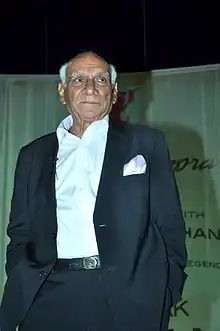 Yash Chopra, the founder of Yash Raj Films, pictured in 2012. He directed 13 films for the company between 1973 and 2012.
Yash Raj Films (abbreviated as YRF) is an Indian entertainment company, established by filmmaker Yash Chopra in 1970, that produces and distributes motion pictures. As of 2022, the company has produced over 80 Hindi films and one Tamil film. YRF started a film distribution business in 1997; in addition to distributing their own productions, the company has handled the domestic and/or international distribution of over 50 films from other companies. The most frequent collaborations of the company have been with the actors Rani Mukerji, Rishi Kapoor, Shah Rukh Khan, Anushka Sharma, Katrina Kaif, and Saif Ali Khan.
YRF's first release came in 1973 with the Chopra-directed Daag, a drama about bigamy, starring Rajesh Khanna, Raakhee and Sharmila Tagore. The company had four more releases in the 1970s, including the ensemble romantic drama Kabhi Kabhie and the action film Kaala Patthar, both of which starred Amitabh Bachchan and Raakhee. YRF's sole commercial success in the 1980s was the Sridevi-starring romantic musical Chandni. The year 1995 marked the directorial debut of Chopra's elder son Aditya Chopra with the highly successful romantic drama Dilwale Dulhania Le Jayenge. Starring Shahrukh Khan and Kajol, the film has the longest theatrical run in Indian cinema history. Other successful releases of the 1990s were Darr (1993) and Dil To Pagal Hai (1997), both starring Khan. (Full article...) Zinta at a promotional event for Jaan-E-Mann in 2006
Preity Zinta (born 31 January 1975) is an Indian actress, film producer and entrepreneur who has received several awards for her acting in Hindi films. Her career began in 1998 with Mani Ratnam's acclaimed drama Dil Se.. and the box office hit Soldier. Both films won her the award for Best Female Debut at the 44th Filmfare Awards. Her performance in Dil Se.. also earned her a Best Supporting Actress nomination at the same ceremony, while Soldier won her three more Best Debut awards at other major ceremonies. Zinta received her first Filmfare nomination for Best Actress for her portrayal of a teenage single mother in Kya Kehna. She followed these films with several critically and commercially successful films, such as Mission Kashmir (2000) and Dil Chahta Hai (2001), and her performances in Chori Chori Chupke Chupke (2001), Dil Hai Tumhaara (2002) and Armaan (2003) were praised.
Zinta won several awards for her performance in the romantic comedy-drama Kal Ho Naa Ho, including her first and only Filmfare Award for Best Actress. She went on to star in top-grossing productions in India and abroad, including Koi... Mil Gaya (2003), Veer-Zaara (2004), Salaam Namaste (2005) and Kabhi Alvida Naa Kehna (2006), all of which earned her different nominations at major award ceremonies, which, in addition to Filmfare, include such organisations as Screen, Zee Cine, the International Indian Film Academy (IIFA), and Stardust, among others. After a relatively low phase, she started appearing in arthouse films, known in India as parallel cinema. She played her first international film role in Deepa Mehta's Canadian drama Heaven on Earth (2008, titled Videsh in India). Her portrayal in the film won her the Silver Hugo Award for Best Actress at the Chicago International Film Festival, and she was a Best Actress nominee at several award functions in Canada, including the Genie Awards by the Academy of Canadian Cinema & Television, and the Vancouver Film Critics Circle. (Full article...) Kaif in 2018
Katrina Kaif is a British-born Indian actress who predominantly appears in Bollywood films. She made her film debut in the 2003 heist film Boom, a box office bomb. She then played the titular princess in the Telugu film Malliswari (2004). Kaif had her first success in Bollywood when she appeared opposite Salman Khan in David Dhawan's romantic comedy Maine Pyaar Kyun Kiya?. The 2006 musical romance Humko Deewana Kar Gaye saw Kaif pair opposite Akshay Kumar for the first of many films, though the film was a critical and financial failure.
Beginning with Namastey London, the year 2007 marked a turning point in her career when all four releases proved to be successful at the box-office. Among these were two of the highest grossing productions of the year — the comedies Partner and Welcome. The following year, Kaif appeared in three films including the action comedy Singh Is Kinng. In 2009, Kaif received a nomination for the Filmfare Award for Best Actress for her performance in Kabir Khan's terrorism drama New York. Later that year, she starred opposite Ranbir Kapoor in the comedy Ajab Prem Ki Ghazab Kahani. In 2010, Kaif portrayed the role of a politician in Prakash Jha's political thriller Raajneeti and an aspiring actress in Tees Maar Khan. While the former was a box-office hit, the latter was a critical and commercial failure. Kaif starred alongside an ensemble cast in Zoya Akhtar's comedy drama Zindagi Na Milegi Dobara (2011). She received her second Filmfare Award nomination for Best Actress for her portrayal of a runaway bride in the romantic comedy Mere Brother Ki Dulhan (2011). (Full article...) Bachchan in 2013
Abhishek Bachchan is an Indian actor and producer known for his work in Hindi films. He made his debut in 2000, opposite Kareena Kapoor, in the J. P. Dutta-directed war drama Refugee. His portrayal of the titular unnamed refugee garnered him a nomination for Best Male Debut at the Filmfare Awards ceremony. However, the film was a box office failure, as were a series of his subsequent films, including Bas Itna Sa Khwaab Hai (2001), and Shararat (2002). His career prospects improved in 2004, when he played a gangster in the Mani Ratnam-directed political drama Yuva, and a police officer in Sanjay Gadhvi's action thriller Dhoom. For the former, he won his first Filmfare Award for Best Supporting Actor, and the latter became one of the highest-grossing films of the year and his first commercial success.
In 2005, Bachchan starred in the crime comedy Bunty Aur Babli opposite Rani Mukerji, and the Ram Gopal Varma-directed thriller Sarkar. The former was the second highest-grossing film of the year, and his performance in the latter earned him a second Filmfare Award for Best Supporting Actor. In both films he co-starred with his father, Amitabh Bachchan. That same year, he also appeared in the Bengali film Antarmahal (2005). The following year, Bachchan appeared in the Karan Johar-directed musical romantic drama Kabhi Alvida Naa Kehna (2006), for which he received his third consecutive Filmfare Award for Best Supporting Actor. The same year, he reunited with Dutta on the historical romance Umrao Jaan (2006), and reprised his role as a police officer in the second installment of the Dhoom series, entitled Dhoom 2 (2006). The latter was the highest grossing Bollywood film to that point. Bachchan next starred alongside Aishwarya Rai in Guru (2007), a biopic inspired by the life of the businessman Dhirubhai Ambani. His titular role in the film was positively received. (Full article...)_Image.jpg.webp) Nani promoting Jersey (2019)
Nani promoting Jersey (2019)
Nani is an Indian actor, producer and television presenter who works predominantly in Telugu cinema and appears in a few Tamil language films. He made his acting debut with Mohana Krishna Indraganti's 2008 comedy film Ashta Chamma, an Indian adaptation of Oscar Wilde's play The Importance of Being Earnest. After Ashta Chamma's commercial success, Nani played the lead roles in three Telugu films in the next two years: Ride (2009), Snehituda... (2009) and Bheemili Kabaddi Jattu (2010). In 2011, Nani collaborated with B. V. Nandini Reddy on the romantic comedy film Ala Modalaindi which was profitable. The same year, he made his Tamil cinema debut with Anjana Ali Khan's Veppam, a crime drama set in the backdrop of North Chennai. The following year, Nani collaborated with S. S. Rajamouli and Gautham Vasudev Menon on the Telugu-Tamil bilingual Eega and the romance film Yeto Vellipoyindhi Manasu respectively. The former, which was about a murdered man reincarnating as a housefly and avenging his death, earned Nani an award in the Best Hero category at the 2013 Toronto After Dark Film Festival. He received the Nandi Award for Best Actor for his performance in Yeto Vellipoyindhi Manasu.
Nani ventured into film production in 2013 as a co-producer for the film D for Dopidi. He faced three box office failures in the upcoming years: Paisa (2013), Aaha Kalyanam (2014) and Janda Pai Kapiraju (2015). Nani termed it a "low phase" in his career and worked on the "planning of films and the timing of their release". He then played the lead role in Nag Ashwin's Yevade Subramanyam (2015), a film focusing on a businessperson's journey to the Himalayas seeking self exploration. Nani later starred in Maruthi's comedy film Bhale Bhale Magadivoy (2015), in which he played an absent minded scientist easily prone to distraction. It was the actor's first blockbuster success, and earned him the Critics Award for Best Actor – South at the 63rd Filmfare Awards South ceremony. With his subsequent releases, the profitable ventures Krishna Gaadi Veera Prema Gaadha (2016) and Gentleman (2016), he gained stardom in Telugu cinema. Nani later played the lead in the commercially successful Telugu films Majnu (2016), Nenu Local (2017) and Ninnu Kori (2017). In 2018, Nani featured as the host of the second season of the Telugu game show Bigg Boss. (Full article...).jpg.webp) Shetty in 2018
Shetty in 2018
Shilpa Shetty is an Indian actress, film producer, author, businesswoman and former model. Known primarily for her work in Hindi films, she has also appeared in Telugu, Kannada and Tamil films. Shetty made her acting debut opposite Shah Rukh Khan in the 1993 thriller Baazigar. Shetty's performance earned her two Filmfare Awards nominations for Lux New Face of the Year and Best Supporting Actress. She subsequently earned wide recognition with dual roles in the 1994 action-comedy Main Khiladi Tu Anari. After initial success, Shetty's films fared poorly at the box office for the next five years. Films Shetty starred in including action drama Aag, romantic drama Aao Pyaar Karen, comedy Haathkadi and Chhote Sarkar proved to be financially unsuccessful. However, Shetty received Best Supporting Actress at the Zee Gold Bollywood Awards for romantic drama Pardesi Babu.
The 2000 romantic drama Dhadkan marked a turning point in her career, earning her several nominations in the Best Actress category at various award ceremonies. Shetty rose to prominence by featuring as the lead female in top-grossing films such as family drama Apne, police drama Garv: Pride and Honour and musical drama Life in a... Metro. Her comic performance as an eccentric fisherwoman in 2002 action-drama release Rishtey earned her a nomination for the Filmfare Best Supporting Actress Award. Shetty became a global figure after winning the 2007 British reality television series Celebrity Big Brother, after comments made by other contestants about Shetty fell afoul of Ofcom rules and caused an international controversy over racism. (Full article...)- Padmaavat is a 2018 Indian Hindi-language epic period drama film directed and produced by Sanjay Leela Bhansali. The film stars Deepika Padukone as Rani Padmavati, Shahid Kapoor as Maharawal Ratan Singh and Ranveer Singh as Sultan Alauddin Khilji and features Aditi Rao Hydari, Jim Sarbh, Raza Murad, and Anupriya Goenka in supporting roles. The film's screenplay was written by Bhansali and Prakash Kapadia. Bhansali also composed the soundtrack of the film, with lyrics written by A. M. Turaz, Siddharth-Garima and Swaroop Khan. The original score of the film is composed by Sanchit Balhara. Padmaavat was edited by Rajesh G. Pandey while Sudeep Chatterjee is its cinematographer. Set in medieval Rajasthan in 1303 AD, Queen Padmavati of Mewar is married to a noble king and they live in a prosperous fortress with their subjects until an ambitious Sultan hears of Padmavati's beauty and becomes obsessed with having her.
Made on a budget of ₹2.15 billion (US$27 million), Padmaavat was released on 25 January 2018 in 2D, 3D and IMAX 3D formats, making it the first Indian film to be released in IMAX 3D. Despite not being released in some states of India, it grossed over ₹5.85 billion (US$73 million) at the box office, becoming a commercial success and one of the highest-grossing Indian films of all time. The film won 25 awards from 68 nominations; its music, and the performance of Singh have received the most attention from award groups. (Full article...)  Matondkar in 2010
Urmila Matondkar is an Indian actress known for her work in Hindi films. She has appeared in over 60 films. She has been praised by the critics for her acting and dancing skills. She made her screen debut as a child artist in B.R. Chopra's Karm (1977), and later appeared in Shekhar Kapur's critically acclaimed Masoom (1983). After making her debut as the heroine in 1989 Malayalam thriller Chanakyan, Urmila began a full-time acting career, with a leading role in the 1991 action Narsimha. She rose to prominence with Ram Gopal Varma's blockbuster Rangeela (1995). Her portrayal of an aspiring actress, Mili Joshi, opposite Aamir Khan received praise from critics, and garnered her first nomination for the Filmfare Award for Best Actress.
In 1997, Urmila received a nomination for Filmfare Award for Best Supporting Actress for her performance in the drama Judaai. The following year, she starred in the crime drama Satya, which has been cited as one of the greatest films of Indian cinema, for which she received another nomination for Best Actress. The same year, her dance performance in the item number "Chamma Chamma" from China Gate won her rave reviews. In 1999, she received praise for playing a psychopath in the thriller Kaun and a reserved girl in the romantic comedy Khoobsurat, a box office success. Her other four releases of the year including Jaanam Samjha Karo, and Hum Tum Pe Marte Hain were commercial failures. She played an obsessive lover in the 2001 romantic drama Pyaar Tune Kya Kiya, which earned her a nomination for the Filmfare Award for Best Performance in a Negative Role. (Full article...) Amitabh Bachchan received several accolades for his performance in Mohabbatein
Mohabbatein (transl. Love Stories) is a 2000 Indian Hindi-language romantic drama film written and directed by Aditya Chopra. It stars an ensemble cast of Amitabh Bachchan, Shah Rukh Khan, Aishwarya Rai, and the newcomers Uday Chopra, Shamita Shetty, Jugal Hansraj, Kim Sharma, Jimmy Sheirgill, and Preeti Jhangiani. It tells the story of the all-boys college Gurukul's principal Narayan Shankar (Bachchan) who prohibits his students from falling in love and will unhesitantly expel those who do not obey the rule. The rest of the film focuses on how the arrival of the violin teacher Raj Aryan Malhotra (Khan) changes his views. Mohabbatein's soundtrack was composed by Jatin–Lalit, and the lyrics were written by Anand Bakshi. The film was shot by Manmohan Singh on sets designed by Sharmishta Roy, while the editor was V. Karnik.
The film opened at theatres on 27 October 2000 and was met with widespread acclaim from critics, who praised the performances of Bachchan and Khan. Made on a production budget of ₹130 million (US$1.6 million), the film had a total gross of ₹900.1 million (US$11 million) becoming the year's highest-grossing Indian film. (Full article...) Kapoor in 2022
Ranbir Kapoor is an Indian actor who appears in Hindi films. He worked as an assistant director on the films Aa Ab Laut Chalen (1999) and Black (2005), before making his acting debut opposite Sonam Kapoor in Sanjay Leela Bhansali's romantic drama Saawariya (2007). It earned Kapoor the Filmfare Award for Best Male Debut. He established himself in 2009 with leading roles in three films—the coming-of-age drama Wake Up Sid, the comedy Ajab Prem Ki Ghazab Kahani and the drama Rocket Singh: Salesman of the Year. He won the Filmfare Critics Award for Best Actor for his combined work in these three films. In 2010, Kapoor played a character based on Arjuna and Michael Corleone in the commercially successful political thriller Raajneeti.
From 2011 to 2013, Kapoor's releases were among the highest-grossing Hindi films of their respective years. In Imtiaz Ali's musical Rockstar (2011), he played an aspiring singer, and in Anurag Basu's comedy-drama Barfi! (2012), he starred as a joyful deaf and mute man. His performance in both films was critically acclaimed and he earned two consecutive Best Actor awards at Filmfare and the former also earned him a Filmfare Critics Award for Best Actor. The romantic comedy Yeh Jawaani Hai Deewani (2013) grossed over ₹2.95 billion (US$37 million) to emerge as his biggest-grosser to that point. (Full article...)_(cropped).jpg.webp) Ashwin has taken a pair of five-wicket hauls in a match on four occasions.
Ashwin has taken a pair of five-wicket hauls in a match on four occasions.
In cricket, a five-wicket haul (also known as a "fifer") refers to a bowler taking five or more wickets in a single innings. This is regarded as a notable achievement, and only 49 bowlers have taken 15 or more five-wicket hauls at international level in their cricketing careers. Ravichandran Ashwin – a right-arm off break bowler – is a Test, One Day International (ODI) and Twenty20 International (T20I) cricketer who represents the India national cricket team. In a 2016 interview, former Sri Lanka spinner Muttiah Muralitharan described Ashwin as the "best current Test spinner". , Ashwin has taken 31 five-wicket hauls in international cricket; he ranks joint ninth in the all-time list, and second among his countrymen.
Ashwin made his Test debut in November 2011 against the West Indies. He took nine wickets in the match, including a five-wicket haul in the second innings. India won the match and his performance earned him the man of the match honour. His career-best figures of seven wickets for 59 runs came against New Zealand in October 2016; in the process he also became the fifth bowler to take six five-wicket hauls against them. He has picked up ten or more wickets in a match on seven occasions. Ashwin made his ODI and T20I debuts in June 2010 against Sri Lanka and Zimbabwe, respectively, and is yet to take a five-wicket haul in both formats. His four wickets for 25 runs against the United Arab Emirates in the 2015 World Cup remain his best in ODIs, while his figures of four wickets for 8 runs against Sri Lanka are the fourth-best by an Indian in T20Is. (Full article...) Roshan in 2014
Hrithik Roshan is an Indian actor known for his work in Hindi-language films. As a child, he made uncredited appearances in three films directed by his maternal grandfather, J. Om Prakash, the first of which was in Aasha (1980). In 1986, Roshan played the adopted son of Rajinikanth's character in Prakash's crime drama Bhagwaan Dada. Roshan subsequently worked as an assistant director on four films, including Khudgarz (1987) and Karan Arjun (1995), all of which were directed by his father, Rakesh.
Roshan's first leading role came opposite Ameesha Patel in Kaho Naa... Pyaar Hai (2000), a highly successful romantic drama directed by his father, for which he won two Filmfare Awards—Best Male Debut and Best Actor. In 2001, Roshan played a supporting role in Karan Johar's lucrative ensemble melodrama Kabhi Khushi Kabhie Gham.... This initial success was followed by roles in a series of critical and commercial failures, including Aap Mujhe Achche Lagne Lage (2002) and Main Prem Ki Diwani Hoon (2003), leading critics to believe that Roshan's career was over. His career prospects improved in 2003 when he played the role of a mentally disabled teenager in his father's science fiction film Koi... Mil Gaya. The film emerged as one of the highest-grossing Bollywood film of that year and earned Roshan the Best Actor – Critics and the Best Actor awards at Filmfare. His next release, the war drama Lakshya (2004), performed poorly at the box office despite earning positive reviews. (Full article...).jpg.webp) Chhetri has scored 84 international goals for India.
Chhetri has scored 84 international goals for India.
Sunil Chhetri is an Indian professional footballer who represents the India national football team as a forward. The current captain of the India national team, he is the country's all-time top goal scorer and most-capped player. As of 27 September 2022, he has scored 84 goals in 131 official international appearances since his debut on 12 June 2005 against Pakistan.
On 9 December 2011, Chhetri netted twice in a match (also known as a brace) in India's 3–1 semi-final win over the Maldives in the 2011 SAFF Championship to take his tally to 31, thus becoming his country's all-time leading goalscorer and surpassing the 29 set by I. M. Vijayan. With his 84 international goals, he is currently the third-highest international goalscorer among active players, behind only Cristiano Ronaldo and Lionel Messi. He is also the highest active goalscorer from Asia. On 5 September 2019, Chhetri scored the only goal for India in a 2–1 defeat against Oman in 2022 FIFA World Cup qualifiers to take his tally to 72 international goals, thus becoming the fifth-highest international goalscorer from Asia of all time. His tally of 84 puts him as the fifth-highest goalscorer jointly with Ferenc Puskás in the history of international football. After guiding India to 2–0 victory with his brace against Bangladesh on 7 June 2021, he levelled with the record set by I. M. Vijayan for the most goals scored by an Indian in the FIFA World Cup qualifiers. (Full article...) Vidya Balan's performance in Kahaani garnered her several awards and nominations
Kahaani (transl. Story) is a 2012 Indian mystery thriller film directed and co-produced by Sujoy Ghosh. The film stars Vidya Balan as the protagonist, and features Parambrata Chatterjee, Nawazuddin Siddiqui, and Saswata Chatterjee in supporting roles. The film was edited by Namrata Rao, with the cinematography provided by Setu. Set in the city of Kolkata during the festivities of Durga Puja, Kahaani follows the life of a pregnant woman, Vidya Bagchi (Vidya Balan), in search of her husband, a man whose existence is denied by the people she encounters.
Made on a budget of ₹80 million (US$1.0 million), Kahaani was released on 9 March 2012 and grossed over ₹1.04 billion (US$13 million) worldwide after a 50-day theatrical run. The film garnered awards and nominations in several categories, with particular praise for its direction and the performance of the lead actress. As of 2014, the film has won 28 awards. (Full article...) Vijay in 2014
Vijay is an Indian actor who works in Tamil cinema. He made his cinematic debut in 1984 with Vetri, directed by his father, S. A. Chandrasekhar. After appearing in Chandrasekhar's films as an child artist, Vijay made his debut as a lead actor with Naalaiya Theerpu (1992) at the age of 18. He followed it with a supporting role opposite Vijayakanth in Sendhoorapandi (1993). Vijay went on to play lead roles in his father's directorial ventures such as Rasigan (1994) and Deva (1995). Most of those films were successful commercially.
Vijay's first breakthrough was in 1996 with Vikraman's romance film, Poove Unakkaga. His subsequent films, Vasanth's Nerrukku Ner (1997) and Fazil's Kadhalukku Mariyadhai (1997), were critically and commercially successful. His performance in the latter won him the Tamil Nadu State Film Award for Best Actor. Thulladha Manamum Thullum (1999), where he played a passionate singer gained him the reputation of a romantic hero. (Full article...)_2.jpg.webp)
The India women's national cricket team represents India in international women's cricket. A full member of the International Cricket Council (ICC), the team is governed by the Board of Control for Cricket in India (BCCI). The India women's national cricket team first competed in 1976 when they played the West Indies in a six-match Test series at home. They recorded their first victory in the fourth match held at the Moin-ul-Haq Stadium, Patna; however, a loss in the sixth match led to the series being tied. India secured their first overseas victory in a one-off series against South Africa in 2002. , they have played 38 Test matches against five different opponents—Australia, England, South Africa, New Zealand and the West Indies. In terms of victories, they have been most successful against England and South Africa with two wins against each of them.
India played their first Women's One Day International cricket (WODI) match against England in the 1978 World Cup, which they hosted. They finished at the bottom of the table as they lost the remaining two games of the group stage. In the 1982 World Cup, they won their first ever WODI match when they beat the International XI by 79 runs at McLean Park, Napier. India's first overseas WODI series win came at the 1994–95 New Zealand Women's Centenary Tournament. They won the WODI series during their tour 1999 of England. They were the runner-up at the 2005 and the 2017 World Cup tournaments. , they have played 301 WODIs against twelve different opponents, and have the fourth highest number of victories (164) for any team in the format; They have recorded 81 wins and have been the fifth most successful team in the T20 format. Since their first Women's Twenty20 International (WT20I) against England in August 2006, India have played 151 matches. They have been most successful against Bangladesh with eleven wins against them. They were among the semi-finalists in the 2009 and 2010 ICC Women's World Twenty20 tournaments. (Full article...)
A women's Twenty20 International (WT20I) is a 20 overs-per-side cricket match played in a maximum of 150 minutes between two ICC member sides, and is played under the rules of Twenty20 cricket. The first such match was held in August 2004 between England and New Zealand. The India women's national cricket team played its first WT20I against England in August 2006; India won the match by eight wickets.
Since the team made its first WT20I appearance in 2006, 73 players—including five different captains—have represented India in the format. The list is arranged in the order in which each player won her first Twenty20 cap. Where more than one player won her first Twenty20 cap in the same match, those players are listed alphabetically by surname. (Full article...) Kapoor at a promotional event for Teri Meri Kahaani in 2012
Indian actor Shahid Kapoor began his career as a background dancer, making uncredited appearances in the films Dil To Pagal Hai (1997) and Taal (1999). He also appeared in several music videos, including one for the singer Kumar Sanu, before making his acting debut with a lead role in Ken Ghosh's romantic comedy Ishq Vishk (2003). The film was a sleeper hit, and Kapoor's portrayal of a teenage student earned him the Filmfare Award for Best Male Debut.
Kapoor found little success in the next two years; all five of his releases, including the thriller Fida (2004) and the drama Shikhar (2005), were commercial failures. In 2006, he starred opposite Kareena Kapoor in 36 China Town and Chup Chup Ke, and played a prospective groom opposite Amrita Rao in Vivah, a commercially successful family drama from director Sooraj Barjatya. In the following year, he reunited with Kareena Kapoor in the romantic comedy Jab We Met, for which he received his first Best Actor nomination at Filmfare. Kapoor's sole film release in 2008 was opposite Vidya Balan in the romantic comedy Kismat Konnection. In 2009, Kapoor portrayed twin brothers, one with a lisp and the other with a stutter, in Vishal Bhardwaj's critically acclaimed caper thriller Kaminey. He then appeared in a series of films which performed poorly at the box-office, including Mausam (2011) and Teri Meri Kahaani (2012). The 2013 action-drama R... Rajkumar proved to be his first commercial success in four years. (Full article...)- The president of India is the head of state of the Republic of India and the Supreme Commander of the Indian Armed Forces. The president is referred to as the first citizen of India. Although vested with these powers by the Constitution of India, the position is largely a ceremonial one and executive powers are de facto exercised by the prime minister.
The president is elected by the Electoral College composed of elected members of the parliament houses, the Lok Sabha and the Rajya Sabha, and also members of the Saasana Sabha or Vidhan Sabha, the state legislative assemblies. Presidents may remain in office for a tenure of five years, as stated by article 56, part V, of the Constitution of India. In the case where a president's term of office is terminated early or during the absence of the president, the vice president assumes office. By article 70 of part V, the parliament may decide how to discharge the functions of the president where this is not possible, or in any other unexpected contingency. (Full article...) 
The chief minister of Chhattisgarh is the chief executive of the Indian state of Chhattisgarh. In accordance with the Constitution of India, the governor is a state's de jure head, but de facto executive authority rests with the chief minister. Following elections to the legislative assembly, the state's governor usually invites the party (or coalition) with a majority of seats to form the government. The governor appoints the chief minister, whose council of ministers are collectively responsible to the assembly. Given the confidence of the assembly, the chief minister's term is for five years and is subject to no term limits.
Three people have served as the state's chief minister since Chhattisgarh's formation on 1 November 2000 as a result of the Madhya Pradesh Reorganisation Act, 2000. The first was Ajit Jogi of the Indian National Congress. He was succeeded in 2003 by Raman Singh of the Bharatiya Janata Party who served three consecutive five-year terms. His successor, and current incumbent, is the Indian National Congress leader Bhupesh Baghel who was elected in 2018. (Full article...)
Piku is a 2015 Indian comedy-drama film directed by Shoojit Sircar and produced by N.P. Singh, Ronnie Lahiri and Sneha Rajani. The film stars Deepika Padukone as the eponymous protagonist, alongside Amitabh Bachchan and Irrfan Khan. Moushumi Chatterjee and Jisshu Sengupta play supporting roles. It was written by Juhi Chaturvedi and the musical score was composed by Anupam Roy. Piku tells the story of a headstrong Bengali architect, who along with her hypochondriac father and a helpful businessman embark on a road trip from New Delhi to Kolkata.
Made on an estimated budget of ₹420 million (US$5.3 million), Piku was released on 8 May 2015, and grossed approximately ₹1.41 billion (US$18 million) worldwide. The film garnered awards and nominations in several categories, with particular praise for its writing, music, and the performances of Padukone and Bachchan. As of June 2016, the film has won a minimum of 35 awards. (Full article...) Districts of West Bengal
The Himalayas lies in the north of West Bengal and the Bay of Bengal is at the south. Between them, the river Ganga flows eastwards and its main distributary, the Hooghly River, flows south to reach the Bay of Bengal. The Siliguri Corridor, which connects North-East India with rest of the India, lies in the North Bengal region of the state. Geographically, West Bengal is divided into a variety of regions—Darjeeling Himalayan hill region, Terai and Dooars region, North Bengal plains, Rarh region, Western plateau and high lands, coastal plains, Sundarbans and the Ganga Delta.
In 1947, when India gained independence, the state of West Bengal was formed, with 14 districts, as per partition plan of the then Bengal province of British India. The former princely state Koch Bihar joined as a district on 26 January 1950, and the former French enclave Chandannagore joined as part of the Hooghly district in 1954. The States Reorganisation Act of 1956 led to addition of Purulia district to the state and to enlargement of West Dinajpur district. Later, larger districts such as West Dinajpur, 24 Parganas and Midnapore were bifurcated. (Full article...).jpg.webp)
Mersal (transl. Stunning) is a 2017 Indian Tamil-language action film directed by Atlee Kumar, who co-wrote the screenplay with V. Vijayendra Prasad and S. Ramana Girivasan. Produced by N. Ramasamy and Hema Rukmani under the banner of Thenandal Studio Limited, Mersal features Vijay in triple roles for the first time in his career. S. J. Surya, Kajal Aggarwal, Nithya Menen and Samantha Akkineni play the other lead roles while Vadivelu, Kovai Sarala and Sathyaraj feature as supporting characters. A. R. Rahman composed the film's soundtrack, while also handling the background score along with Qutub-E-Kripa. Ruben and G. K. Vishnu were in charge of the editing and cinematography respectively. The film follows two brothers, Vetri (Vijay), a renowned magician, and Maaran (Vijay), a doctor who charges meagre amounts for his patients, who try to expose the corrupt dealings and medical crimes of another doctor, Daniel Arockiaraj (Surya), who also happens to be the same person that killed their parents, Vetrimaaran (Vijay) and Aishwarya (Menen).
Produced on a budget of ₹1.2 billion (about US$17.5 million in 2017), Mersal was released on 18 October 2017 and received positive reviews. It was also a commercial success, grossing ₹2.6 billion (about US$39.3 million in 2017) worldwide. The film won 35 awards from 57 nominations; its direction, screenplay, music and Vijay's performances received the most attention from award groups. (Full article...)- The Chameli Devi Jain Award for Outstanding Women Mediaperson is an Indian journalism award named after Chameli Devi Jain, an Indian independence activist who became the first Jain woman to go to prison during India's independence struggle. The award was instituted in 1980 by The Media Foundation and is given to women in the field of journalism. According to Business Standard, the award is "perhaps India's longest running media award for women".
The Media Foundation was founded in 1979 by B. G. Verghese, Lakshmi Chand Jain, Prabhash Joshi, Ajit Bhattacharjea and N. S. Jagannathan. The award was instituted in 1980 by Verghese and the family of Chameli Devi. The criteria for selection include social concern, dedication, courage and compassion in the individual's work. Journalists in print, digital and broadcast are eligible including photographers, cartoonists and newspaper designers; the entries are judged by an independent jury. Preferences are given to rural or small-town journalists and journalists in regional Indian languages. (Full article...)
 Good article –
.jpg.webp) Location of airport in Karnataka
Location of airport in Karnataka
Kempegowda International Airport (IATA: BLR, ICAO: VOBL) is an international airport serving Bangalore, the capital of Karnataka, India. Spread over 4,000 acres (1,600 ha), it is located about 30 kilometres (19 mi) north of the city near the suburb of Devanahalli. It is owned and operated by Bengaluru International Airport Limited (BIAL), a public–private consortium. The airport opened in May 2008 as an alternative to increased congestion at HAL Airport, the original primary commercial airport serving the city. It is named after Kempe Gowda I, the founder of Bangalore. Kempegowda International Airport became Karnataka's first fully solar powered airport developed by CleanMax Solar.
Kempegowda International Airport is the third-busiest airport by passenger traffic, air traffic movements and domestic and total cargo handled in India, behind the airports in Delhi and Mumbai, and is the 29th busiest airport in Asia. In the FY 2021–22, the airport handled around 16.2 million passengers and 411,550 tonnes (453,660 short tons) of cargo. The airport offers connecting flights to all six inhabited continents, and direct flights to five of them. (Full article...) Kaushal in 2019
Vicky Kaushal (pronounced [ˈʋɪkːi ˈkɔːʃəl]; born 16 May 1988) is an Indian actor known for his work in Hindi films. Kaushal is the recipient of numerous accolades including a National Film Award and two Filmfare Awards, and has appeared in Forbes India's Celebrity 100 list of 2019.
After graduating with an engineering degree from Rajiv Gandhi Institute of Technology, He began his film career by assisting Anurag Kashyap in the 2012 crime drama Gangs of Wasseypur and went on to play minor roles in two of Kashyap's productions. His first leading role was in the 2015 drama Masaan, following which he starred in the psychological thriller Raman Raghav 2.0 (2016). Kaushal gained wider recognition in 2018 with supporting roles in Raazi and Sanju, two of the highest-grossing Hindi films of the year, winning the Filmfare Award for Best Supporting Actor for the latter. (Full article...)
The Mumbai Mirror is an Indian English-language newspaper published in Mumbai, Maharashtra. Launched in 2005 as a compact daily newspaper, its coverage focuses on city specific local news and civic issues concerning education, healthcare and municipal administration. The founding editor of the paper was Meenal Baghel who is credited for developing an aggressive public service oriented editorial outlook for the paper. In 2017, it had a readership of over 1.8 million which made it the fifth most widely read English language newspaper in the country.
The newspaper is owned by The Times Group, the publisher of The Times of India. It was launched as part of a ringfencing tactic against competitors in the city of Mumbai. The paper's growth in circulation and positive editorial reception inspired the creation of other city specific newspapers such as the Bangalore Mirror, Pune Mirror and Ahmedabad Mirror. (Full article...) Sikkal Singaravelan temple, Nagapattinam Lighthouse, Beach view, Nagore Dargah, Velankanni Basilica of Our Lady of Good Health
Nagapattinam (nākappaṭṭinam, previously spelt Nagapatnam or Negapatam) is a town in the Indian state of Tamil Nadu and the administrative headquarters of Nagapattinam District. The town came to prominence during the period of Medieval Cholas (9th–12th century CE) and served as their important port for commerce and east-bound naval expeditions. The Chudamani Vihara in Nagapattinam constructed by the Srivijayan king Sri Mara Vijayattungavarman of the Sailendra dynasty with the help of Rajaraja Chola I was an important Buddhist structure in those times. Nagapattinam was settled by the Portuguese and, later, the Dutch under whom it served as the capital of Dutch Coromandel from 1660 to 1781. In November 1781, the town was conquered by the British East India Company. It served as the capital of Tanjore district from 1799 to 1845 under Madras Presidency of the British. It continued to be a part of Thanjavur district in Independent India. In 1991, it was made the headquarters of the newly created Nagapattinam District. Nagapattinam is administered by a Special grade municipality covering an area of 17.92 km2 (6.92 sq mi) and had a population of 102,905 as of 2011.
A majority of the people of Nagapattinam are employed in sea-borne trading, fishing, agriculture and tourism. Kayarohanaswami Temple and Soundararajaperumal Temple, Nagapattinam are the major Hindu pilgrimage sites. Nagapattinam is the base for tourism for Sikkal, Velankanni, Poompuhar, Kodiakkarai, Vedaranyam, and Tharangambadi. Roadways is the major mode of transport to Nagapattinam, while the city also has rail and sea transport. (Full article...)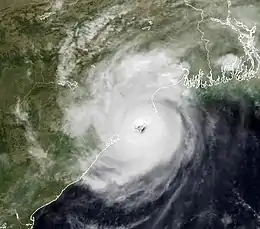 The cyclone on 29 October at its record peak intensity, as it made landfall on Odisha
The 1999 Odisha cyclone (IMD designation BOB 06, JTWC designation 05B) was the most intense recorded tropical cyclone in the North Indian Ocean and among the most destructive in the region. The 1999 Odisha cyclone organized into a tropical depression in the Andaman Sea on 25 October, though its origins could be traced back to an area of convection in the Sulu Sea four days prior. The disturbance gradually strengthened as it took a west-northwesterly path, reaching cyclonic storm strength the next day. Aided by highly favorable conditions, the storm rapidly intensified, attaining super cyclonic storm intensity on 28 October, before peaking on the next day with winds of 260 km/h (160 mph) and a record-low pressure of 912 mbar (hPa; 26.93 inHg). The storm maintained this intensity as it made landfall on Odisha on 29 October. The cyclone steadily weakened due to persistent land interaction and dry air, remaining quasi-stationary for two days before slowly drifting offshore as a much weaker system; the storm dissipated on 4 November over the Bay of Bengal.
Although its primary effects were felt in a localized area of India, the outer fringes of the super cyclone impacted Myanmar and Bangladesh. Ten people were killed in the former, while two were killed in the latter by the storm's rainbands. The storm was the most severe to strike Odisha in the 20th century, raking the state and adjacent areas with high storm surge, powerful winds, and torrential rainfall. The storm's impacts exacerbated the damage caused by a very severe cyclone that struck the same region less than two weeks earlier. The 5–6 m (16–20 ft) surge brought water up to 35 km (20 mi) inland, carrying along with it coastal debris and inundating towns and villages. The surge combined with heavy rains to produce widespread flooding, damaging around 1.6 million homes and causing rivers to breach 20,005 flood embankments. The storm's effects destroyed numerous crops, including sugar cane, rice, and other winter-time harvests. Although estimates of the death toll varied significantly—at times suggesting 30,000 fatalities—the Government of India enumerated 9,887 fatalities in the country, of which a majority were caused by storm surge; over 8,000 deaths occurred in Jagatsinghpur. The total damage cost of the destruction wrought by the super cyclone amounted to US$4.44 billion. (Full article...)
Rakkiaiah (alternatively Rokkiah, born Rajathi Samsudeen in 1968) is an Indian Tamil writer, activist, and politician known by the pen name Salma and the nickname Rajathi, and often referred to as Rajathi Salma. Her works have received international acclaim and she is renowned as a sensation in contemporary Tamil literature.
She is a member of the Dravida Munnetra Kazhagam and involved in women's and transgender rights activism. Between 2007 and 2011, she served as the chairperson of the State Social Welfare Board of Tamil Nadu. Salma is also the founder of a non-government women's rights organisation named "Your Hope is Remaining". (Full article...)
Ravish Malhotra (born 25 December 1943 in Lahore, British India) is a retired Air Commodore of the Indian Air Force. He was an Air Force test pilot stationed at the test centre in Bangalore. He was also the Air Officer Commanding of Hindon Air Force Station near Delhi.
In 1982, he was chosen to train for spaceflight in the Soviet Union's Intercosmos program. Malhotra served as backup for Rakesh Sharma on the Soyuz T-11 mission which launched the first Indian into space, but never went to space himself. Malhotra was awarded the Soviet Order of Friendship of Peoples in 1984 and the Kirti Chakra in 1985. (Full article...) Chauhan at the launch of The Voice India in 2015
Sunidhi Chauhan (pronounced [sʊnɪd̪i tʃʰoːhən]; born 14 August 1983) is an Indian playback singer. Born in Delhi, she began performing in local gatherings at the age of 5 and made her career debut at the age of 13, with the film Shastra (1996). During the year, she won the first singing reality show titled Meri Awaz Suno and rose to prominence after recording "Ruki Ruki Si Zindagi" from Mast (1999). It won her Filmfare RD Burman Award for New Music Talent and was nominated for the Best Female Playback Singer. She is known for her versatility as a vocalist.
Her second breakthrough was released in 2000, with the song "Mehboob Mere" from Fiza, for which she received another Filmfare nomination. Sunidhi received her third Filmfare nomination with the song "Dhoom Machale" from Dhoom (2004) followed by two more nominations during the next year for "Kaisi Paheli" and "Deedar De" from Parineeta and Dus (2005). In 2006, she was bestowed with her first Filmfare award for her rendition of the song "Beedi" from Omkara and further two nominations for "Soniye" from Aksar and "Aashiqui Main" from 36 China Town. (Full article...)- Rang De Basanti (transl. Paint it Saffron) is a 2006 Indian drama film written, produced and directed by Rakeysh Omprakash Mehra. The film stars an ensemble cast including Aamir Khan, Siddharth, R. Madhavan, Atul Kulkarni, Soha Ali Khan, Sharman Joshi, Kunal Kapoor and British actress Alice Patten. It follows a British film student traveling to India to document the story of five freedom fighters of the Indian revolutionary movement. She befriends and casts five young men in the film, which inspires them to fight against the corruption of their own government.
Shot primarily in New Delhi, Rang De Basanti, was released globally on 20 January 2006. Upon release, the film broke all opening box office records in India, becoming the country's highest-grossing film in its opening weekend and holding the highest opening-day collections for a Hindi film. It received critical acclaim, winning the National Film Award for Best Popular Film, and being nominated for Best Foreign Language Film at the 2007 BAFTA Awards. The film was chosen as India's official entry for the Golden Globe Awards and the Academy Awards in the Best Foreign Language Film category, though it did not ultimately yield a nomination for either award. A. R. Rahman's soundtrack, which earned positive reviews, had two of its tracks considered for an Academy Award nomination. (Full article...) 
Mangalore (/mæŋɡəˈlɔːr/), officially known as Mangaluru, is a major port city in the Indian state of Karnataka & on the west coast of India. It is located between the Arabian Sea and the Western Ghats about 352 km (219 mi) west of Bangalore, the state capital, 20 km north of Karnataka–Kerala border, 297 km south of Goa. Mangalore is the state's only city to have all four modes of transport—air, road, rail and sea. The population of the urban agglomeration was 619,664 national census of India. It is known for being one of the locations of the Indian strategic petroleum reserves.
The city developed as a port in the Arabian Sea during ancient times, and has since become a major port of India that handles 75 percent of India's coffee and cashew exports. It is also the country's seventh largest container port. Mangalore has been ruled by several major powers, including the Kadambas, Alupas, Vijayanagar Empire, Keladi Nayaks, and the Portuguese. The city was a source of contention between the British and the Kingdom of Mysore rulers Hyder Ali and Tipu Sultan, and was eventually annexed by the British in 1799. Mangalore remained part of the Madras Presidency until India's independence in 1947 and was unified with Mysore State (now called Karnataka) in 1956. (Full article...)- Anniyan (transl. Stranger) is a 2005 Indian Tamil-language psychological action thriller film written and directed by S. Shankar and produced by V. Ravichandran of Aascar Films. The plot centres on a disillusioned everyman whose frustration at what he sees as increasing social apathy and public negligence leads to a split personality that attempts to improve the system. Vikram stars as Ambi, an idealistic, law-abiding lawyer who has Dissociative identity disorder (formerly known as Multiple personality disorder) and develops two other identities: a suave fashion model named Remo and a murderous vigilante named Anniyan. Sadha plays the female lead role. Actors Vivek, Nedumudi Venu, Nassar and Prakash Raj also featured in the film.
Shankar conceived the film in mid-2003 during the post-production period of his previous film, Boys. He based the film on his own life experiences during his formative years when he was disturbed by what he saw around him, and his eventual displeasure with the society. Pre-production for Anniyan began in November 2003 and principal photography in March 2004. The making of the film, which included numerous production delays, took 14 months. The film was shot at Hyderabad, Thanjavur, Tindivanam and Chennai, and the song sequences were filmed in Mumbai, Malaysia, Amsterdam and Tenkasi. The film was notable for its recreation of the Tyagaraja Aradhana music festival and the extensive use of time slice photography in an action sequence. (Full article...) - Cigars of the Pharaoh (French: Les Cigares du pharaon) is the fourth volume of The Adventures of Tintin, the series of comic albums by Belgian cartoonist Hergé. Commissioned by the conservative Belgian newspaper Le Vingtième Siècle for its children's supplement Le Petit Vingtième, it was serialised weekly from December 1932 to February 1934. The story tells of young Belgian reporter Tintin and his dog Snowy, who are travelling in Egypt when they discover a pharaoh's tomb filled with dead Egyptologists and boxes of cigars. Pursuing the mystery of these cigars, they travel across Arabia and India, and reveal the secrets of an international drug smuggling enterprise.
Following on from Tintin in America, Cigars was a commercial success, and was published in book form by Casterman shortly after its conclusion. Hergé continued The Adventures of Tintin with The Blue Lotus, the plot of which followed on from Cigars. The series itself became a defining part of the Franco-Belgian comic tradition. In 1955, it was re-drawn and coloured by Hergé and his assistants at Studios Hergé to match his distinctive ligne-claire style. Critical analysis of the story has focused on its innovation, and the Adventure introduces the recurring characters of detectives Thomson and Thompson and villain Rastapopoulos. The comic was loosely adapted by Hergé and Jacques Van Melkebeke for the 1941 play Tintin in India: The Mystery of the Blue Diamond; a more faithful adaptation was later made for the 1991 Ellipse/Nelvana animated series The Adventures of Tintin. (Full article...)  Fernandez in 2014
Jacqueline Fernandez (born 11 August 1985) is a Sri Lankan actress and model. She has worked in Indian films, predominantly in Hindi, besides appearing in reality shows and music videos. Debuting with Aladin in 2009 she has since then established a career in the Hindi film industry. Fernandez was born and raised in Bahrain to a multiracial Eurasian family of Sri Lankan, Canadian, and Malaysian descent. After graduating in mass communication from the University of Sydney and working as a television reporter in Sri Lanka, she joined the modeling industry. She was crowned Miss Universe Sri Lanka in 2006, and represented her country at Miss Universe 2006.
While on a modelling assignment in India in 2009, Fernandez successfully auditioned for Sujoy Ghosh's fantasy drama Aladin, which marked her acting debut. Fernandez had her breakthrough role with the psychological thriller Murder 2 (2011), her first commercial success. This was followed by glamorous roles in the commercially successful ensemble-comedy Housefull 2 (2012) and the action thriller Race 2 (2013), which garnered her an IIFA Award for Best Supporting Actress nomination. Fernandez went on to star in the top-grossing action films Kick (2014) and Vikrant Rona (2022), and the comedies Housefull 3 (2016) and Judwaa 2 (2017). (Full article...)- Teri Meri Kahaani (transl. The story of you and me) is a 2012 Indian Hindi-language romantic comedy film directed by Kunal Kohli. Shahid Kapoor (Vivah - 2006, Jab We Met - 2007 & Kismat Konnection - 2008) and Priyanka Chopra (Dostana - 2008, What's Your Raashee? - 2009 & Anjaana Anjaani - 2010), who also co-starred in Kaminey in 2009, portray three couples from three different eras. In 1910 Sargodha, they are two star-crossed lovers during the British Raj; in 1960 Mumbai, a popular Bollywood actress and a struggling musician; and in 2012 London, two university students.
Kohli conceived Teri Meri Kahaani from the idea of soulmates, showing the strength of love beyond generations by having the same two actors portray all three couples without using a reincarnation theme. He co-wrote the film with Robin Bhatt. Muneesh Sappel created three sets for depicting the different time periods, requiring months of research and detailed designs. Principal photography began in Mumbai in mid-2011 and later moved to London, where it was primarily shot at the Jublee Campus of the University of Nottingham and Stratford-upon-Avon. (Full article...) .jpg.webp) 7th century statue of Revanta from Sarnath, Eastern Uttar Pradesh
7th century statue of Revanta from Sarnath, Eastern Uttar Pradesh
Revanta or Raivata (Sanskrit: रेवन्त, lit. "brilliant") is a minor Hindu deity. According to the Rig-Veda, Revanta is the youngest son of the sun-god Surya, and his wife Saranyu. Revanta is chief of the Guhyakas, semi-divine and demonic class entities – like the Yakshas – who are believed to live as forest dwellers in the Himalayas. Images and sculptures of Revanta often show him as a huntsman on a horse, with a bow and arrow.
The worship of Revanta was especially common in medieval Eastern India (Bihar and Bengal) with many archaeological finds indicating the existence of a cult dedicated to him that began in the 6th century A.D. (Full article...)- Manam (transl. We) is a 2014 Indian Telugu-language fantasy drama film written and directed by Vikram Kumar, and produced by the Akkineni Family under the Annapurna Studios banner. The film stars Akkineni Nageswara Rao, Nagarjuna, Naga Chaitanya, Shriya Saran and Samantha Ruth Prabhu. The film is set in various time periods, over the course of a hundred years up until 2013, and deals with the concepts of rebirth and eternal love. The plot features a wealthy businessman, Nageswara Rao (Nagarjuna), attempting to bring a young couple together resembling his deceased parents and the elderly Chaitanya's (Nageswara Rao) attempts to bring the businessman and a doctor together. They resemble Chaitanya's deceased parents, who died because of a mistake committed by him in his childhood.
The film was made with a budget of ₹28 crore ($4.6 million). Harsha Vardhan wrote the film's dialogues, while Anup Rubens composed the film's music. P. S. Vinod handled the film's cinematography and Prawin Pudi edited the film. Production began on 3 June 2013. Principal photography began on 7 June 2013 and was shot in and around Hyderabad, Coorg and Mysore till mid April 2014. (Full article...) 
Mysore Airport (IATA: MYQ, ICAO: VOMY), also known as Mandakalli Airport, is a domestic airport serving Mysore, a city in the Indian state of Karnataka. It is located near the village of Mandakalli, 10 kilometres (6.2 mi) south of the city, and is owned and operated by the Airports Authority of India (AAI). As of January 2023, the airport has regular daily flights to Chennai, Hyderabad and Goa.
The airport's history dates to the 1940s, when it was constructed by the Kingdom of Mysore. Passenger service, training flights of the Indian Air Force, and other operations took place at Mysore Airport during its first several decades. (Full article...)- Munir Hussain (29 November 1929 – 29 July 2013) was a cricket commentator, administrator, and journalist from Pakistan who also played a first-class cricket match for Kalat in the 1969–70 season. He was the first to introduce Urdu commentary to cricket, and was the founder of the first Urdu cricket magazine, Akhbar-e-Watan. During the 1970s, Hussain commentated on the game for Pakistan Television (PTV) and Radio Pakistan, and wrote weekly columns on cricket for the Daily Jang for many years. He received many accolades for his work for cricket. ESPNcricinfo writer Saad Shafqat described him as "a pioneering commentator, groundbreaking publisher, Karachi City Cricket Association (KCCA) mandarin, and sagacious elder presence in the nation's cricket circles". He also served as the president of the KCCA. (Full article...)

Mahadevi Varma (26 March 1907 – 11 September 1987) was an Indian Hindi-language poet, essayist, sketch story writer and an eminent personality of Hindi literature. She is considered one of the four major pillars of the Chhayawadi era in Hindi literature. She has been also addressed as the Modern Meera. Poet Nirala had once called her "Saraswati in the vast temple of Hindi Literature". Varma had witnessed India both before and after independence. She was one of those poets who worked for the wider society of India. Not only her poetry but also her social upliftment work and welfare development among women were also depicted deeply in her writings. These largely influenced not only the readers but also the critics especially through her novel Deepshikha.
She developed a soft vocabulary in the Hindi poetry of Khadi Boli, which before her was considered possible only in Braj bhasha. For this, she chose the soft words of Sanskrit and Bangla and adapted to Hindi. She was well-versed in music. The beauty of her songs lies in the tone that captures the euphemistic style of sharp expressions. She started her career with teaching. She was the Principal of Prayag Mahila Vidyapeeth. She was married, but she chose to live an ascetic life. She was also a skilled painter and creative translator. She had the distinction of receiving all the important awards in Hindi literature. As the most popular female litterateur of the last century, she remained revered throughout her life. The year 2007 was celebrated as her birth cenhenotenary. Later, Google also celebrated the day through its Google Doodle. (Full article...)
Irfan Pathan (pronunciation; born 27 October 1984) is a former Indian cricketer turned Commentator, Cricket Analyst, Actor and Dancer. He was a bowling all rounder and a member of the Indian cricket team that won the inaugural 2007 ICC Twenty20 World Cup and 2013 ICC Champions Trophy.
Beginning his career as a fast-medium swing and seam bowler, Pathan broke into the national team soon after turning 19, and evoked comparisons with Pakistan's Wasim Akram with his promising performances and prodigious swing. In early 2006, Pathan became the only bowler to take a Test hat-trick in the first over of the match (vs Pakistan at Karachi). However, the productive run did not last and after the start of 2006, Pathan began to steadily lose pace and swing, and his wicket-taking dwindled. Although Pathan's batting continued to be productive, he was not regarded as a specialist and was dropped from the team in both Tests and ODIs by the end of 2006, and by 2007 was no longer in the squad until his return in 2007 World Twenty20. (Full article...)- Erode Subramanian Raja Gopal (12 May 1936 – 15 November 2018) was an Indian condensed matter physicist, a former professor at the Indian Institute of Science and a former director of the National Physical Laboratory of India. Known for his research in condensed matter physics, Raja Gopal was an elected fellow of all the three major Indian science academies – the Indian National Science Academy, the National Academy of Sciences, India, and the Indian Academy of Sciences – as well as a member of the Institute of Physics. He was a former CSIR emeritus scientist, an alumnus of the University of Oxford and the author of three reference texts in condensed matter physics. The Council of Scientific and Industrial Research, the apex agency of the Government of India for scientific research, awarded him the Shanti Swarup Bhatnagar Prize for Science and Technology, one of the highest Indian science awards, for his contributions to Physical Sciences in 1978. (Full article...)
- Leila is a 2017 Indian dystopian novel written by Prayaag Akbar. Set in the 2040s, the story follows Shalini, who tries to find her missing daughter Leila in a totalitarian regime. It was published by Simon & Schuster in several formats worldwide on 20 April 2017 and received a positive critical reception. It is also available as an audiobook narrated by Tania Rodriguez.
The novel was awarded the 2018 juried Crossword Book Award for fiction and the Tata Literature Live First Book Award the same year. It was also shortlisted for The Hindu Literary Prize. Leila was adapted as a Netflix series by Deepa Mehta, Shanker Raman and Pawan Kumar with Huma Qureshi, Siddharth, Rahul Khanna, Sanjay Suri and Arif Zakaria. The series premiered on 14 June 2019 to mostly positive reviews from critics. (Full article...) - Devikarani Priscilla Sewpal Jana (5 December 1943 – 10 October 2020) was a South African human rights lawyer, politician and diplomat of Indian descent. As a member of the African National Congress (ANC) during the anti-apartheid movement, she participated in both legal activism as well as in the underground movement to end apartheid. She represented many significant figures in the movement, including South African president Nelson Mandela, Winnie Madikizela-Mandela, Steve Biko, Govan Mbeki, Walter Sisulu, and Archbishop Desmond Tutu. Jana was one of the very few South Africans who had access to political prisoners, including Mandela, in the maximum security Robben Island prison, and served as an emissary for coded messages between the political prisoners and the ANC leadership.
Jana’s activism made her subject to violent harassment and an eventual banning order. Following the advent of full democracy in South Africa, she became a lawmaker and served as a Member of Parliament with the ANC between 1994 and 1999. She was also an ambassador of the South African government to the Netherlands and Ireland, and a commissioner with the South African Human Rights Commission. She was a member of the justice committee that was responsible for the roll-out of the South African Truth and Reconciliation Commission. (Full article...) - The Hero: Love Story of a Spy is a 2003 Indian Hindi-language spy thriller film directed by Anil Sharma and produced by Time Magnetics. It stars Sunny Deol, Preity Zinta and Priyanka Chopra in her Bollywood film debut. Written by Shaktimaan, the film tells the story of an undercover Research and Analysis Wing (RAW) agent who must gather intelligence about cross-border terrorism and stop the terrorist responsible for it and his separation from his fiancé.
Sharma had long contemplated making a spy film but felt this was not economically viable for the Indian market because Indian films did not have sufficient budgets. He first planned a film about India's spy network set in the early 2000s but made the 2001 film Gadar: Ek Prem Katha, which became the one of the highest-grossing Indian films of all time. Following the record-breaking success of that film, Sharma decided to make The Hero: Love Story of a Spy. The Shah Brothers were engaged to produce the film, which was touted to have a huge budget and scale, unlike previous Bollywood films. Aiming for high production values, a sizeable amount of money was spent on the film. Several large sets were created to give the film a feeling of grandeur, and international stunt experts were hired to coordinate action sequences new to Bollywood. Principal photography was done at Indian locations, including Kullu and Manali, and in locations in Canada and Switzerland. Uttam Singh composed the soundtrack with lyrics written by Anand Bakshi and Javed Akhtar. (Full article...)  Late 19th-century lithograph depicting the goddess with a sword, shield, goad and club
Matangi (Sanskrit: मातङ्गी, Mātaṅgī) is a Hindu goddess. She is one of the Mahavidyas, ten Tantric goddesses and an aspect of the Hindu Divine Mother. She is considered to be the Tantric form of Saraswati, the goddess of music and learning. Matangi governs speech, music, knowledge and the arts. Her worship is prescribed to acquire supernatural powers, especially gaining control over enemies, attracting people to oneself, acquiring mastery over the arts and gaining supreme knowledge.
Matangi is often associated with pollution, inauspiciousness and the periphery of Hindu society, which is embodied in her most popular form, known as Uchchhishta-Chandalini or Uchchhishta-Matangini. She is described as an outcaste (Chandalini) and offered left-over or partially eaten food (Uchchhishta) with unwashed hands or food after eating, both of which are considered to be impure in classical Hinduism. (Full article...)
News
- 29 January 2023 – 2022–23 South-West Indian Ocean cyclone season
- The death toll from Cyclone Cheneso's landfall in Madagascar has increased to 25, with 21 others still missing. (AFP via ABS-CBN News)
- 27 January 2023 – Rewilding
- Cheetah reintroduction in India
- South Africa agrees to send twelve cheetahs to India each year for the next eight to ten years to help secure a viable wild population. The Asiatic cheetah went extinct in India in the 1940s due to overhunting and habitat destruction. (BBC News)
- 24 January 2023 – List of earthquakes in 2023
- Three people are killed, twelve are missing and twelve are rescued after a building collapses in Lucknow, Uttar Pradesh, India, due to the earthquake in Nepal. (Reuters)
- 14 January 2023 – Miss Universe 2022
- American R'Bonney Gabriel is crowned Miss Universe by her predecessor, Indian Harnaaz Sandhu. (CNN)
Did you know...
- ... that Myra MacDonald, whose career as a foreign correspondent for Reuters spanned virtually three decades, and who covered South Asia for a long time, wrote three books on India and Pakistan?
- ... that in 1943, Bhicoo Batlivala led a group of Indian women to the House of Commons to request the release of Gandhi from prison?
- ... that Robert Nimmo's command of the UN Military Observer Group in India and Pakistan remains the longest ever command of a United Nations operation?
- ... that the colonial enslavement of American Indians is described as a cultural genocide?
- ... that Colonel Hugh Pettigrew observed that troops who thought that the Scottish Highlands resembled Waziristan on India's North West Frontier were "of little use to anyone"?
- ... that the adults and larvae of the cactus lady beetle prey on the West Indian red scale, the date palm scale, the white peach scale, the sugarcane scale, and the minute cypress scale?
- ... that the opera Die Prinzessin Girnara, by composer Wellesz and librettist Wassermann, and based on a legend from India, premiered simultaneously at two opera houses in 1921?
- ... that Gita Sarabhai was among the first women to play the pakhavaj, a traditional musical instrument of India?
- ... that Jewish Indian theory, the erroneous idea that some lost tribes of Israel became ancestors to Native Americans, influenced the Book of Mormon?
- ... that Asus had to rename their ZenFone 6 for the Indian market after the Delhi High Court ruled that the name violated a competitor's trademark?
- ... that Kolkata's Currency Building has housed the Agra Bank, an office for the issue and exchange of currency, the Reserve Bank of India, and a public art museum?
- ... that the Indian wax scale was first described in 1798 by Fabricius, but was wrongly attributed to another author for nearly two hundred years?
Topics related to India
Timeline of Indian history, Indus Valley Civilisation, Dholavira, Science and technology in ancient India, Meluhha, Aryan invasion theory, Out of India theory, Greek conquests in India, Indian maritime history, Maurya Empire, Ashoka, Shunga Empire, Hoysala Empire, Vijayanagara, Satavahana dynasty, Indo-Greek Kingdom, Indo-Scythians, Indo-Parthian Kingdom, Kushan Empire, Western Satraps, Gupta Empire, Chola dynasty, Pala Empire, Islamic incursions in India, Mughal Empire, Maratha Empire, British Raj, East India Company, Governor-General, Viceroy, War of Independence, 1857, Indian independence movement, Indian National Army, Azad Hind, Quit India Movement, Partition of India, History of Republic of India, Non-Aligned Movement, Sino-Indian War, Indo-Pakistani War of 1947–1948, Indo-Pakistani War of 1965, Indo-Pakistani War of 1971, Kargil War, 2001–02 India–Pakistan standoff, Military, Demographic
Law, Hindu law, Constitution, Political parties (Indian National Congress, Bharatiya Janata Party), Foreign relations, Elections, Political divisions, Reservation in India
Government agencies, Legislative branch (Lok Sabha, Rajya Sabha) Executive branch (President & Vice President, Prime Minister & Deputy Prime Minister, Cabinet Ministers, Cabinet Secretary, Election Commission, Foreign Minister; Law enforcement: CBI, CID, Intelligence: IB, RAW), Directorate General of Income Tax Investigation Judicial branch (Supreme Court), Armed Forces (Army, Navy, Air Force, Border Security Force, Coast Guard)
Himalayas, Western Ghats, Eastern Ghats, Indo-Gangetic Plain, Deccan Plateau, Thar Desert, Ganges, Rann of Kutch, Brahmaputra River, Northeast India; Mountains, Valleys, Islands, Rivers; States and union territories, Cities, Districts, Regions, Fauna, Flora
Rupee, Bombay Stock Exchange, National Stock Exchange, Standard of living, Companies, Reserve Bank of India, Energy policy (Solar, Wind, Nuclear), Tourism, Transport (Expressways, Rail transport, Auto rickshaw),
Languages, Standard of living, Religion
Music (Carnatic, Hindustani, Indi-pop), Dance, Languages, Literature, Architecture, Film & TV, Cuisine, Holidays, Folklore, Education, Media, Indian martial arts
Indian Council of Agricultural Research (ICAR), Indian Institute of Astrophysics, National Centre for Software Technology, AIIMS, IISc, IIT, NIT, BITS-Pilani, INRegistry, Indian numbering system, Indian Space Research Organisation, National Internet Exchange of India, ICRISAT, International Institute of Information Technology, Hyderabad
Indian English, Indian nationality law, Numbering system, Indian Space Research Organisation, Telecommunications, National Highways Development Project, Flag, Vehicle registration plates, Indian nationalism, Metrication in India
Categories

Related portals
Wikipedias in Indian languages
- অসমীয়া (Assamese)
- বাংলা (Bengali)
- भोजपुरी (Bhojpuri)
- বিষ্ণুপ্রিয়া মণিপুরী (Bishnupriya Manipuri)
- गोंयची कोंकणी / Gõychi Konknni (Konkani)
- ગુજરાતી (Gujarati)
- हिन्दी (Hindi)
- ಕನ್ನಡ (Kannada)
- कॉशुर/كشميري (Kashmiri)
- मैथिली (Maithili)
- മലയാളം (Malayalam)
- मराठी (Marathi)
- नेपाली (Nepali)
- नेपाल भाषा
- (Newari)
- ଓଡ଼ିଆ (Odiya)
- ਪੰਜਾਬੀ (Punjabi)
- पालि (Pali)
- संस्कृत (Sanskrit)
- سنڌي (Sindhi)
- தமிழ் (Tamil)
- తెలుగు (Telugu)
- ತುಳು (Tulu)
- اردو (Urdu)
Associated Wikimedia
The following Wikimedia Foundation sister projects provide more on this subject:
-
 Commons
Free media repository -
 Wikibooks
Free textbooks and manuals -
 Wikidata
Free knowledge base -
 Wikinews
Free-content news -
 Wikiquote
Collection of quotations -
 Wikisource
Free-content library -
 Wikiversity
Free learning tools -
 Wikivoyage
Free travel guide -
 Wiktionary
Dictionary and thesaurus
-
 List of all portalsList of all portals
 -
 The arts portal
 -
 Biography portal
 -
 Current events portal
 -
 Geography portal
 -
 History portal
 -
 Mathematics portal
 -
 Science portal
 -
 Society portal
 -
 Technology portal
 -
 Random portalRandom portal
 -
 WikiProject PortalsWikiProject Portals