Portal:Devon

The Devon Portal

Devon (/ˈdɛvən/ DEV-ən, also historically known as Devonshire /ˈdɛvənʃɪər, -ʃər/ DEV-ən-sheer, -shər) is a ceremonial, non-metropolitan, and historic county in South West England. Devon is coastal with a variety of cliffs and sandy beaches. It has the largest open space in southern England, Dartmoor National Park. A predominately rural county, Devon has a relatively low population density for a county in England. Its most populous settlement is the City of Plymouth. The county town of Devon, the City of Exeter, is the second most populous settlement. The county is bordered by Somerset to the north east, Dorset to the east, and Cornwall to the west. Its economy is heavily orientated around the tourism and agriculture industries.
The county derives its name from Dumnonia (the shift from m to v is a typical Celtic consonant shift). During the British Iron Age, Roman Britain and the early Middle Ages, this was the homeland of the Dumnonii Brittonic Celts. The Anglo-Saxon settlement of Britain resulted in the partial assimilation of Dumnonia into the Kingdom of Wessex during the eighth and ninth centuries. The western boundary with Cornwall was set at the River Tamar by King Æthelstan in 936. Devon was later constituted as a shire of the Kingdom of England. (Full article...)
Selected article -
_(cropped).jpg.webp) Robert Falcon Scott in 1905 |
Captain Robert Falcon Scott, CVO, (6 June 1868 – c. 29 March 1912) was a British Royal Navy officer and explorer who led two expeditions to the Antarctic regions: the Discovery expedition of 1901–1904 and the ill-fated Terra Nova expedition of 1910–1913. On the first expedition, he set a new southern record by marching to latitude 82°S and discovered the Antarctic Plateau, on which the South Pole is located. On the second venture, Scott led a party of five which reached the South Pole on 17 January 1912, less than five weeks after Amundsen's South Pole expedition.
A planned meeting with supporting dog teams from the base camp failed, despite Scott's written instructions, and at a distance of 162 miles (261 km) from their base camp at Hut Point and approximately 12.5 miles (20 km) from the next depot, Scott and his companions died. When Scott and his party's bodies were discovered, they had in their possession the first Antarctic fossils ever discovered. The fossils were determined to be from the Glossopteris tree and proved that Antarctica was once forested and joined to other continents.
Before his appointment to lead the Discovery expedition, Scott had a career as a naval officer in the Royal Navy. In 1899, he had a chance encounter with Sir Clements Markham, the president of the Royal Geographical Society, and thus learned of a planned Antarctic expedition, which he soon volunteered to lead. Having taken this step, his name became inseparably associated with the Antarctic, the field of work to which he remained committed during the final 12 years of his life.
Following the news of his death, Scott became a celebrated hero, a status reflected by memorials erected across the UK. However, in the last decades of the 20th century, questions were raised about his competence and character. Commentators in the 21st century have regarded Scott more positively after assessing the temperature drop below −40 °C (−40 °F) in March 1912, and after re-discovering Scott's written orders of October 1911, in which he had instructed the dog teams to meet and assist him on the return trip. (Full article...)General images

.jpg.webp) Barnfield Theatre (from Exeter)
Barnfield Theatre (from Exeter) Prysten House, Finewell Street, 1498, is the oldest surviving house in Plymouth, and built from local Plymouth Limestone and Dartmoor granite (from Plymouth)
 Frontispiece to Shapter's "History of the Cholera in Exeter in 1832" (from Exeter)
- St Petroc's flag of Devon (from Devon)

 Exeter Civic Centre (from Exeter)
 The Plymouth Combined Crown and County Court centre (from Plymouth)
.jpg.webp) Oil on canvas painting by an unknown artist c.1870. These houses were later demolished to make way for St Edmund’s Church. The painting depicts the edge of the River Exe flowing under three arches of the Old Exe Bridge, with houses on the bridge and on the river bank, St Edmund’s Church can be seen in the top left. (from Exeter)
Oil on canvas painting by an unknown artist c.1870. These houses were later demolished to make way for St Edmund’s Church. The painting depicts the edge of the River Exe flowing under three arches of the Old Exe Bridge, with houses on the bridge and on the river bank, St Edmund’s Church can be seen in the top left. (from Exeter) the 'Invincible' Spanish Armada, 1588 (from Plymouth)
.jpg.webp)
 The coat of arms of Devon County Council. (from Devon)
 County Hall, Exeter. Headquarters for Devon County Council. (from Devon)
 Population pyramid of Plymouth (unitary authority) in 2020 (from Plymouth)
 The River Exe (from Exeter)
 An illustration of Exeter in 1563, entitled Civitas Exoniae (vulgo Excester) urbs primaria in comitatu Devoniae (from Exeter)
 St Michael's Church and Episcopal Building (from Exeter)
 Agatha Christie, best selling crime novelist (from Devon)
 Siege of Plymouth, 1643 (from Plymouth)
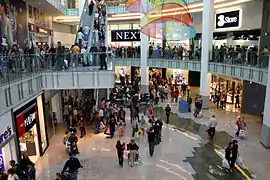 Interior of the Drake Circus Shopping Centre in 2006 (from Plymouth)
 Exeter St Davids Railway Station (from Exeter)
.jpg.webp) Beckley Point (from Plymouth)
Beckley Point (from Plymouth) The High Street ca. 1895 (from Exeter)
 The Exeter Law Courts (from Exeter)
 Laver Building, University of Exeter (from Exeter)

 Exeter Guildhall, which dates from 1470 (from Exeter)
 HMNB Devonport – the largest operational naval base in Western Europe. (from Plymouth)

 MV Pont-Aven: Brittany Ferries service to Roscoff, France and Santander, Spain in Millbay Docks (from Plymouth)
 Naval War Memorial (from Plymouth)

 Plymouth Pavilions, home to the Plymouth City Patriots. (from Plymouth)
 Remains of the medieval Exe Bridge, built around 1200 (from Exeter)
 Exeter International Airport (from Exeter)
 Exeter Canal Basin (from Exeter)
 Northeastward view of Plymouth Sound from Mount Edgcumbe Country Park in Cornwall, with Drake's Island (centre) and, behind it from left to right, the Royal Citadel, the fuel tanks of Cattedown, and Mount Batten; in the background, the hills of Dartmoor. (from Plymouth)
 Population pyramid of Exeter (district) in 2020 (from Exeter)
 Exe Flood Relief Channel built after the floods of 1960 (from Exeter)
 The gatehouse of Rougemont Castle (from Exeter)
 The Exeter Riddle Sculpture in Exeter High Street, created by artist Michael Fairfax and installed in 2005 (from Exeter)
 The Cathedral Green after a rare snowfall (from Exeter)
 Civic Centre, 1954–61, symbolic of the Post War 'Heroic Modernism' of the Welfare State; nationally listed in 2009 to prevent its demolition by Plymouth City Councillors (from Plymouth)
 Charter map of Sutton harbour and Plymouth in 1540 (from Plymouth)
 The Mayflower Steps Memorial (from Plymouth)
 Smeaton's Tower (from Plymouth)
 Unloading mail by hand from the Sir Francis Drake at Millbay Docks, March 1926 (from Plymouth)
 The New Palace Theatre in 2008 (from Plymouth)
 Sir Francis Drake (from Plymouth)
 Lamp standard from the 1905 Exe bridge, installed at Butts Ferry on Exeter Quayside in 1983 (from Exeter)
 A portion of Exeter's city wall, formed of both Roman and medieval stones. (from Exeter)
 Elliot Terrace, Plymouth Hoe (from Plymouth)
 Geological map of Wales & Southwest England. (from Devon)
 "The House that Moved", West Street, Exeter (from Exeter)
 The Higher Market, Exeter, in 1943; at this time the larger firms such as Mac Fisheries had joined the smaller shopkeepers' stalls in the market, which, before the war, along with neighbouring Goldsmith Street, was earmarked for demolition; a new Civic Centre was to be built on the site (from Exeter)
 Grade I listed Town Hall, Column and Library in Devonport (from Plymouth)
 Cliffs in Devon. (from Devon)
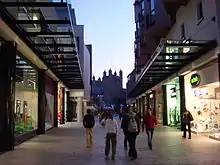 Princesshay Shopping Centre with Exeter Cathedral in the background (from Exeter)
 Armada Way looking north (from Plymouth)
.jpg.webp) Roger Deakins, acclaimed cinematographer (from Devon)
Roger Deakins, acclaimed cinematographer (from Devon) Black-eyed Sue and Sweet Poll of Plymouth mourning their lovers, who are soon to be transported to Botany Bay, 1792 (from Plymouth)
 Torquay sea front during Storm Emma – March 2018 (from Devon)
 Watercolour by Olive Wharry circa 1942 of St. Sidwell’s Church, Exeter, after the Blitz. In the early hours of 4th May 1942 a 250kg bomb fell directly on St Sidwells. The church tower was left standing but was so badly damaged that it was pulled down shortly after. A replacement church was built on the site. From the Royal Albert Memorial Museum's collection (63/2004/4). (from Exeter)
- Coat of arms of Devon (from Devon)
 St David's Church, Exeter (from Exeter)
 John Rocque's 1744 map of Exeter (from Exeter)
Selected image

Recently featured: Bigbury sea tractor - Crazywell cross - South Devon Cattle - Dartmoor tors – Plymouth harbour – Westward Ho! beach
Subcategories

Map


Related portals
Did you know...
- ... that Plymouth's lighthouse, Smeaton's Tower (pictured), was dismantled and then rebuilt on Plymouth Hoe as a memorial?
- ... that Devon is the third largest of the English counties and has a population of 1,109,900?
- ... that the name Devon derives from the name of the Celtic people who inhabited the southwestern peninsula of Britain at the time of the Roman invasion?
- ... that Devon was one of the first areas of England settled following the end of the last ice age?
- ... that the St Nicholas Priory in Exeter is being restored with the same methods that were used 500 years ago?
- ... that Devon is the only county in England to have two separate coastlines?
- ... that there was no established coat of arms for Devon until 1926?
- ... that the English Riviera Geopark in Torbay is the world's only urban Geopark?
Topics
WikiProjects

- Devon WikiProject
- Cornwall WikiProject
- England WikiProject
- Somerset WikiProject
- UK geography WikiProject
Associated Wikimedia
The following Wikimedia Foundation sister projects provide more on this subject:
-
 Commons
Free media repository -
 Wikibooks
Free textbooks and manuals -
 Wikidata
Free knowledge base -
 Wikinews
Free-content news -
 Wikiquote
Collection of quotations -
 Wikisource
Free-content library -
 Wikiversity
Free learning tools -
 Wikivoyage
Free travel guide -
 Wiktionary
Dictionary and thesaurus
-
 List of all portalsList of all portals
 -
 The arts portal
 -
 Biography portal
 -
 Current events portal
 -
 Geography portal
 -
 History portal
 -
 Mathematics portal
 -
 Science portal
 -
 Society portal
 -
 Technology portal
 -
 Random portalRandom portal
 -
 WikiProject PortalsWikiProject Portals