Portal:Edinburgh

The Edinburgh Portal
Welcome! — Fàilte! — Walcome!


_P-EDI_Banner.jpg.webp)


_P-EDI_Banner.jpg.webp)

.jpg.webp)
Edinburgh (/ˈɛdɪnbərə/ ( listen) Scots: [ˈɛdɪnbʌrə]; Scottish Gaelic: Dùn Èideann [ˌt̪un ˈeːtʲən̪ˠ]) is the capital city of Scotland and one of its 32 council areas. The city was historically part of the county of Midlothian (formally called the "county of Edinburgh" or Edinburghshire until 1947), but was administered separately from the surrounding county from 1482 onwards. It is located in Lothian on the southern shore of the Firth of Forth. Edinburgh is Scotland's second-most populous city, after Glasgow, and the seventh-most populous city in the United Kingdom.
Recognised as the capital of Scotland since at least the 15th century, Edinburgh is the seat of the Scottish Government, the Scottish Parliament and the highest courts in Scotland. The city's Palace of Holyroodhouse is the official residence of the British monarchy in Scotland. The city has long been a centre of education, particularly in the fields of medicine, Scottish law, literature, philosophy, the sciences, and engineering. It is the second-largest financial centre in the United Kingdom, and the city's historical and cultural attractions have made it the UK's second-most visited tourist destination attracting 4.9 million visits, including 2.4 million from overseas in 2018. Time Out magazine rated Edinburgh the best city in the world in 2022.
Edinburgh's official population estimates are 506,520 (mid-2020) for the locality, 518,500 (mid-2019) for the City of Edinburgh council area, which takes in some outlying villages in the western part of its territory, and 1,384,950 (2019) for the wider Edinburgh and South East Scotland city region which also includes East Lothian, Fife, Midlothian, the Scottish Borders and West Lothian. (Full article...)
Selected location article

Governor's House is a building situated on the southernmost spur of Calton Hill, beside the south-east corner of Old Calton Burial Ground, in Edinburgh, Scotland. It looks out over Waverley Station, the Canongate and Holyrood Park to the south.
The building of 1815–17 is all that remains of Calton Jail, once the largest prison in Scotland, completed in 1817. It was designed by Archibald Elliot (1761-1823) who was also responsible for the nearby Waterloo Place and Regent Arch. The House contained the Committee Room used by the Commissioners who governed the prison. (Full article...)
Selected images
 The Castle Rock
 Jenners Department Store, the oldest department store in Scotland
 The Band of the Royal Regiment of Scotland in Edinburgh Castle
 The ruins of Holyrood Abbey
 Two Edinburgh Trams seen at the West End - Princes Street stop
.jpg.webp)
 The Princes Street Gardens, the best known park in Edinburgh
The Princes Street Gardens, the best known park in Edinburgh The National Monument of Scotland (right) and Nelson Monument (left)
 Holyrood Palace, the official residence of the British monarch in Scotland
 Queensferry Crossing road bridge
.jpg.webp) Fountain at Holyrood Palace
Fountain at Holyrood Palace View over Edinburgh
 Edinburgh (from Salisbury Crags) by William Crozier, a painter associated with The Edinburgh School
 Architecture in Edinburgh
 Ratho Park Golf Club
 View looking west along George Street
 Scottish baronial-style turrets on Victorian tenements in St. Mary's Street
 Sir Walter Scott
 St Giles' Cathedral, the principal place of worship of the Church of Scotland in Edinburgh
 The BT building in Edinburgh Park
.jpg.webp) The Governor's House
The Governor's House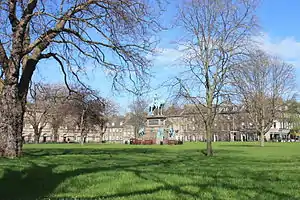 Charlotte Square, a garden square in the New Town
 City Observatory, the Gothic Tower
.jpg.webp)
 The Dean Gallery, part of the Scottish National Gallery of Modern Art
.jpg.webp)
 The High Street, part of the Royal Mile
 David Hume, Scottish philosopher, historian, economist, and essayist born in Edinburgh in 1711
Selected transportation article
 New entrance to Haymarket railway station. |
Haymarket railway station is the second largest railway station in Edinburgh, Scotland, after Waverley railway station.
The station serves as a major commuter and long-distance destination, located near the city centre, in the West End. Trains from the station serve much of Scotland, including Fife and Glasgow, as well as suburban lines to the east, and the East Coast Main Line through to London King's Cross. It is the seventh busiest railway station in Scotland. (Full article...)
Selected area article
 Minto Street, looking south |
Newington is a neighbourhood of southern Edinburgh, Scotland. Developed from the early 19th century, it is an affluent, predominantly residential area.
Located between 1 (1.5km) and 2.5 miles (4km) south of Edinburgh city centre, Newington is bounded to the east by St Leonard's and Prestonfield; to the south by Cameron Toll and Nether Liberton; to the west by Blackford, the Grange, and Sciennes; and to the north by the Southside, Edinburgh. Historically part of the parishes of St Cuthbert's and Liberton in the county of Midlothian, Newington was incorporated into the city of Edinburgh between 1832 and 1896. (Full article...)
Selected environment article
 Cramond Island from the air |
Cramond Island (Scottish Gaelic: Eilean Chathair Amain) is one of several islands in the Firth of Forth in eastern Scotland, near Edinburgh. It lies off the foreshore at Cramond. It is 1⁄3 mile (0.54 km) long and covers 19.03 acres (7.70 ha). The island is part of the Dalmeny Estate, owned by the Rosebery Estates Partnership, and is let to Cramond Boat Club. (Full article...)
Did you know?
- ... that the Aesculapian Club, founded in Edinburgh in 1773, still meets twice a year?
- ... that the uncommon Florida lichen species Gyalectidium yahriae was named after Rebecca Yahr of the Royal Botanic Garden Edinburgh in Scotland?
Selected arts article

This is a list of arts and cultural festivals regularly taking place in Edinburgh, Scotland.
The city has become known for its festivals since the establishment in 1947 of the Edinburgh International Festival and the Edinburgh Festival Fringe which runs alongside it. The latter is the largest event of its kind in the world. (Full article...)
Selected education article

The University of Edinburgh (Scots: University o Edinburgh, Scottish Gaelic: Oilthigh Dhùn Èideann; abbreviated as Edin. in post-nominals) is a public research university based in Edinburgh, Scotland. Founded by the town council under the authority of a royal charter of King James VI in 1582 and officially opened in 1583, it is one of Scotland's four ancient universities and the sixth-oldest university in continuous operation in the English-speaking world. The university played an important role in Edinburgh becoming a chief intellectual centre during the Scottish Enlightenment and contributed to the city being nicknamed the "Athens of the North." Edinburgh is ranked among the top universities in the United Kingdom and the world.
Edinburgh is a member of several associations of research-intensive universities, including the Coimbra Group, League of European Research Universities, Russell Group, Una Europa, and Universitas 21. In the fiscal year ending 31 July 2022, it had a total income of £1.262 billion, of which £331.6 million was from research grants and contracts, with the third-largest endowment in the UK, behind only Cambridge and Oxford. The university has five main campuses in the city of Edinburgh, which include many buildings of historical and architectural significance such as those in the Old Town. (Full article...)
Selected sports article
 Meggetland in 2006 |
Meggetland Sports Complex, owned by Edinburgh Leisure, is a Sports Pavilion used for a number of International fixtures across the five outdoor facilities they hold; 3G Pitch, Astroturf, Football Pitches, Rugby Pitches and Cricket Pitches. They regularly host matches for many clubs and groups, including Boroughmuir Rugby Club, Boroughmuir Hockey Club, Edinburgh Cala Hockey Club, Boroughmuir Thistle Football Club and Boroughmuir Cricket Club. In addition, the ground also hosted three Edinburgh Rugby matches during the 2013–14 Pro 12 season. They hosted Edinburgh against the Ospreys on 28 February, Cardiff Blues on 11 April and Munster on 3 May.
In January 2016, the Edinburgh Wolves (American Football) announced that due to the closure of Meadowbank Stadium for development, they would be moving to play their home games for the 2016 season at Meggetland. (Full article...)
Selected religion article
West façade of the church building |
St Giles' Cathedral (Scottish Gaelic: Cathair-eaglais Naomh Giles), or the High Kirk of Edinburgh, is a parish church of the Church of Scotland in the Old Town of Edinburgh. The current building was begun in the 14th century and extended until the early 16th century; significant alterations were undertaken in the 19th and 20th centuries, including the addition of the Thistle Chapel. St Giles' is closely associated with many events and figures in Scottish history, including John Knox, who served as the church's minister after the Scottish Reformation.
Likely founded in the 12th century and dedicated to Saint Giles, the church was elevated to collegiate status by Pope Paul II in 1467. In 1559, the church became Protestant with John Knox, the foremost figure of the Scottish Reformation, as its minister. After the Reformation, St Giles' was internally partitioned to serve multiple congregations as well as secular purposes, such as a prison and as a meeting place for the Parliament of Scotland. In 1633, Charles I made St Giles' the cathedral of the newly created Diocese of Edinburgh. Charles' attempt to impose a Scottish Prayer Book in St Giles' on 23 July 1637 caused a riot, which precipitated the formation of the Covenanters and the beginnings of the Wars of the Three Kingdoms. St Giles' role in the Scottish Reformation and the Covenanters' Rebellion has led to its being called "the Mother Church of World Presbyterianism".
(Full article...)
Related portals
Categories

Topics


In the news
No recent news
Associated Wikimedia
The following Wikimedia Foundation sister projects provide more on this subject:
-
 Commons
Free media repository -
 Wikibooks
Free textbooks and manuals -
 Wikidata
Free knowledge base -
 Wikinews
Free-content news -
 Wikiquote
Collection of quotations -
 Wikisource
Free-content library -
 Wikiversity
Free learning tools -
 Wikivoyage
Free travel guide -
 Wiktionary
Dictionary and thesaurus
-
 List of all portalsList of all portals
 -
 The arts portal
 -
 Biography portal
 -
 Current events portal
 -
 Geography portal
 -
 History portal
 -
 Mathematics portal
 -
 Science portal
 -
 Society portal
 -
 Technology portal
 -
 Random portalRandom portal
 -
 WikiProject PortalsWikiProject Portals