Portal:Illinois

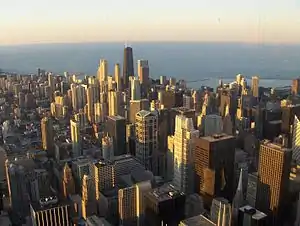
The Illinois Portal  The flag of Illinois Illinois (/ˌɪlɪˈnɔɪ/ ( Illinois has a highly diverse economy, with the global city of Chicago in the northeast, major industrial and agricultural hubs in the north and center, and natural resources such as coal, timber, and petroleum in the south. Owing to its central location and favorable geography, the state is a major transportation hub: the Port of Chicago has access to the Atlantic Ocean through the Great Lakes and Saint Lawrence Seaway and to the Gulf of Mexico from the Mississippi River via the Illinois Waterway. Additionally, the Mississippi, Ohio, and Wabash rivers form parts of the state's boundaries. Chicago's O'Hare International Airport has been among the world's ten busiest airports for decades. Illinois has long been considered a microcosm of the United States and a bellwether in American culture, exemplified by the phrase Will it play in Peoria?. What is now Illinois was inhabited for thousands of years by various indigenous cultures, including the advanced civilization centered in the Cahokia region. The French were the first Europeans to arrive, settling near the Mississippi River in the 17th century, in the region they called Illinois Country, as part of the sprawling colony of New France. Following U.S. independence in 1783, American settlers began arriving from Kentucky via the Ohio River, and the population grew from south to north. Illinois was part of the United States' oldest territory, the Northwest Territory, and in 1818 it achieved statehood. The Erie Canal brought increased commercial activity in the Great Lakes, and the small settlement of Chicago became one of the fastest growing cities in the world, benefiting from its location as one of the few natural harbors in southwestern Lake Michigan. The invention of the self-scouring steel plow by Illinoisan John Deere turned the state's rich prairie into some of the world's most productive and valuable farmland, attracting immigrant farmers from Germany and Sweden. In the mid-19th century, the Illinois and Michigan Canal and a sprawling railroad network greatly facilitated trade, commerce, and settlement, making the state a transportation hub for the nation. Selected article Promotional picture from the 1924 Bears team. The Chicago Bears are a professional American football team based in Chicago. They are members of the North Division of the National Football Conference (NFC) in the National Football League (NFL). The Bears have won nine Professional American Football league championships (eight NFL Championships and Super Bowl XX), trailing only the Green Bay Packers, who have twelve. The Bears have the most enshrinees in the Pro Football Hall of Fame with 26 members. The club was founded in Decatur, Illinois, in 1919 and moved to Chicago in 1921. The team played home games at Wrigley Field on Chicago's North Side through the 1970 season. With the exception of the 2002 season, they have played their home games at Chicago's Soldier Field every year since 1971. The stadium is located next to Lake Michigan and was recently remodeled in a modernization that has attempted to bring stadium amenities expected by today's fans to a historic Chicago building. The team has a fierce, longstanding rivalry with the Packers, whom they have played in over 170 games. (Read more...) Selected biography Portrait of Hay by John Singer Sargent, 1902 John Hay (October 8, 1838 – July 1, 1905) was an American statesman and official whose career in government stretched over almost half a century. Beginning as a private secretary and assistant to Abraham Lincoln, Hay's highest office was United States Secretary of State under Presidents William McKinley and Theodore Roosevelt. Hay was also an author and biographer and wrote poetry and other literature throughout much of his life. Born in Indiana to an anti-slavery family that moved to Illinois when he was young, Hay showed great potential, and his family sent him to Brown University. After graduation in 1858, Hay read law in his uncle's office in Springfield, Illinois, adjacent to that of Lincoln. Hay worked for Lincoln's successful presidential campaign and became one of his private secretaries at the White House. Throughout the American Civil War, Hay was close to Lincoln and stood by his deathbed after the President was shot at Ford's Theatre. In addition to his other literary works, Hay co-authored with John George Nicolay a multi-volume biography of Lincoln that helped shape the assassinated president's historical image. As Secretary of State, Hay was responsible for negotiating the Open Door Policy, which kept China open to trade with all countries on an equal basis, with international powers. By negotiating the Hay–Pauncefote Treaty with the United Kingdom, the (ultimately unratified) Hay–Herrán Treaty with Colombia, and finally the Hay–Bunau-Varilla Treaty with the newly-independent Republic of Panama, Hay also cleared the way for the building of the Panama Canal. (Read more...) Did you know...
Selected images
Recent news
Featured content
TopicsSubcategories Category puzzle Select [►] to view subcategories
Illinois Illinois-related lists Buildings and structures in Illinois Communications in Illinois Illinois culture Demographics of Illinois Economy of Illinois Education in Illinois Environment of Illinois Geography of Illinois Government of Illinois Health in Illinois History of Illinois Illinois law Military in Illinois Native American tribes in Illinois Organizations based in Illinois People from Illinois Politics of Illinois Professional wrestling in Illinois Science and technology in Illinois Illinois society Sports in Illinois Tourist attractions in Illinois Transportation in Illinois Works about Illinois Images of Illinois Illinois stubs Related portalsWikiProjects
Things you can do
Associated WikimediaThe following Wikimedia Foundation sister projects provide more on this subject:
Discover Wikipedia using portals
|

.jpg.webp)





_Singer_369296.jpg.webp)
.jpg.webp)

.jpg.webp)






-edit3.jpg.webp)


.jpg.webp)


