Iran has one of the oldest histories in the world, extending more than 5000 years, and throughout history, Iran has been of geostrategic importance because of its central location in Eurasia and Western Asia. Iran is a founding member of the UN, NAM, OIC, OPEC, and ECO. Iran as a major regional power occupies an important position in the world economy due to its substantial reserves of petroleum and natural gas, and has considerable regional influence in Western Asia. The name Iran is a cognate of Aryan and literally means "Land of the Aryans." (Full article...)
Recognized content -
Entries here consist of Good and Featured articles, which meet a core set of high editorial standards.
Basra, located in present-day Iraq, had already been under Safavid control from 1508 to 1524, when it was lost upon Shah ("King") Ismail I's death. In the ensuing period, the Ottomans, rivals of the Safavids, managed to establish nominal rule over the city. De facto rule of Basra remained in the hands of the local Arab Al-Mughamis tribe, a branch of the Banu'l-Muntafiq. In 1596, the Ottoman governor of Basra, Ali Pasha, sold his office to a local named Afrasiyab. Over the next c.70 years, Basra was considered a hereditary eyalet under Afrasiyab and his descendants. (Full article...)
Image 2
Themistocles (/θəˈmɪstəkliːz/; Greek: Θεμιστοκλῆς; c. 524–459BC) was an Athenianpolitician and general. He was one of a new breed of non-aristocratic politicians who rose to prominence in the early years of the Athenian democracy. As a politician, Themistocles was a populist, having the support of lower-class Athenians, and generally being at odds with the Athenian nobility. Elected archon in 493BC, he convinced the polis to increase the naval power of Athens, a recurring theme in his political career. During the first Persian invasion of Greece, he fought at the Battle of Marathon (490 BC), and was possibly one of the ten Athenian strategoi (generals) in that battle.
In the years after Marathon, and in the run-up to the second Persian invasion of 480–479 BC, Themistocles became the most prominent politician in Athens. He continued to advocate for a strong Athenian Navy, and in 483 BC he persuaded the Athenians to build a fleet of 200 triremes; these proved crucial in the forthcoming conflict with Persia. During the second invasion, he effectively commanded the Greek allied navy at the battles of Artemisium and Salamis in 480 BC. Due to his subterfuge, the Allies successfully lured the Persian fleet into the Straits of Salamis, and the decisive Greek victory there was the turning point of the war. The invasion was conclusively repulsed the following year after the Persian defeat at the land Battle of Plataea. (Full article...)
It is unclear if there was a formally established constitution dictating the laws, organization, and divisions of power in ancient Macedonia's government, although some tangential evidence suggests this. The king (basileus) served as the head of state and was assisted by his noble companions and royal pages. Kings served as the chief judges of the kingdom, although little is known about Macedonia's judiciary. The kings were also expected to serve as high priests of the nation, using their wealth to sponsor various religious cults. The Macedonian kings had command over certain natural resources such as gold from mining and timber from logging. The right to mint gold, silver, and bronze coins was shared by the central and local governments. (Full article...)
Image 4
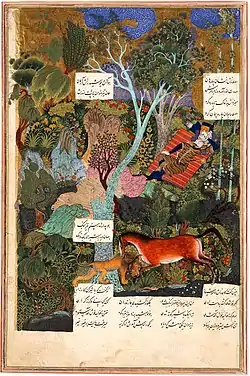
Detail of a posthumous 1664 painting depicting Barbad playing the barbat for Khosrow II.
Barbad or Bārbad (Persian: باربد; various other names; fl.late 6th – early 7th century CE) was a Persian poet-musician, lutenist, music theorist and composer of Sasanian music who served as chief minstrel-poet under ShahanshahKhosrow II (r.590–628). A barbat player, he is among the major figures in the history of Iranian/Persian music and was the most distinguished Persian musician of his time. He appears frequently in later Persian literature, most famously in Ferdowsi's Shahnameh. The content and abundance of such references demonstrate his unique influence on the music and culture of his time, with some sources declaring him the "founder of Persian music".
Despite scarce biographical information, Barbad's historicity is generally secure. Purportedly born in Merv or Jahrom, Barbad served most of his career under Khosrow, who held him in high regard. He interacted closely and rivaled with other musicians of his time, such as Sarkash. After Khosrow's assassination, sources vary as to whether Barbad was murdered, or if he murdered another musician himself. (Full article...)
Image 5
Sasanian-style coin of Peroz I Kushanshah, minted at Herat. Obverse: King with Pahlavi legend around. "The Mazda-worshipping lord Peroz the Great Kushan Shah". Reverse: Peroz standing at left, holding an investiture wreath, facing Anahita rising from her throne.
Nebuchadnezzar III (Babylonian cuneiform: Nabû-kudurri-uṣur, meaning "Nabu, watch over my heir", Old Persian: Nabukudracara), alternatively spelled Nebuchadrezzar III and also known by his original name Nidintu-Bêl (Old Persian: Naditabaira or Naditabira),' was a rebel king of Babylon in late 522 BC who attempted to restore Babylonia as an independent kingdom and end the rule of the Persian Achaemenid Empire in Mesopotamia. A Babylonian noble of the Zazakku family and the son of a man by the name of Mukīn-zēri or Kîn-Zêr, Nidintu-Bêl took the regnal name Nebuchadnezzar upon his accession to the Babylonian throne and claimed to be a son of Nabonidus, Babylon's last independent king. ('Full article...)
Image 8
The reverse side of the Uruk King List (IM 65066). The first line on this side of the tablet is the fragmentary line which references Nidin-Bel.
Nidin-Bel (Babylonian cuneiform: Nidin-Bêl) might have been a rebel king of Babylon who in the autumn of 336 BC and/or the winter of 336–335 BC attempted to restore Babylonia as an independent kingdom and end the rule of the Persian Achaemenid Empire in the region. The only known surviving reference which points to there being a ruler by this name in Babylon is the Uruk King List, which records rulers of Babylon from the 7th to 3rd centuries BC. In this list, the rule of Darius III (r.336–330 BC), the last Achaemenid king, is immediately preceded by a fragmentary reference to Nidin-Bel. (Full article...)
Yazdegerd I's largely-uneventful reign is seen in Sasanian history as a period of renewal. Although he was periodically known as "the Sinner" in native sources, Yazdegerd was more competent than his recent predecessors. He enjoyed cordial relations with the Eastern Roman Empire and was entrusted by Arcadius with the guardianship of the latter's son Theodosius. Yazdegerd I is known for his friendly relations with Jews and the Christians of the Church of the East, which he acknowledged in 410. Because of this, he was praised by Jews and Christians as the new Cyrus the Great (r.550–530 BC, king of the Iranian Achaemenid Empire who liberated the Jews from captivity in Babylon). (Full article...)
Image 10
Medallion of Adud al-Dawla
Fannā (Panāh) Khusraw (Persian: پناه خسرو), better known by his laqab of ʿAḍud al-Dawla (Arabic: عضد الدولة, "Pillar of the [Abbasid] Dynasty") (September 24, 936– March 26, 983) was an emir of the Buyid dynasty, ruling from 949 to 983, and at his height of power ruling an empire stretching from Makran to Yemen and the shores of the Mediterranean Sea. He is widely regarded as the greatest monarch of the dynasty, and by the end of his reign he was the most powerful ruler in the Middle East.
The son of Rukn al-Dawla, Fanna Khusraw was given the title of Adud al-Dawla by the Abbasid caliph in 948 when he was made emir of Fars after the death of his childless uncle Imad al-Dawla, after which Rukn al-Dawla became the senior emir of the Buyids. In 974 Adud al-Dawla was sent by his father to save his cousin Izz al-Dawla from a rebellion. After defeating the rebel forces, he claimed the emirate of Iraq for himself, and forced his cousin to abdicate. His father, however, became angered by this decision and restored Izz al-Dawla. After the death of Adud al-Dawla's father, his cousin rebelled against him, but was defeated. Adud al-Dawla became afterwards the sole ruler of the Buyid dynasty and assumed the ancient Iranian title of Shahanshah ("King of Kings"). (Full article...)
Selected picture
Outline of the Milad Tower
Milad Tower (also known as Borj-e Milad , Persian: برج میلاد) is the tallest tower in Iran. Built in 2007 in between the Shahrak-e Gharb and Gisha districts of Tehran, it stands 435m (1,427ft) high from base to tip of the antenna.
Israel (orange) was an important clandestine weapons supplier to Iran (green) during the Iran–Iraq War.
Israel's role in the Iran–Iraq War consisted of support provided by Israel to Iran during the Iran–Iraq War from 1980 to 1988. During the war, Israel was one of the main suppliers of military equipment to Iran. Israel also provided military instructors during the war and direct support to Iran's war effort, when it bombed and destroyed Iraq's Osirak nuclear reactor, during Operation Opera. The nuclear reactor was a central component of Iraq's nuclear weapons program.
Israel supported Iran during the war so that Iran could provide a counterweight to Iraq; to re-establish influence in Iran which Israel lost with the overthrow of the shah in 1979, and to create business for the Israeli weapons industry. The Israeli arms sales to Iran also facilitated the unhindered immigration of the Persian Jewish community from Iran to Israel and the United States. Israel's support for Iran during the war was done clandestinely, and Iran publicly denied any cooperation between the two countries. (Full article...)
Foreign investors have concentrated their activity in a few sectors of the economy: the oil and gas industries, vehicle manufacture, coppermining, petrochemicals, foods, and pharmaceuticals. Iran absorbed US$24.3 billion of foreign investment from 1993 to 2007 and US$34.6 billion for 485 projects from 1992 to 2009. (Full article...)
Due to the increasingly significant socio-economic issues, the decentralization of the Seljuk government leading to inefficient army mobilization, and a unifying factor of religion in the provinces facilitating the swift spread of the revolt, the Seljuks were unable to quickly put down the revolt. (Full article...)
Image 5
The Roman–Parthian War of 58–63 or the War of the Armenian Succession was fought between the Roman Empire and the Parthian Empire over control of Armenia, a vital buffer state between the two realms. Armenia had been a Roman client state since the days of Emperor Augustus, but in 52/53, the Parthians succeeded in installing their own candidate, Tiridates, on the Armenian throne.
These events coincided with the accession of Nero to the imperial throne in Rome, and the young emperor decided to react vigorously. The war, which was the only major foreign campaign of his reign, began with rapid success for the Roman forces, led by the able general Gnaeus Domitius Corbulo. They overcame the forces loyal to Tiridates, installed their own candidate, Tigranes VI, on the Armenian throne, and left the country. The Romans were aided by the fact that the Parthian king Vologases was embroiled in the suppression of a series of revolts in his own country. As soon as these had been dealt with, however, the Parthians turned their attention to Armenia, and after a couple of years of inconclusive campaigning, inflicted a heavy defeat on the Romans in the Battle of Rhandeia. (Full article...)
Image 6
Meng during her time under house arrest in Vancouver in 2021
During the extradition courtroom proceedings, Meng's lawyers made several allegations against the prosecution, including allegations of unlawful detention of Meng, unlawful search and seizure, extradition law violations, misrepresentation, international law violation, and fabricated testimonies by the CBSA, each of which were responded to by the prosecution. In August 2021, the extradition judge questioned the regularity of the case and expressed great difficulty in understanding how the Record of Case (ROC) presented by the US supported their allegation of criminality. (Full article...)
Image 7
The Achaemenid Empire or Achaemenian Empire (/əˈkiːmənɪd/; Old Persian: 𐎧𐏁𐏂, Xšāça, lit.'The Empire' or 'The Kingdom'), was the ancient Iranian empire founded by Cyrus the Great in 550 BC; the First Persian Empire. Based in Western Asia, it was the largest empire the world had ever seen at its time, spanning a total of 5.5million square kilometres (2.1million square miles) from the Balkans and Egypt in the west to Central Asia and the Indus Valley in the east.
Khosrow I (also spelled Khosrau, Khusro or Chosroes; Middle Persian: 𐭧𐭥𐭮𐭫𐭥𐭣𐭩; New Persian: خسرو [xosˈroʊ̯]), traditionally known by his epithet of Anushirvan (انوشيروان [ænuːʃi:rˈvɔːn] "the Immortal Soul"), was the SasanianKing of Kings of Iran from 531 to 579. He was the son and successor of Kavad I (r.488–496,498/9–531).
Inheriting a reinvigorated empire at war with the Byzantines, Khosrow I made a peace treaty with them in 532, known as the Perpetual Peace, in which the Byzantine emperor Justinian I paid 11,000 pounds of gold to the Sasanians. Khosrow then focused on consolidating his power, executing conspirators, including his uncle Bawi. Dissatisfied with the actions of the Byzantine clients and vassals, the Ghassanids, and encouraged by the Ostrogoth envoys from Italy, Khosrow violated the peace treaty and declared war against the Byzantines in 540. He sacked the major city of Antioch and deported its population to Persia. In 541, he invaded Lazica and made it an Iranian protectorate, thus initiating the Lazic War. In 545, the two empires agreed to halt the wars in Mesopotamia and Syria, while it waged on in Lazica. A truce was made in 557, and by 562 a Fifty-Year Peace Treaty was made. (Full article...)
The Little Zab or Lower Zab (Arabic: الزاب الاسفل, al-Zāb al-Asfal; Kurdish: Zêy Koya or Zêyê Biçûk; Persian: زاب کوچک, Zâb-e Kuchak; Syriac: ܙܒܐ ܬܚܬܝܐ, Zāba Taḥtāya) is a river that originates in Iran and joins the Tigris just south of Al Zab in the Kurdistan region of Iraq. It is approximately 400 kilometres (250mi) long and drains an area of about 22,000 square kilometres (8,500sqmi). The river is fed by rainfall and snowmelt, resulting in a peak discharge in spring and low water in summer and early fall. Two dams have been built on the Little Zab, regulating the river flow, providing water for irrigation and generating hydroelectricity. The Zagros Mountains have been occupied since at least the Lower Palaeolithic, but the earliest archaeological site in the Little Zab basin, Barda Balka, dates to the Middle Palaeolithic. Human occupation of the Little Zab basin has been attested for every period since then. (Full article...)
The term "Persianate" is a neologism credited to Marshall Hodgson. In his 1974 book, The Venture of Islam: The expansion of Islam in the Middle Periods, he defined it thus: "The rise of Persian had more than purely literary consequences: it served to carry a new overall cultural orientation within Islamdom.... Most of the more local languages of high culture that later emerged among Muslims... depended upon Persian wholly or in part for their prime literary inspiration. We may call all these cultural traditions, carried in Persian or reflecting Persian inspiration, 'Persianate' by extension." (Full article...)
February 7, 1979 - Supporters of Khomeini take over the Iranian law enforcement, courts and government administration; the final session of the Iranian National Consultative Assembly is held.
February 10, 1979 - The Iranian army mutinies and joins the Islamic Revolution.
This is a list of recognized content, updated weekly by JL-Bot(talk · contribs). There is no need to edit the list yourself. If an article is missing from the list, make sure it is tagged(e.g. {{WikiProject Iran}})or categorized correctly. See WP:RECOG for configuration options.
Military operations of the Syrian civil war involving Iran
Organisations based in Iran
Iranian people
Politics of Iran
Society of Iran
Works about Iran
Images of Iran
Iran stubs
Related portals
WikiProjects
Parent projects
Asia • Western Asia • Countries
Main project
WikiProject Iran
Sub-projects
Persian cinema • Persian literature • Zoroastrianism
Related projects
Geography • History • Armenia • Azerbaijan • Caucasia • Central Asia • Iraq • Russia • Georgia • Islam • Kurdistan • Afghanistan • Turkmenistan • Tajikistan • Greece • Turkey
You are invited to participate in WikiProject Iran, a WikiProject dedicated to developing and improving articles about Iran.
~~~~
Things you can do
Things you can do
Requested articles:House of Dahae, House of Parni, House of Sohae, Amards civilization, Iranian / Persian Cuisine / Cooking / Food, Anjoman e Payvand, More...

.svg.png.webp)


.jpg.webp)


.png.webp)





.jpg.webp)




%252C_2014.JPG.webp)


