Portal:Jordan

The Jordan Portal.svg.png.webp) location of Jordan  Jordan (Arabic: الأردن; tr. Al-ʾUrdunn [al.ʔur.dunː]), officially the Hashemite Kingdom of Jordan, is a country in Western Asia. It is situated at the crossroads of Asia, Africa, and Europe, within the Levant region, on the East Bank of the Jordan River. Jordan is bordered by Saudi Arabia to the south and east, Iraq to the northeast, Syria to the north, and the Palestinian West Bank, Israel, and the Dead Sea to the west. It has a 26 km (16 mi) coastline in its southwest on the Gulf of Aqaba's Red Sea, which separates Jordan from Egypt. Amman is Jordan's capital and largest city, as well as its economic, political, and cultural centre. Modern-day Jordan has been inhabited by humans since the Paleolithic period. Three stable kingdoms emerged there at the end of the Bronze Age: Ammon, Moab and Edom. In the third century BC, the Arab Nabataeans established their Kingdom with Petra as the capital. Later rulers of the Transjordan region include the Assyrian, Babylonian, Roman, Byzantine, Rashidun, Umayyad, Abassid, and the Ottoman empires. After the Great Arab Revolt against the Ottomans in 1916 during World War I, the Greater Syria region was partitioned by Britain and France. The Emirate of Transjordan was established in 1921 by the Hashemite, then Emir, Abdullah I, and the emirate became a British protectorate. In 1946, Jordan gained independence and became officially known in Arabic as the Hashemite Kingdom of Jordan. The country captured the West Bank during the 1948 Arab–Israeli War and annexed it until it was lost to Israel in 1967. Jordan renounced its claim to the territory in 1988, and became the second Arab state to sign a peace treaty with Israel in 1994. Jordan is a semi-arid country, covering an area of 89,342 km2 (34,495 sq mi), with a population of 10 million, making it the eleventh-most populous Arab country. The dominant majority, or around 95% of the country's population, is Sunni Muslim, with a mostly Arab Christian minority. Jordan has been mostly unscathed by the violence that swept the region following the Arab Spring in 2010. From as early as 1948, Jordan has accepted refugees from multiple neighboring countries in conflict. An estimated 2.1 million Palestinian and 1.4 million Syrian refugees are present in Jordan as of a 2015 census; with most Palestinian refugees holding Jordanian citizenship. The kingdom is also a refuge to thousands of Christian Iraqis fleeing persecution by the Islamic State. While Jordan continues to accept refugees, the recent large influx from Syria placed substantial strain on national resources and infrastructure. The sovereign state is a constitutional monarchy, but the king holds wide executive and legislative powers. Jordan is a founding member of the Arab League and the Organisation of Islamic Co-operation. The country has a high Human Development Index, ranking 102nd, and is considered an upper middle income economy. The Jordanian economy, one of the smallest economies in the region, is attractive to foreign investors based upon a skilled workforce. The country is a major tourist destination, also attracting medical tourism due to its well developed health sector. Nonetheless, a lack of natural resources, large flow of refugees, and regional turmoil have hampered economic growth. (Full article...) Selected article -
The Battles of Latrun were a series of military engagements between the Israel Defense Forces and the Jordanian Arab Legion on the outskirts of Latrun between 25 May and 18 July 1948, during the 1948 Arab–Israeli War. Latrun takes its name from the monastery close to the junction of two major highways: Jerusalem to Jaffa/Tel Aviv and Gaza to Ramallah. During the British Mandate it became a Palestine Police base with a Tegart fort. The United Nations Resolution 181 placed this area within the proposed Arab state. In May 1948, it was under the control of the Arab Legion. It commanded the only road linking the Yishuv-controlled area of Jerusalem to Israel, giving Latrun strategic importance in the battle for Jerusalem. Despite assaulting Latrun on five separate occasions Israel was ultimately unable to capture Latrun, and it remained under Jordanian control until the Six-Day War. The battles were such a decisive Jordanian victory that the Israelis decided to construct a bypass surrounding Latrun so as to allow vehicular movement between Tel Aviv and Jerusalem, thus avoiding the main road. Regardless, during the Battle for Jerusalem, the Jewish population of Jerusalem could still be supplied by a new road, named the "Burma Road", that bypassed Latrun and was suitable for convoys. The Battle of Latrun left its imprint on the Israeli collective imagination and constitutes part of the "founding myth" of the Jewish State. The attacks cost the lives of 168 Israeli soldiers, but some accounts inflated this number to as many as 2,000. The combat at Latrun also carries a symbolic significance because of the participation of Holocaust survivors. (Full article...)Selected biography -
Hussein bin Talal (Arabic: الحسين بن طلال, Al-Ḥusayn ibn Ṭalāl; 14 November 1935 – 7 February 1999) was King of Jordan from 11 August 1952 until his death in 1999. As a member of the Hashemite dynasty, the royal family of Jordan since 1921, Hussein was a 40th-generation direct descendant of Muhammad. Hussein was born in Amman as the eldest child of Talal bin Abdullah and Zein al-Sharaf bint Jamil. Talal was then the heir to his own father, King Abdullah I. Hussein began his schooling in Amman, continuing his education abroad. After Talal became king in 1951, Hussein was named heir apparent. The Jordanian Parliament forced Talal to abdicate a year later due to his illness, and a regency council was appointed until Hussein came of age. He was enthroned at the age of 17 on 2 May 1953. Hussein was married four separate times and fathered eleven children including King Abdullah II of Jordan. (Full article...)WikiProjectFor editor resources and to collaborate with other editors on improving Wikipedia's Jordan-related articles, see WikiProject Jordan. General images -The following are images from various Jordan-related articles on Wikipedia.
Selected city -
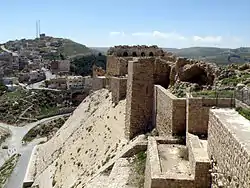
Al-Karak (Arabic: الكرك), is a city in Jordan known for its medieval castle, the Kerak Castle. The castle is one of the three largest castles in the region, the other two being in Syria. Al-Karak is the capital city of the Karak Governorate. Al-Karak lies 140 kilometres (87 mi) to the south of Amman on the ancient King's Highway. It is situated on a hilltop about 1,000 metres (3,300 ft) above sea level and is surrounded on three sides by a valley. Al-Karak has a view of the Dead Sea. A city of about 32,216 people (2005) has been built up around the castle and it has buildings from the 19th-century Ottoman period. The town is built on a triangular plateau, with the castle at its narrow southern tip. (Full article...)
See also: List of cities in Jordan
Related portalsRecognized content
Featured articlesGood articles
Topics
Selected topic overview -
Categories Category puzzle Select [►] to view subcategories
Jordan Jordan-related lists Buildings and structures in Jordan Jordanian culture Economy of Jordan Education in Jordan Environment of Jordan Geography of Jordan Government of Jordan Health in Jordan History of Jordan Organisations based in Jordan Jordanian people Politics of Jordan Society of Jordan Jordan stubs Selected picture -.JPG.webp) The Karak Castle (c. 12th century AD) built by the Crusaders, and later expanded under the Muslim Ayyubids and Mamluks.
Associated WikimediaThe following Wikimedia Foundation sister projects provide more on this subject:
SourcesDiscover Wikipedia using portals
| ||||||||||||||||||||||||||||||||||||||||||||||||||||||||||||||||||||||||||||||||||




.svg.png.webp)
.svg.png.webp)


