Portal:Lebanon

The Lebanon Portal A view of Byblos, Lebanon
 Lebanon (/ˈlɛbənɒn, -nən/ The earliest evidence of civilization in Lebanon dates back to 5,000 BCE. From c. 3200–539 BC, it was home to the flourishing Phoenician civilization before being annexed by various Near Eastern empires. In 64 BC, the Roman Empire conquered the region, and the region became a major center for Christianity under the Byzantine Empire. In the 7th century, the Muslim conquest of the Levant established caliphal rule. The 11th century saw the start of the Crusades and the establishment of Crusader States in the region only for it to be later reclaimed by the Ayyubids and Mamluks before being ceded to the Ottoman Empire in the 16th century. Under Sultan Abdulmejid I, the first Lebanese protostate took form in the 19th century as the Mount Lebanon Mutasarrifate, created as a home for the Maronite Christians under the Tanzimat reforms. Lebanon is a developing country, ranking 112th on the Human Development Index. It has been classified as an upper middle income state. However, the Lebanese liquidity crisis, corruption as well as recent events have precipitated the collapse of currency, political instability, widespread shortages, high unemployment and poverty. The World Bank defined the economic crisis in Lebanon as one of the worst in the world since the 19th century. Despite the country's small size, Lebanese culture is renowned both in the Middle East and globally, primarily powered by its extensive diaspora. Lebanon is a founding member of the United Nations and is a member of the Arab League, the Non-Aligned Movement, the Organization of Islamic Cooperation, and the Organisation internationale de la Francophonie. (Full article...) Selected article -
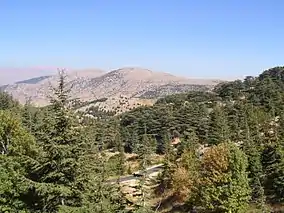
Al Shouf Cedar Nature Reserve is a nature reserve in the Chouf and Aley districts of Lebanon. It is located on the slopes of Jebel Baruk mountain and has an area of 550 km2 (210 sq mi), nearly 5.3% of the Lebanese territory, making it the largest natural reserve in Lebanon. The reserve contains the Lebanon cedar forests of Barouk, Maaser el Shouf and Ain Zhalta-Bmohray. It is an Important Bird Area (IBA) and Eco-tourism area. It hosts 32 species of wild mammals, 200 species of birds, and 500 species of plants. (Full article...)Did you know (auto-generated) -
TopicsRelated portals
| ||



.jpg.webp)


-2.png.webp)


