Portal:Madagascar

The Madagascar Portal
Madagascar (/ˌmædəˈɡæskər, -kɑːr/; Malagasy: Madagasikara, pronounced [ma.da.ga.si.kʲa.ra]), officially the Republic of Madagascar (Malagasy: Repoblikan'i Madagasikara, Malagasy pronunciation: [repuˈblikʲanʲ madaɡasʲˈkʲarə̥]; French: République de Madagascar) is an island country in the Indian Ocean, approximately 400 kilometres (250 miles) off the coast of East Africa across the Mozambique Channel. At 592,800 square kilometres (228,900 sq mi), it is the world's second-largest island country, after Indonesia. Home to around 30 million people, it consists of the island of Madagascar (the fourth-largest island in the world) and numerous smaller peripheral islands. Following the prehistoric breakup of the supercontinent Gondwana, Madagascar split from the Indian subcontinent around 90 million years ago, allowing native plants and animals to evolve in relative isolation. Consequently, it is a biodiversity hotspot; over 90% of its wildlife is endemic. Human settlement of Madagascar occurred during or before the mid first millennium AD by Austronesian peoples, presumably arriving on outrigger canoes from present-day Indonesia. These were joined around the 9th century AD by Bantu migrants crossing the Mozambique Channel from East Africa. Other groups continued to settle on Madagascar over time, each one making lasting contributions to Malagasy cultural life. The Malagasy ethnic group is often divided into 18 or more subgroups, of which the largest are the Merina of the central highlands. (Full article...)
| |||||||


 Figure 1. Jaw of Ambondro, seen in lingual view (from the side of the tongue). Scale bar is 1 mm. |
Ambondro mahabo is a mammal from the Middle Jurassic (Bathonian) Isalo III Formation (about 167 million years ago) of Madagascar. The only described species of the genus Ambondro, it is known from a fragmentary lower jaw with three teeth, interpreted as the last premolar and the first two molars. The premolar consists of a central cusp with one or two smaller cusps and a cingulum (shelf) on the inner, or lingual, side of the tooth. The molars also have such a lingual cingulum. They consist of two groups of cusps: a trigonid of three cusps at the front and a talonid with a main cusp, a smaller cusp, and a crest at the back. Features of the talonid suggest that Ambondro had tribosphenic molars, the basic arrangement of molar features also present in marsupial and placental mammals. It is the oldest known mammal with putatively tribosphenic teeth; at the time of its discovery it antedated the second oldest example by about 25 million years.
Upon its description in 1999, Ambondro was interpreted as a primitive relative of Tribosphenida (marsupials, placentals, and their extinct tribosphenic-toothed relatives). In 2001, however, an alternative suggestion was published that united it with the Cretaceous Australian Ausktribosphenos and the monotremes (the echidnas, the platypus, and their extinct relatives) into the clade Australosphenida, which would have acquired tribosphenic molars independently from marsupials and placentals. The Jurassic Argentinean Asfaltomylos and Henosferus and the Cretaceous Australian Bishops were later added to Australosphenida, and new work on wear in australosphenidan teeth has called into question whether these animals, including Ambondro, did have tribosphenic teeth. Other paleontologists have challenged this concept of Australosphenida, and instead proposed that Ambondro is not closely related to Ausktribosphenos plus monotremes, or that monotremes are not australosphenidans and that the remaining australosphenidans are related to placentals. (Full article...)Selected article -
 Philibert Tsiranana in 1962. |
Philibert Tsiranana (18 October 1912 – 16 April 1978) was a Malagasy politician and leader, who served as the first President of Madagascar from 1959 to 1972.
During the twelve years of his administration, the Republic of Madagascar experienced institutional stability that stood in contrast to the political turmoil many mainland African countries experienced in this period. This stability contributed to Tsiranana's popularity and his reputation as a remarkable statesman. Madagascar experienced moderate economic growth under his social democratic policies and came to be known as "the Happy Island." However, the electoral process was fraught with issues and his term ultimately terminated in a series of farmer and student protests that brought about the end of the First Republic and the establishment of the officially socialist Second Republic. (Full article...) Good article -
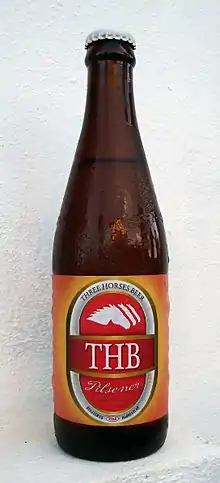
Three Horses Beer (better known locally as THB) is a pale lager that has been brewed by Star Breweries of Madagascar since 1958. It is the highest selling beer in Madagascar and has been described as emblematic of the country. THB is sold nationwide and since 2005 has been exported to such markets as France, Reunion Island, Comoros and Mayotte. The Malagasy beer is produced at two breweries in Madagascar, the first centrally located in Antsirabe and the other in the northern city of Antsiranana. THB Pilsener, the most common variant of THB, has a light taste and is produced from mostly local barley, corn and hops. Star Breweries also produces THB Fresh (a shandy with less than 1% alcohol), THB Special (6.2% alcohol), and THB Lite (1% alcohol). Recent investments in Star Brewery infrastructure have allowed a 20% increase in production since 2011.
After advertising alcohol in the media was banned under former President Marc Ravalomanana, Star Breweries has increasingly promoted THB through unconventional means. These have included sponsoring the THB Champions League, Madagascar's national football championship, and holding annual beer festivals. In addition, THB is a regular sponsor of local musicians through major annual festivals and tours. Star Breweries has also hired musicians to perform in music videos specifically created to promote the beer. In 2014 the THB label was significantly redesigned, and in 2015 a new slogan, "THB eo foana e!" ("THB always!") was promoted alongside the beer's longstanding trademark Soa Ny Fiarahantsika ("The Pleasure of Being Together"). The beer is regularly promoted by Malagasy musical stars and other public figures. (Full article...)General images -
 Map of Madagascar and the western portion of the East Indies, circa 1702–1707 (from History of Madagascar)
 A Hiragasy dancer. (from Madagascar)
 Men in an Outrigger Canoe Headed for Shore, an oil painting by Arman Manookian depicting the Vezo people, c. 1929 (from History of Madagascar)
 Moraingy is a traditional martial art of Madagascar. (from Culture of Madagascar)
 A Sumatran village showing several traditional houses (Malagasy levu). The vahoaka ntaolo villages of Madagascar were probably similar in the first millennium AD. This model is still currently present on every coast and in the remote inland areas and forests. (from History of Madagascar)
 Madagascar's President Andry Rajoelina (from Madagascar)
 Map of Madagascar and the Mascarene Islands (1502) (from History of Madagascar)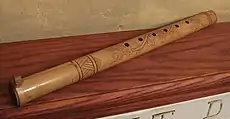
 The ring-tailed lemur is one of over 100 known species and subspecies of lemur found only in Madagascar. (from Madagascar)
 Canoe-sarcophagus of the Dayak: a burial that recalls the Malagasy tradition that former Ntaolo Vazimba and Vezo buried their dead in canoe-sarcophagi in the sea or in a lake (from History of Madagascar)
 The regional distribution of Malagasy ethnic subgroups (from Madagascar)
 Historical change in per capita GDP of Madagascar since 1950 (from Madagascar)
 Hiragasy musicians wearing coordinating lambas (from Culture of Madagascar)
 Christians burned at the stake by Ranavalona I (from History of Madagascar)
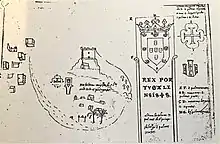 Matatana, represented in a picture of 1613, regarding a settlement of the beginning of the 16th century, in the Book of Humberto Leitão" (from Madagascar)
.jpg.webp) Madagascar—Gathering of The People for The Making of Laws (LMS, 1869, p.52) (from History of Madagascar)
Madagascar—Gathering of The People for The Making of Laws (LMS, 1869, p.52) (from History of Madagascar) Landing of the 40th Battaillon de Chasseur à Pieds in Majunga, between 5 May and 24 May 1895. (from History of Madagascar)
 A French poster about the Franco-Hova War (from Madagascar)

 A Köppen climate classification map of Madagascar (from Madagascar)
 A news stand in Antananarivo (from Madagascar)
 Antananarivo is the political and economic capital of Madagascar. (from Madagascar)
 Austronesians expansion map (from History of Madagascar)
 Antandroy dancers (from Culture of Madagascar)
 Cinemas in Antananarivo (from Culture of Madagascar)
 Mahafaly tomb with traditional painted decoration (from Culture of Madagascar)
 King Andrianampoinimerina (1787–1810) (from Madagascar)
 Map of Madagascar and surroundings, circa 1702–1707 (from History of Madagascar)
.jpg.webp) European contact began in 1500 when Portuguese explorer Diogo Dias recorded the island while participating in the 2nd Portuguese India Armadas. (from Madagascar)
European contact began in 1500 when Portuguese explorer Diogo Dias recorded the island while participating in the 2nd Portuguese India Armadas. (from Madagascar).jpg.webp) Girl with colored braids in her hair. (from Culture of Madagascar)
Girl with colored braids in her hair. (from Culture of Madagascar)- Poster of the French war in Madagascar (from History of Madagascar)
 The taro (saonjo in Malagasy) is, according to an old Malagasy proverb, "the elder of the rice" (Ny saonjo no zokin'ny vary), and was also a staple diet for the proto-Austronesians (from History of Madagascar)
 A street vendor selling fresh potato chips and traditional kaka pizon snacks (from Culture of Madagascar)
- Moraingy is a traditional martial art of Madagascar. (from Madagascar)
 Toy animals made from raffia, a native palm (from Madagascar)
 National monument in Moramanga commemorating the beginning of the Malagasy Uprising on 29 March 1947. Between 11,000 and 90,000 Malagasy died during the uprising which lasted nearly two years. (from Madagascar)
 A map of Madagascar's regions (from Madagascar)
 Radama I, the first monarch of the kingdom unified central Madagascar. (from History of Madagascar)
 Vaγimba- "Those of the forest" in Proto–Southeast Barito, the reconstructed ancestor of the Southeast Barito languages, which includes the languages spoken by the Dayak peoples of the Barito River in Borneo. (from History of Madagascar)
.jpg.webp) A Malagasy child (from Madagascar)
A Malagasy child (from Madagascar)_Madagascar.jpg.webp)
 Malagasy Embassy to Europe in 1863. Left to right: Rainifiringa Ralaimaholy, Rev. John Duffus and Rasatranabo aka Rainandrianandraina. (from History of Madagascar)
 An Austronesian outrigger canoe; Malagasy vahoaka "people" is from Proto-Malayo-Polynesian *va-waka "people of the canoe". The Vahoaka Ntaolo, the first Austronesian ancestors of the Malagasy, probably used similar canoes to reach the great island from the Sunda Islands (from History of Madagascar)
 Nosy Iranja is one of the international tourism destinations in Madagascar (from Madagascar)
 Biogeographic timetable of Madagascar over the last 200 million years (from Madagascar)
 Malagasy ancestry reflects a blend of Southeast Asian and Bantu (Southeast African) roots. (from Madagascar)
.svg.png.webp) A proportional representation of Madagascar's exports in 2019 (from Madagascar)
A proportional representation of Madagascar's exports in 2019 (from Madagascar) Valiha orchestra at the Paris World Exposition of 1931 (from Culture of Madagascar)
Selected panorama

Topics
Categories

Selected picture


Associated Wikimedia
The following Wikimedia Foundation sister projects provide more on this subject:
-
 Commons
Free media repository -
 Wikibooks
Free textbooks and manuals -
 Wikidata
Free knowledge base -
 Wikinews
Free-content news -
 Wikiquote
Collection of quotations -
 Wikisource
Free-content library -
 Wikispecies
Directory of species -
 Wikiversity
Free learning tools -
 Wikivoyage
Free travel guide -
 Wiktionary
Dictionary and thesaurus
-
 List of all portalsList of all portals
 -
 The arts portal
 -
 Biography portal
 -
 Current events portal
 -
 Geography portal
 -
 History portal
 -
 Mathematics portal
 -
 Science portal
 -
 Society portal
 -
 Technology portal
 -
 Random portalRandom portal
 -
 WikiProject PortalsWikiProject Portals