Portal:Painting
The Painting Portal

Painting is the practice of applying paint, pigment, color or other medium to a solid surface (called the "matrix" or "support"). The medium is commonly applied to the base with a brush, but other implements, such as knives, sponges, and airbrushes, can be used.
In art, the term painting describes both the act and the result of the action (the final work is called "a painting"). The support for paintings includes such surfaces as walls, paper, canvas, wood, glass, lacquer, pottery, leaf, copper and concrete, and the painting may incorporate multiple other materials, including sand, clay, paper, plaster, gold leaf, and even whole objects.
Painting is an important form in the visual arts, bringing in elements such as drawing, composition, gesture (as in gestural painting), narration (as in narrative art), and abstraction (as in abstract art). Paintings can be naturalistic and representational (as in still life and landscape painting), photographic, abstract, narrative, symbolistic (as in Symbolist art), emotive (as in Expressionism) or political in nature (as in Artivism).
A portion of the history of painting in both Eastern and Western art is dominated by religious art. Examples of this kind of painting range from artwork depicting mythological figures on pottery, to Biblical scenes on the Sistine Chapel ceiling, to scenes from the life of Buddha (or other images of Eastern religious origin). (Full article...)
Selected general articles


In the visual arts, style is a "... distinctive manner which permits the grouping of works into related categories" or "... any distinctive, and therefore recognizable, way in which an act is performed or an artifact made or ought to be performed and made". It refers to the visual appearance of a work of art that relates it to other works by the same artist or one from the same period, training, location, "school", art movement or archaeological culture: "The notion of style has long been the art historian's principal mode of classifying works of art. By style he selects and shapes the history of art".
Style is often divided into the general style of a period, country or cultural group, group of artists or art movement, and the individual style of the artist within that group style. Divisions within both types of styles are often made, such as between "early", "middle" or "late". In some artists, such as Picasso for example, these divisions may be marked and easy to see; in others, they are more subtle. Style is seen as usually dynamic, in most periods always changing by a gradual process, though the speed of this varies greatly, from the very slow development in style typical of prehistoric art or Ancient Egyptian art to the rapid changes in Modern art styles. Style often develops in a series of jumps, with relatively sudden changes followed by periods of slower development. (Full article...) Scheveningen village, a small section of the Panorama Mesdag (1880–1881), with false terrain in the foreground.
Panoramic paintings are massive artworks that reveal a wide, all-encompassing view of a particular subject, often a landscape, military battle, or historical event. They became especially popular in the 19th century in Europe and the United States, inciting opposition from some writers of Romantic poetry. A few have survived into the 21st century and are on public display. Typically shown in rotundas for viewing, panoramas were meant to be so lifelike they confused the spectator between what was real and what was image.
In China, panoramic paintings are an important subset of handscroll paintings, with some famous examples being Along the River During the Qingming Festival and Ten Thousand Miles of the Yangtze River. (Full article...)- A binder or binding agent is any material or substance that holds or draws other materials together to form a cohesive whole mechanically, chemically, by adhesion or cohesion.
In a more narrow sense, binders are liquid or dough-like substances that harden by a chemical or physical process and bind fibres, filler powder and other particles added into it. Examples include glue, adhesive and thickening. (Full article...) - In painting, local color is the color of an object when seen under flat white light with no adjustment for form shadow or colors of light or secondary light sources. An example would be the assumption that an apple is "red" when it is actually dependent on the color of the light hitting it, color of objects around it, glossiness, and variations within the colors on the surface of the apple itself. Local color is learned in childhood to help simplify and make sense of the world. Coloring books reinforce the idea of simplifying colors. "The sky is blue", "grass is green", etc. when there are actually myriad variations in hue, chroma, within these areas. In order to represent objects realistically, painters must look beyond the simplifications of local color. Demonstrations of color constancy show how flawed local color assumptions can be when the light source has a color shift.
In contemporary sculpture local color is the original color of the raw material that remains unpainted in the completed work. (Full article...) .jpg.webp)
Painterliness is a concept based on German: malerisch ('painterly'), a word popularized by Swiss art historian Heinrich Wölfflin (1864–1945) to help focus, enrich and standardize the terms being used by art historians of his time to characterize works of art.
A painting is said to be painterly when there are visible brushstrokes in the final work – the result of applying paint in a manner that is not entirely controlled, generally without closely following carefully drawn lines. Any painting media – oils, acrylics, watercolors, gouache, etc. – can produce either linear or painterly work. Some artists whose work could be characterized as painterly are Pierre Bonnard, Francis Bacon, Vincent van Gogh, Rembrandt, Renoir, John Singer Sargent, and Andrew Wyeth (his early watercolors). The Impressionists, Fauvists and the Abstract Expressionists tended strongly to be painterly. (Full article...)- Incised painting is a technique used to decorate stone surfaces. First, a channel is scratched in the stone. Then, a thick paint or stucco plaster is laid across the surface. Last, the paint is scraped off the surface of the stone, leaving paint in the incision. This technique was used in decorating the Taj Mahal. (Full article...)
- The Jerwood Painting Prize was a prize for originality and excellence in painting in the United Kingdom, awarded and funded by the Jerwood Foundation. It was open to all artists born or resident in the UK, regardless of age or reputation. Winners of the prize include Craigie Aitchison, Patrick Caulfield, Prunella Clough and Maggi Hambling. The prize was instituted in 1994, and at £30,000 was the largest of its kind in Britain. The prize is no longer awarded. (Full article...)
- Inscape, in visual art, is a term especially associated with certain works of Chilean artist Roberto Matta, but it is also used in other senses within the visual arts. Though the term inscape has been applied to stylistically diverse artworks, it usually conveys some notion of representing the artist's psyche as a kind of interior landscape. The word inscape can therefore be read as a kind of portmanteau, combining interior (or inward) with landscape. (Full article...)
 David (1504)
"What spirit is so empty and blind, that it cannot recognize the fact that the foot is more noble than the shoe, and skin more beautiful than the garment with which it is clothed?"
— Michelangelo
The nude, as a form of visual art that focuses on the unclothed human figure, is an enduring tradition in Western art. It was a preoccupation of Ancient Greek art, and after a semi-dormant period in the Middle Ages returned to a central position with the Renaissance. Unclothed figures often also play a part in other types of art, such as history painting, including allegorical and religious art, portraiture, or the decorative arts. From prehistory to the earliest civilizations, nude female figures are generally understood to be symbols of fertility or well-being.
In India, the Khajuraho Group of Monuments built between 950 and 1050 CE are known for their erotic sculptures, which comprise about 10% of the temple decorations. Japanese prints are one of the few non-western traditions that can be called nudes, but the activity of communal bathing in Japan is portrayed as just another social activity, without the significance placed upon the lack of clothing that exists in the West. Through each era, the nude has reflected changes in cultural attitudes regarding sexuality, gender roles, and social structure. (Full article...) Hue relationships between the primary and secondary colors in the ISCC-NBS system of color designation
The ISCC–NBS System of Color Designation is a system for naming colors based on a set of 13 basic color terms and a small set of adjective modifiers. It was first established in the 1930s by a joint effort of the Inter-Society Color Council (ISCC), made up of delegates from various American trade organizations, and the National Bureau of Standards (NBS), a US government agency. As suggested in 1932 by the first chairman of the ISCC, the system’s goal is to be "a means of designating colors in the United States Pharmacopoeia, in the National Formulary, and in general literature ... such designation to be sufficiently standardized as to be acceptable and usable by science, sufficiently broad to be appreciated and used by science, art, and industry, and sufficiently commonplace to be understood, at least in a general way, by the whole public." The system aims to provide a basis on which color definitions in fields from fashion and printing to botany and geology can be systematized and regularized, so that each industry need not invent its own incompatible color system.
In 1939, the system’s approach was published in the Journal of Research of the National Bureau of Standards, and the ISCC formally approved the system, which consisted of a set of blocks within the color space defined by the Munsell color system as embodied by the Munsell Book of Color. Over the following decades the ISCC–NBS system’s boundaries were tweaked and its relation to various other color standards were defined, including for instance those for plastics, building materials, botany, paint, and soil. After the definition of the Munsell system was slightly altered by its 1943 renotations, the ISCC–NBS system was redefined in the 1950s in relation to the new Munsell coordinates. In 1955, the NBS published The Color Names Dictionary, which cross-referenced terms from several other color systems and dictionaries, relating them to the ISCC–NBS system and thereby to each other. In 1965, the NBS published Centroid Color Charts made up of color samples demonstrating the central color in each category, as a physical representation of the system usable by the public, and also published The Universal Color Language, a more general system for color designation with various degrees of precision from completely generic (13 broad categories) to extremely precise (numeric values from spectrophotometric measurement). In 1976, The Color Names Dictionary and The Universal Color Language were combined and updated with the publication of Color: Universal Language and Dictionary of Names, the definitive source on the ISCC–NBS system. (Full article...) Vincent van Gogh, Self-portrait without beard, end September 1889, (F 525), Oil on canvas, 40 × 31 cm., Private collection. This may have been Van Gogh's last self-portrait. Given as a birthday gift to his mother.
A self-portrait is a representation of an artist that is drawn, painted, photographed, or sculpted by that artist. Although self-portraits have been made since the earliest times, it is not until the Early Renaissance in the mid-15th century that artists can be frequently identified depicting themselves as either the main subject, or as important characters in their work. With better and cheaper mirrors, and the advent of the panel portrait, many painters, sculptors and printmakers tried some form of self-portraiture. Portrait of a Man in a Turban by Jan van Eyck of 1433 may well be the earliest known panel self-portrait. He painted a separate portrait of his wife, and he belonged to the social group that had begun to commission portraits, already more common among wealthy Netherlanders than south of the Alps. The genre is venerable, but not until the Renaissance, with increased wealth and interest in the individual as a subject, did it become truly popular.
By the Baroque period, most artists with an established reputation at least left drawings of themselves. Printed portraits of artists had a market, and many were self-portraits. They were also sometimes given as gifts to family and friends. If nothing else, they avoided the need to arrange for a model, and for the many professional portrait-painters, a self-portrait kept in the studio acted as a demonstration of the artist's skill for potential new clients. The unprecedented number of self-portraits by Rembrandt, both as paintings and prints, made clear the potential of the form, and must have further encouraged the trend. (Full article...) A digital painting by David Revoy.
Digital painting is an established art medium that typically combines a computer, a graphics tablet, and software of choice. The artist uses painting and drawing with the stylus that comes with the graphics tablet to create 2D paintings within a digital art software. There are multiple techniques and tools that are utilized by digital artists, the first being digital brushes. These come standard with all digital art programs, but users can create their own by altering their shape, texture, size, and transfer. Many of these brushes are created to represent traditional styles like oils, acrylics, pastels, charcoal, and airbrushing, but not all. Other effective tools include layers, lasso tools, shapes, and masks. Digital painting has evolved to not just mimic traditional art styles, but fully become its own technique.
Digital painting is used by amateur and professional artists alike. Its use is particularly prevalent in commercial production studios that create games, television, and film. There are multiple reasons for this which applies to amateur artists as well. Digital painting enables artists to experiment with different techniques and colors easily as its use of layers, the undo function, and save files, make it a non-destructive work process. Artists can always return to an earlier state within the art piece so nothing is ever truly lost. This not only saves time but also materials while giving the artist more freedom to create. (Full article...) Ancient Rome
In art, a pendant is one of two paintings, statues, reliefs or other type of works of art intended as a pair. Typically, pendants are related thematically to each other and are displayed in close proximity. For example, pairs of portraits of married couples are very common, as are symmetrically arranged statues flanking an altar.
Pendants may be the work of a single artist or of two artists, who in some instances might be in competition with one another. An example of the latter case is the pairing of the marble groups The Triumph of Faith over Idolatry by Jean-Baptiste Théodon and Religion Overthrowing Heresy and Hatred by Pierre Le Gros the Younger on the Altar of Saint Ignatius of Loyola (1695–1697/98), in the Church of the Gesù, Rome. (Full article...)
The depiction of night in paintings is common in Western art. Paintings that feature a night scene as the theme may be religious or history paintings, genre scenes, portraits, landscapes, or other subject types. Some artworks involve religious or fantasy topics using the quality of dim night light to create mysterious atmospheres. The source of illumination in a night scene—whether it is the moon or an artificial light source—may be depicted directly, or it may be implied by the character and coloration of the light that reflects from the subjects depicted. (Full article...)- Oil painting reproductions are paintings that have been created by copying in oils an original oil painting by an artist.
Oil painting reproductions are distinct from original oil painting such as are often of interest to collectors and museums. Oil painting reproduction can, however, sometimes be regarded as artworks in themselves. (Full article...)  BALVINO MAURICIO, José Honorato Lozano, 1864
Letras y figuras (Spanish, "letters and figures") is a genre of painting pioneered by José Honorato Lozano during the Spanish colonial period in the Philippines. The art form is distinguished by the depiction of letters of the alphabet using a genre of painting that contoured shapes of human figures, animals, plants, and other objects called Tipos del País popularized by Damián Domingo. The letters depicted spell out a phrase or a name, usually that of the patron who commissioned the work. The paintings were done with watercolor on Manila paper. The earliest example of this art form dates from 1845; the latest existing specimens were completed during the latter portion of the American period in the 1930s during the administration of the Commonwealth of the Philippines.
In 1995, an album of José Honorato Lozano's paintings were auctioned at Christie’s at the starting bid of £300,000. (Full article...)- Historic paint analysis, or architectural paint research, is the scientific analysis of a broad range of architectural finishes, and is primarily used to determine the color and behavior of surface finishes at any given point in time. This helps us to understand the building's structural history and how its appearance has changed over time.
Historic paint analysis shares a common methodology with the conservation and restoration of paintings used to conserve and restore two- and three dimensional works of art. This involves the identification of components such as organic or inorganic pigments and dyes contained in the pigments. Historic paint analysis also identifies the pigments' media of suspension such as (water, oil, or latex and the paints' associated substrate. A variety of techniques are used to identify and analyze the pigment layers and finish exposure, including Finish Exposure, optical microscopy, fluorescent light microscopy, polarized light microscopy, and Fourier-transform infrared spectroscopy. (Full article...) - A problem picture is a genre of art popular in late Victorian painting, characterised by the deliberately ambiguous depiction of a key moment in a narrative that can be interpreted in several different ways, or which portrays an unresolved dilemma. It has some relation to the problem play. The viewer of the picture is invited to speculate about several different possible explanations of the scene. The genre has much in common with that of book illustration, then at its most popular, but with the text belonging to the illustration omitted.
 Defendant and Counsel (1895), by William Frederick Yeames, an example of the problem picture, which invites the viewer to speculate on the woman's alleged crime and on whether or not she may be guilty.
The genre began to emerge in the second half of the nineteenth century, along with the development of book illustrations that depicted "pregnant" moments in a narrative. One of the earliest problem pictures is John Everett Millais' Trust Me, which depicts an older man demanding that a young woman hand him a letter she has received. Either character might be uttering the words. The significance and content of the letter is left to the imagination. Their relationship is also unclear; in view of their ages, they might be a married couple, or a father and daughter. (Full article...) .JPG.webp) Annibale Carracci, An Allegory of Truth and Time (1584–85), an allegorical history painting relying very little upon realism.
Annibale Carracci, An Allegory of Truth and Time (1584–85), an allegorical history painting relying very little upon realism.
A hierarchy of genres is any formalization which ranks different genres in an art form in terms of their prestige and cultural value.
In literature, the epic was considered the highest form, for the reason expressed by Samuel Johnson in his Life of John Milton: "By the general consent of criticks, the first praise of genius is due to the writer of an epick poem, as it requires an assemblage of all the powers which are singly sufficient for other compositions." Below that came lyric poetry, and comic poetry, with a similar ranking for drama. The novel took a long time to establish a firm place in the hierarchy, doing so only as belief in any systematic hierarchy of forms expired in the 19th century. (Full article...) Tondo by Andrea della Robbia
A tondo (plural "tondi" or "tondos") is a Renaissance term for a circular work of art, either a painting or a sculpture. The word derives from the Italian rotondo, "round." The term is usually not used in English for small round paintings, but only those over about 60 cm (two feet) in diameter, thus excluding many round portrait miniatures – for sculpture the threshold is rather lower.
A circular or oval relief sculpture is also called a roundel. (Full article...) Robert Delaunay, 1912–13, Le Premier Disque, 134 cm (52.7 in.), private collection
Abstract art uses visual language of shape, form, color and line to create a composition which may exist with a degree of independence from visual references in the world.
Western art had been, from the Renaissance up to the middle of the 19th century, underpinned by the logic of perspective and an attempt to reproduce an illusion of visible reality. By the end of the 19th century many artists felt a need to create a new kind of art which would encompass the fundamental changes taking place in technology, science and philosophy. The sources from which individual artists drew their theoretical arguments were diverse, and reflected the social and intellectual preoccupations in all areas of Western culture at that time. (Full article...) A photo of the orange peel effect on a car door.
Orange peel is a certain kind of finish that may develop on painted and cast surfaces. The texture resembles the surface of the skin of an orange, hence the name "orange peel".
Gloss paint sprayed on a smooth surface (such as the body of a car) should also dry into a smooth surface. However, various factors can cause it to dry into a bumpy surface. This is typically the result of improper painting technique, and is caused by the quick evaporation of thinner, incorrect spray gun setup (e.g., low air pressure or incorrect nozzle), spraying the paint at an angle other than perpendicular, or applying excessive paint. (Full article...) Johannes Vermeer's Girl with a Pearl Earring (1665–1667), known as the Mona Lisa of the North.
The history of Western painting represents a continuous, though disrupted, tradition from antiquity until the present time. Until the mid-19th century it was primarily concerned with representational and Classical modes of production, after which time more modern, abstract and conceptual forms gained favor.
Initially serving imperial, private, civic, and religious patronage, Western painting later found audiences in the aristocracy and the middle class. From the Middle Ages through the Renaissance painters worked for the church and a wealthy aristocracy. Beginning with the Baroque era artists received private commissions from a more educated and prosperous middle class. The idea of "art for art's sake" began to find expression in the work of the Romantic painters like Francisco de Goya, John Constable, and J. M. W. Turner. During the 19th century commercial galleries became established and continued to provide patronage in the 20th century. (Full article...) Live painting by Beo Beyond at Shôko Club in Barcelona, working with fluorescent colors which glow under blacklight.
Live painting is a form of visual performance art in which artists complete a visual art piece in a public performance, often at a bar, music concert, wedding reception, or public event, accompanied by a DJ or live music. The artwork which is created live may be planned or improvisational. This live art form is often contrasted with more studied fine art compositions from the same artists, which are generally executed in an artist studio or other private space.
Artists in a number of genres have performed live painting, including LeRoy Neiman creating a painting during the 1976 Summer Olympics. In the 1990s and 2000s, live painting became a hallmark of street art and graffiti artists. (Full article...).jpg.webp) House painters working in Capri, Italy
House painters working in Capri, Italy
A house painter and decorator is a tradesman responsible for the painting and decorating of buildings, and is also known as a decorator or house painter. The purpose of painting is to improve the appearance of a building and to protect it from damage by water, corrosion, insects and mould. House painting can also be a form of artistic and/or cultural expression such as Ndebele house painting. (Full article...)

Selected painting techniques
.jpg.webp) French Atelier of Painters: titled "School of Fine Arts - Painter Workshop" (Ecole des Beaux-Arts - Atelier de Peintre)
French Atelier of Painters: titled "School of Fine Arts - Painter Workshop" (Ecole des Beaux-Arts - Atelier de Peintre)
An atelier (French: [atəlje]) is the private workshop or studio of a professional artist in the fine or decorative arts or an architect, where a principal master and a number of assistants, students, and apprentices can work together producing fine art or visual art released under the master's name or supervision.
Ateliers were the standard vocational practice for European artists from the Middle Ages to the 19th century, and common elsewhere in the world. In medieval Europe this way of working and teaching was often enforced by local guild regulations, such as those of the painters' Guild of Saint Luke, and of other craft guilds. Apprentices usually began working on simple tasks when young, and after some years with increasing knowledge and expertise became journeymen, before possibly becoming masters themselves. This master-apprentice system was gradually replaced as the once powerful guilds declined, and the academy became a favored method of training. However, many professional artists continued using students and assistants as they had been in ateliers; sometimes the artist paid the student-assistants, while sometimes they paid the artist fees to learn. (Full article...) 18"x34" powder painting by Jim Boles, homage to Wolf Kahn.
Powder painting is the art of using ground glass in powdered form to create kilnformed glass art. The process differs from enameling in many respects. Firstly, the powder is actually ground glass typically from a single manufacturer who supplies an extensive color palette. Large jars can be purchased which are fairly inexpensive compared to enamels, making large scale paintings possible
This technique is one variation of many ways to create images on glass using glass bits (frits), and in this case powder. (Full article...)- In art, an underpainting is an initial layer of paint applied to a ground, which serves as a base for subsequent layers of paint. Underpaintings are often monochromatic and help to define color values for later painting. Underpainting gets its name because it is painting that is intended to be painted over (see overpainting) in a system of working in layers.
There are several different types of underpainting, such as veneda, verdaccio, morellone, imprimatura and grisaille. The different types have different colourings. Grisaille is plain grey. Verdaccio is a grey tending towards yellow or green that brings out more luminous tones. While imprimatura uses earth tones. (Full article...)  Hanging scroll painting by Gao Qipei: Finger Painting of Eagle and Pine Trees. On display at the Shanghai Museum.
Fingerpaint is a kind of paint intended to be applied with the fingers; it typically comes in tubes and is used by small children, though it has occasionally been used by adults either to teach art to children, or for their own use. (Full article...) White lead pastiglia on an Italian casket, late 15th century, with Marcus Curtius at left, British Museum.
Pastiglia [paˈstiʎʎa], an Italian term meaning "pastework", is low relief decoration, normally modelled in gesso or white lead, applied to build up a surface that may then be gilded or painted, or left plain. The technique was used in a variety of ways in Italy during the Renaissance. The term is mostly found in English applied to gilded work on picture frames or small pieces of furniture such as wooden caskets and cassoni, and also on areas of panel paintings, but there is some divergence as to the meaning of the term between these specialisms.
On frames and furniture the technique is in origin a cheaper imitation of woodcarving, metalwork or ivory carving techniques. Within paintings, the technique gives areas with a three-dimensional effect, usually those representing inanimate objects, such as foliage decoration on architectural surrounds, halos and details of dress, rather than parts of figures. In white lead pastiglia on caskets, the subject matter is usually classical, with a special emphasis on stories from Ancient Roman history. (Full article...)
Shaped canvases are paintings that depart from the normal flat, rectangular configuration. Canvases may be shaped by altering their outline, while retaining their flatness. An ancient, traditional example is the tondo, a painting on a round panel or canvas: Raphael, as well as some other Renaissance painters, sometimes chose this format for madonna paintings. Alternatively, canvases may be altered by losing their flatness and assuming a three-dimensional surface. Or, they can do both. That is, they can assume shapes other than rectangles, and also have surface features that are three-dimensional. Arguably, changing the surface configuration of the painting transforms it into a sculpture. But shaped canvases are generally considered paintings.
Apart from any aesthetic considerations, there are technical matters, having to do with the very nature of canvas as a material, that tend to support the flat rectangle as the norm for paintings on canvas. (Full article...)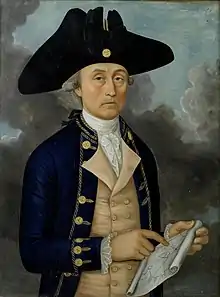 Captain Joseph – Chinese reverse glass painting from c. 1785 – 1789.
Reverse painting on glass is an art form consisting of applying paint to a piece of glass and then viewing the image by turning the glass over and looking through the glass at the image. Another term used to refer to the art of cold painting and gilding on the back of glass is verre églomisé, named after the French decorator Jean-Baptiste Glomy (1711–86), who framed prints using glass that had been reverse-painted. In German it is known as Hinterglasmalerei.
This art form has been around for many years. It was widely used for sacral paintings since the Middle Ages. The most famous was the art of icons in the Byzantine Empire. Later the painting on glass spread to Italy, where in Venice it influenced its Renaissance art. Since the middle of the 18th century, painting on glass became favored by the Church and the nobility throughout Central Europe. A number of clock faces were created using this technique in the early-to-mid-19th century. Throughout the 19th century painting on glass was widely popular as folk art in Austria, Bavaria, Moravia, Bohemia and Slovakia. Unfortunately, during the inter-war period (1914–1945) this traditional "naive" technique fell nearly to a complete oblivion and its methods of paint composition and structural layout had to be re-invented by combining acrylic and oil paints. A new method of reverse painting emerged using polymer glazing methods that permitted the artworks to be painted direct to an acrylic UV coating on the glass. The unique under glass effect retains a curious depth even though the layered painting on the glass was bonded to a final linen support and now stretcher bar mounted after being carefully removed from the original 'glass easel'. Current glass painting may disappear with the advent of using aerospace mylar as a preliminary support. (Full article...) U.S. President George W. Bush examines a Yirrkala bark painting during a tour of the Australian National Maritime Museum in Sydney on 6 September 2007.
Bark painting is an Australian Aboriginal art form, involving painting on the interior of a strip of tree bark. This is a continuing form of artistic expression in Arnhem Land (especially among the Yolngu peoples) and other regions in the Top End of Australia, including parts of the Kimberley region of Western Australia. Traditionally, bark paintings were produced for instructional and ceremonial purposes and were transient objects. Today, they are keenly sought after by collectors and public arts institutions. (Full article...)- Nōtan (濃淡) is a Japanese design concept involving the play and placement of light and dark elements as they are placed next to the other in the composition of art and imagery. (Full article...)
- Graining is the practice of imitating wood grain on a non-wood surface, or on relatively undesirable wood surface, in order to give it the appearance of a rare or higher quality wood, thereby increase that surface's aesthetic appeal. Graining was common in the 19th century, as people were keen on imitating hard, expensive woods by applying a superficial layer of paint onto soft, inexpensive woods or other hard surfaces. Graining can be accomplished using either rudimentary tools or highly specialized tools. A specialized thick brush used for graining is often called a mottler. Fan brushes, floggers, softening brushes, texture combs and even fingers are used to create various effects. The painting is carried out in layers, with the first layer being a base. Today that is usually done with latex paint in a gold or orange or tan tone, depending on the type of wood the artist is aiming to imitat. A second layer of tempera or thinned paint is applied over the dry base, by means of a sponge or large inexpensive brush. During the 19th century, however, brushes were more commonly used. It can also be applied on bricks and brass, as is more common today.
Graining can also mean the production of any artificial texture on any surface. For example, in printing, making the smooth metal sheets used in modern printing processes coarse. A stoneworking equivalent of graining is marbling. (Full article...) 
China painting, or porcelain painting, is the decoration of glazed porcelain objects such as plates, bowls, vases or statues. The body of the object may be hard-paste porcelain, developed in China in the 7th or 8th century, or soft-paste porcelain (often bone china), developed in 18th-century Europe. The broader term ceramic painting includes painted decoration on lead-glazed earthenware such as creamware or tin-glazed pottery such as maiolica or faience.
Typically the body is first fired in a kiln to convert it into a hard porous biscuit or bisque. Underglaze decoration may then be applied, followed by glaze, which is fired so it bonds to the body. The glazed porcelain may then be painted with overglaze decoration and fired again to bond the paint with the glaze. Most pieces use only one of underglaze or overglaze painting, the latter often being referred to as "enamelled". Decorations may be applied by brush or by stenciling, transfer printing and screen printing. (Full article...) The Ghent Altarpiece by Jan van Eyck and his brothers, 1432. A large altarpiece on panel. The outer wings are hinged, and painted on both sides.
A panel painting is a painting made on a flat panel of wood, either a single piece or a number of pieces joined together. Until canvas became the more popular support medium in the 16th century, panel painting was the normal method, when not painting directly onto a wall (fresco) or on vellum (used for miniatures in illuminated manuscripts). Wood panels were also used for mounting vellum paintings. (Full article...)- Verdaccio is an Italian name for the mixture of black, white, and yellow pigments resulting in a grayish or yellowish (depending on the proportion) soft greenish brown.
Verdaccio became an integral part of fresco painting, in which this color is used for defining tonal values, forming a complete monochromatic underpainting. Often architectural details in frescoes are left in verdaccio without any additional color layers; a notable example is the ceiling of the Sistine Chapel, where verdaccio underpainting can be clearly seen, left as it is on all architectural details of the composition. (Full article...)  Burial of a Franciscan Friar, oil on canvas brunaille by Allessandro Magnasco, c. 1730
Brunaille is a painting executed entirely or primarily in shades of brown. Such a painting is described as having been painted "en brunaille".
Brunaille has its roots in 12th century stained glass made for Cistercian monasteries, which prohibited the use of colored art in 1134. However, it was only in the early 17th century that the French term “brunaille” was coined to describe pictures painted in shades of brown. Brunaille are less common than paintings executed in grey (grisaille), though more common than those in green (verdaille). (Full article...) Beach scene with bacterial strains expressing different kinds of fluorescent protein, from the laboratory of the Nobel Prize–winning biochemist Roger Tsien
Microbial art, agar art, or germ art is artwork created by culturing microorganisms in certain patterns. The microbes used can be bacteria, yeast, fungi, or less commonly, protists. The microbes can be chosen for their natural colours, or can be engineered to express fluorescent proteins and viewed under ultraviolet light to make them fluoresce in colour. (Full article...) A Chinoiserie Procession of Figures Riding on Elephants with Temples Beyond, oil on canvas verdaille by Jean-Baptiste Pillement
Verdaille is a painting executed entirely or primarily in shades of green. Such a painting is described as having been painted "en verdaille".
Verdaille has its roots in 12th century stained glass made for Cistercian monasteries, which prohibited the use of colored art in 1134. Such paintings are less common than paintings executed in grey (grisaille) or in brown (brunaille). (Full article...) Newly Risen Moon over a Brushwood Gate. Fujita Museum of Art, Osak.
Shigajiku (Japanese: 詩画軸, "poem-and-painting scrolls"), are a form of Japanese ink wash painting. These hanging scrolls depict poetic inscriptions at the top of the scroll and a painted image, usually a landscape scene, below. Buddhist monks of the gozan 五山 or Five Mountain monasteries of the early Muromachi Period (1336-1573) first introduced the poem-and-painting scrolls.
Shigajiku is a modern category given to the visual and literary culture of the Muromachi Period rooted in the Zen tradition. The most common visual aesthetic for shigajiku is a monochrome water and ink style of painting, suibokuga 水墨画, with only occasional traces of color throughout the scroll. (Full article...)- Industrial Painting is defined by the 1959 "Manifesto of Industrial Painting: For a unitary applied art", a text by Giuseppe Pinot-Gallizio which was originally published in Notizie Arti Figurative No. 9 (1959). A French translation was soon published in Internationale Situationniste no.3 (1959).
In May 1997, Molly Klein translated the original Italian-language version into English: (Full article...)  Masking tape being peeled off of a canvas, to reveal the protected, unpainted area below
In art, craft, and engineering, masking is the use of materials to protect areas from change, or to focus change on other areas. This can describe either the techniques and materials used to control the development of a work of art by protecting a desired area from change; or a phenomenon that (either intentionally or unintentionally) causes a sensation to be concealed from conscious attention.
The term is derived from the word mask, in the sense that it hides the face from view. (Full article...)- Overspray refers to the application of any form of paint, varnish, stain or other non-water-soluble airborne particulate material onto an unintended location. This concept is most commonly encountered in graffiti, auto detailing, and when commercial paint jobs drift onto unintended objects. (Full article...)
 Dirk Bouts' Entombment, distemper on linen, 1450s
Distemper is a decorative paint and a historical medium for painting pictures, and contrasted with tempera. The binder may be glues of vegetable or animal origin (excluding egg). Soft distemper is not abrasion resistant and may include binders such as chalk, ground pigments, and animal glue. Hard distemper is stronger and wear-resistant and can include casein or linseed oil as binders. (Full article...)- Freehand brush work is a genre of Chinese traditional painting which includes poem, calligraphy, painting and seal. In Chinese called Hsieh yi (traditional Chinese: 寫意; simplified Chinese: 写意; pinyin: Xiěyì), which literally means "writing ideas". It was formed in a long period of artistic activities and promoted by the literati. Through the inheritance and development in the past dynasties, freehand brush work has gradually become the most influential and popular genre.
The freehand brush work emphasizes the semblance in the spiritual aspect. This kind of artwork does not chase for the physical similarity and the cooperation of reality. And it might be the essence of freehand brush work that it mostly grasps the most obvious or essential spiritual characteristics. The first rule of freehand brush work is the use of connotation which is a kind of spiritual meaning. It focuses on the personality and the cooperation of every element in the painting. (Full article...) 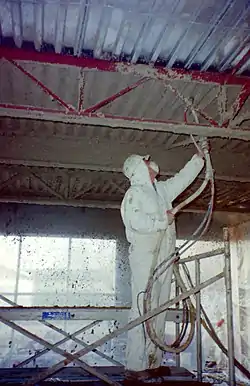 Example of spray fireproofing, using a gypsum based plaster in a low-rise industrial building in Vancouver, British Columbia.
Intonaco is an Italian term for the final, very thin layer of plaster on which a fresco is painted. The plaster is painted while still wet, in order to allow the pigment to penetrate into the intonaco itself. An earlier layer, called arriccio, is laid slightly coarsely to provide a key for the intonaco, and must be allowed to dry, usually for some days, before the final very thin layer is applied and painted on. In Italian the term intonaco is also used much more generally for normal plaster or mortar wall-coatings in buildings.
Intonaco is traditionally a mixture of sand (with granular dimensions less than two millimeters) and a binding substance. (Full article...) Oil sketch modello by Tiepolo, 69 × 55 cm
An oil sketch or oil study is an artwork made primarily in oil paint in preparation for a larger, finished work. Originally these were created as preparatory studies or modelli, especially so as to gain approval for the design of a larger commissioned painting. They were also used as designs for specialists in other media, such as printmaking or tapestry, to follow. Later they were produced as independent works, often with no thought of being expanded into a full-size painting.
The usual medium for modelli was the drawing, but an oil sketch, even if done in a limited range of colours, could better suggest the tone of the projected work. It is also possible to more fully convey the flow and energy of a composition in paint. For a painter with exceptional technique, the production of an oil sketch may be as rapid as that of a drawing, and many practitioners had superb brush skills. In its rapidity of execution the oil sketch may be used not only to express movement and transient effects of light and color, its gestural nature may even represent a mimetic parallel to the action of the subject. (Full article...)
Need help?
Do you have a question about Painting that you can't find the answer to?
Consider asking it at the Wikipedia reference desk.
Get involved
For editor resources and to collaborate with other editors on improving Wikipedia's Painting-related articles, see WikiProject Painting.
General images
 Francis Picabia, (Left) Le saint des saints c'est de moi qu'il s'agit dans ce portrait, 1 July 1915; (center) Portrait d'une jeune fille americaine dans l'état de nudité, 5 July 1915: (right) J'ai vu et c'est de toi qu'il s'agit, De Zayas! De Zayas! Je suis venu sur les rivages du Pont-Euxin, New York, 1915 (from History of painting)
 Two Scribes Seated with Books and a Writing Table Fragment of a decorative margin Northern India (Mughal school), ca. 1640–1650 (from History of painting)
 An Ethiopian illuminated Evangelist portrait of Mark the Evangelist, from the Ethiopian Garima Gospels, 6th century AD, Kingdom of Aksum (from History of painting)
 The oldest known figurative painting is a depiction of a bull that was discovered in the Lubang Jeriji Saléh cave in Indonesia. It was painted 40,000 - 52,000 years ago or earlier. (from Painting)
 Young Mother Sewing, Mary Cassatt (from History of painting)
_cropped.jpg.webp) Khan Bahadur Khan with Men of his Clan, c. 1815, from the Fraser Album, Company Style (from Painting)
Khan Bahadur Khan with Men of his Clan, c. 1815, from the Fraser Album, Company Style (from Painting)
 Lascaux, Horse (from History of painting)
 The Eternal Father Painting the Virgin of Guadalupe. Attributed to Joaquín Villegas (1713 – active in 1753) (Mexican) (painter, Museo Nacional de Arte. (from History of painting)
 Loquats and Mountain Bird, anonymous artist of the Southern Song dynasty; paintings in leaf album style such as this were popular in the Southern Song (1127–1279). (from History of painting)
 Pictographs from the Great Gallery, Canyonlands National Park, Horseshoe Canyon, Utah, c. 1500 BCE (from History of painting)
 Pettakere Cave are more than 44,000 years old, Maros, South Sulawesi, Indonesia (from History of painting)
 Joan Miró, Horse, Pipe and Red Flower, 1920, abstract Surrealism, Philadelphia Museum of Art (from History of painting)
 A fresco showing Hades and Persephone riding in a chariot, from the tomb of Queen Eurydice I of Macedon at Vergina, Greece, 4th century BC (from History of painting)


 The Sakyamuni Buddha, by Zhang Shengwen, 1173–1176 AD, Song dynasty period. (from History of painting)
 Lascaux, Bulls and Horses (from History of painting)
 Mother Goddess A miniature painting of the Pahari style, dating to the eighteenth century. Pahari and Rajput miniatures share many common features. (from History of painting)
 Wayang beber, 17th century (from History of painting)
 Jean de Court (attributed), painted Limoges enamel dish in detail (mid-16th century), Waddesdon Bequest, British Museum (from Painting)
.JPG.webp) A fresco from Cave 1 of Ajanta. (from History of painting)
A fresco from Cave 1 of Ajanta. (from History of painting)
%252C_oil_on_canvas%252C_73_x_54_cm_DSC05359...jpg.webp) Jean Metzinger, La danse (Bacchante) (c.1906), oil on canvas, 73 x 54 cm, Kröller-Müller Museum (from Painting)
Jean Metzinger, La danse (Bacchante) (c.1906), oil on canvas, 73 x 54 cm, Kröller-Müller Museum (from Painting)
 Prehistoric cave painting of aurochs (French: Bos primigenius primigenius), Lascaux, France (from Painting)
 An artistic depiction of a group of rhinos was made in the Chauvet Cave 30,000 to 32,000 years ago. (from Painting)

%252C_oil_on_canvas%252C_133_x_154_cm%252C_Kunstsammlung_Nordrhein-Westfalen%252C_D%C3%BCsseldorf.jpg.webp) Max Beckmann, The Night (Die Nacht), 1918–1919, Kunstsammlung Nordrhein-Westfalen, Düsseldorf (from History of painting)
Max Beckmann, The Night (Die Nacht), 1918–1919, Kunstsammlung Nordrhein-Westfalen, Düsseldorf (from History of painting)

.jpg.webp) Francisco de Zurbarán, Still Life with Pottery Jars (Spanish: Bodegón de recipientes) (1636), oil on canvas, 46 x 84 cm, Museo del Prado, Madrid (from Painting)
Francisco de Zurbarán, Still Life with Pottery Jars (Spanish: Bodegón de recipientes) (1636), oil on canvas, 46 x 84 cm, Museo del Prado, Madrid (from Painting) Cueva de las Manos (Spanish for Cave of the Hands) in the Santa Cruz province in Argentina, c. 7300 BC (from History of painting)

.jpg.webp)
 Honoré Daumier, The Painter (1808–1879), oil on panel with visible brushstrokes (from Painting)
 A Chinese painted jar from the Western Han Era (202 BCE – 9 CE) (from History of painting)
.jpg.webp)
 Nino Pisano, Apelles or the Art of painting in detail (1334–1336); relief of the Giotto's Bell Tower in Florence, Italy
 Spring Morning in the Han Palace, by Ming-era artist Qiu Ying (1494–1552 AD) (from History of painting)
 White Angel (fresco, c. 1235), Mileševa monastery, Serbia (from Painting)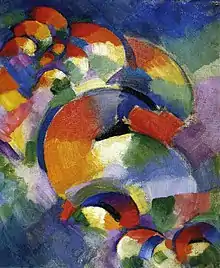
 Book of Hours (from History of painting)
 Krishna and Radha, might be the work of Nihâl Chand, master of Kishangarh school of Rajput Painting (from Painting)
 19th Century Mysore Painting of Goddess Saraswathi (from Painting)
 Otto Marseus van Schrieck, A Forest Floor Still-Life (1666) (from Painting)
_-_Napoli_MAN_9018.jpg.webp)

 Hand stencils in the "Tree of Life" cave painting in Gua Tewet, Kalimantan, Indonesia (from History of painting)
 Silk painting depicting a man riding a dragon, painting on silk, dated to 5th–3rd century BC, Warring States period, from Zidanku Tomb no. 1 in Changsha, Hunan Province (from History of painting)
 Bharat Mata by Abanindranath Tagore (1871–1951), a nephew of the poet Rabindranath Tagore, and a pioneer of the movement (from History of painting)
 Spanish cave painting of Bulls (from History of painting)
 Sesshū Tōyō, Landscapes of the Four Seasons (1486), ink and light color on paper (from Painting)
- The Mona Lisa (1503–1517) by Leonardo da Vinci is one of the world's most recognizable paintings. (from Painting)

.jpg.webp)
 Gwion Gwion rock paintings found in the north-west Kimberley region of Western Australia c. 15,000 BC (from History of painting)
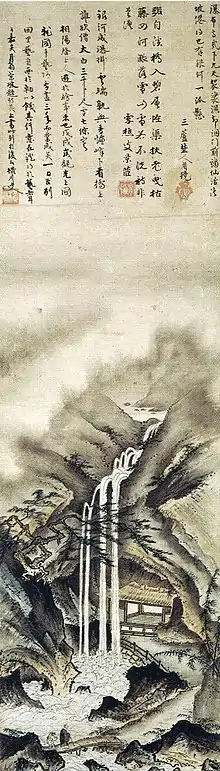 Muromachi period, Shingei (1431–1485), Viewing a Waterfall, Nezu Museum, Tokyo. (from History of painting)
 Ray Burggraf, Jungle Arc (1998), acrylic paint on wood (from Painting)
 Maurice Quentin de La Tour, Portrait of Louis XV of France (1748), pastel (from Painting)
 Diego Rivera, Recreation of Man at the Crossroads (renamed Man, Controller of the Universe), originally created in 1934, Mexican muralism movement (from History of painting)
 Piet Mondrian, Composition en rouge, jaune, bleu et noir (1921), Gemeentemuseum Den Haag (from Painting)
.jpg.webp) Reza Abbasi, Two Lovers (1630) (from Painting)
Reza Abbasi, Two Lovers (1630) (from Painting)
Categories

- Select [►] to view subcategories
Topics
General painting topics
- 20th-century Western painting
- Abstract art
- Accidentalism
- Animal-made art
- Architectural painting
- Binder
- Boston Expressionism
- Boston School
- Cabinet painting
- Coloring book
- Combine painting
- Conservation and restoration of paintings
- Conservation and restoration of panel paintings
- Digital painting
- En plein air
- Figura serpentinata
- Figure painting
- Flatness
- French standard sizes for oil paintings
- Genre art
- Genre painting
- Ghost sign
- Grand manner
- Hierarchy of genres
- Historic paint analysis
- House painter and decorator
- Incised painting
- Inscape
- ISCC–NBS system
- Jerwood Painting Prize
- Letras y figuras
- Live painting
- Local color
- Mixed media
- Mural
- Night in paintings (Eastern art)
- Night in paintings (Western art)
- Nocturne
- Nude
- Oil painting
- Oil painting reproduction
- Orange peel
- Overdoor
- Paint and sip industry
- Paint Dancing
- Paint robot
- Painterliness
- History of painting
- Panoramic painting
- Peintres de la Réalité
- Pendant painting
- Pentimento
- Picture frame
- Pinxit
- Pliage
- Portrait painting
- Prime version
- Problem picture
- Raking light
- Range-finder painting
- Scottish genre art
- Self-portrait
- Sign painting
- Signwriter
- Staffage
- Style
- Tenebrism
- Theory of painting
- Tondo
- Volume solid
- Wash
- Watercolor painting
- Western painting
Painting techniques
- Acrylic painting techniques
- Action painting
- Airbrush
- Al-Qatt Al-Asiri
- Atelier
- Bark painting
- Brain painting
- Brunaille
- Buon fresco
- Cangiante
- Carnation
- Ceramic glaze
- China painting
- Cobweb art
- Cobweb painting
- Craquelure
- Distemper
- Double-sided painting
- Drip painting
- Drybrush
- Electrostatic coating
- Encaustic painting
- Fat over lean
- Figure painting
- Fingerpaint
- Fore-edge painting
- Freehand brush work
- Fresco
- Fresco-secco
- Gambier Parry process
- Generative art
- Giornata
- Glaze
- Glue-size
- Gongbi
- Graffiti
- Graining
- Grisaille
- Haboku
- Illusionism
- Illusionistic ceiling painting
- Impasto
- Imprimatura
- Industrial painting
- Ink wash painting
- Intonaco
- Keim's process
- Lacquer painting
- Leaf painting
- Licked finish
- Lining of paintings
- Maki-e
- Marouflage
- Masking
- Matte painting
- Microbial art
- Mineral painting
- Mischtechnik
- Mold painting
- Mouth and foot painting
- Nocturne
- Notan
- Oil sketch
- Ombré
- Overpainting
- Overspray
- Paint by number
- Painting
- Panel painting
- Papier collé
- Pastiglia
- Pen painting
- Pinstriping
- Pointillism
- Polychrome
- Powder painting
- Prestezza
- Protoquadro
- Quadratura
- Quadro riportato
- Repoussoir
- Reverse glass painting
- Rosemåling
- Rotational bell painting
- Sandpainting
- Sfumato
- Shaped canvas
- Shigajiku
- Silk painting
- Speed line
- Speed painting
- Spray painting
- Tempera
- Texture
- Theorem stencil
- Trompe-l'œil
- Underdrawing
- Underpainting
- Unione
- Velvet painting
- Verdaccio
- Verdaille
- Vitreography
- Wash
- Watercolor painting
- Wet-on-wet
- Working in layers
Associated Wikimedia
The following Wikimedia Foundation sister projects provide more on this subject:
-
 Commons
Free media repository -
 Wikibooks
Free textbooks and manuals -
 Wikidata
Free knowledge base -
 Wikinews
Free-content news -
 Wikiquote
Collection of quotations -
 Wikisource
Free-content library -
 Wikiversity
Free learning tools -
 Wiktionary
Dictionary and thesaurus
-
 List of all portalsList of all portals
 -
 The arts portal
 -
 Biography portal
 -
 Current events portal
 -
 Geography portal
 -
 History portal
 -
 Mathematics portal
 -
 Science portal
 -
 Society portal
 -
 Technology portal
 -
 Random portalRandom portal
 -
 WikiProject PortalsWikiProject Portals
