Portal:Sierra Leone

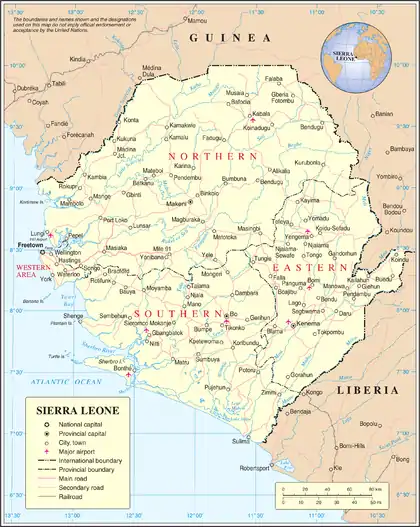
The Sierra Leone Portal Location of Sierra Leone Sierra Leone, officially the Republic of Sierra Leone, is a country on the southwest coast of West Africa. It shares its southeastern border with Liberia, and the northern half of the nation is surrounded by Guinea. Covering a total area of 71,740 km2 (27,699 sq mi), Sierra Leone has a tropical climate, with diverse environments ranging from savanna to rainforests. The country has a population of 7,092,113 as of the 2015 census. Freetown is the capital and largest city. The country is divided into five administrative regions, which are subdivided into 16 districts. Sierra Leone is a constitutional republic with a unicameral parliament and a directly elected president serving a five-year term with a maximum of two terms. The current president is Julius Maada Bio. Sierra Leone is a secular nation with the constitution providing for the separation of state and religion and freedom of conscience (which includes freedom of thoughts and religion). Muslims make up about three-quarters of the population, though with an influential Christian minority. Religious tolerance in the West African nation is very high and is generally considered a norm and part of Sierra Leone's cultural identity. The geographic area has been inhabited for millennia, but Sierra Leone, as the country and its borders are known today, was founded by the British Crown in two phases: first, the coastal Sierra Leone Colony in 1808 (for returning Africans after the abolition of slavery); second, the inland Protectorate in 1896 (as the Crown needed to establish more dominion inland following the outcome of the Berlin Conference of 1884-1885). Hence, the country formally became known as the Sierra Leone Colony and Protectorate or simply British Sierra Leone. Sierra Leone gained independence from the United Kingdom on 27 April 1961, and became a Commonwealth realm on the same day; the country's name changed to the Dominion of Sierra Leone. Sir Milton Margai became Sierra Leone's first prime minister. During the few decades following independence, Sierra Leone witnessed an increase in political activities, transformations, turmoil, humanitarian and socio-economic crises. The country had its first general elections as an independent nation on 27 May 1961. Margai's Sierra Leone People's Party (SLPP) won a plurality of parliamentary seats and he was re-elected Prime Minister. A new constitution was adopted in 1971, paving the way for Sierra Leone becoming a republic, and Siaka Stevens, leader of the All People's Congress (APC), becoming the first executive president of the Republic of Sierra Leone. Stevens held on to this position for 14 years (until 1985) under a one-party system of government facilitated by the controversial 1978 Constitution. However, Stevens' hand-picked successor Joseph Saidu Momoh promised to return the country to a multi-party system; a new constitution was adopted in 1991 that provided the means for a multi-party democracy. A brutal civil war broke out the same year, which went on for 11 years with devastating effects. In 1992, just a year after the war broke out, President Momoh was ousted in a coup led by Sierra Leone Army captain Valentine Strasser. Strasser was later ousted by his army colleague and second-in-command Julius Maada Bio, for failing to commit to a quick transfer to civilian rule. Bio would then return the country back to a democratic republic in 1996 through a general election. (Full article...) Selected article -
The Special Court for Sierra Leone, or the "Special Court" (SCSL), also called the Sierra Leone Tribunal, was a judicial body set up by the government of Sierra Leone and the United Nations to "prosecute persons who bear the greatest responsibility for serious violations of international humanitarian law and Sierra Leonean law" committed in Sierra Leone after 30 November 1996 and during the Sierra Leone Civil War. The court's working language was English. The court listed offices in Freetown, The Hague, and New York City. Following its dissolution in 2013, it was replaced by the Residual Special Court for Sierra Leone in order to complete its mandate and manage a variety of ongoing and ad-hoc functions, including witness protection and support, supervision of prison sentences and claims for compensation. (Full article...)General images -The following are images from various Sierra Leone-related articles on Wikipedia.
| ||||||||


.svg.png.webp)


.jpg.webp)




 A pygmy hippopotamus at Edinburgh Zoo |
The pygmy hippopotamus or pygmy hippo (Choeropsis liberiensis) is a small hippopotamid which is native to the forests and swamps of West Africa, primarily in Liberia, with small populations in Sierra Leone, Guinea, and Ivory Coast. It has been extirpated from Nigeria.
The pygmy hippo is reclusive and nocturnal. It is one of only two extant species in the family Hippopotamidae, the other being its much larger relative, the common hippopotamus (Hippopotamus amphibius) or Nile hippopotamus. The pygmy hippopotamus displays many terrestrial adaptations, but like the hippo, it is semiaquatic and relies on water to keep its skin moist and its body temperature cool. Behaviors such as mating and giving birth may occur in water or on land. The pygmy hippo is herbivorous, feeding on ferns, broad-leaved plants, grasses, and fruits it finds in the forests. (Full article...)List of recognized articles |
|---|
Categories

Did you know

- ... that education in Sierra Leone (pictured) had to recover from the destruction of 1,270 primary schools during the Sierra Leone Civil War?
Topics

Provinces: Eastern Province • Northern Province • Southern Province • Western Area
History: Sierra Leone Colony and Protectorate • Kingdom of Koya • British West Africa • Sierra Leone Liberated Africans • Sierra Leone Civil War • United Nations Mission in Sierra Leone
Law: Sierra Leone Police • Special Court for Sierra Leone • Truth and Reconciliation Commission • Prisons in Sierra Leone
Politics: List of Presidents • Political Parties • Parliament • Foreign relations • Elections • Military of Sierra Leone
Geography: Protected • Sierra Leone River • Western Guinean lowland forests • Outamba-Kilimi National Park • Transport
Society: Sport • Demographics • Education • Cuisine • Media • Music
Symbols: Flag • Coat of arms • National anthem (High We Exalt Thee, Realm of the Free)

Selected picture -

Credit: Stephanie Zito
Crossing the Moa River at Tiwai Island Wildlife Sanctuary. (read more . . . )

Associated Wikimedia
The following Wikimedia Foundation sister projects provide more on this subject:
-
 Commons
Free media repository -
 Wikibooks
Free textbooks and manuals -
 Wikidata
Free knowledge base -
 Wikinews
Free-content news -
 Wikiquote
Collection of quotations -
 Wikisource
Free-content library -
 Wikiversity
Free learning tools -
 Wikivoyage
Free travel guide -
 Wiktionary
Dictionary and thesaurus
Things to do
 |
Here are some tasks awaiting attention:
|
-
 List of all portalsList of all portals
 -
 The arts portal
 -
 Biography portal
 -
 Current events portal
 -
 Geography portal
 -
 History portal
 -
 Mathematics portal
 -
 Science portal
 -
 Society portal
 -
 Technology portal
 -
 Random portalRandom portal
 -
 WikiProject PortalsWikiProject Portals