Portal:Taiwan

Main   Geography   Recognized content

Introduction

Taiwan, officially the Republic of China (ROC), is a country in East Asia. It is located at the junction of the East and South China Seas in the northwestern Pacific Ocean, with the People's Republic of China (PRC) to the northwest, Japan to the northeast, and the Philippines to the south. The territories controlled by the ROC consist of 168 islands, with a combined area of 36,193 square kilometres (13,974 sq mi). The main island of Taiwan, also known as Formosa, has an area of 35,808 square kilometres (13,826 sq mi), with mountain ranges dominating the eastern two-thirds and plains in the western third, where its highly urbanised population is concentrated. The capital, Taipei, forms along with New Taipei City and Keelung the largest metropolitan area of Taiwan. Other major cities include Taoyuan, Taichung, Tainan, and Kaohsiung. With around 23.9 million inhabitants, Taiwan is among the most densely populated countries in the world.

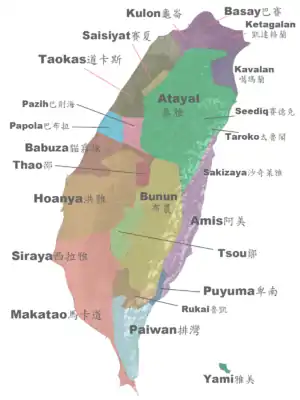
Taiwan has been settled for at least 25,000 years. Ancestors of Taiwanese indigenous peoples settled the island around 6,000 years ago. In the 17th century, large-scale Han Chinese (specifically the Hakkas and Hoklos) immigration to western Taiwan began under a Dutch colony and continued under the Kingdom of Tungning, the first predominantly Han Chinese state in Taiwanese history. The island was annexed in 1683 by the Qing dynasty of China and ceded to the Empire of Japan in 1895. The Republic of China, which had overthrown the Qing in 1911, took control of Taiwan following the surrender of Japan in 1945. Japan would renounce sovereignty over Taiwan in 1952. The immediate resumption of the Chinese Civil War resulted in the loss of the Chinese mainland to Communist forces who established the People's Republic of China, and the flight of the ROC central government to Taiwan in 1949. The effective jurisdiction of the ROC has since been limited to Taiwan, Penghu, and smaller islands.

In the early 1960s, Taiwan entered a period of rapid economic growth and industrialisation called the "Taiwan Miracle". In the late 1980s and early 1990s, the ROC transitioned from a one-party state under martial law to a multi-party democracy, with democratically elected presidents since 1996. Taiwan's export-oriented industrial economy is the 21st-largest in the world by nominal GDP and 19th-largest by PPP measures, with a focus on steel, machinery, electronics and chemicals manufacturing. Taiwan is a developed country, ranking 20th on GDP per capita. It is ranked highly in terms of civil liberties, healthcare, and human development.

The political status of Taiwan is contentious. The ROC no longer represents China as a member of the United Nations, after UN members voted in 1971 to recognize the PRC instead. The ROC maintained its claim of being the sole legitimate representative of China and its territory, although this has been downplayed since its democratization in the 1990s. Taiwan is claimed by the PRC, which refuses diplomatic relations with countries that recognise the ROC. Taiwan maintains official diplomatic relations with 13 out of 193 UN member states and the Holy See, though many others maintain unofficial diplomatic ties through representative offices and institutions that function as de facto embassies and consulates. International organisations in which the PRC participates either refuse to grant membership to Taiwan or allow it to participate only on a non-state basis under various names. Domestically, the major political contention is between parties favouring eventual Chinese unification and promoting a pan-Chinese identity, contrasted with those aspiring to formal international recognition and promoting a Taiwanese identity; into the 21st century, both sides have moderated their positions to broaden their appeal. (Full article...)

Selected article -

Vice President of Taiwan ROC Annette Lu (2000-2008)
Annette Lu Hsiu-lien (Chinese: 呂秀蓮; pinyin: Lǚ Xiùlián; Pe̍h-ōe-jī: Lū Siù-liân; born 7 June 1944) is a Taiwanese politician. A feminist active in the tangwai movement, she joined the Democratic Progressive Party in 1990, and was elected to the Legislative Yuan in 1992. Subsequently, she served as Taoyuan County Magistrate between 1997 and 2000, and was the Vice President of the Republic of China from 2000 to 2008, under President Chen Shui-bian. Lu announced her intentions to run for the presidency on 6 March 2007, but withdrew to support eventual DPP nominee Frank Hsieh. Lu ran again in 2012, but withdrew for a second time, ceding the nomination to DPP chairwoman Tsai Ing-wen. She lost the party's Taipei mayoral nomination to Pasuya Yao in 2018, and stated that she would leave the party. However, by the time Lu announced in September 2019 that she would contest the 2020 presidential election on behalf of the Formosa Alliance, she was still a member of the Democratic Progressive Party. (Full article...)

Selected biography

Lee at the 2016 NAB Show

Ang Lee OBS (Chinese: 李安; pinyin: Lǐ Ān; born October 23, 1954) is a Taiwanese filmmaker. Born in Pingtung County of southern Taiwan, Lee was educated in Taiwan and later in the United States. As a filmmaker Lee's work is known for its emotional charge and exploration of repressed, hidden emotions. During his career, he has received international critical and popular acclaim and a range of accolades.

Lee's early successes included Pushing Hands (1991), The Wedding Banquet (1993), and Eat Drink Man Woman (1994), which explored the relationships and conflicts between tradition and modernity, Eastern and Western; the three films are informally known as the "Father Knows Best" trilogy. The films were critically successful both in his native Taiwan and internationally. His breakthrough in Hollywood was the acclaimed costume drama Sense and Sensibility (1995), which was also his first entirely English-language film. He went on to direct films in a broad range of genres, including the drama The Ice Storm (1997); the Civil War epic Ride with the Devil (1999); the martial arts wuxia drama Crouching Tiger, Hidden Dragon (2000); the superhero blockbuster Hulk (2003); the romantic drama Brokeback Mountain (2005); the erotic espionage period film Lust, Caution (2007); and the magic realist survival drama Life of Pi (2012). (Full article...)

Selected picture -

Alishan Station
Alishan Station in Alishan, Chiayi is part of an 86 km network of narrow gauge railway built by the Japanese in 1912 for logging but is now a tourist attraction operated by Alishan Forest Railway.

Photo credit: Jāzeps Baško

Good article -

This is a Good article, an article that meets a core set of high editorial standards.

Chai Trong-rong at 2008 CIPFG Global Human Rights Torch Relay in Taiwan

Chai Trong-rong (Chinese: 蔡同榮; pinyin: Cài Tóngróng; Wade–Giles: Ts‘ài4 T‘ung2-jung2; Pe̍h-ōe-jī: Chhòa Tông-êng; June 13, 1935 – January 11, 2014), sometimes known in English as Trong Chai, was a Taiwanese politician.

Born in Japanese-era Taiwan, Chai earned his master's and doctorate degrees in the United States. He was a pro-democracy advocate and founded the Association for a Plebiscite (Chinese: 公民投票促進會; pinyin: Gōngmín Tóupiaò Cùjìnhùi) and Formosa Television. (Full article...)

Did you know -

Formosan black bear.
  • ... that the Formosan black bear (pictured) is an endangered and endemic species of bear that can only be found in Taiwan?
  • ... that Jade Mountain, at 3,952 meters (13,114 feet), is the tallest mountain in Taiwan. Did you also know that it stands 176 meters taller than Mount Fuji in Japan, and that it was named Niitakayama, or 'new tall mountain' during Japanese rule?
  • ... that Gueishan Island is an islet formed by the only active volcano in Taiwan?

General images

The following are images from various Taiwan-related articles on Wikipedia.

On this day...

Topics

Categories

Category puzzle
Select [►] to view subcategories
Taiwan
Taiwan-related lists
Buildings and structures in Taiwan
Taiwanese culture
Economy of Taiwan
Education in Taiwan
Environment of Taiwan
Geography of Taiwan
Government of Taiwan
Health in Taiwan
History of Taiwan
National symbols of Taiwan
Organizations based in Taiwan
Taiwanese people
Politics of Taiwan
Society of Taiwan
Sport in Taiwan
Images of Taiwan
Taiwan stubs
Taiwan templates

Administrative divisions

Portals listed here are related to Taiwan by way of history, Asian region, diplomatic relations with ROC, and significant diaspora of overseas Taiwanese

Projects

You are cordially invited to join and contribute to WikiProject Taiwan, a WikiProject dedicated to the development and improvement of articles relating to Taiwan.

WikiProject Taiwan Membership Discussion

Associated Wikimedia

The following Wikimedia Foundation sister projects provide more on this subject:

Sources

      Discover Wikipedia using portals
      Taiwan portal logo
      This article is issued from Wikipedia. The text is licensed under Creative Commons - Attribution - Sharealike. Additional terms may apply for the media files.