Portal:World

The World Portal


In its most general sense, the term "world" refers to the totality of entities, to the whole of reality or to everything that is. The nature of the world has been conceptualized differently in different fields. Some conceptions see the world as unique while others talk of a "plurality of worlds". Some treat the world as one simple object while others analyze the world as a complex made up of many parts. In scientific cosmology the world or universe is commonly defined as "[t]he totality of all space and time; all that is, has been, and will be". Theories of modality, on the other hand, talk of possible worlds as complete and consistent ways how things could have been. Phenomenology, starting from the horizon of co-given objects present in the periphery of every experience, defines the world as the biggest horizon or the "horizon of all horizons". In philosophy of mind, the world is commonly contrasted with the mind as that which is represented by the mind. Theology conceptualizes the world in relation to God, for example, as God's creation, as identical to God or as the two being interdependent. In religions, there is often a tendency to downgrade the material or sensory world in favor of a spiritual world to be sought through religious practice. A comprehensive representation of the world and our place in it, as is commonly found in religions, is known as a worldview. Cosmogony is the field that studies the origin or creation of the world while eschatology refers to the science or doctrine of the last things or of the end of the world.
In various contexts, the term "world" takes a more restricted meaning associated, for example, with the Earth and all life on it, with humanity as a whole or with an international or intercontinental scope. In this sense, world history refers to the history of humanity as a whole or world politics is the discipline of political science studying issues that transcend nations and continents. Other examples include terms such as "world religion", "world language", "world government", "world war", "world population", "world economy" or "world championship". (Full article...)
Selected articles -
 The Global Competitiveness Report (GCR) is a yearly report published by the World Economic Forum. Since 2004, the Global Competitiveness Report ranks countries based on the Global Competitiveness Index, developed by Xavier Sala-i-Martin and Elsa V. Artadi. Before that, the macroeconomic ranks were based on Jeffrey Sachs's Growth Development Index and the microeconomic ranks were based on Michael Porter's Business Competitiveness Index. The Global Competitiveness Index integrates the macroeconomic and the micro/business aspects of competitiveness into a single index.
The report "assesses the ability of countries to provide high levels of prosperity to their citizens". This in turn depends on how productively a country uses available resources. Therefore, the Global Competitiveness Index measures the set of institutions, policies, and factors that set the sustainable current and medium-term levels of economic prosperity." (Full article...)- The United Nations uses three definitions for what constitutes a city, as not all cities in all jurisdictions are classified using the same criteria. Cities may be defined as the cities proper, the extent of their urban area, or their metropolitan regions. The largest city by population using the city proper definition, which is the area under the administrative boundaries of a local government, is Chongqing, China. The largest city by population using the metropolitan area definition, which is a loose term referring to urban area and its primary commuter areas, is Tokyo, Japan. The largest city by population using the urban area definition, which is a loose term referring to a contiguous area with a certain population density, is also Tokyo, Japan. (Full article...)
- A megacity is a very large city, typically with a population of more than 10 million people. Precise definitions vary: the United Nations Department of Economic and Social Affairs in its 2018 "World Urbanization Prospects" report counted urban agglomerations having over 10 million inhabitants. A University of Bonn report held that they are "usually defined as metropolitan areas with a total population of 10 million or more people". Others list cities satisfying criteria of either 5 or 8 million and also having a population density of 2,000 per square kilometre. The terms conurbation, metropolis, and metroplex are also applied to the latter.
The total number of megacities in the world varies between different sources: The world had 33 according to the UN (in 2018), 37 according to CityPopulation.de (in 2020), and 44 according to Demographia (in 2022). About half these urban agglomerations are in China and India. The other four countries with more than one megacity are Brazil, Japan, Pakistan, and the United States. African megacities are present in Nigeria, Egypt, South Africa, and the DRC; European megacities are present in Russia, France, the United Kingdom, and Turkey (also in Asia); megacities can be found in Latin America in the countries of Brazil, Mexico, Colombia, Peru, and Argentina. Some sources identify Tokyo's Greater Tokyo Area as the largest megacity in the world, while some others give the title to Pearl River Delta. (Full article...) .svg.png.webp) 🜨
🜨
Earth is the third planet from the Sun and the only place known in the universe where life has originated and found habitability. While large volumes of water can be found throughout the Solar System, only Earth sustains liquid surface water. Approximately 70.8% of Earth's surface is made up of the ocean, dwarfing Earth's polar ice, lakes, and rivers. The remaining 29.2% of Earth's surface is land, consisting of continents and islands. Earth's surface layer is formed of several slowly moving tectonic plates, which interact to produce mountain ranges, volcanoes, and earthquakes. Earth's liquid outer core generates the magnetic field that shapes the magnetosphere of Earth, deflecting destructive solar winds.
The atmosphere of Earth consists mostly of nitrogen and oxygen. Greenhouse gases in the atmosphere like carbon dioxide (CO2) trap a part of the energy from the Sun close to the surface. Water vapor is widely present in the atmosphere and forms clouds that cover most of the planet. More solar energy is received by tropical regions than polar regions and is redistributed by atmospheric and ocean circulation. A region's climate is governed not only by latitude but also by elevation and proximity to moderating oceans. In most areas, severe weather, such as tropical cyclones, thunderstorms, and heat waves, occurs and greatly impacts life. (Full article...)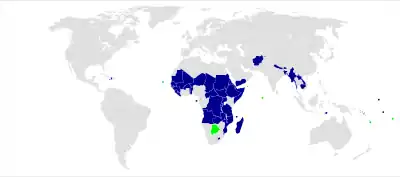 Least developed countries (designated by the UN as of 2020)Former LDCs
The least developed countries (LDCs) are developing countries listed by the United Nations that exhibit the lowest indicators of socioeconomic development. The concept of LDCs originated in the late 1960s and the first group of LDCs was listed by the UN in its resolution 2768 (XXVI) on 18 November 1971.
A country is classified among the Least Developed Countries if it meets three criteria:- Poverty – adjustable criterion based on Gross national income (GNI) per capita averaged over three years. As of 2018, a country must have GNI per capita less than US$1,025 to be included on the list, and over $1,230 to graduate from it.
- Human resource weakness (based on indicators of nutrition, health, education and adult literacy).
- Economic vulnerability (based on instability of agricultural production, instability of exports of goods and services, economic importance of non-traditional activities, merchandise export concentration, handicap of economic smallness, and the percentage of population displaced by natural disasters).

Globalization, or globalisation (Commonwealth English; see spelling differences), is the process of interaction and integration among people, companies, and governments worldwide. The term globalization first appeared in the early 20th century (supplanting an earlier French term mondialization), developed its current meaning some time in the second half of the 20th century, and came into popular use in the 1990s to describe the unprecedented international connectivity of the post-Cold War world. Its origins can be traced back to 18th and 19th centuries due to advances in transportation and communications technology. This increase in global interactions has caused a growth in international trade and the exchange of ideas, beliefs, and culture. Globalization is primarily an economic process of interaction and integration that is associated with social and cultural aspects. However, disputes and international diplomacy are also large parts of the history of globalization, and of modern globalization.
Economically, globalization involves goods, services, data, technology, and the economic resources of capital. The expansion of global markets liberalizes the economic activities of the exchange of goods and funds. Removal of cross-border trade barriers has made the formation of global markets more feasible. Advances in transportation, like the steam locomotive, steamship, jet engine, and container ships, and developments in telecommunication infrastructure, like the telegraph, Internet, mobile phones, and smartphones, have been major factors in globalization and have generated further interdependence of economic and cultural activities around the globe. (Full article...)- The atmosphere of Earth is the layer of gases, known collectively as air, retained by Earth's gravity that surrounds the planet and forms its planetary atmosphere. The atmosphere of Earth protects life on Earth by creating pressure allowing for liquid water to exist on the Earth's surface, absorbing ultraviolet solar radiation, warming the surface through heat retention (greenhouse effect), and reducing temperature extremes between day and night (the diurnal temperature variation).
 Blue light is scattered more than other wavelengths by the gases in the atmosphere, surrounding Earth in a visibly blue layer at the stratosphere, above the clouds of the troposphere, when seen from space on board the ISS at an altitude of 335 km (208 mi) (the Moon is visible as crescent in the far background).
As of 2023, by mole fraction (i.e., by number of molecules), dry air contains 78.08% nitrogen, 20.95% oxygen, 0.93% argon, 0.04% carbon dioxide, and small amounts of other gases.
Air also contains a variable amount of water vapor, on average around 1% at sea level, and 0.4% over the entire atmosphere. Air composition, temperature, and atmospheric pressure vary with altitude. Within the atmosphere, air suitable for use in photosynthesis by terrestrial plants and breathing of terrestrial animals is found only in Earth's troposphere. (Full article...)
General images -

 Artist's conception of Hadean Eon Earth, when it was much hotter and inhospitable to all forms of life. (from History of Earth)
 Artist's rendition of an oxinated fully-frozen Snowball Earth with no remaining liquid surface water. (from History of Earth)
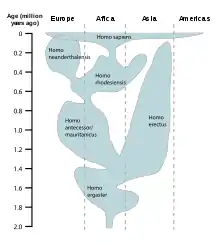 A reconstruction of human history based on fossil data. (from History of Earth)
 Artist's impression of Earth during the later Archean, the largely cooled planetary crust and water-rich barren surface, marked by volcanoes and continents, features already round microbialites. The Moon, still orbiting Earth much closer than today and still dominating Earth's sky, produced strong tides. (from History of Earth)
.svg.png.webp)
 A view of Earth with different layers of its atmosphere visible: the troposphere with its shadows casting clouds and a band of stratospheric blue sky at the horizon, and above this a line of green airglow of the lower thermosphere around an altitude of 100 km, at the edge of space. (from Earth)
 Cross-section through a liposome (from History of Earth)
 Earth's history with time-spans of the eons to scale (from History of Earth)
.jpeg.webp) The Standing Buddha from Gandhara, 2nd century AD (from Human history)
The Standing Buddha from Gandhara, 2nd century AD (from Human history)

 An artist's impression of ice age Earth at glacial maximum. (from History of Earth)
 Artist's impression of the enormous collision that probably formed the Moon (from History of Earth)
 A reconstruction of Pannotia (550 Ma). (from History of Earth)
 The replicator in virtually all known life is deoxyribonucleic acid. DNA is far more complex than the original replicator and its replication systems are highly elaborate. (from History of Earth)
.jpg.webp) The first aeroplane, the Wright Flyer, flew on 17 December 1903. (from Human history)
The first aeroplane, the Wright Flyer, flew on 17 December 1903. (from Human history)
 Global map of heat flow from Earth's interior to the surface of Earth's crust, mostly along the oceanic ridges (from Earth)

 Trilobites first appeared during the Cambrian period and were among the most widespread and diverse groups of Paleozoic organisms. (from History of Earth)
 A computer-generated image mapping the prevalence of artificial satellites and space debris around Earth in geosynchronous and low Earth orbit (from Earth)
 Change in average surface air temperature and drivers for that change. Human activity has caused increased temperatures, with natural forces adding some variability. (from Earth)
 Geologic map of North America, color-coded by age. From most recent to oldest, age is indicated by yellow, green, blue, and red. The reds and pinks indicate rock from the Archean.
 A 580 million year old fossil of Spriggina floundensi, an animal from the Ediacaran period. Such life forms could have been ancestors to the many new forms that originated in the Cambrian Explosion. (from History of Earth)
 Schematic of Earth's magnetosphere, with the solar wind flows from left to right (from Earth)
 The Pantheon in Rome, Italy, originally a Roman temple, now a Catholic church (from Human history)
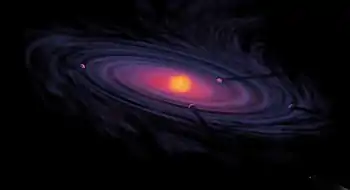 An artist's rendering of a protoplanetary disk (from History of Earth)
 Great Mosque of Kairouan, Tunisia, founded 670 CE (from Human history)
 A pillar from Göbekli Tepe (from Human history)
 Notre-Dame de Paris in Paris, France: is among the most recognizable symbols of the civilization of Christendom. (from Human history)
 Artist's impression of the early Solar System's protoplanetary disk, out of which Earth and other Solar System bodies formed (from Earth)

 A banded iron formation from the 3.15 Ga Moodies Group, Barberton Greenstone Belt, South Africa. Red layers represent the times when oxygen was available; gray layers were formed in anoxic circumstances. (from History of Earth)
 Earth–Moon system seen from Mars (from Earth)
 Tiktaalik, a fish with limb-like fins and a predecessor of tetrapods. Reconstruction from fossils about 375 million years old. (from History of Earth)
 Artist's impression of a Hadean landscape with the relatively newly formed Moon still looming closely over Earth and both bodies sustaining strong volcanism. (from History of Earth)
 Earth's rotation imaged by Deep Space Climate Observatory, showing axis tilt (from Earth)
.jpg.webp) Vitruvian Man by Leonardo da Vinci epitomizes the advances in art and science seen during the Renaissance. (from History of Earth)
Vitruvian Man by Leonardo da Vinci epitomizes the advances in art and science seen during the Renaissance. (from History of Earth)
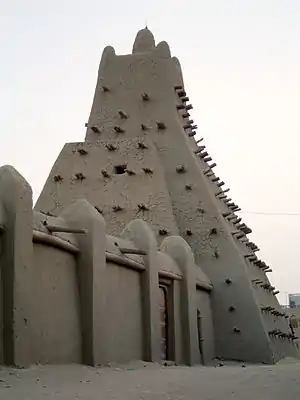 University of Timbuktu, Mali (from Human history)
 The pale orange dot, an artist's impression of the early Earth which might have appeared orange through its hazy methane rich prebiotic second atmosphere. Earth's atmosphere at this stage was somewhat comparable to today's atmosphere of Titan. (from History of Earth)
- Overview map of the peopling of the world by early humans during the Upper Paleolithic, following the Southern Dispersal paradigm. Labels are in thousands of years ago. (from Human history)
 Battle during 1281 Mongol invasion of Japan (from Human history)
 1570 world map, showing Europeans' discoveries (from Human history)
 Graph showing range of estimated partial pressure of atmospheric oxygen through geologic time (from History of Earth)
 Lithified stromatolites on the shores of Lake Thetis, Western Australia. Archean stromatolites are the first direct fossil traces of life on Earth. (from History of Earth)
 Pangaea was a supercontinent that existed from about 300 to 180 Ma. The outlines of the modern continents and other landmasses are indicated on this map. (from History of Earth)


 Image of the physical world, captured by the Hubble Space Telescope (from World)
 Tracy Caldwell Dyson in the Cupola module of the International Space Station observing the Earth below (from Earth)
 Astronaut Bruce McCandless II outside of the Space Shuttle Challenger in 1984 (from History of Earth)
 A view of Earth with its global ocean and cloud cover, which dominate Earth's surface and hydrosphere. At Earth's polar regions Earth's hydrosphere forms larger areas of ice cover. (from Earth)
 Last Moon landing: Apollo 17 (1972) (from Human history)
 Empires of the world in 1898 (from Human history)
 Topographic view of Earth relative to Earth's center (instead of to mean sea level, as in common topographic maps) (from Earth)
.jpg.webp)
 Approximately 70.8% of Earth's surface is ocean water, the remaining 29.2% is land. At the polar regions, Earth's ocean and land surface is mostly covered by ice, as depicted in this composite image of the ice cover over the Southern Ocean (in grey) and Antarctica (in white). (from Earth)
 Earth's land use for human agriculture (from Earth)
 An animation of the changing density of productive vegetation on land (low in brown; heavy in dark green) and phytoplankton at the ocean surface (low in purple; high in yellow) (from Earth)
 A composite image of artificial light emissions at night on a map of Earth (from Earth)
 Chloroplasts in the cells of a moss (from History of Earth)
 Artist's conception of Devonian flora (from History of Earth)

 Earth's atmosphere as it appears from space, as bands of different colours at the horizon. From the bottom, afterglow illuminates the troposphere in orange with silhouettes of clouds, and the stratosphere in white and blue. Next the mesosphere (pink area) extends to just below the edge of space at one hundred kilometers and the pink line of airglow of the lower thermosphere (invisible), which hosts green and red aurorae over several hundred kilometers. (from Earth)
 Yggdrasil, a modern attempt to reconstruct the Norse world tree which connects the heavens, the world, and the underworld. (from World)
- Pale orange dot artist's impression of the early Earth tinted orange by its methane-rich early atmosphere (from Earth)
 Dinosaurs were the dominant terrestrial vertebrates throughout most of the Mesozoic (from History of Earth)

 Hagia Sophia, in Istanbul, is among the most recognizable symbols of the Byzantine civilization. (from Human history)
 Earth's axial tilt causing different angles of seasonal illumination at different orbital positions around the Sun (from Earth)
- Artist's impression of the Archean, the eon after Earth's formation, featuring round stromatolites which are early oxygen producing forms of life from billions of years ago. After the Late Heavy Bombardment, Earth's crust had cooled, its water-rich barren surface is marked by continents and volcanoes, with the Moon still orbiting Earth much closer than today, producing strong tides. (from Earth)
 Olmec colossal head from La Venta (from Human history)

Megacities of the world -

Chongqing (/ˌtʃɒŋˈtʃɪŋ/ chong-CHING or /ˈtʃɒŋˌtʃɪŋ/ CHONG-ching; simplified Chinese: 重庆; traditional Chinese: 重慶; pinyin: Chóngqìng; Sichuanese pronunciation: [tsʰoŋ˨˩tɕʰin˨˩˦], Standard Mandarin pronunciation: [ʈʂʰʊ̌ŋ.tɕʰîŋ] ( listen)), alternately romanized as Chungking (/ˈtʃʊŋˈkɪŋ/), is one of the four direct-administered municipalities of the People's Republic of China (PRC). The official abbreviation of the city, "Yú" (渝), was approved by the State Council on 18 April 1997. This abbreviation is derived from the old name of a part of the Jialing River that runs through Chongqing and feeds into the Yangtze River. Chongqing is China’s major modernized manufacturing base, a financial center and an international transport hub in Western China. Geographically, Chongqing is strategically positioned as a gateway to China’s west, a key connection in the Yangtze River Economic Belt, and a strategic base for China’s Belt and Road Initiative.
Did you know -

- ... that in 1998, the Mercedes-Benz CLK GTR received the Guinness World Record for the most expensive production car?
- ... that the buoy in Edward Hopper's 1939 painting Ground Swell alludes to impending doom, possibly the beginning of World War II?
- ... that a construction worker working on the Great World MRT station died after an excavator's bucket dislodged and fell on him?
- ... that turbine manufacturer S. Morgan Smith Company made large gun lathes during World War I and large aircraft carrier, gun, and tank parts during World War II?
- ... that in 1975 Time named Schwester Selma, head nurse at the Shaare Zedek Hospital in Jerusalem, one of the world's "living saints", alongside Mother Teresa and Sister Annie?
- ... that despite being the third edition of the tournament, the 1982 Women's Cricket World Cup featured the first final held in the tournament's history?
- ... that the founder of the Guide to the Free World, helping people leave Russia after its invasion of Ukraine, said she was told: "It's good that you get out of Russia, but a pity that you won't be shot"?
- ... that Travis Ludlow broke the world record for the youngest person to fly solo around the world?
Countries of the world -

Northern Ireland (Irish: Tuaisceart Éireann [ˈt̪ˠuəʃcəɾˠt̪ˠ ˈeːɾʲən̪ˠ] (listen); Ulster-Scots: Norlin Airlann) is a part of the United Kingdom, situated in the north-east of the island of Ireland, that is variously described as a country, province or region. Northern Ireland shares an open border to the south and west with the Republic of Ireland. In 2021, its population was 1,903,100, making up about 27% of Ireland's population and about 3% of the UK's population. The Northern Ireland Assembly, established by the Northern Ireland Act 1998, holds responsibility for a range of devolved policy matters, while other areas are reserved for the UK Government. The government of Northern Ireland cooperates with the government of the Republic of Ireland in several areas agreed under the terms of the Belfast Agreement. The Republic of Ireland also has a consultative role on non-devolved governmental matters through the British-Irish Governmental Conference (BIIG).
The Seven Wonders of Portuguese Origin in the World are a list of seven significant landmarks across the world which were built by the Portuguese during the six centuries of the Portuguese Empire (1415-1999). The competition was held in conjunction with the Ministry of Culture of Portugal and the Portuguese Institute for Architectural Heritage.
The objective of the list and competition was to promote the architectural heritage and legacy of the Portuguese across the world. A commission pre-selected 27 notable monuments of Portuguese origin from 16 countries across Asia, Africa, and the Americas. The results of the competition were announced at a ceremony at the Portugal Day celebrations in 2010. (Full article...)Related portals
Protected areas of the world -
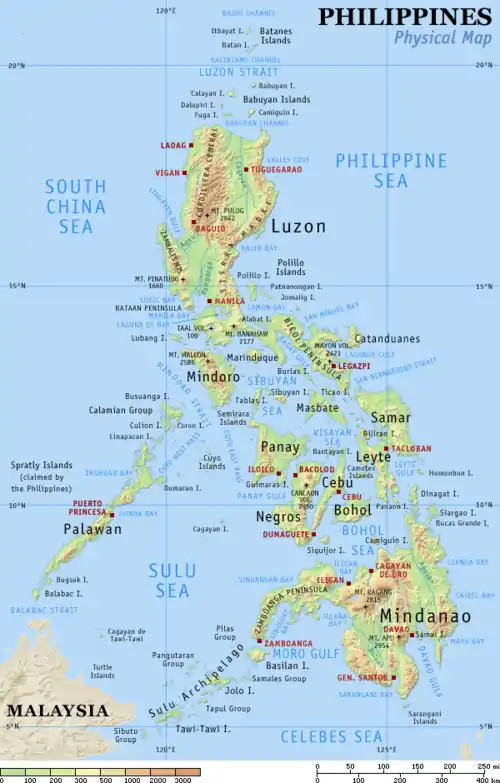 Map of the Philippine archipelago
This is a list of protected areas of the Philippines administered by the Department of Environment and Natural Resources (DENR)'s Biodiversity Management Bureau under the National Integrated Protected Areas System (NIPAS) Act of 1992. As of 2020, there are 244 protected areas in the Philippines covering a total area of about 7,760,000 hectares (19,200,000 acres) – 15.4% of the Philippines' total area. (Full article...) Andohahela National Park in southern Madagascar
This list of national parks of Madagascar includes all officially recognized protected areas as of 2015. The protected areas network of Madagascar is managed by the Madagascar National Parks Association (PNM-ANGAP). The network includes three types of protected areas: Strict Nature Reserves (IUCN category Ia), National Parks (IUCN category II) and Wildlife Reserves (IUCN category IV). At the 2003 IUCN World Parks Congress in Durban, the Malagasy President, Marc Ravalomanana, announced an initiative to more than triple the area under protection from approximately 4,200,791 acres (17,000.00 km2) to over 14,826,322 acres (60,000.00 km2) (from 3% to 10% of Madagascar's area). This "Durban Vision", as it has been dubbed, involved broadening the definition of protected areas in the country and legislation has been passed to allow the creation of four new categories of protected area: Natural Parks (IUCN category II), Natural Monuments (IUCN category III), Protected Landscapes (IUCN category V), and Natural Resource Reserves (IUCN category VI). As well as allowing these new objectives for protected areas management, the new legislation also provided for entities other than PNM-ANGAP to manage protected areas, such as government ministries, community associations, NGOs and other civil society organizations, and the private sector. (Full article...)
This list of protected areas of Quebec includes federally, provincially and municipally administered parks and wildlife reserves in Quebec, the largest province in Canada. (Full article...)- The National Parks of Argentina make up a network of 35 national parks in Argentina. The parks cover a very varied set of terrains and biotopes, from Baritú National Park on the northern border with Bolivia to Tierra del Fuego National Park in the far south of the continent. The Administración de Parques Nacionales (National Parks Administration) is the agency that preserves and manages these national parks along with Natural monuments and National Reserves within the country.
The headquarters of the National Parks Service are in downtown Buenos Aires, on Santa Fe Avenue. A library and information centre are open to the public. The administration also covers the national monuments, such as the Jaramillo Petrified Forest, and natural and educational reserves. (Full article...) - This is a list of protected areas of Romania.
About 5.18% of the area of Romania has a protected status (12,360 km²), including the Danube Delta, which makes half of these areas (2.43% of Romania's area). (Full article...) - Protected areas of Norway include:
About 17 percent of the mainland of Norway is protected. Of this, ca. 8.3 percent is national parks, 1.3 percent is nature reserves and 4.7 percent otherwise protected. (Full article...)  Viru bog in Lahemaa National Park
Protected areas in Estonia are national parks, nature reserves and landscape protection areas (nature parks).
Estonia has five national parks, 167 nature reserves and 152 landscape conservation areas. In addition, there are 116 (118) protected areas with an old (Soviet-era) protection regulation and 537 parks. In total, 18.1% of Estonia are protected nature areas, with Lääne County having the highest percentage (32%) and Põlva County the lowest percentage of protected areas, about 9%. (Full article...).svg.png.webp)
Wales, a country that is part of the United Kingdom, contains protected areas under various designations. The largest designation by land area is Wales' three national parks, followed by the five Areas of Outstanding Natural Beauty (sometimes collectively the "Designated Landscapes of Wales").
Among these protected areas is Snowdonia, Wales' first and the UK's third designated national park, and the Gower AONB covering parts of the Gower Peninsula being both Wales' and the UK's first Area of Outstanding Natural Beauty (AONB), as well as smaller designations. (Full article...) "Temple Gate" Rock formation at Alkhanay National Park
Protected areas of Russia, (official Russian title: Russian: Особо охраняемые природные территории, literally "Specially Protected Natural Areas"), is governed by the corresponding 1995 law of the Russian Federation. (Full article...) Part of the Brecon Beacons National Park, looking from the highest point of Pen y Fan (886 m/2907 feet) to Cribyn (795 m/2608 feet).
Protected areas of the United Kingdom are areas in the United Kingdom which need and /or receive protection because of their environmental, historical or cultural value to the nation. Methods and aims of protection vary depending on the nature and importance of the resource. Protection operates at local, regional, national and international levels, and may be backed by legislation and international treaty, or less formally by planning policy.
Within the United Kingdom, different approaches are taken to some forms of protection within the constituent countries of England, Scotland, Wales and Northern Ireland, while other forms of protection are more consistent across the UK. Protected areas can be divided according to the type of resource which each seeks to protect. Primarily, these are: scenic or landscape value; biodiversity value (species and habitats); geodiversity value (relating to geology and geomorphology); and cultural or historic value. Several types of protected areas are focused on more than one of these areas. (Full article...)- The country of Burundi in Africa has the following national parks and other protected areas. (Full article...)
- Protected areas of Turkmenistan include nine nature reserves (zapovednik) and 13 sanctuaries (zakaznik) with a total area of 19,750 km2 or more than 4% of Turkmenistan's territory. (Full article...)
- Papua New Guinea is home to several protected areas, which receive protection because of their environmental, cultural or similar value.
The total area of Papua New Guinea protected territories is 14,330 km2 (5,530 sq mi), which amounts to approximately 3.07% of the country's territory. The total number of protected areas as 2018 is 71. (Full article...)  Map of Georgia
The protected areas of Georgia cover almost one million acres (4,000 km2) of the state. These areas are managed by different federal and state level authorities and receive varying levels of protection. Some areas are managed as wilderness while others are operated with acceptable commercial exploitation. On the Federal level, Georgia contains 1 Biosphere Reserve, 15 National Park Service Managed Sites, 1 National Forest and 8 Wildlife Refuges. Georgia is home to 63 state parks, 48 of which are state parks and 15 that are National Historic Sites, and many state wildlife preserves, under the supervision of the Georgia Department of Parks and Recreation, a division of the Georgia Department of Natural Resources. (Full article...)
This is a list of protected areas of Alberta. Protected areas are managed by the Government of Canada or the Government of Alberta. The provincial government owns 60% of Alberta's landmass but most of this has not been formally protected. The total protected area throughout Alberta including federal and provincial protected areas is approximately 90,700 km2 (35,000 sq mi). (Full article...)

Selected world maps
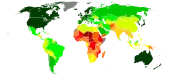 United Nations Human Development Index map by country (2016)
 Index map from the International Map of the World (1:1,000,000 scale)
 1516 map of the world by Martin Waldseemüller
 Mollweide projection of the world
 The world map by Gerardus Mercator (1569), the first map in the well-known Mercator projection
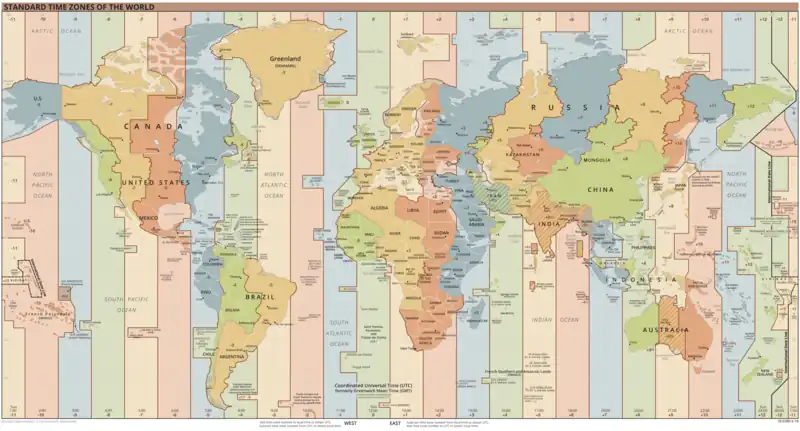 Time zones of the world
 The Goode homolosine projection is a pseudocylindrical, equal-area, composite map projection used for world maps.
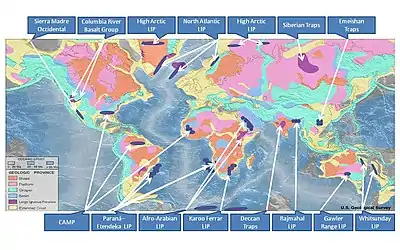 Only a few of the largest large igneous provinces appear (coloured dark purple) on this geological map, which depicts crustal geologic provinces as seen in seismic refraction data
 A plate tectonics map with volcano locations indicated with red circles
World records
- List of Olympic records in athletics
- List of world records in athletics
- List of junior world records in athletics
- List of world records in masters athletics
- List of world youth bests in athletics
- List of IPC world records in athletics
- List of world records in canoeing
- List of world records in chess
- List of cycling records
- List of world records in track cycling
- List of world records in finswimming
- List of world records in juggling
- List of world records in rowing
- List of world records in speed skating
- List of world records in swimming
- List of IPC world records in swimming
- List of world records in Olympic weightlifting
Topics

Continents of Earth | ||||||||
|---|---|---|---|---|---|---|---|---|
| ||||||||
| ||||||||
| ||||||||
.svg.png.webp)
.svg.png.webp)
.svg.png.webp)
.svg.png.webp)


.svg.png.webp)
_political.svg.png.webp)
.svg.png.webp)
.svg.png.webp)
.svg.png.webp)
.svg.png.webp)


| Cenozoic Era (66.0 Ma–present) |
| ||||||||||||
|---|---|---|---|---|---|---|---|---|---|---|---|---|---|
| Mesozoic Era (252–66.0 Ma) |
| ||||||||||||
| Paleozoic Era (539–252 Ma) |
| ||||||||||||
| Proterozoic Eon (2.5 Ga–539 Ma) |
| ||||||||||||
| Archean Eon (4–2.5 Ga) | |||||||||||||
| Hadean Eon (4.6–4 Ga) | |||||||||||||
ka = kiloannum (thousands years ago); Ma = megaannum (millions years ago); Ga = gigaannum (billions years ago). See also: Geologic time scale •  Geology portal • World portal Geology portal • World portal | |||||||||||||
| Locations |  | |
|---|---|---|
| Related | ||


| Summer Games |
|  |
|---|---|---|
| Winter Games |
| |
| ||

Economic classification of countries | |||||
|---|---|---|---|---|---|
| Three-World Model | |||||
| Gross domestic product (GDP) |
| ||||
| Gross national income (GNI) | |||||
| Wages | |||||
| Wealth | |||||
| Other national accounts | |||||
| Human development | |||||
| Digital divide | |||||
| Net international investment position (NIIP) | |||||

| Technological |
| ||||
|---|---|---|---|---|---|
| Sociological | |||||
| Ecological |
| ||||
| Biological |
| ||||
| Astronomical | |||||
| Eschatological |
| ||||
| Others |
| ||||
| Fictional | |||||
| Organizations | |||||
| |||||
| Theatres |
| ||||||||||||||||||
|---|---|---|---|---|---|---|---|---|---|---|---|---|---|---|---|---|---|---|---|
Principal participants |
| ||||||||||||||||||
| Timeline |
| ||||||||||||||||||
| Aspects |
| ||||||||||||||||||
| |||||||||||||||||||
.jpg.webp)
| General |
| ||||||||||||||||
|---|---|---|---|---|---|---|---|---|---|---|---|---|---|---|---|---|---|
| Participants |
| ||||||||||||||||
| Timeline |
| ||||||||||||||||
| |||||||||||||||||

Categories

Wikimedia
The following Wikimedia Foundation sister projects provide more on this subject:
-
 Commons
Free media repository -
 Wikibooks
Free textbooks and manuals -
 Wikidata
Free knowledge base -
 Wikinews
Free-content news -
 Wikiquote
Collection of quotations -
 Wikisource
Free-content library -
 Wikispecies
Directory of species -
 Wikiversity
Free learning tools -
 Wikivoyage
Free travel guide -
 Wiktionary
Dictionary and thesaurus
More portals
-
 List of all portalsList of all portals
 -
 The arts portal
 -
 Biography portal
 -
 Current events portal
 -
 Geography portal
 -
 History portal
 -
 Mathematics portal
 -
 Science portal
 -
 Society portal
 -
 Technology portal
 -
 Random portalRandom portal
 -
 WikiProject PortalsWikiProject Portals