Portal:Alaska

 Introduction The flag of Alaska .svg.png.webp) Location of Alaska  The seal of Alaska Alaska (/əˈlæskə/ ( Alaska is the largest U.S. state by area, comprising more total area than the next three largest states of Texas, California, and Montana combined, and is the seventh-largest subnational division in the world. It is the third-least populous and most sparsely populated U.S. state, but with a population of 736,081 as of 2020, is the continent's most populous territory located mostly north of the 60th parallel, more than quadruple the combined populations of Northern Canada and Greenland. The state capital of Juneau is the second-largest city in the United States by area, and the former capital of Alaska, Sitka, is the largest U.S. city by area. Approximately half of Alaska's residents live within the Anchorage metropolitan area. Indigenous people have lived in Alaska for thousands of years, and it is widely believed that the region served as the entry point for the initial settlement of North America by way of the Bering land bridge. The Russian Empire was the first to actively colonize the area beginning in the 18th century, eventually establishing Russian America, which spanned most of the current state, and promoted and maintained a native Alaskan Creole population. The expense and logistical difficulty of maintaining this distant possession prompted its sale to the U.S. in 1867 for US$7.2 million (equivalent to $140 million in 2021). The area went through several administrative changes before becoming organized as a territory on May 11, 1912. It was admitted as the 49th state of the U.S. on January 3, 1959. Abundant natural resources have enabled Alaska—with one of the smallest state economies—to have one of the highest per capita incomes, with commercial fishing, and the extraction of natural gas and oil, dominating Alaska's economy. U.S. Armed Forces bases and tourism also contribute to the economy; more than half the state is federally-owned land containing national forests, national parks, and wildlife refuges. The Indigenous population of Alaska is proportionally the highest of any U.S. state, at over 15 percent. Various Indigenous languages are spoken, and Alaskan Natives are influential in local and state politics. (Full article...)
| |||||||||||||||||


.jpg.webp) Steadman Street in Nome, looking north from King Place, in May 2002 |
Nome (/ˈnoʊm/; Inupiaq: Sitŋasuaq, pronounced [sitŋɐsuɑq]) is a city in the Nome Census Area in the Unorganized Borough of Alaska, United States. The city is located on the southern Seward Peninsula coast on Norton Sound of the Bering Sea. It had a population of 3,699 recorded in the 2020 census, up from 3,598 in 2010. Nome was incorporated on April 9, 1901, and was once the most-populous city in Alaska. Nome lies within the region of the Bering Straits Native Corporation, which is headquartered in Nome.
The city of Nome also claims to be home to the world's largest gold pan, although this claim has been disputed by the Canadian city of Quesnel, British Columbia.
In the winter of 1925, a diphtheria epidemic raged among Alaska Natives in the Nome area. Fierce territory-wide blizzard conditions prevented the delivery of a life-saving diphtheria antitoxin serum by airplane from Anchorage. A relay of dog sled teams was organized to deliver the serum. Today, the Iditarod Dog Sled Race follows the same route they took and ends in Nome. (Full article...)Selected picture -

The aurora borealis as viewed in Interior Alaska.
Photo credit: Joshua Strang (United States Air Force)
General images
 Map of the Trans-Alaska Pipeline (from History of Alaska)
 Alaska in 1895 (Rand McNally). The boundary of southeastern Alaska shown is that claimed by the United States prior to the conclusion of the Alaska boundary dispute. (from History of Alaska)
 Buildings burning after the first Japanese attack on Dutch Harbor, June 3, 1942. (from History of Alaska)
 Earthquake damage in Anchorage (from History of Alaska)
 Alaska has more acreage of public land owned by the federal government than any other state. (from Geography of Alaska)
.jpg.webp) The check that paid for Alaska (from History of Alaska)
The check that paid for Alaska (from History of Alaska)
 1860 map of Russian America (from History of Alaska)
 Spanish contact in British Columbia and Alaska (from History of Alaska)
 Near Little Port Walter in Southeast Alaska (from Geography of Alaska)
 Alaska's area compared to the 48 contiguous states (from Geography of Alaska)

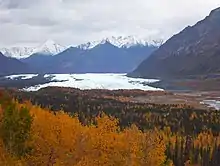 Matanuska glacier (from Geography of Alaska)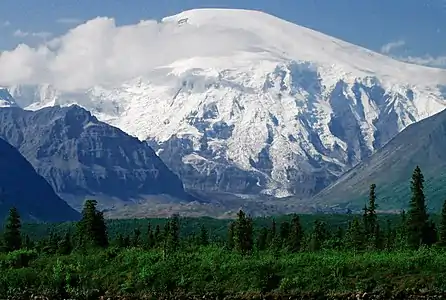
 St. Michael's Cathedral in Sitka. The original structure, built in 1848, burned down in a fire on January 2, 1966. The cathedral was rebuilt from plans of the original structure and contains artifacts rescued from the fire. (from History of Alaska)
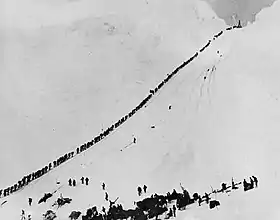 Miners and prospectors climb the Chilkoot Trail during the Klondike Gold Rush. (from History of Alaska)
 Ketchikan, one of the places affected by COVID-19 during the 2020 outbreak in Alaska (from History of Alaska)
 Köppen climate types of Alaska (from Geography of Alaska)
 Aleksandr Baranov, "Lord of Alaska" (from History of Alaska)
 Oil pooled on rocks on the shore of Prince William Sound after the oil spill. (from History of Alaska)
 Propaganda poster, World War II, depicting Alaska as a death trap for Japan. (from History of Alaska)
Recognized content
 | This is a list of recognized content, updated weekly by JL-Bot (talk · contribs). There is no need to edit the list yourself. If an article is missing from the list, make sure it is tagged (e.g. {{WikiProject Alaska}}) or categorized correctly. See WP:RECOG for configuration options. |
Featured articles
Good articles
- 1973 Alaska's at-large congressional district special election
- 2008 Tanana Valley flood
- Alaska Airlines
- USS Alaska (CB-1)
- Alaska marmot
- Lake Atna
- Laura Bergt
- Binky (polar bear)
- Frederick Russell Burnham
- Mount Cleveland (Alaska)
- Coeur Alaska, Inc. v. Southeast Alaska Conservation Council
- Construction of the Trans-Alaska Pipeline System
- Wyatt Earp
- Eskimo (1933 film)
- Espenberg volcanic field
- Fairbanks Daily News-Miner
- Glacier Bay Basin
- Curtis Glencross
- Mike Gravel
- Joseph Hazelwood
- History of Fairbanks, Alaska
- History of Inuit clothing
- Hope Highway
- Kaktovik numerals
- Jean Keene
- Klondike Gold Rush
- Maritime fur trade
- Military history of the Aleutian Islands
- Colton Parayko
- Polar bear
- Portage Glacier Highway
- The Proposal (2009 film)
- Mount Redoubt
- Research on Inuit clothing
- Rika's Landing Roadhouse
- Salmon Creek Dam
- Stikine River
- Robert Stroud
- Jeremy Swayman
- Kenneth M. Taylor
- Trans-Alaska Pipeline System
- White-tailed ptarmigan
- Willow ptarmigan
Featured pictures
 2010-kodiak-bear-1
- Alaska Purchase (hi-res)
 Alaska wild berries
 Heinrich Berann NPS Panorama of Denali without labels
 Malaspina-panorama-no-type
 MtRedoubtedit1
 Parque estatal Chugach, Alaska, Estados Unidos, 2017-08-22, DD 94
.jpg.webp) Russian-American Co - 1 Ruble (7559)
Russian-American Co - 1 Ruble (7559) Whales Bubble Net Feeding-edit1
 Yukon Delta
Former featured pictures
 Grizzly Denali edit
Related Portals
|
|


.svg.png.webp)

Related WikiProjects
|
 |
| Alaska | U.S. States |
| Alaska Project Divisions | |
|
|
State facts
- Nicknames: The Last Frontier, Land of the Midnight Sun, Land of the Noonday Moon, Seward's Folly
- Capital: Juneau
- Governor: Michael J. Dunleavy (R)
- Lieutenant Governor Kevin Meyer (R)
- Attorney General: Kevin G. Clarkson
- Senators: Dan Sullivan (R), Lisa Murkowski (R)
- Representatives: Don Young (R)
- Total area: 663,268 mi2
- Land: 571,936 mi2
- Water: 91,332 mi2
- Highest elevation: 20,310 ft (Denali)
- Population 741,894 (2016 est)
- Admission to the Union: January 3, 1959 (49th)
State symbols:
- Dog: Alaskan Malamute
- Bird: Willow Ptarmigan
- Insect: Four-spot Skimmer Dragonfly
- Colors: None
- Fish: King Salmon
- Flower: Alpine Forget-me-not
- Gem: Jade
- Sport: Dog Mushing
- Songs: Alaska's Flag
Tasks
 |
Open tasks for Wikipedia:WikiProject Alaska. Edit or discuss these tasks. Shortcuts: Recent changes | Categories | History |
- Urgent: An editor in Alaska able/willing to actively work with the Wikipedia Ambassador Program to provide direction/oversight for any articles within the project which are being improved upon under the program.
- To Rate: Unassessed Alaska articles, Unknown-importance Alaska articles
- To Nominate at WP:FAC:
- To Improve to Featured standard: Alaska, Anchorage, Alaska, Fairbanks, Alaska, Juneau, Alaska, History of Alaska
- Collaboration:
- To Expand: Category:Alaska stubs, Alaskeros, Sheldon Jackson, Scouting in Alaska
- Governor articles: Steve Cowper, Bill Sheffield, Keith Harvey Miller, Waino Edward Hendrickson
- To Clean up: Diomede Islands
- To Merge:
- To Destub: See: Category:Alaska stubs
- To Deorphan:
- To Categorize:
- To Create: Articles on incoming (2019) legislators (and updating outgoing ones), Articles for new 2010 Census CDPs: Badger, Alaska, Chena Ridge, Alaska, Eureka Roadhouse, Alaska, Farmers Loop, Alaska, Goldstream, Alaska, Loring, Alaska, Point Possession, Alaska, South Van Horn, Alaska, Steele Creek, Alaska, Whitestone, Alaska
- Lists to de-redlink: List of mayors of Anchorage DoneDavid chamberlain (talk) 20:49, 2 February 2014 (UTC)
- Lists to complete: List of mayors of Fairbanks, Alaska
- Wanted Pics/Graphics:
- Wanted New Pics: See Category:Wikipedia requested photographs in Alaska
- Common mistakes to avoid (and correct):
- Knik, Alaska, the ghost town, and Knik River, Alaska, the CDP, are not the same place. In fact, they are approximately an hour's drive away from each other.
- Despite its name of "City and Borough of Yakutat," this entity is a borough, not a consolidated city-borough.
- See the talk page (or archives of same) of WP:ALASKA, or of the articles in question, for more information.
- Maintain: add {{WikiProject Alaska}} to the talk pages of Alaska-related articles and add the articles to Wikipedia:WikiProject Alaska/Recent changes (if not done already by a bot) so related changes link works.
- To expand: Rie Muñoz, Rosita Worl
Associated Wikimedia
The following Wikimedia Foundation sister projects provide more on this subject:
-
 Commons
Free media repository -
 Wikibooks
Free textbooks and manuals -
 Wikidata
Free knowledge base -
 Wikinews
Free-content news -
 Wikiquote
Collection of quotations -
 Wikisource
Free-content library -
 Wikispecies
Directory of species -
 Wikiversity
Free learning tools -
 Wikivoyage
Free travel guide -
 Wiktionary
Dictionary and thesaurus
-
 List of all portalsList of all portals
 -
 The arts portal
 -
 Biography portal
 -
 Current events portal
 -
 Geography portal
 -
 History portal
 -
 Mathematics portal
 -
 Science portal
 -
 Society portal
 -
 Technology portal
 -
 Random portalRandom portal
 -
 WikiProject PortalsWikiProject Portals