Portal:Asia

 The Asia Portal
.svg.png.webp) Asia (/ˈeɪʒə/ ( In general terms, Asia is bounded on the east by the Pacific Ocean, on the south by the Indian Ocean, and on the north by the Arctic Ocean. The border of Asia with Europe is a historical and cultural construct, as there is no clear physical and geographical separation between them. It is somewhat arbitrary and has moved since its first conception in classical antiquity. The division of Eurasia into two continents reflects East–West cultural, linguistic, and ethnic differences, some of which vary on a spectrum rather than with a sharp dividing line. A commonly accepted division places Asia to the east of the Suez Canal separating it from Africa; and to the east of the Turkish Straits, the Ural Mountains and Ural River, and to the south of the Caucasus Mountains and the Caspian and Black seas, separating it from Europe. China and India alternated in being the largest economies in the world from 1 to 1,800 CE. China was a major economic power and attracted many to the east, and for many the legendary wealth and prosperity of the ancient culture of India personified Asia, attracting European commerce, exploration and colonialism. The accidental discovery of a trans-Atlantic route from Europe to America by Columbus while in search for a route to India demonstrates this deep fascination. The Silk Road became the main east–west trading route in the Asian hinterlands while the Straits of Malacca stood as a major sea route. Asia has exhibited economic dynamism (particularly East Asia) as well as robust population growth during the 20th century, but overall population growth has since fallen. Asia was the birthplace of most of the world's mainstream religions including Hinduism, Zoroastrianism, Judaism, Jainism, Buddhism, Confucianism, Taoism, Christianity, Islam, Sikhism, as well as many other religions. (Full article...) Featured articleThe July 2009 Ürümqi riots were a series of violent riots over several days that broke out on 5 July 2009 in Ürümqi, the capital city of the Xinjiang Uyghur Autonomous Region (XUAR), in northwestern China. The first day's rioting, which involved at least 1,000 Uyghurs, began as a protest, but escalated into violent attacks that mainly targeted Han people. A total of 197 people died, most of whom were Han people or non-Muslim minorities, with 1,721 others injured and many vehicles and buildings destroyed. Many Uyghurs disappeared during wide-scale police sweeps in the days following the riots; Human Rights Watch (HRW) documented 43 cases and said figures for real disappearances were likely to be much higher. Rioting began following the Shaoguan incident, where false accusations of rape of a Han woman by Uyghur men led to a brawl between ethnic Han and Uyghur factory workers in Shaoguan, resulting in the deaths of 2 Uyghurs who were both from Xinjiang. The Chinese central government alleges that the riots themselves were planned from abroad by the World Uyghur Congress (WUC) and its leader Rebiya Kadeer, while Kadeer denies fomenting the violence in her fight for Uyghur "self-determination". (Full article...)Selected Country Azerbaijan (UK: /ˌæzərbaɪˈdʒɑːn, -ˈdʒæn/ ( Featured biography
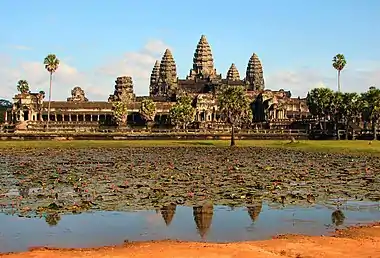
Antiochus XI Epiphanes Philadelphus (Greek: Ἀντίοχος Ἐπιφανής Φιλάδελφος; died 93 BC) was a Seleucid monarch who reigned as King of Syria between 94 and 93 BC, during the Hellenistic period. He was the son of Antiochus VIII and his wife Tryphaena. Antiochus XI's early life was a time of constant civil war between his father and his uncle Antiochus IX. The conflict ended with the assassination of Antiochus VIII, followed by the establishment of Antiochus IX in Antioch, the capital of Syria. Antiochus VIII's eldest son Seleucus VI, in control of western Cilicia, marched against his uncle and had him killed, taking Antioch for himself, only to be expelled from it and driven to his death in 94 BC by Antiochus IX's son Antiochus X. Following the murder of Seleucus VI, Antiochus XI declared himself king jointly with his twin brother Philip I. Dubious ancient accounts, which may be contradicted by archaeological evidence, report that Antiochus XI's first act was to avenge his late brother by destroying Mopsuestia in Cilicia, the city responsible for the death of Seleucus VI. In 93 BC, Antiochus XI took Antioch, an event not mentioned by ancient historians but confirmed through numismatic evidence. Antiochus XI appears to have been the senior king, minting coinage as a sole king and reigning alone in the capital, while Philip I remained in Cilicia, but kept his royal title. Antiochus XI may have restored the temple of Apollo and Artemis in Daphne, but his reign did not last long. In the autumn of the same year, Antiochus X regrouped and counter-attacked; Antiochus XI was defeated and drowned in the Orontes River as he tried to flee. (Full article...)General imagesThe following are images from various Asia-related articles on Wikipedia.
Featured picture Seaweed farming in Indonesia A farmer harvests seaweed growing on a rope, on the small island of Nusa Lembongan, Indonesia. Wooden posts demarcate the bay into rectangular plots that are owned by different families. Seaweed farming is a fairly simple process: Attached plants are placed in the sea and allowed to grow naturally, with little human intervention.
Did you know...
Updated: 1:33, 20 March 2022 In the news
Related portalsSelected panorama
The night skyline of Hong Kong, Victoria Harbour and Kowloon, as seen from Victoria Peak, the tallest mountain on Hong Kong Island. Hong Kong is located on China's south coast on the Pearl River Delta, and borders Guangdong province in the north and faces the South China Sea in the east, west and south. It has a population of 6.9 million people, and is one of the most densely populated areas in the world. TopicsCategories Category puzzle Select [►] to view subcategories
Asia Countries in Asia Dependent territories in Asia Asia-related lists Buildings and structures in Asia Asian culture Economy of Asia Education in Asia Environment of Asia Geography of Asia Government in Asia Health in Asia History of Asia Asian people Politics of Asia Asian society Stone crosses in Asia Images of Asia Asia stubs Associated WikimediaThe following Wikimedia Foundation sister projects provide more on this subject:
More portalsDiscover Wikipedia using portals
Shortcuts to this page: Asia portal • P:ASIA | ||||||||




.png.webp)




.jpg.webp)




-Temple_Mount-Dome_of_the_Rock_(SE_exposure).jpg.webp)

.jpeg.webp)

.jpg.webp)

.jpg.webp)


.jpg.webp)


